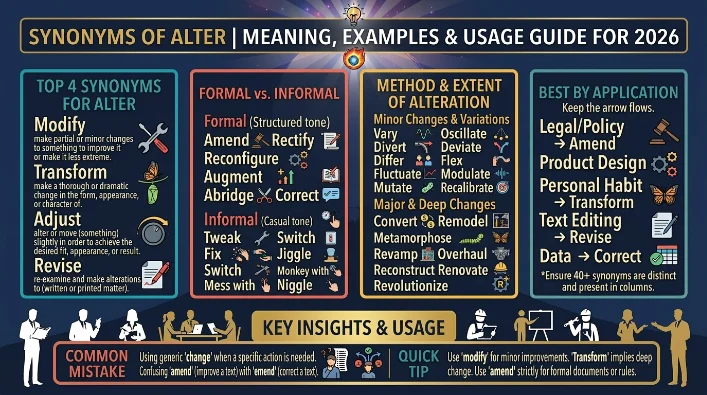
Alter means to make something different without completely changing its identity. The best synonyms include change, modify, adjust, revise, amend, adapt, transform, convert, vary, and shift. The most common everyday synonym is change, while modify works best for formal writing. Each synonym carries a slightly different meaning and fits specific situations.
Top 10 Synonyms
- Change
- Modify
- Adjust
- Revise
- Amend
- Adapt
- Transform
- Convert
- Vary
- Shift
Every synonym has a slightly different meaning, tone, or context, so choose carefully based on your situation.
Do you find yourself always using the word “change” when you mean something slightly different? English has many ways to describe making something different, and each word has its own unique shade of meaning.
Learning these alternatives will help you write more precisely and sound more natural. Whether you’re editing a document, adjusting a schedule, or transforming a business, the right word makes your message clearer.
In this guide, you’ll discover 40 powerful alternatives to “alter.” You’ll learn their meanings, when to use them, and which ones native speakers prefer in different situations. Let’s get started!
What Does “Alter” Mean?
Definition
To alter means to make something different while keeping its basic nature or identity intact. It’s about changing parts of something without completely replacing it.
Think of it like tailoring a suit. When you alter a suit, you change the sleeves or the waist, but it’s still the same suit. You’re not making a completely new outfit.
Alter can describe:
- Small changes (“I need to alter this document slightly”)
- Gradual changes (“The landscape altered over time”)
- Intentional changes (“She altered her workout routine”)
Pronunciation
| Feature | Value |
|---|---|
| US IPA | /ˈɔːl.tɚ/ |
| UK IPA | /ˈɒl.tə/ |
| Syllables | 2 (al-ter) |
| Tip | Stress the first syllable: AL-ter |
Grammar
| Grammar Feature | Information |
|---|---|
| Part of Speech | Verb (transitive and intransitive) |
| Common Position | Before an object (altered + something) |
| Typical Pattern | alter + noun / alter + noun + to + noun |
Example Sentences:
- “The tailor altered my dress to fit perfectly.”
- “Her attitude altered after she started the new job.”
- “We need to alter our plans because of the weather.”
Word Family
| Word | Part of Speech | Meaning |
|---|---|---|
| Alter | Verb | To make different; to change |
| Alteration | Noun | The act or result of changing something |
| Altered | Adjective | Changed from the original state |
| Altering | Verb (continuous) | The process of making changes |
| Unaltered | Adjective | Not changed; remaining the same |
| Alterable | Adjective | Capable of being changed |
40 Synonyms of “Alter”
1. Change
Meaning: To make something different from what it was before.
Best Used For: Daily conversation, general writing, any situation where something becomes different.
Formality: Neutral
Tone: Neutral
Frequency: ⭐⭐⭐⭐⭐ Very Common
CEFR Level: A2
Example Sentence 1: “I need to change my hairstyle for the new season.”
Example Sentence 2: “The weather changed suddenly from sunny to rainy.”
Usage Tip: “Change” is the most general and common synonym. Use it when you don’t need to specify exactly how something is different. It works in almost every situation.
Common Confusion: Change vs Alter – They’re often interchangeable, but “alter” often suggests a partial change, while “change” can mean complete transformation. “I changed my clothes” (completely) vs “I altered my dress” (adjusted it).
2. Modify
Meaning: To make small changes to something to improve it or make it more suitable.
Best Used For: Professional writing, business, technical documents, describing adjustments.
Formality: Formal
Tone: Professional, Precise
Frequency: ⭐⭐⭐⭐ Common
CEFR Level: B2
Example Sentence 1: “The engineer modified the design to reduce costs.”
Example Sentence 2: “You should modify your essay before submitting it.”
Usage Tip: “Modify” suggests you’re making specific, purposeful changes to improve something. It’s more formal than “change” and perfect for professional contexts.
3. Adjust
Meaning: To make small changes so that something fits, works, or is more suitable.
Best Used For: Settings, schedules, positions, or making things more comfortable or accurate.
Formality: Neutral
Tone: Practical, Careful
Frequency: ⭐⭐⭐⭐⭐ Very Common
CEFR Level: B1
Example Sentence 1: “Please adjust the temperature; it’s too cold in here.”
Example Sentence 2: “She adjusted her glasses to see more clearly.”
Usage Tip: “Adjust” usually means small, precise changes. It often involves making something work better or fit more comfortably. Think of adjusting a watch, a seat, or a plan.
4. Revise
Meaning: To review and change something, especially written work, to improve it.
Best Used For: Essays, articles, books, documents, plans.
Formality: Formal
Tone: Academic, Professional
Frequency: ⭐⭐⭐⭐ Common
CEFR Level: B2
Example Sentence 1: “She revised her essay three times before submitting it.”
Example Sentence 2: “The company revised its policy after the feedback.”
Usage Tip: “Revise” is specifically about reviewing and improving written work or plans. It implies careful examination and thoughtful changes. Don’t use it for physical objects.
5. Amend
Meaning: To make small changes to improve or correct something, especially written documents or laws.
Best Used For: Legal documents, contracts, rules, formal writing.
Formality: Formal
Tone: Serious, Legal
Frequency: ⭐⭐⭐ Moderate
CEFR Level: B2
Example Sentence 1: “The government amended the constitution last year.”
Example Sentence 2: “Please amend your application before the deadline.”
Usage Tip: “Amend” is formal and often relates to legal or official documents. It usually means making improvements or corrections. Use it in professional or legal contexts.
6. Adapt
Meaning: To change something to fit new conditions or different uses.
Best Used For: Lifestyle changes, behavior, products, ideas that need to work in new situations.
Formality: Neutral
Tone: Flexible, Positive
Frequency: ⭐⭐⭐⭐ Common
CEFR Level: B2
Example Sentence 1: “She adapted her teaching methods for online classes.
Example Sentence 2: “Birds adapt to their environment over time.
Usage Tip: “Adapt” suggests making something work in a new environment or situation. It’s about survival, flexibility, and making things fit different uses.
7. Transform
Meaning: To change completely in appearance, form, or character.
Best Used For: Dramatic changes, personal growth, business makeovers, physical changes.
Formality: Neutral
Tone: Powerful, Dramatic
Frequency: ⭐⭐⭐⭐ Common
CEFR Level: B2
Example Sentence 1: “The new paint job transformed the old house.”
Example Sentence 2: “Yoga transformed her health and mindset.”
Usage Tip: “Transform” means a complete or dramatic change. Use it when the result looks or feels completely different from the original. It’s stronger than “change” or “alter.”
8. Convert
Meaning: To change something into a different form, purpose, or system.
Best Used For: Changing format, purpose, beliefs, or systems.
Formality: Neutral
Tone: Purposeful, Practical
Frequency: ⭐⭐⭐⭐ Common
CEFR Level: B2
Example Sentence 1: “We converted the garage into a home office.”
Example Sentence 2: “The software converts files from PDF to Word.”
Usage Tip: “Convert” suggests changing the form or purpose of something. It often involves a clear before-and-after transformation. Think of converting currencies, religions, or spaces.
9. Vary
Meaning: To change something regularly or to be different in different situations.
Best Used For: Routines, prices, flavors, any situation where things differ or change.
Formality: Neutral
Tone: Flexible, Natural
Frequency: ⭐⭐⭐⭐ Common
CEFR Level: B2
Example Sentence 1: “Prices vary depending on the season.”
Example Sentence 2: “The colors vary from light to dark green.”
Usage Tip: “Vary” is about being different or changing in different situations. It often describes natural or intentional differences. It’s different from “change” because it suggests fluctuation.
10. Shift
Meaning: To move or change position, direction, or focus slightly.
Best Used For: Priorities, attention, opinions, physical movement.
Formality: Neutral
Tone: Natural, Active
Frequency: ⭐⭐⭐⭐ Common
CEFR Level: B2
Example Sentence 1: “Her focus shifted to a new project.”
Example Sentence 2: “The wind shifted direction during the storm.”
Usage Tip: “Shift” suggests a movement or change in position, direction, or emphasis. It can be subtle or significant but always involves movement from one point to another.
11. Tweak
Meaning: To make small, careful changes to improve something.
Best Used For: Technology, writing, design, any situation needing minor improvements.
Formality: Informal
Tone: Casual, Modern
Frequency: ⭐⭐⭐⭐ Common
CEFR Level: B2
Example Sentence 1: “I just need to tweak a few things before I submit.”
Example Sentence 2: “The designer tweaked the layout to make it cleaner.”
Usage Tip: “Tweak” is informal and means small, specific adjustments. It’s perfect for casual conversations and modern professional settings. It sounds more friendly and less formal than “modify.”
12. Refine
Meaning: To make changes to improve something by removing mistakes or unwanted parts.
Best Used For: Skills, writing, design, cooking, any process of improvement.
Formality: Formal
Tone: Professional, Polished
Frequency: ⭐⭐⭐⭐ Common
CEFR Level: B2
Example Sentence 1: “She refined her cooking skills over many years.”
Example Sentence 2: “The team refined their proposal before the presentation.”
Usage Tip: “Refine” suggests a process of gradual improvement to achieve excellence. It’s about making something better through careful attention to detail.
13. Renovate
Meaning: To restore something to good condition or make it look new again.
Best Used For: Buildings, homes, rooms, properties.
Formality: Neutral
Tone: Practical, Positive
Frequency: ⭐⭐⭐⭐ Common
CEFR Level: B2
Example Sentence 1: “They renovated their kitchen over the summer.”
Example Sentence 2: “The old theater was renovated and reopened last month.”
Usage Tip: “Renovate” specifically describes improving buildings or physical spaces. It usually involves repair and modernization. Don’t use it for non-physical things.
14. Remodel
Meaning: To change the structure or appearance of something, especially a building.
Best Used For: Houses, rooms, buildings, interiors.
Formality: Neutral
Tone: Practical, Structural
Frequency: ⭐⭐⭐ Moderate
CEFR Level: B2
Example Sentence 1: “They remodeled the bathroom to add a shower.”
Example Sentence 2: “The restaurant remodeled its dining area.”
Usage Tip: “Remodel” is similar to “renovate” but often involves changing the structure or layout more significantly. It’s about redesigning, not just updating.
15. Redesign
Meaning: To change the design of something to improve it.
Best Used For: Websites, products, logos, anything with a visual design.
Formality: Neutral
Tone: Creative, Practical
Frequency: ⭐⭐⭐⭐ Common
CEFR Level: B2
Example Sentence 1: “The company redesigned its website for better user experience.”
Example Sentence 2: “They redesigned the packaging to be more eco-friendly.”
Usage Tip: “Redesign” means changing the visual or structural design. It’s about creating a new appearance or layout, not just making small adjustments.
16. Restructure
Meaning: To change the organization, structure, or system of something.
Best Used For: Companies, organizations, teams, systems, departments.
Formality: Formal
Tone: Professional, Strategic
Frequency: ⭐⭐⭐ Moderate
CEFR Level: B2
Example Sentence 1: “The company restructured its departments to improve efficiency.”
Example Sentence 2: “They restructured the debt to avoid bankruptcy.”
Usage Tip: “Restructure” describes major organizational changes. It’s a business and management term. Use it when there are significant changes to how something is organized.
17. Redo
Meaning: To do something again because it wasn’t correct or satisfying.
Best Used For: Tasks, work, writing, any completed thing that needs to be done again.
Formality: Informal
Tone: Practical, Casual
Frequency: ⭐⭐⭐⭐ Common
CEFR Level: A2
Example Sentence 1: “I made a mistake, so I need to redo this section.”
Example Sentence 2: “She redid her homework after the teacher’s feedback.”
Usage Tip: “Redo” is informal and means doing something again from the beginning. Use it for tasks or work that need to be repeated, often because the first attempt wasn’t good enough.
18. Overhaul
Meaning: To completely change or improve something, especially by fixing problems.
Best Used For: Systems, processes, machines, organizations.
Formality: Neutral
Tone: Dramatic, Thorough
Frequency: ⭐⭐⭐ Moderate
CEFR Level: B2
Example Sentence 1: “The company overhauled its customer service system.
Example Sentence 2: “He overhauled the old engine to make it run better.”
Usage Tip: “Overhaul” suggests a thorough, complete improvement. It often involves examining everything and fixing what’s not working. It’s more dramatic than “adjust” or “tweak.”
19. Update
Meaning: To make something more modern, current, or accurate.
Best Used For: Information, software, documents, knowledge, technology.
Formality: Neutral
Tone: Modern, Practical
Frequency: ⭐⭐⭐⭐⭐ Very Common
CEFR Level: B1
Example Sentence 1: “Please update your contact information in the system.”
Example Sentence 2: “The app updates automatically on your phone.”
Usage Tip: “Update” means making something current or providing new information. It’s a common word for technology and information. Use it when something needs to be brought up to date.
20. Modernize
Meaning: To make something more modern by adding new features or technology.
Best Used For: Buildings, systems, equipment, methods, companies.
Formality: Neutral
Tone: Progressive, Modern
Frequency: ⭐⭐⭐ Moderate
CEFR Level: B2
Example Sentence 1: “The library modernized its facilities with computers.”
Example Sentence 2: “We need to modernize our manufacturing process.”
Usage Tip: “Modernize” suggests updating something to meet current standards. It often involves adding technology or contemporary features. It’s about progress and keeping up with the times.
21. Reform
Meaning: To make changes to improve something, especially a system or institution.
Best Used For: Government, education, laws, healthcare, institutions.
Formality: Formal
Tone: Serious, Political
Frequency: ⭐⭐⭐ Moderate
CEFR Level: B2
Example Sentence 1: “The government plans to reform the healthcare system.”
Example Sentence 2: “She campaigned to reform the education policy.”
Usage Tip: “Reform” describes significant, systemic changes, usually in institutions or systems. It’s often used in political or social contexts and implies improvement or correction.
22. Revamp
Meaning: To give something a new and improved version; to renovate.
Best Used For: Companies, products, websites, services.
Formality: Informal to Neutral
Tone: Modern, Energetic
Frequency: ⭐⭐⭐ Moderate
CEFR Level: B2
Example Sentence 1: “The hotel revamped its lobby for a fresh look.”
Example Sentence 2: “She revamped her resume before applying for jobs.”
Usage Tip: “Revamp” is a more informal alternative to “renovate” or “modernize.” It means giving something a new appearance or makeover.
23. Turn
Meaning: To change in form, character, or condition.
Best Used For: Emotions, weather, direction, simple changes.
Formality: Neutral
Tone: Natural, Common
Frequency: ⭐⭐⭐⭐ Common
CEFR Level: A2
Example Sentence 1: “The weather turned cold overnight.”
Example Sentence 2: “Her mood turned from happy to sad.”
Usage Tip: “Turn” is a simple, everyday word for change. It often describes natural or gradual changes. Use it for changes in conditions, emotions, or directions.
24. Transition
Meaning: To move or change from one state or condition to another.
Best Used For: Life changes, career moves, business changes, growth.
Formality: Formal
Tone: Progressive, Smooth
Frequency: ⭐⭐⭐⭐ Common
CEFR Level: B2
Example Sentence 1: “She transitioned from employee to manager.”
Example Sentence 2: “The company is transitioning to a remote work model.”
Usage Tip: “Transition” emphasizes the process of moving from one state to another. It’s about the journey, not just the change itself. Use it for gradual or planned changes.
25. Convert
Meaning: To change something from one form, use, or purpose to another.
Best Used For: Currency, religion, format, purpose, spaces.
Formality: Neutral
Tone: Practical, Purposeful
Frequency: ⭐⭐⭐⭐ Common
CEFR Level: B2
Example Sentence 1: “We converted the spare room into a nursery.”
Example Sentence 2: “The machine converts sunlight into electricity.”
Usage Tip: “Convert” always involves changing from one distinct state to another. Think of it as making something serve a new purpose or take a new form.
26. Augment
Meaning: To make something larger or more complete by adding to it.
Best Used For: Income, skills, resources, knowledge.
Formality: Formal
Tone: Positive, Professional
Frequency: ⭐⭐⭐ Moderate
CEFR Level: C1
Example Sentence 1: “She augmented her salary with freelance work.”
Example Sentence 2: “We need to augment our team with more experts.”
Usage Tip: “Augment” means increasing or adding to something. It’s more about making something bigger or more complete than about just changing it.
27. Adjust
Meaning: To make small changes to get something right or comfortable.
Best Used For: Settings, schedules, positions, personal comfort.
Formality: Neutral
Tone: Careful, Practical
Frequency: ⭐⭐⭐⭐⭐ Very Common
CEFR Level: B1
Example Sentence 1: “Please adjust the volume; it’s too loud.”
Example Sentence 2: “She adjusted her schedule to accommodate the meeting.”
Usage Tip: “Adjust” is about making small, often precise changes to achieve the right fit or condition. It’s less formal than “modify” and very common in daily conversation.
28. Align
Meaning: To change something to make it match or fit with something else.
Best Used For: Goals, strategies, interests, schedules.
Formality: Formal
Tone: Professional, Strategic
Frequency: ⭐⭐⭐⭐ Common
CEFR Level: B2
Example Sentence 1: “We need to align our goals with the company’s vision.”
Example Sentence 2: “Her interests align perfectly with the team’s mission.”
Usage Tip: “Align” suggests making things work together or share the same direction. It’s about compatibility and unity, not just simple change.
29. Customize
Meaning: To change something according to personal preference or needs.
Best Used For: Products, services, technology, anything that can be personalized.
Formality: Neutral
Tone: Personal, Modern
Frequency: ⭐⭐⭐⭐ Common
CEFR Level: B2
Example Sentence 1: “You can customize the app to fit your needs.”
Example Sentence 2: “The company customizes each piece for the customer.”
Usage Tip: “Customize” means making something personal or tailored to individual preferences. It’s about personalization, not just change.
30. Polish
Meaning: To make small improvements to something to make it perfect.
Best Used For: Writing, presentation, performance, any work that needs final improvement.
Formality: Neutral
Tone: Careful, Professional
Frequency: ⭐⭐⭐⭐ Common
CEFR Level: B2
Example Sentence 1: “She polished her speech before the presentation.”
Example Sentence 2: “We need to polish the details before the launch.”
Usage Tip: “Polish” means making final, careful improvements. It’s about making something shine or become perfect through attention to detail. Think of polishing silver or polishing a performance.
31. Edit
Meaning: To change written material by correcting, improving, or preparing it.
Best Used For: Writing, documents, content, videos.
Formality: Neutral
Tone: Professional, Practical
Frequency: ⭐⭐⭐⭐⭐ Very Common
CEFR Level: B2
Example Sentence 1: “Please edit this article before publication.”
Example Sentence 2: “She edited the photos to improve the colors.”
Usage Tip: “Edit” specifically means making changes to content, especially written or visual media. It’s about improving through correction and revision.
32. Remake
Meaning: To make something again in a new version or different form.
Best Used For: Movies, songs, products, anything created again.
Formality: Neutral
Tone: Creative, Dramatic
Frequency: ⭐⭐⭐ Moderate
CEFR Level: B2
Example Sentence 1: “The studio remade the classic movie for modern audiences.”
Example Sentence 2: “She remade the cake because it didn’t turn out well.”
Usage Tip: “Remake” suggests creating something again, often with a new version. It’s like starting over but with the existing idea or product as a reference.
33. Reshape
Meaning: To change the shape, structure, or form of something.
Best Used For: Physical objects, organizations, systems, ideas.
Formality: Neutral
Tone: Transformative, Structural
Frequency: ⭐⭐⭐ Moderate
CEFR Level: B2
Example Sentence 1: “The company reshaped its strategy for the new market.”
Example Sentence 2: “She reshaped the dough into a different shape.”
Usage Tip: “Reshape” suggests changing the fundamental form or structure. It’s about reforming how something is organized or appears.
34. Reorder
Meaning: To change the arrangement or order of things.
Best Used For: Tasks, priorities, sequence, information.
Formality: Neutral
Tone: Practical, Organized
Frequency: ⭐⭐⭐ Moderate
CEFR Level: B2
Example Sentence 1: “She reordered the list by importance.”
Example Sentence 2: “We need to reorder the sections in the document.”
Usage Tip: “Reorder” specifically means changing the sequence or arrangement. It’s about putting things in a different order, not changing their nature.
35. Reconstruct
Meaning: To rebuild or reassemble something after damage or changes.
Best Used For: Buildings, events, events, evidence, systems.
Formality: Formal
Tone: Serious, Scientific
Frequency: ⭐⭐⭐ Moderate
CEFR Level: B2
Example Sentence 1: “They reconstructed the damaged building.”
Example Sentence 2: “The police reconstructed the accident scene.”
Usage Tip: “Reconstruct” means rebuilding or putting back together. It often involves restoring something to its original state or understanding how it happened.
36. Reorient
Meaning: To change direction or focus.
Best Used For: Goals, strategies, careers, direction.
Formality: Formal
Tone: Strategic, Directional
Frequency: ⭐⭐⭐ Moderate
CEFR Level: B2
Example Sentence 1: “She reoriented her career toward technology.
Example Sentence 2: “The company reoriented its strategy for growth.”
Usage Tip: “Reorient” means changing direction or focus. It’s about finding a new path or approach. Think of a compass being pointed in a new direction.
37. Rejuvenate
Meaning: To make something look or feel younger, fresher, or more energetic.
Best Used For: Businesses, skin, energy, spaces, enthusiasm.
Formality: Neutral
Tone: Positive, Refreshing
Frequency: ⭐⭐⭐ Moderate
CEFR Level: B2
Example Sentence 1: “The spa treatment rejuvenated her skin.”
Example Sentence 2: “New leadership rejuvenated the company’s culture.”
Usage Tip: “Rejuvenate” suggests bringing new life or energy to something. It’s about making something feel fresh and energetic again.
38. Readjust
Meaning: To adjust again, especially to a new situation.
Best Used For: Plans, expectations, relationships, after changes.
Formality: Neutral
Tone: Flexible, Practical
Frequency: ⭐⭐⭐ Moderate
CEFR Level: B2
Example Sentence 1: “She needed time to readjust to working in an office.”
Example Sentence 2: “We had to readjust our budget after the price changes.”
Usage Tip: “Readjust” means making changes after something has already been adjusted. It’s about adapting to new circumstances or correcting previous changes.
39. Recode
Meaning: To change the code or system of something.
Best Used For: Software, language, systems, processes.
Formality: Neutral
Tone: Technical, Modern
Frequency: ⭐⭐⭐ Moderate
CEFR Level: B2
Example Sentence 1: “The programmer recoded the website for better performance.”
Example Sentence 2: “She recoded the form to include new questions.”
Usage Tip: “Recode” is a technical term for changing code or systems. Use it in technology contexts or when describing systematic changes.
40. Regulate
Meaning: To control or change something by rules or adjustment.
Best Used For: Systems, temperature, rules, flow, behavior.
Formality: Formal
Tone: Control, Order
Frequency: ⭐⭐⭐⭐ Common
CEFR Level: B2
Example Sentence 1: “The thermostat regulates the room temperature.”
Example Sentence 2: “Laws regulate business practices in many industries.”
Usage Tip: “Regulate” means controlling or maintaining something to keep it working properly. It suggests management or oversight, not just change.
Synonyms Comparison Table
| Synonym | Best Context | Formality | Tone | Frequency |
|---|---|---|---|---|
| Change | Everyday situations | Neutral | Neutral | ⭐⭐⭐⭐⭐ |
| Modify | Professional settings | Formal | Precise | ⭐⭐⭐⭐ |
| Adjust | Making small corrections | Neutral | Practical | ⭐⭐⭐⭐⭐ |
| Revise | Written work | Formal | Academic | ⭐⭐⭐⭐ |
| Amend | Legal/official documents | Formal | Serious | ⭐⭐⭐ |
| Adapt | New situations | Neutral | Flexible | ⭐⭐⭐⭐ |
| Transform | Dramatic changes | Neutral | Powerful | ⭐⭐⭐⭐ |
| Convert | Form/purpose changes | Neutral | Purposeful | ⭐⭐⭐⭐ |
| Vary | Differing situations | Neutral | Natural | ⭐⭐⭐⭐ |
| Shift | Direction/focus changes | Neutral | Active | ⭐⭐⭐⭐ |
| Tweak | Small adjustments | Informal | Casual | ⭐⭐⭐⭐ |
| Refine | Improvement through detail | Formal | Polished | ⭐⭐⭐⭐ |
| Renovate | Buildings/spaces | Neutral | Practical | ⭐⭐⭐⭐ |
| Redesign | Visual/layout changes | Neutral | Creative | ⭐⭐⭐⭐ |
| Restructure | Organizations/systems | Formal | Strategic | ⭐⭐⭐ |
| Overhaul | Complete improvements | Neutral | Thorough | ⭐⭐⭐ |
| Update | Making current | Neutral | Modern | ⭐⭐⭐⭐⭐ |
| Modernize | Adding technology | Neutral | Progressive | ⭐⭐⭐ |
| Reform | Institutions/systems | Formal | Serious | ⭐⭐⭐ |
| Revamp | Makeover/refresh | Informal | Energetic | ⭐⭐⭐ |
Best Synonyms by Situation
| Situation | Best Synonym | Why It Works |
|---|---|---|
| Editing an essay | Revise, Polish | Suggests careful improvement |
| Changing clothes | Change, Alter | Simple and natural |
| Updating a website | Redesign, Update | Modern and technical |
| Fixing a schedule | Adjust, Readjust | Precise and flexible |
| Legal document | Amend, Modify | Formal and serious |
| Personal habits | Adapt, Alter | Shows willingness to grow |
| Business strategy | Restructure, Reorient | Strategic and professional |
| DIY project | Renovate, Remodel | Practical and specific |
| Software changes | Tweak, Recode | Casual and technical |
| Improving skills | Refine, Polish | Shows dedication to excellence |
| Career change | Transition, Shift | Suggests thoughtful movement |
| Home improvement | Renovate, Remodel | Specific to physical spaces |
Formal vs Informal Synonyms
Formal Alternatives
| Synonym | Best Used For |
|---|---|
| Modify | Business writing, technical documents |
| Amend | Legal contracts, official documents |
| Revise | Academic papers, professional reports |
| Restructure | Organizational changes |
| Reform | Political, social changes |
| Augment | Professional, formal additions |
| Reconstruct | Scientific, legal contexts |
| Regulate | Systems, rules, government |
Neutral Alternatives
| Synonym | Best Used For |
|---|---|
| Change | General conversation, all contexts |
| Adjust | Making small corrections |
| Adapt | Fitting new situations |
| Transform | Dramatic, visible changes |
| Convert | Changing form or purpose |
| Update | Making things current |
| Vary | Describing differences |
| Shift | Changing direction or focus |
Informal Alternatives
| Synonym | Best Used For |
|---|---|
| Tweak | Small improvements, casual settings |
| Redo | Starting over, everyday tasks |
| Revamp | Makeovers, fresh looks |
| Remake | Creating something again |
| Turn | Simple, natural changes |
When to choose each level: Use formal synonyms in legal documents, academic writing, and professional reports. Use neutral synonyms in most daily writing and conversation. Use informal synonyms with friends, colleagues, and on social media.
Strong vs Mild Synonyms
Mild (Everyday Adjustments)
These describe small, simple changes that don’t dramatically affect the thing being changed.
- Adjust
- Tweak
- Vary
- Shift
- Update
Moderate (Significant Changes)
These describe clear, noticeable changes that improve or repurpose something.
- Modify
- Revise
- Adapt
- Convert
- Refine
- Redesign
- Modernize
Strong (Dramatic Transformations)
These describe major, often complete changes that fundamentally alter something.
- Transform
- Overhaul
- Restructure
- Reconstruct
- Reform
- Remodel (structural)
Remember: Choose intensity based on how different the result is from the original. If you’re making small improvements, use mild words. If you’re completely rebuilding something, use strong words.
Real-Life Examples
At the Office
“We need to revise the proposal before the client presentation.”
In a Business Email
“I’d like to modify the schedule to include more training time.”
At Home
“She decided to renovate the kitchen over the holidays.”
Daily Conversation
“Can you adjust the air conditioning? It’s freezing in here.”
Academic Writing
“The researcher amended the hypothesis after analyzing the results.”
When Describing Personal Growth
“He transformed his life through meditation and exercise.”
Creative Writing
“The new paint color transformed the room from dull to dramatic.”
Social Media
“Just tweaked my homepage design – what do you think? 💻”
Common Collocations
| Common Phrase | Better Alternative |
|---|---|
| Change plans | Modify plans, Adjust plans |
| Change policy | Amend policy, Revise policy |
| Change schedule | Adjust schedule, Update schedule |
| Change strategy | Restructure strategy, Reform strategy |
| Change design | Redesign, Tweak the design |
| Change building | Renovate, Remodel, Refurbish |
| Change appearance | Transform, Alter appearance |
| Change approach | Shift approach, Modify approach |
Common Phrases
- “Change your ways” – Meaning: Improve your behavior. Instead of “change,” try “reform” or “transform.”
- “Change of heart” – Meaning: A change in opinion or feeling. Instead of “change,” try “shift” or “turn.”
- “Change the subject” – Meaning: Start talking about something different. Instead of “change,” try “shift.”
- “Change of pace” – Meaning: A variation in routine. Instead of “change,” try “variation” or “shift.”
Context Guide
| Situation | Best Synonym | Reason |
|---|---|---|
| Essay | Revise, Refine | Academic and precise |
| Speech | Adapt, Adjust | Shows preparation |
| Business Email | Modify, Amend | Professional and clear |
| Novel | Transform, Alter | Creative and descriptive |
| Presentation | Polish, Edit | Shows attention to detail |
| Conversation | Change, Adjust | Natural and easy to understand |
| Academic Writing | Amend, Reform | Serious and scholarly |
| Marketing Copy | Transform, Revamp | Energetic and persuasive |
Related Words
Near Synonyms
- Adjust: Make small changes for better fit.
- Modify: Make changes for improvement.
- Transform: Completely change appearance or nature.
Antonyms
- Preserve: Keep something the same.
- Maintain: Continue without change.
- Retain: Hold onto without altering.
- Preserve: Protect from change.
- Related Adjectives
- Alterable: Capable of being changed.
- Adjustable: Can be changed or fitted.
- Flexible: Able to change easily.
- Adaptable: Able to change to fit new conditions.
- Related Nouns
- Alteration: The act or result of changing.
- Modification: A small change or adjustment.
- Transformation: A dramatic change.
- Adaptation: Change to suit new conditions.
- Related Verbs
- Shift: To move or change position.
- Turn: To change direction or condition.
- Move: To change position or state.
Frequently Asked Questions
What is another word for alter?
- The most common synonyms are change, modify, adjust, revise, and adapt. For formal writing, use amend, restructure, or reform. For everyday conversation, change and adjust are your safest choices. For creative writing, transform and convert add variety.
Which synonym sounds the most professional?
Modify, amend, restructure, and revise sound most professional in formal contexts. Adjust and update are professional but more practical. Avoid informal words like tweak or redo in formal documents unless you’re writing casually.
What is the strongest synonym for alter?
Transform, overhaul, and reconstruct are among the strongest alternatives. They suggest complete or dramatic changes. Restructure also implies significant changes, especially to organizations or systems. Use these when you want to emphasize major transformation.
Which synonym is best for essays?
Revise, refine, and amend are excellent for academic essays. They suggest
Conclusion
After exploring 40 powerful alternatives to “alter,” you now have a rich vocabulary to describe change with precision and confidence. Remember that alter means making something different while keeping its basic nature intact, and choosing the right synonym depends entirely on your situation.
For everyday conversation, change and adjust are your most reliable choices. For professional writing, modify, amend, and revise will help you sound polished and competent. When describing dramatic transformations, transform, overhaul, and restructure add power and impact to your message.
The key takeaway is this: no two synonyms are exactly alike. Each word carries its own shade of meaning, formality, and emotional weight. Tweak sounds casual and friendly, while amend sounds serious and official. Adapt suggests flexibility, while convert suggests a complete change in purpose.
As we move into 2026, precise language matters more than ever. Whether you’re writing emails, creating content, or simply having conversations, using the right word shows your command of English and helps you communicate more effectively.
So the next time you want to say “alter,” pause for a moment. Ask yourself: What kind of change am I describing? How formal is my situation? What tone do I want to convey? Then choose the perfect synonym from this guide. Your readers and listeners will notice the difference!
