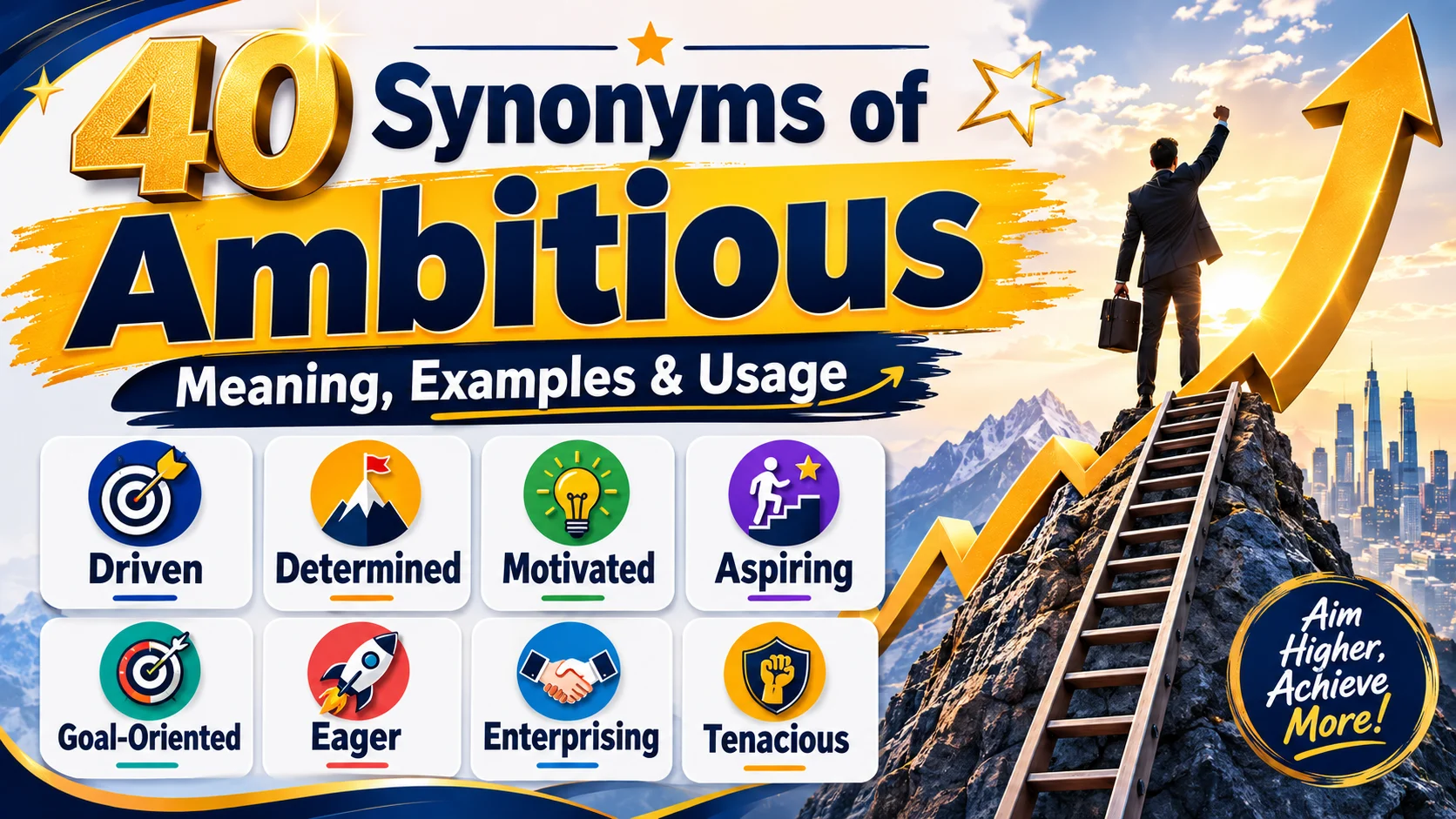
- Ambitious means having a strong desire to achieve success, power, or wealth. The best synonyms are driven, determined, aspiring, motivated, and goal-oriented. Driven is the most common everyday alternative. Aspiring works well for people wanting to achieve something specific. Each synonym has a slightly different meaning, tone, or context.
Do you ever feel like you’re using the word “ambitious” too often? Maybe you’re describing yourself, a colleague, or a character in a story. Repeating the same word can make your English sound dull and uninteresting.
Learning synonyms for “ambitious” will help you express yourself more clearly and naturally. In this guide, you’ll discover 20 useful alternatives. We’ll explain each one’s meaning, show you exactly when to use it, and give you practical examples. By the end, you’ll confidently choose the perfect word for any situation.
What Does “Ambitious” Mean?
Definition
“Ambitious” describes someone who has a strong wish to be successful, powerful, or famous. It can also describe a plan or goal that requires a lot of effort to achieve. For example, an ambitious student works hard to get into a top university. An ambitious project might take years to complete. The word can be positive (showing determination) or negative (showing too much desire for power).
Pronunciation
US IPA: /æmˈbɪʃəs/
UK IPA: /æmˈbɪʃəs/
Syllables: 3 (am-bi-tious)
Tip: Stress the second syllable: am-BISH-us.
Grammar
| Feature | Information |
|---|---|
| Part of Speech | Adjective |
| Common Position | Before a noun or after a linking verb |
| Typical Pattern | Ambitious + noun / To be ambitious + infinitive |
Examples:
- She is an ambitious young lawyer.
- He’s ambitious to become the CEO.
- They have ambitious plans for the company.
Grammar Note: “Ambitious” is often followed by an infinitive verb (to + verb) or “for” + noun.
Word Family
| Word | Part of Speech | Meaning |
|---|---|---|
| Ambition | Noun | A strong desire to achieve something |
| Ambitious | Adjective | Having a strong desire for success |
| Ambitiously | Adverb | In an ambitious way |
| Overambitious | Adjective | Too ambitious, unrealistic |
| Unambitious | Adjective | Lacking ambition or desire to succeed |
20 Synonyms of “Ambitious”
1. Driven
Meaning: Extremely motivated and determined to succeed, often working very hard.
Best Used For: Daily conversation, business writing, personal descriptions.
Formality: Neutral
Tone: Positive, professional
Frequency: ⭐⭐⭐⭐⭐ Very Common
CEFR Level: B1
Example Sentence 1: She’s so driven that she works on weekends too.
Example Sentence 2: My new manager is incredibly driven and expects the same from us.
Usage Tip: “Driven” suggests someone has a powerful internal motivation. Use it when you want to emphasize hard work and determination. It’s more personal than “ambitious.”
Common Confusion: Driven vs Ambitious – “Driven” suggests a more urgent, almost compulsive need to achieve. “Ambitious” can be a more general desire. Many native speakers use “driven” to describe people who seem to never stop working.
2. Determined
Meaning: Having made a firm decision and not letting anything stop you.
Best Used For: All contexts, from casual to formal.
Formality: Neutral
Tone: Positive, strong
Frequency: ⭐⭐⭐⭐⭐ Very Common
CEFR Level: B1
Example Sentence 1: She’s determined to finish her degree no matter what.
Example Sentence 2: The team is determined to win the championship.
Usage Tip: “Determined” focuses on persistence and not giving up. Use it when you want to highlight someone’s strength and refusal to quit. It’s often followed by “to” + verb.
3. Motivated
Meaning: Having a strong reason or desire to do something well.
Best Used For: Education, business, personal development.
Formality: Neutral
Tone: Positive, professional
Frequency: ⭐⭐⭐⭐⭐ Very Common
CEFR Level: B1
Example Sentence 1: The students are highly motivated to learn English.
Example Sentence 2: She stays motivated by setting small daily goals.
Usage Tip: “Motivated” is a great alternative for any situation. It doesn’t sound as intense as “driven” or “determined.” Use it when you want to describe someone who has good reasons for working hard.
4. Aspiring
Meaning: Hoping to become or achieve something specific in the future.
Best Used For: Professional contexts, self-descriptions, career talk.
Formality: Neutral to Formal
Tone: Positive, hopeful
Frequency: ⭐⭐⭐⭐ Common
CEFR Level: B1
Example Sentence 1: He’s an aspiring actor who moves to Hollywood.
Example Sentence 2: Many aspiring entrepreneurs dream of starting their own business.
Usage Tip: “Aspiring” is perfect when you’re describing someone who hasn’t reached their goal yet but is working toward it. It’s commonly used with professions: aspiring writer, aspiring chef, aspiring musician.
5. Goal-Oriented
Meaning: Focused on achieving specific objectives or targets.
Best Used For: Business writing, resumes, professional communication.
Formality: Neutral to Formal
Tone: Professional, structured
Frequency: ⭐⭐⭐⭐ Common
CEFR Level: B2
Example Sentence 1: We need goal-oriented people for this project.
Example Sentence 2: She’s very goal-oriented and always meets her deadlines.
Usage Tip: “Goal-oriented” describes someone who thinks in terms of targets and objectives. It’s a popular phrase in resumes and job interviews. It sounds organized and professional.
6. Eager
Meaning: Very interested and excited to do something.
Best Used For: Daily conversation, informal writing.
Formality: Neutral to Informal
Tone: Positive, enthusiastic
Frequency: ⭐⭐⭐⭐ Common
CEFR Level: A2
Example Sentence 1: The new interns are eager to learn everything.
Example Sentence 2: She’s eager to start her new job.
Usage Tip: “Eager” is less intense than “ambitious.” Use it when you want to show enthusiasm without implying a huge desire for power or success. It works well for beginners or people starting something new.
7. Enterprising
Meaning: Showing initiative and a willingness to start new projects.
Best Used For: Business writing, professional communication, resumes.
Formality: Formal
Tone: Positive, professional
Frequency: ⭐⭐⭐ Moderate
CEFR Level: B2
Example Sentence 1: The enterprising young woman started three businesses before she was 25.
Example Sentence 2: We need more enterprising ideas to grow the company.
Usage Tip: “Enterprising” often relates to business or creative projects. It suggests someone who sees opportunities and acts on them. Use it for professional contexts, especially when discussing innovation or leadership.
8. Self-Starting
Meaning: Able to begin work without needing to be told or encouraged.
Best Used For: Resumes, job descriptions, professional writing.
Formality: Neutral
Tone: Professional, practical
Frequency: ⭐⭐⭐ Moderate
CEFR Level: B2
Example Sentence 1: We need a self-starting employee who can work without supervision.
Example Sentence 2: Her self-starting attitude impressed the boss.
Usage Tip: “Self-starting” highlights independence and initiative. It’s a great word for the workplace but isn’t used much in daily conversation. Use it to describe someone who takes action without waiting for instructions.
9. Career-Driven
Meaning: Focused strongly on advancing in one’s profession.
Best Used For: Business writing, professional discussions, resumes.
Formality: Neutral
Tone: Professional, focused
Frequency: ⭐⭐⭐ Moderate
CEFR Level: B1
Example Sentence 1: She’s very career-driven and spends most of her time at work.
Example Sentence 2: Many career-driven professionals attend networking events.
Usage Tip: This is a specific type of ambition. Use it when you want to make clear that someone’s ambition is focused on their job or career path. It’s not about personal goals or creative projects.
10. Aspirational
Meaning: Having or showing a strong desire to achieve something better.
Best Used For: Marketing, business writing, academic contexts.
Formality: Formal
Tone: Positive, idealistic
Frequency: ⭐⭐⭐ Moderate
CEFR Level: B2
Example Sentence 1: The brand creates aspirational content that inspires people.
Example Sentence 2: Her aspirational goals include becoming a CEO.
Usage Tip: “Aspirational” describes people or things that represent what people want to achieve. It’s often used in marketing to describe products or brands that make people want to improve themselves. It’s more formal than “aspiring.”
11. Pushy
Meaning: Using too much effort to get what you want in an unpleasant way.
Best Used For: Describing negative behavior, informal contexts.
Formality: Informal
Tone: Negative, critical
Frequency: ⭐⭐⭐ Moderate
CEFR Level: B2
Example Sentence 1: Don’t be so pushy; let people make their own decisions.
Example Sentence 2: He’s pushy about getting his ideas accepted.
Usage Tip: “Pushy” is a negative synonym. Use it when you want to criticize someone for being too ambitious in a rude or aggressive way. It’s informal and not appropriate for polite company.
Common Confusion: Pushy vs Ambitious – “Ambitious” is usually positive. “Pushy” is negative and suggests someone is trying too hard or ignoring other people’s needs. Be careful: calling someone pushy can hurt their feelings.
12. Forward-Thinking
Meaning: Thinking about the future in a positive and practical way.
Best Used For: Business writing, leadership descriptions, interviews.
Formality: Neutral to Formal
Tone: Positive, professional
Frequency: ⭐⭐⭐ Moderate
CEFR Level: B2
Example Sentence 1: Our forward-thinking CEO has planned for the next decade.
Example Sentence 2: We need forward-thinking strategies for the new market.
Usage Tip: “Forward-thinking” describes someone who plans ahead and imagines future possibilities. It’s about ambition combined with intelligence and planning. It sounds very professional and positive.
13. Hungry
Meaning: Having a strong desire to achieve, especially in a competitive way.
Best Used For: Sports, business, informal contexts.
Formality: Informal
Tone: Intense, competitive
Frequency: ⭐⭐⭐ Moderate
CEFR Level: B2
Example Sentence 1: The young players are hungry for a win.
Example Sentence 2: She’s hungry for success and works tirelessly.
Usage Tip: “Hungry” is a powerful, informal metaphor. It suggests someone wants success as much as they want food. It works well in sports, business, and other competitive fields. Avoid it in formal academic writing.
14. Tenacious
Meaning: Determined and not giving up easily, especially in difficult situations.
Best Used For: Academic writing, formal descriptions, professional contexts.
Formality: Formal
Tone: Strong, positive
Frequency: ⭐⭐ Rare
CEFR Level: C1
Example Sentence 1: Her tenacious spirit helped her overcome many obstacles.
Example Sentence 2: The tenacious lawyer fought for justice for years.
Usage Tip: “Tenacious” is a more sophisticated synonym for “determined.” It implies sticking with something through difficulty. Use it in formal writing when you want to sound educated and precise.
15. Single-Minded
Meaning: Having one clear aim and focusing completely on it.
Best Used For: Academic writing, formal descriptions.
Formality: Formal
Tone: Neutral to positive
Frequency: ⭐⭐ Rare
CEFR Level: C1
Example Sentence 1: He was single-minded in his pursuit of the record.
Example Sentence 2: Her single-minded dedication impressed the committee.
Usage Tip: “Single-minded” describes someone who focuses entirely on one goal. It can be positive (showing dedication) or slightly negative (suggesting they ignore other things). Use it when you want to emphasize intense focus.
16. Up-and-Coming
Meaning: Likely to become successful in the near future.
Best Used For: Professional contexts, media, sports.
Formality: Neutral to Informal
Tone: Positive, optimistic
Frequency: ⭐⭐⭐ Moderate
CEFR Level: B2
Example Sentence 1: She’s one of the most up-and-coming artists in the city.
Example Sentence 2: The up-and-coming company has attracted many investors.
Usage Tip: “Up-and-coming” describes someone who is ambitious and likely to succeed. It’s a positive, optimistic phrase. Use it when talking about young people or new companies that are making progress.
17. Driven (variant)
Meaning: Pushed forward by intense motivation.
Best Used For: All contexts where you want to emphasize passion.
Formality: Neutral
Tone: Positive, intense
Frequency: ⭐⭐⭐⭐⭐ Very Common
CEFR Level: B1
Example Sentence 1: He’s driven by a desire to help others.
Example Sentence 2: The driven entrepreneur worked 18 hours a day.
Usage Tip: This is one of the closest synonyms to “ambitious.” It often implies ambition plus passion. It’s a great choice when you want to sound natural and human.
18. Committed
Meaning: Dedicated to a cause, goal, or activity.
Best Used For: Personal relationships, work, volunteer activities.
Formality: Neutral
Tone: Positive, reliable
Frequency: ⭐⭐⭐⭐ Common
CEFR Level: B1
Example Sentence 1: The team is committed to achieving its goals.
Example Sentence 2: She’s committed to making a difference.
Usage Tip: “Committed” focuses on dedication and loyalty more than desire for success. It implies you’ll stay with something even when it’s hard. Use it when you want to highlight reliability and consistency.
19. Purpose-Driven
Meaning: Guided by a clear purpose or mission.
Best Used For: Business writing, personal development, leadership.
Formality: Neutral to Formal
Tone: Positive, meaningful
Frequency: ⭐⭐⭐ Moderate
CEFR Level: B2
Example Sentence 1: Purpose-driven leaders inspire their teams.
Example Sentence 2: She’s purpose-driven and knows exactly what she wants.
Usage Tip: “Purpose-driven” suggests ambition that comes from a deeper meaning or mission. It’s a bit more spiritual or philosophical than “ambitious.” Use it in contexts where values and goals are important.
20. Zealous
Meaning: Having great enthusiasm and energy for a cause or goal.
Best Used For: Formal writing, creative contexts, religious or political discussions.
Formality: Formal
Tone: Intense, emotional
Frequency: ⭐⭐ Rare
CEFR Level: C1
Example Sentence 1: The zealous supporters cheered loudly for their team.
Example Sentence 2: She’s zealous about environmental protection.
Usage Tip: “Zealous” means very passionate and energetic. It can be positive but sometimes suggests an extreme, even unreasonable, enthusiasm. Use it carefully in formal writing when you want to describe strong passion.
Synonyms Comparison Table
| Synonym | Best Context | Formality | Tone | Frequency |
|---|---|---|---|---|
| Driven | All contexts | Neutral | Positive | ⭐⭐⭐⭐⭐ |
| Determined | All contexts | Neutral | Positive | ⭐⭐⭐⭐⭐ |
| Motivated | Work, education | Neutral | Positive | ⭐⭐⭐⭐⭐ |
| Aspiring | Career, goals | Neutral | Hopeful | ⭐⭐⭐⭐ |
| Goal-Oriented | Business, resumes | Neutral | Professional | ⭐⭐⭐⭐ |
| Eager | Conversation | Informal | Enthusiastic | ⭐⭐⭐⭐ |
| Enterprising | Business | Formal | Professional | ⭐⭐⭐ |
| Self-Starting | Work, resumes | Neutral | Practical | ⭐⭐⭐ |
| Career-Driven | Professional | Neutral | Focused | ⭐⭐⭐ |
| Aspirational | Marketing, academia | Formal | Idealistic | ⭐⭐⭐ |
| Pushy | Criticism | Informal | Negative | ⭐⭐⭐ |
Best Synonyms by Situation
| Situation | Best Synonym | Why It Works |
|---|---|---|
| Daily Conversation | Driven | Natural and common |
| Business Email | Motivated or Goal-Oriented | Professional and clear |
| Academic Writing | Tenacious | Formal and precise |
| School Assignment | Eager | Simple and positive |
| Professional Meeting | Self-Starting | Practical and professional |
| Presentation | Forward-Thinking | Impressive and strategic |
| Creative Writing | Zealous | Emotional and vivid |
| Social Media | Hungry or Driven | Engaging and relatable |
| Resume | Goal-Oriented | Shows focus |
| Job Interview | Aspiring | Shows growth mindset |
Formal vs Informal Synonyms
Formal Alternatives
| Synonym | Best Used For |
|---|---|
| Enterprising | Business writing, academic contexts |
| Tenacious | Academic essays, formal reports |
| Aspirational | Marketing, professional discussions |
| Zealous | Formal writing, political contexts |
Neutral Alternatives
| Synonym | Best Used For |
|---|---|
| Driven | Most professional and personal contexts |
| Determined | All everyday situations |
| Motivated | Work, education, self-development |
| Goal-Oriented | Business and professional contexts |
Informal Alternatives
| Synonym | Best Used For |
|---|---|
| Hungry | Competitive settings, sports |
| Pushy | Criticizing someone’s behavior |
| Eager | Casual conversations |
When to choose each level: Choose formal synonyms for academic essays, official documents, and professional presentations. Choose neutral synonyms for most business and everyday writing. Choose informal synonyms when you’re speaking with friends or writing social media posts.
Strong vs Mild Synonyms
Mild
Motivated, Eager, Aspiring – These words describe someone who wants to achieve something but don’t suggest extreme intensity. They’re safe, positive choices for most situations.
Moderate
Driven, Determined, Goal-Oriented, Committed – These synonyms are stronger than “motivated.” They suggest real effort and focus. Use them when you want to sound serious about success.
Strong
Hungry, Zealous, Tenacious, Pushy – These are intense words. “Hungry” and “zealous” suggest powerful desire. “Tenacious” emphasizes stubborn persistence. “Pushy” is negative and critical. Use strong words carefully, only when you want to make a strong impression.
How intensity changes meaning: Mild words are safe and appropriate for most situations. Moderate words show real commitment. Strong words can make you sound passionate or even aggressive, depending on the word and context.
Real-Life Examples
- In a business email:
- “I’m looking for motivated people who are goal-oriented and ready to work.”
- In a presentation:
- “Our forward-thinking approach will help us stay ahead of competitors.”
- In an academic essay:
- “The tenacious scientist refused to abandon her research despite setbacks.”
- In daily conversation:
- “Honestly, she’s so driven, she never stops working.”
On a resume:
“Self-starting professional with 10 years of experience in marketing.”
In a job interview:
“I’m an aspiring leader who’s eager to learn and grow.”
In a sports article:
“The young player is hungry for victory and determined to succeed.”
Common Collocations
| Common Phrase | Better Alternative |
|---|---|
| Very ambitious | Highly motivated (more natural) |
| Ambitious person | Driven individual |
| Ambitious plan | Aspirational goals |
| Ambitious student | Motivated learner |
| Ambitious goal | Tenacious pursuit (for formal) |
Common Phrases
“Aim high”
Meaning: To set ambitious goals. It’s a natural phrase that sounds motivating.
“Reach for the stars”
Meaning: To have very high ambitions. This is an inspiring, informal phrase.
“Go-getter”
Meaning: An ambitious and energetic person. It’s a very common informal noun.
“Grit”
Meaning: Courage and determination. Native speakers use this to describe tenacious people.
“Fire in the belly”
Meaning: Strong ambition and desire. It’s a vivid, informal expression.
Context Guide
| Situation | Best Synonym | Reason |
|---|---|---|
| Essay | Tenacious | Academic and strong |
| Speech | Driven or Committed | Inspiring and clear |
| Business Email | Motivated | Professional and direct |
| Novel | Zealous or Determined | Emotional and descriptive |
| Presentation | Forward-Thinking | Impressive and strategic |
| Conversation | Eager or Driven | Natural and friendly |
| Academic Writing | Aspirational | Formal and precise |
| Marketing Copy | Aspirational | Inspires desire |
Related Words
Near Synonyms
Driven, Determined, Motivated, Aspiring – These words have the closest meaning to “ambitious” and can be used in most of the same situations.
Antonyms
- Unambitious – Having no desire to achieve
- Lazy – Not willing to work or make an effort
- Apathetic – Not interested or concerned
- Content – Satisfied with things as they are
- Related Adjectives
- Assertive – Confident and direct (can be positive or negative)
- Competitive – Wanting to be better than others
- Persistent – Continuing to try despite difficulties
- Resourceful – Able to find solutions in difficult situations
- Related Nouns
- Ambition – The desire to achieve something
- Drive – Motivation and determination
- Determination – Firmness of purpose
- Initiative – The ability to act independently
- Related Verbs
- Aspire – To hope or aim for something
- Strive – To make great efforts to achieve something
- Persevere – To continue trying despite difficulty
- Pursue – To follow or chase a goal
Frequently Asked Questions
What is another word for ambitious?
Common synonyms include driven, determined, motivated, aspiring, and goal-oriented. Your choice depends on context and the specific nuance you want to express.
Which synonym sounds the most professional?
“Motivated” and “goal-oriented” are professional and widely used in business contexts. “Enterprising” is also formal and professional but less common in daily use.
What is the strongest synonym for ambitious?
Hungry” and “tenacious” are strong synonyms. “Hungry” suggests intense desire, while “tenacious” emphasizes persistent effort. “Zealous” is also strong but more emotional.
Which synonym is best for resumes?
“Goal-oriented,” “driven,” and “self-starting” are excellent for resumes. They show motivation and independence without sounding arrogant or aggressive.
What is the most common synonym in everyday English?
“Driven” and “determined” are extremely common in daily conversation. Native speakers use them frequently to describe motivated people.
What is the opposite of ambitious?
The most direct opposites are “unambitious,” “lazy,” and “apathetic.” “Content” is also an opposite, but it has a more positive meaning of being satisfied with what you have.
Conclusion
“Ambitious” is a powerful word, but using it too often can make your writing sound repetitive. Now you have 20 excellent alternatives to choose from. The key to choosing the right synonym is understanding context, formality, and tone.
- For most everyday situations, “driven” and “determined” are excellent, natural choices. For professional settings, try “motivated” or “goal-oriented.” For formal writing, “tenacious” and “enterprising” will make you sound sophisticated.
Remember that no two synonyms are exactly the same. Each word has its own shade of meaning. “Driven” suggests intense inner motivation. “Aspiring” shows hope for the future. “Pushy” is clearly negative. Pay attention to these subtle differences, and you’ll choose the perfect word every time.
The best way to master these synonyms is to use them. Start by replacing “ambitious” with one new word each day. Before you know it, you’ll naturally reach for the perfect synonym without even thinking about it.
