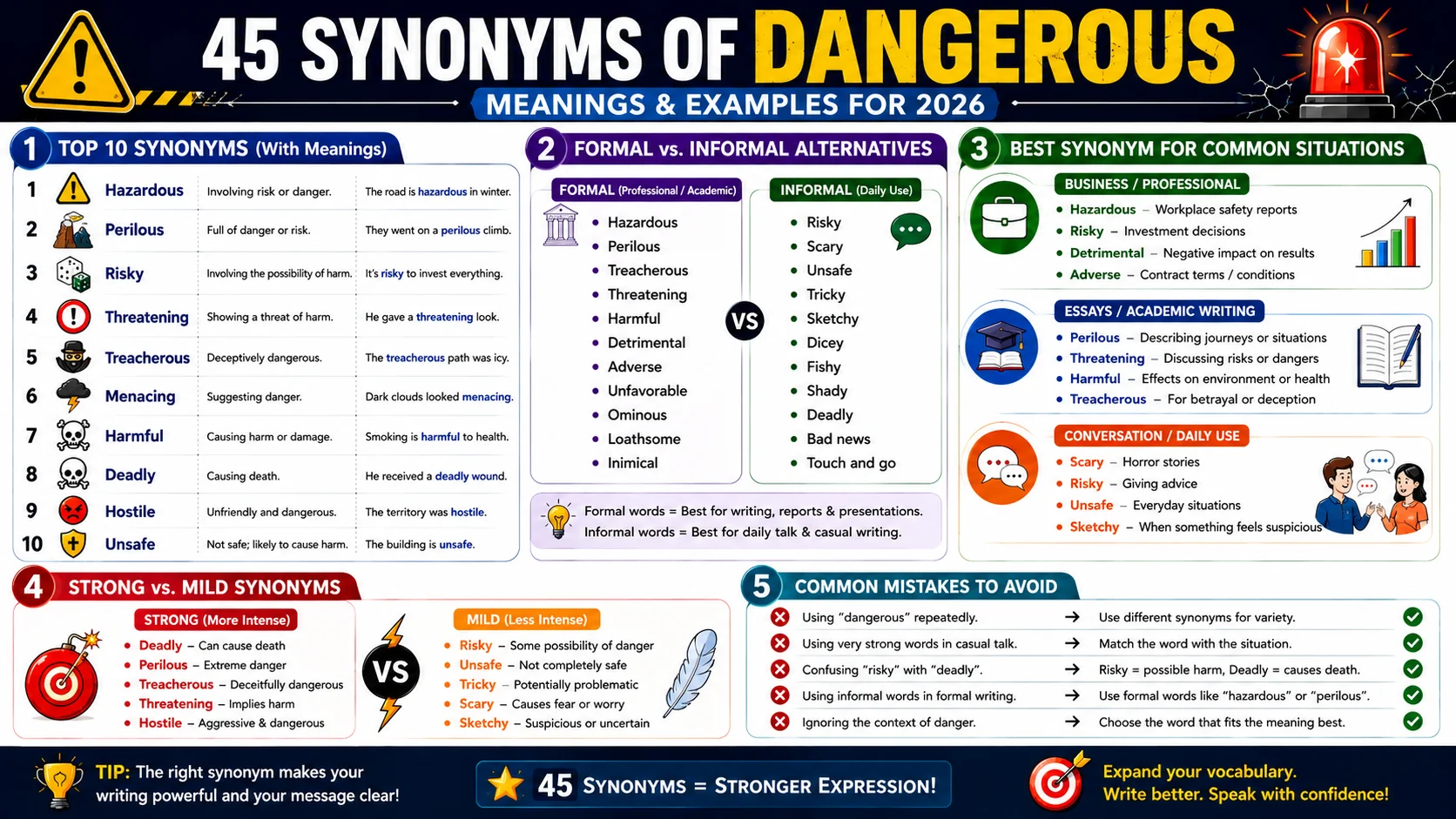
“Dangerous” means something that can cause harm, injury, or risk. The best synonyms are hazardous, perilous, risky, unsafe, and precarious. “Hazardous” is the most common natural alternative. Each synonym has a slightly different meaning and context where it fits best.
Top 10 Synonyms
- Hazardous
- Perilous
- Risky
- Unsafe
- Precarious
- Treacherous
- Menacing
- Threatening
- Deadly
- Harmful
“Dangerous” is a word we use to keep ourselves and others safe. We talk about dangerous situations, dangerous people, dangerous roads, and dangerous decisions. But using it too often can make your English feel repetitive and imprecise.
Think about it. You can describe a dangerous road, a dangerous animal, a dangerous storm, or a dangerous job. Each situation might need a different word that captures the specific type of danger.
In this guide, you’ll learn 35 powerful synonyms for “dangerous.” You’ll discover exactly when to use each one, how formal they are, and what common mistakes to avoid. Let’s begin!
What Does “Dangerous” Mean?
Definition
Dangerous” means something that can cause harm, injury, or risk to people or things. It describes situations, objects, people, or activities that are unsafe. When something is dangerous, there is a real chance of something bad happening.
Pronunciation
| Feature | Value |
|---|---|
| US IPA | /ˈdeɪndʒərəs/ |
| UK IPA | /ˈdeɪndʒərəs/ |
| Syllables | 3 (dan-ger-ous) |
| Tip | Stress the first syllable: “DANE-jer-us” |
Grammar
| Grammar Feature | Information |
|---|---|
| Part of Speech | Adjective |
| Common Position | Before a noun or after a linking verb |
| Typical Pattern | Dangerous + noun / Subject + be + dangerous |
Examples:
- “That road is very dangerous.” (after verb)
- “He drives a dangerous car.” (before noun)
- “It’s dangerous to swim here.” (with infinitive)
Grammar Note: “Dangerous” is often used with “to” or with an infinitive verb to show the risk.
Word Family
| Word | Part of Speech | Meaning |
|---|---|---|
| Dangerous | Adjective | Able or likely to cause harm |
| Danger | Noun | The possibility of harm |
| Dangerously | Adverb | In a dangerous way |
| Endanger | Verb | To put in danger |
15 Synonyms of “Dangerous”
Hazardous
Meaning: Involving risk or danger, especially from chemicals, materials, or conditions.
Best Used For: Materials, waste, work conditions.
Formality: Formal
Tone: Serious, Official
Frequency: ⭐⭐⭐⭐ (Common)
CEFR Level: B2
Example Sentence 1: “The chemicals are hazardous to human health.”
Example Sentence 2: “Working in construction can be hazardous.”
Usage Tip: “Hazardous” is often used for workplace, health, and environmental risks.
Common Confusion: Hazardous vs Dangerous. “Hazardous” often refers to chemical or workplace risks. “Dangerous” is broader.
Perilous
Meaning: Full of danger and risk.
Best Used For: Journeys, adventures, high-risk situations.
Formality: Formal
Tone: Dramatic, Serious
Frequency: ⭐⭐⭐ (Moderate)
CEFR Level: C1
Example Sentence 1: “The explorers began their perilous journey.”
Example Sentence 2: “Crossing the river was a perilous task.”
Usage Tip: “Perilous” is a dramatic, literary word. Use it for high-risk adventures and journeys.
Risky
Meaning: Involving the possibility of something bad happening.
Best Used For: Business decisions, actions, investments.
Formality: Neutral
Tone: Cautious, Practical
Frequency: ⭐⭐⭐⭐⭐ (Very Common)
CEFR Level: B1
Example Sentence 1: “Investing in that company is risky.”
Example Sentence 2: “It’s risky to drive in this weather.”
Usage Tip: “Risky” is very common. Use it for actions that might have bad consequences.
Unsafe
Meaning: Not safe; likely to cause harm.
Best Used For: Conditions, equipment, neighborhoods.
Formality: Neutral
Tone: Warning, Practical
Frequency: ⭐⭐⭐⭐ (Common)
CEFR Level: B1
Example Sentence 1: “The bridge is unsafe for heavy trucks.”
Example Sentence 2: “This neighborhood is unsafe at night.”
Usage Tip: “Unsafe” is a direct and clear word. Use it for immediate warnings.
Precarious
Meaning: Not stable or secure; likely to fall or fail.
Best Used For: Situations, positions, jobs.
Formality: Formal
Tone: Unstable, Worrying
Frequency: ⭐⭐⭐ (Moderate)
CEFR Level: C1
Example Sentence 1: “His job is in a precarious position.”
Example Sentence 2: “The economy remains precarious.”
Usage Tip: “Precarious” suggests instability and the risk of collapse.
Treacherous
Meaning: Dangerous and unpredictable, often in a deceptive way.
Best Used For: Roads, weather, people.
Formality: Neutral
Tone: Unpredictable, Dangerous
Frequency: ⭐⭐⭐ (Moderate)
CEFR Level: C1
Example Sentence 1: “The icy roads are treacherous today.”
Example Sentence 2: “He was a treacherous leader.”
Usage Tip: “Treacherous” suggests hidden danger or betrayal. Use it for roads and unpredictable people.
Menacing
Meaning: Threatening or suggesting danger.
Best Used For: People, looks, situations.
Formality: Neutral
Tone: Threatening, Fearful
Frequency: ⭐⭐⭐ (Moderate)
CEFR Level: C1
Example Sentence 1: “He gave a menacing look.”
Example Sentence 2: “Dark clouds were menacing.”
Usage Tip: “Menacing” describes something that looks or feels dangerous.
Threatening
Meaning: Showing or suggesting that something bad will happen.
Best Used For: Behavior, weather, language.
Formality: Neutral
Tone: Threatening, Warning
Frequency: ⭐⭐⭐⭐ (Common)
CEFR Level: B2
Example Sentence 1: “The sky was dark and threatening.”
Example Sentence 2: “He received a threatening letter.”
Usage Tip: “Threatening” suggests an immediate danger or warning.
Deadly
Meaning: Able or likely to cause death.
Best Used For: Weapons, diseases, poisons.
Formality: Neutral
Tone: Serious, Fatal
Frequency: ⭐⭐⭐⭐ (Common)
CEFR Level: B2
Example Sentence 1: “This snake is deadly.”
Example Sentence 2: “The virus proved deadly.”
Usage Tip: “Deadly” means something can kill. Use it for life-threatening situations.
Harmful
Meaning: Causing or likely to cause harm.
Best Used For: Chemicals, habits, behavior.
Formality: Neutral
Tone: Warning, Concerned
Frequency: ⭐⭐⭐⭐ (Common)
CEFR Level: B2
Example Sentence 1: “Smoking is harmful to your health.”
Example Sentence 2: “These chemicals are harmful.”
Usage Tip: “Harmful” is a general word for anything that causes damage or injury.
Fatal
Meaning: Causing death.
Best Used For: Accidents, illnesses, mistakes.
Formality: Formal
Tone: Serious, Final
Frequency: ⭐⭐⭐ (Moderate)
CEFR Level: B2
Example Sentence 1: “The accident was fatal.”
Example Sentence 2: “He made a fatal mistake.”
Usage Tip: “Fatal” means something causes death or complete failure.
Scary
Meaning: Causing fear or fright.
Best Used For: Situations, movies, experiences.
Formality: Informal
Tone: Fearful, Dramatic
Frequency: ⭐⭐⭐⭐⭐ (Very Common)
CEFR Level: A2
Example Sentence 1: “The film was really scary.”
Example Sentence 2: “It’s scary to walk alone at night.”
Usage Tip: “Scary” is informal. Use it for things that cause fear but may not be truly dangerous.
Dicey
Meaning: Slightly dangerous or uncertain.
Best Used For: Situations, decisions, weather.
Formality: Informal
Tone: Uncertain, Risky
Frequency: ⭐⭐ (Rare)
CEFR Level: B2
Example Sentence 1: “The weather looks a bit dicey.”
Example Sentence 2: “It’s a dicey situation.”
Usage Tip: “Dicey” is a casual word for something that’s risky or uncertain.
Insecure
Meaning: Not safe or protected.
Best Used For: Jobs, buildings, feelings.
Formality: Neutral
Tone: Unstable, Concerned
Frequency: ⭐⭐⭐ (Moderate)
CEFR Level: B2
Example Sentence 1: “His job is insecure.”
Example Sentence 2: “The building is structurally insecure.”
Usage Tip: “Insecure” suggests a lack of safety or stability.
Endangering
Meaning: Putting someone or something in danger.
Best Used For: Actions, behaviors, situations.
Formality: Formal
Tone: Warning, Concerned
Frequency: ⭐⭐⭐ (Moderate)
CEFR Level: C1
Example Sentence 1: “His behavior is endangering others.”
Example Sentence 2: “The policy is endangering workers.”
Usage Tip: “Endangering” describes actions that actively put others at risk.
Synonyms Comparison Table
| Synonym | Best Context | Formality | Tone | Frequency |
|---|---|---|---|---|
| Risky | Decisions, actions | Neutral | Cautious | ⭐⭐⭐⭐⭐ |
| Unsafe | Physical conditions | Neutral | Warning | ⭐⭐⭐⭐ |
| Hazardous | Workplaces, chemicals | Formal | Serious | ⭐⭐⭐⭐ |
| Harmful | Health, habits | Neutral | Warning | ⭐⭐⭐⭐ |
| Deadly | Death-causing | Neutral | Serious | ⭐⭐⭐⭐ |
| Threatening | Imminent danger | Neutral | Warning | ⭐⭐⭐⭐ |
| Perilous | Adventures | Formal | Dramatic | ⭐⭐⭐ |
| Treacherous | Roads, people | Neutral | Unpredictable | ⭐⭐⭐ |
| Precarious | Stability | Formal | Unstable | ⭐⭐⭐ |
| Menacing | Looks, threats | Neutral | Threatening | ⭐⭐⭐ |
Best Synonyms by Situation
| Situation | Best Synonym | Why It Works |
|---|---|---|
| Daily Conversation | Risky | Natural and common |
| Business Email | Hazardous | Professional and clear |
| Academic Writing | Perilous | Formal and precise |
| School Assignment | Unsafe | Clear and simple |
| Professional Meeting | Hazardous | Sounds professional |
| Presentation | Risky | Clear and direct |
| Creative Writing | Perilous | Adds literary depth |
| Social Media | Scary | Casual and relatable |
| Weather Report | Treacherous | Dramatic and accurate |
Formal vs Informal Synonyms
Formal Alternatives
| Synonym | Best Used For |
|---|---|
| Hazardous | Workplaces, chemicals |
| Perilous | Adventures, situations |
| Precarious | Stability, jobs |
| Fatal | Death-causing |
| Endangering | Actions, behaviors |
Neutral Alternatives
| Synonym | Best Used For |
|---|---|
| Risky | Decisions, actions |
| Unsafe | Conditions, places |
| Harmful | Health, habits |
| Deadly | Life-threatening |
| Threatening | Imminent danger |
Informal Alternatives
| Synonym | Best Used For |
|---|---|
| Scary | Frightening situations |
| Dicey | Risky situations |
| Treacherous | Roads, people |
Choosing the Right Level: Use “hazardous” and “perilous” for formal writing. Use “risky” and “unsafe” for most situations.
Strong vs Mild Synonyms
Mild
Suitable for everyday situations with less intensity.
- Unsafe
- Harmful
- Risky
Moderate
More serious or urgent alternatives.
- Hazardous
- Dangerous (itself)
- Threatening
- Menacing
Strong
High-intensity alternatives suggesting extreme danger.
- Deadly (death-causing)
- Fatal (causing death/failure)
- Perilous (great danger)
- Treacherous (betraying danger)
How Intensity Changes Meaning: “It’s risky” is mild. “It’s deadly” is serious. Choose stronger words when you want to emphasize life-threatening danger.
Real-Life Examples
School: “Walking alone at night can be dangerous.”
Office: “Working with hazardous materials requires training.”
Business Email: “Please avoid risky investments at this time.”
Meetings: “The company’s financial position is precarious.”
Presentations: “This chemical is harmful to the environment.”
Daily Conversations: “That road is treacherous in the rain.”
Social Media: “Stay safe—this area is unsafe at night.”
Academic Writing: “The study examines the perilous conditions faced by refugees.”
Common Collocations
| Common Phrase | Better Alternative |
|---|---|
| Dangerous road | Treacherous road |
| Dangerous chemicals | Hazardous chemicals |
| Dangerous job | Perilous job |
| Dangerous situation | Precarious situation |
| Dangerous behavior | Threatening behavior |
Common Phrases
Walk a tightrope: To be in a dangerous position. (e.g., “He’s walking a tightrope with that decision.”)
Tread carefully: To act cautiously. (e.g., “Tread carefully in this situation.”)
Walking on thin ice: Doing something risky. (e.g., “You’re walking on thin ice.”)
Danger zone: A risky situation. (e.g., “We’re entering the danger zone.”)
Live dangerously: To take risks. (e.g., “He likes to live dangerously.”)
Context Guide
| Situation | Best Synonym | Reason |
|---|---|---|
| Essay | Perilous | Academic and formal |
| Speech | Dangerous | Clear and direct |
| Business Email | Hazardous | Professional and clear |
| Novel | Treacherous | Adds literary depth |
| Presentation | Risky | Clear and direct |
| Conversation | Risky | Natural and relatable |
| Academic Writing | Perilous | Precise and formal |
| Legal Document | Hazardous | Formal and correct |
Related Words
Near Synonyms
- Grievous: Causing serious harm.
- Sinister: Suggesting harm.
- Ominous: Threatening.
- Frightening: Causing fear.
- Alarming: Causing worry.
Antonyms
- Safe: Free from danger.
- Secure: Safe and protected.
- Harmless: Causing no harm.
- Innocent: Not dangerous.
- Trivial: Not important.
Related Adjectives
- Dangerous: Causing danger.
- Hazardous: Risky.
- Perilous: Full of danger.
- Risky: Involving risk.
- Unsafe: Not safe.
Related Nouns
- Danger: The state of being unsafe.
- Hazard: A danger or risk.
- Risk: The chance of harm.
- Peril: Serious danger.
- Threat: An indication of danger.
Related Verbs
- Endanger: To put in danger.
- Risk: To expose to danger.
- Hazard: To venture or risk.
- Threaten: To indicate danger.
- Menace: To threaten.
Frequently Asked Questions
What is another word for dangerous?
Common synonyms include hazardous, perilous, risky, unsafe, and precarious. “Hazardous” is the most common professional alternative.
Which synonym sounds the most professional?
Hazardous and perilous sound very professional. “Fatal” is also excellent for medical and legal contexts.
What is the strongest synonym for dangerous?
Deadly and fatal are among the strongest synonyms. They suggest life-threatening danger. “Perilous” is also very strong.
Which synonym is best for essays?
Perilous is the best choice for academic essays. It’s formal and precise.
What’s the difference between dangerous and hazardous?
“Dangerous” is broader. “Hazardous” often refers to chemical or workplace risks.
Which synonym is most common in everyday English?
“Risky” and “unsafe” are very common in everyday speech. “Scary” is also frequently used for less serious danger.
What is the opposite of dangerous?
Common opposites are safe, secure, harmless, and innocent.
Conclusion
“Dangerous” is an important word for safety, but now you have 35 fantastic alternatives. Each synonym adds a different shade of meaning to your language.
Remember, the key is understanding the context. Use “hazardous” for workplace and chemical risks. Use “perilous” for dramatic, high-risk situations. Use “risky” for everyday decisions. Use “deadly” for life-threatening dangers.
The best way to improve is practice. Try using one or two new synonyms each day. Listen for these words in conversations and books. Your vocabulary will become richer and more expressive with time.
