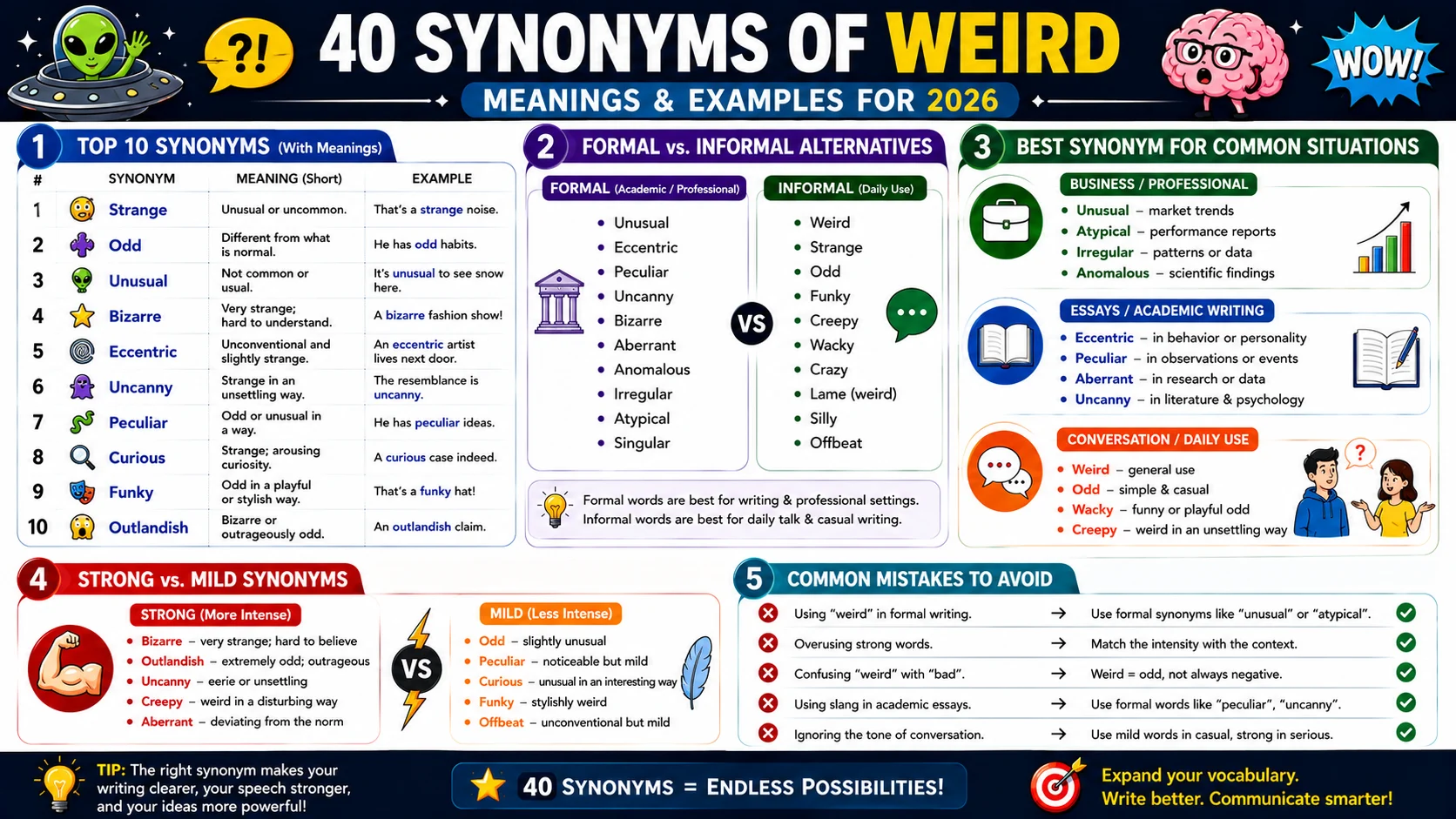
“Weird” means strange, unusual, or different from what is normal. The best synonyms are strange, odd, bizarre, unusual, and peculiar. “Strange” is the most common natural alternative. Each synonym has a slightly different meaning and context where it fits best.
Top 10 Synonyms
- Strange
- Odd
- Bizarre
- Unusual
- Peculiar
- Curious
- Eccentric
- Outlandish
- Offbeat
- Quirky
“Weird” is a word we use all the time. We talk about weird people, weird situations, weird ideas, and weird experiences. But using it too often can make your English feel repetitive and informal.
Think about it. You can call a person weird, a situation weird, an idea weird, or a coincidence weird. Each situation might need a different word that captures the specific type of strangeness.
In this guide, you’ll learn 35 powerful synonyms for “weird.” You’ll discover exactly when to use each one, how formal they are, and what common mistakes to avoid. Let’s begin!
What Does “Weird” Mean?
Definition
Weird” means strange, unusual, or different from what is normal or expected. It can describe people, events, ideas, or situations that seem odd or hard to explain. When something is weird, it doesn’t fit what you usually expect.
Pronunciation
| Feature | Value |
|---|---|
| US IPA | /wɪrd/ |
| UK IPA | /wɪəd/ |
| Syllables | 1 |
| Tip | Rhymes with “beard” and “pierced” |
Grammar
| Grammar Feature | Information |
|---|---|
| Part of Speech | Adjective |
| Common Position | Before a noun or after a linking verb |
| Typical Pattern | Weird + noun / Subject + be + weird |
Examples:
- “She has a weird habit.” (before noun)
- “This feels really weird.” (after verb)
- “That’s a weird coincidence.” (before noun)
Grammar Note: “Weird” can be used with “really,” “very,” “so,” and “totally” to emphasize strangeness.
Word Family
| Word | Part of Speech | Meaning |
|---|---|---|
| Weird | Adjective | Strange and unusual |
| Weirdly | Adverb | In a weird way |
| Weirdness | Noun | The quality of being weird |
| Weirdo | Noun | A strange person (informal) |
15 Synonyms of “Weird”
Strange
Meaning: Unusual or unexpected; hard to understand.
Best Used For: General strangeness, situations, people.
Formality: Neutral
Tone: Mysterious, Unusual
Frequency: ⭐⭐⭐⭐⭐ (Very Common)
CEFR Level: A2
Example Sentence 1: “I heard a strange noise coming from the basement.”
Example Sentence 2: “She’s a bit strange, but very kind.”
Usage Tip: “Strange” is the most common and direct synonym. Use it for anything unusual or hard to explain.
Common Confusion: Strange vs Weird. “Strange” is slightly more neutral and common. “Weird” is more informal and often suggests something unsettling.
Odd
Meaning: Strange, unusual, or different from what is expected.
Best Used For: Small strangeness, numbers, situations.
Formality: Neutral
Tone: Unusual, Curious
Frequency: ⭐⭐⭐⭐⭐ (Very Common)
CEFR Level: A2
Example Sentence 1: “It’s odd that he didn’t call.”
Example Sentence 2: “She has an odd way of laughing.”
Usage Tip: “Odd” often suggests something that doesn’t quite fit. Use it for small, noticeable strangeness.
Bizarre
Meaning: Very strange, especially in a surprising way.
Best Used For: Extreme strangeness, unbelievable situations.
Formality: Neutral
Tone: Shocking, Surprising
Frequency: ⭐⭐⭐⭐ (Common)
CEFR Level: B2
Example Sentence 1: “The murder case was bizarre.”
Example Sentence 2: “He wore a bizarre outfit to the party.”
Usage Tip: “Bizarre” suggests extreme, almost shocking strangeness. Use it for very unusual situations.
Unusual
Meaning: Different from what is normal or expected.
Best Used For: Events, behavior, appearances.
Formality: Neutral
Tone: Different, Notable
Frequency: ⭐⭐⭐⭐⭐ (Very Common)
CEFR Level: B1
Example Sentence 1: “It’s unusual to see snow in June.”
Example Sentence 2: “She has an unusual talent for languages.”
Usage Tip: “Unusual” is neutral and descriptive. Use it for anything that stands out from the normal.
Peculiar
Meaning: Strange, especially in an interesting or suspicious way.
Best Used For: Character, behavior, situations.
Formality: Neutral
Tone: Curious, Suspicious
Frequency: ⭐⭐⭐⭐ (Common)
CEFR Level: B2
Example Sentence 1: “He had a peculiar look in his eyes.”
Example Sentence 2: “There’s something peculiar about this place.”
Usage Tip: “Peculiar” often suggests strangeness with a hint of suspicion or curiosity.
Curious
Meaning: Strange and interesting, making you want to know more.
Best Used For: Situations, coincidences, facts.
Formality: Neutral
Tone: Interesting, Mysterious
Frequency: ⭐⭐⭐⭐ (Common)
CEFR Level: B2
Example Sentence 1: “It’s curious that they didn’t leave a note.”
Example Sentence 2: “She has a curious way of speaking.”
Usage Tip: “Curious” suggests strangeness that makes you want to investigate more.
Eccentric
Meaning: Behaving in a strange, unconventional way.
Best Used For: People, habits, personalities.
Formality: Formal
Tone: Quirky, Different
Frequency: ⭐⭐⭐ (Moderate)
CEFR Level: C1
Example Sentence 1: “He’s an eccentric old man who lives alone.”
Example Sentence 2: “Her eccentric behavior made her memorable.”
Usage Tip: “Eccentric” is a somewhat positive word for strange but harmless people.
Outlandish
Meaning: Extremely strange and unlikely.
Best Used For: Ideas, claims, clothing.
Formality: Formal
Tone: Extreme, Unbelievable
Frequency: ⭐⭐⭐ (Moderate)
CEFR Level: C1
Example Sentence 1: “He made some outlandish claims about his past.”
Example Sentence 2: “The costume was outlandish and colorful.”
Usage Tip: “Outlandish” suggests extreme strangeness that’s hard to believe.
Offbeat
Meaning: Different from the usual in an interesting way.
Best Used For: Humor, taste, style.
Formality: Informal
Tone: Quirky, Fun
Frequency: ⭐⭐⭐ (Moderate)
CEFR Level: B2
Example Sentence 1: “She has an offbeat sense of humor.”
Example Sentence 2: “The movie has an offbeat charm.”
Usage Tip: “Offbeat” is positive and suggests unusual but appealing strangeness.
Quirky
Meaning: Having unusual habits or qualities that are interesting.
Best Used For: People, personalities, habits.
Formality: Informal
Tone: Cute, Interesting
Frequency: ⭐⭐⭐⭐ (Common)
CEFR Level: B2
Example Sentence 1: “She has a quirky sense of fashion.”
Example Sentence 2: “His quirky habits make him lovable.”
Usage Tip: “Quirky” is positive. Use it for interesting, unusual habits or people.
Freaky
Meaning: Very strange and frightening.
Best Used For: Scary situations, weird experiences.
Formality: Informal
Tone: Frightening, Disturbing
Frequency: ⭐⭐⭐ (Moderate)
CEFR Level: B2
Example Sentence 1: “The movie was really freaky.”
Example Sentence 2: “A freaky coincidence happened.”
Usage Tip: “Freaky” is informal and suggests creepy strangeness. Use it carefully.
Uncanny
Meaning: Strange and hard to explain, especially in a surprising way.
Best Used For: Coincidences, similarities.
Formality: Formal
Tone: Surprising, Mysterious
Frequency: ⭐⭐ (Rare)
CEFR Level: C1
Example Sentence 1: “He has an uncanny ability to guess the future.”
Example Sentence 2: “The resemblance between them is uncanny.”
Usage Tip: “Uncanny” suggests surprising, almost supernatural strangeness.
Abnormal
Meaning: Not normal; unusual in a way that might be concerning.
Best Used For: Health, behavior, measurements.
Formality: Formal
Tone: Medical, Clinical
Frequency: ⭐⭐⭐ (Moderate)
CEFR Level: B2
Example Sentence 1: “The test results showed abnormal levels.”
Example Sentence 2: “Her behavior is abnormal.”
Usage Tip: “Abnormal” is a clinical word. Use it for things that deviate from what’s considered normal.
Freakish
Meaning: Very strange and unusual.
Best Used For: Appearance, events, behavior.
Formality: Neutral
Tone: Shocking, Unusual
Frequency: ⭐⭐ (Rare)
CEFR Level: C1
Example Sentence 1: “The weather was freakish for this time of year.”
Example Sentence 2: “He has a freakish talent.”
Usage Tip: “Freakish” suggests extreme, almost impossible strangeness.
Queer
Meaning: Strange or odd (somewhat old-fashioned).
Best Used For: Situations, feelings, impressions.
Formality: Neutral
Tone: Old-fashioned, Strange
Frequency: ⭐⭐ (Rare)
CEFR Level: C1
Example Sentence 1: “There’s something queer about this place.”
Example Sentence 2: “She had a queer feeling that something was wrong.”
Usage Tip: “Queer” is slightly old-fashioned. Be careful—it can have other meanings in some contexts.
Synonyms Comparison Table
| Synonym | Best Context | Formality | Tone | Frequency |
|---|---|---|---|---|
| Strange | General use | Neutral | Mysterious | ⭐⭐⭐⭐⭐ |
| Odd | Small strangeness | Neutral | Curious | ⭐⭐⭐⭐⭐ |
| Unusual | Standing out | Neutral | Different | ⭐⭐⭐⭐⭐ |
| Bizarre | Extreme strangeness | Neutral | Shocking | ⭐⭐⭐⭐ |
| Peculiar | Suspicious strangeness | Neutral | Curious | ⭐⭐⭐⭐ |
| Quirky | Interesting strangeness | Informal | Positive | ⭐⭐⭐⭐ |
| Eccentric | Unconventional people | Formal | Quirky | ⭐⭐⭐ |
| Outlandish | Hard to believe | Formal | Extreme | ⭐⭐⭐ |
| Uncanny | Surprising similarities | Formal | Mysterious | ⭐⭐ |
Best Synonyms by Situation
| Situation | Best Synonym | Why It Works |
|---|---|---|
| Daily Conversation | Strange/Odd | Natural and common |
| Business Email | Unusual | Professional and clear |
| Academic Writing | Peculiar | Formal and precise |
| School Assignment | Unusual | Clear and simple |
| Professional Meeting | Unconventional | Sounds professional |
| Presentation | Unusual | Clear and professional |
| Creative Writing | Bizarre | Adds literary depth |
| Social Media | Weird | Casual and relatable |
| Character Description | Eccentric | Shows personality |
Formal vs Informal Synonyms
Formal Alternatives
| Synonym | Best Used For |
|---|---|
| Peculiar | Suspicious strangeness |
| Eccentric | Unconventional people |
| Outlandish | Unbelievable strangeness |
| Abnormal | Medical, clinical contexts |
| Uncanny | Surprising coincidences |
Neutral Alternatives
| Synonym | Best Used For |
|---|---|
| Strange | Most general situations |
| Odd | Small strangeness |
| Unusual | Standing out |
| Bizarre | Extreme strangeness |
Informal Alternatives
| Synonym | Best Used For |
|---|---|
| Weird | General use |
| Quirky | Interesting strangeness |
| Freaky | Scary strangeness |
Choosing the Right Level: Use “peculiar” and “eccentric” for formal writing. Use “strange” and “unusual” for most situations. Use “weird” and “quirky” with friends.
Strong vs Mild Synonyms
Mild
Suitable for everyday situations with less intensity.
- Odd
- Unusual
- Curious
Moderate
More noticeable or interesting alternatives.
- Strange
- Peculiar
- Quirky
- Eccentric
Strong
High-intensity alternatives suggesting extreme strangeness.
- Bizarre (very strange)
- Outlandish (unbelievably strange)
- Freaky (creepy and strange)
- Uncanny (surprisingly strange)
How Intensity Changes Meaning: “He’s odd” is mild. “He’s bizarre” is extreme. Choose stronger words when you want to emphasize the level of strangeness.
Real-Life Examples
School: “She had a weird feeling about the test.”
Office: “His behavior at the meeting was a bit odd.”
Business Email: “The client requested some unusual specifications.”
Meetings: “We had a bizarre situation with the client.”
Presentations: “This is an unusual approach, but it works.”
Daily Conversations: “That’s a really strange coincidence.”
Social Media: “This is the weirdest thing I’ve ever seen!”
Academic Writing: “The study showed peculiar results.”
Common Collocations
| Common Phrase | Better Alternative |
|---|---|
| Weird feeling | Strange feeling |
| Weird behavior | Peculiar behavior |
| Weird coincidence | Odd coincidence |
| Weird person | Eccentric person |
| Weird situation | Unusual situation |
Common Phrases
Out of the ordinary: Unusual. (e.g., “Nothing out of the ordinary happened.”)
Off the wall: Very strange. (e.g., “He has some off-the-wall ideas.”)
One of a kind: Very unusual and unique. (e.g., “She’s one of a kind.”)
Like nothing else: Very unusual. (e.g., “The experience was like nothing else.”)
Strange bedfellows: Unusual combinations. (e.g., “Politics makes strange bedfellows.”)
Context Guide
| Situation | Best Synonym | Reason |
|---|---|---|
| Essay | Peculiar | Academic and formal |
| Speech | Unusual | Clear and engaging |
| Business Email | Unconventional | Professional and clear |
| Novel | Bizarre | Adds literary depth |
| Presentation | Unusual | Clear and professional |
| Conversation | Strange/Odd | Natural and relatable |
| Academic Writing | Peculiar | Precise and formal |
| Marketing Copy | Quirky | Engaging and memorable |
Related Words
Near Synonyms
- Freakish: Very strange.
- Aberrant: Different from the norm.
- Anomalous: Not fitting the pattern.
- Idiosyncratic: Unique to an individual.
- Uncanny: Surprising and strange.
Antonyms
- Normal: Usual and expected.
- Ordinary: Not special.
- Common: Happening often.
- Typical: Normal and expected.
- Conventional: Following usual patterns.
Related Adjectives
- Strange: Unusual.
- Odd: Not normal.
- Bizarre: Very strange.
- Unusual: Different.
- Peculiar: Strange.
Related Nouns
- Weirdness: The quality of being weird.
- Strange: Something unusual.
- Oddity: A strange thing.
- Eccentricity: Unusual behavior.
- Quirk: An unusual habit.
Related Verbs
- Puzzle: To confuse.
- Baffle: To confuse completely.
- Perplex: To make confused.
- Mystify: To confuse greatly.
Frequently Asked Questions
What is another word for weird?
Common synonyms include strange, odd, bizarre, unusual, and peculiar. “Strange” is the most common and direct alternative.
Which synonym sounds the most professional?
Peculiar and eccentric sound very professional. “Unconventional” is also excellent for formal contexts.
What is the strongest synonym for weird?
Bizarre and outlandish are among the strongest synonyms. They suggest extreme, almost unbelievable strangeness.
Which synonym is best for essays?
Peculiar is the best choice for academic essays. It’s formal and precise.
What’s the difference between weird and strange?
“Strange” is slightly more neutral and common. “Weird” is more informal and often suggests something unsettling.
Which synonym is most common in everyday English?
“Strange” and “odd” are very common in everyday speech. “Weird” itself is also frequently used.
What is the opposite of weird?
Common opposites are normal, ordinary, common, and typical. These words describe things that are usual and expected.
Conclusion
“Weird” is a fun and useful word, but now you have 35 fantastic alternatives. Each synonym adds a different shade of meaning to your language.
Remember, the key is understanding the context. Use “strange” for general strangeness. Use “odd” for small, noticeable strangeness. Use “bizarre” for extreme strangeness. Use “quirky” for interesting, positive strangeness.
The best way to improve is practice. Try using one or two new synonyms each day. Listen for these words in conversations and books. Your vocabulary will become richer and more expressive with time.
