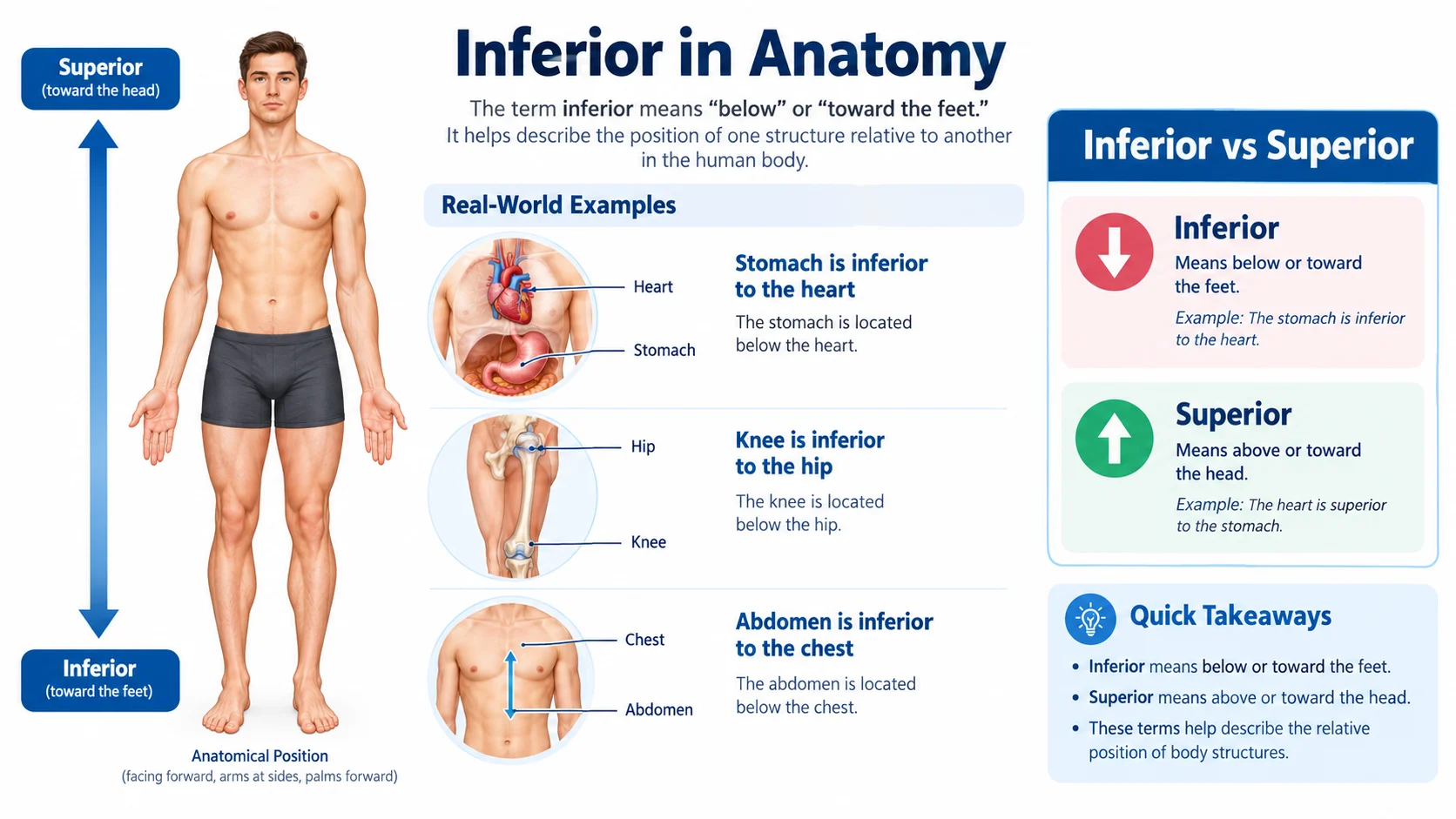
In anatomy, what does inferior mean in anatomy refers to a position closer to the feet or lower part of the body. It describes relative location. For example, the stomach is inferior to the heart because it sits below it.
What does inferior mean in anatomy? It means that one anatomical structure sits below another structure when the body is in the standard anatomical position. The term describes location rather than size, quality, importance, or function.
However, the word can create confusion because everyday English gives “inferior” a different meaning. In ordinary conversation, inferior often means lower in quality or status. In anatomy, it usually carries no judgment at all.
Instead, medical professionals use the term as a precise directional reference. It helps describe where organs, bones, tissues, muscles, blood vessels, and other structures sit in relation to one another.
For example, the chest lies superior to the abdomen. Conversely, the abdomen lies inferior to the chest. Neither statement says that one region is better or more important than the other.
Furthermore, anatomical directions depend on a standard reference position. This position places the person standing upright, facing forward, with the arms at the sides and the palms facing forward. Therefore, anatomical terminology remains consistent even when a patient sits, lies down, or changes position.
The concept also appears throughout anatomy courses, medical exams, nursing education, radiology, physical therapy, surgery, and clinical documentation. Once you understand the reference point, the word becomes much easier to use correctly.
QUICK ANSWER BOX
| Meaning | Context | Primary Platforms | Example | Tone |
| Below or toward the feet | Anatomical position | Anatomy textbooks, medical education, clinical notes | The stomach is inferior to the heart | Neutral and technical |
| Lower in a body region | Relative position | Nursing, medicine, biology | The chin is inferior to the nose | Precise |
| Toward the lower part of a structure | Structural anatomy | Imaging and laboratory education | The inferior pole of the kidney | Technical |
| Lower compared with another reference point | Comparative anatomy | Medical communication | The knee is inferior to the hip | Objective |
What Does Inferior Mean in Anatomy?
The simplest answer to what inferior means in anatomy is “located below another structure.” Anatomists use the word to describe relative position along the vertical axis of the body.
The term becomes especially clear when paired with its opposite, superior.
Superior means toward the head or upper part of the body. Inferior means toward the feet or lower part of the body.
For example:
| Structure or region | Relationship |
| Head compared with chest | The head is superior |
| Chest compared with head | The chest is inferior |
| Heart compared with stomach | The heart is superior |
| Stomach compared with heart | The stomach is inferior |
| Hip compared with knee | The hip is superior |
| Knee compared with hip | The knee is inferior |
This relationship is always relative. A structure is not simply “inferior” by itself. It is inferior to something else or toward a defined lower direction.
The Anatomical Position
Anatomical terminology uses a standard body position so that healthcare professionals can communicate consistently.
In the standard anatomical position, the person stands upright. The face points forward. The arms rest at the sides. The palms face forward. The feet point forward or slightly outward.
This reference position matters because the body can move constantly.
For example, someone can bend forward. Their head then moves physically closer to the ground. However, anatomical directional terminology does not suddenly change because of that movement.
The anatomical relationship remains based on the standard reference system.
Consequently, saying that the stomach is inferior to the heart remains correct regardless of whether a person is standing, sitting, or lying down.
The Word Origin
The anatomical use of “inferior” comes from Latin inferior, meaning lower. The related Latin word inferus refers to something below or beneath.
Medical terminology often preserves Latin and Greek roots. These roots help create a shared vocabulary across healthcare systems.
Therefore, the anatomical meaning connects directly with the ordinary spatial concept of something being lower.
However, the medical meaning differs from the social meaning of “inferior.” Anatomical language does not automatically imply weakness, poor quality, reduced value, or lower status.
Inferior Versus Superior
Understanding the paired terms makes anatomical descriptions much easier.
| Term | Basic meaning | Direction |
| Superior | Above or toward the head | Upward |
| Inferior | Below or toward the feet | Downward |
| Anterior | Toward the front | Frontward |
| Posterior | Toward the back | Backward |
| Medial | Toward the midline | Inward |
| Lateral | Away from the midline | Outward |
| Proximal | Closer to the point of attachment | Closer |
| Distal | Farther from the point of attachment | Farther |
These terms describe different dimensions. Inferior and superior describe vertical relationships. Medial and lateral describe relationships to the body’s midline. Proximal and distal commonly describe the relative position of structures along a limb.
As a result, replacing one term with another can change the meaning of an anatomical statement.
Contextual Dynamics and Nuances of the Term
The meaning becomes more useful when you see how medical professionals apply it to different structures.
Relative Position Matters
Anatomical direction is comparative.
Consider the relationship between the heart and diaphragm. The diaphragm lies inferior to the heart. At the same time, the heart lies superior to the diaphragm.
Both statements describe the same spatial relationship from opposite perspectives.
This is important because anatomical terminology does not work like a fixed label attached permanently to one organ.
Instead, it describes relationships.
For example, the liver is inferior to the diaphragm. Yet the liver can also be superior to structures located farther down in the abdomen.
Therefore, the same structure can be superior to one structure and inferior to another.
Inferior Does Not Mean Smaller
A common mistake involves treating “inferior” as a synonym for smaller.
That interpretation is incorrect in anatomy.
The word describes position. It does not describe physical size.
For example, the heart is superior to the stomach. This does not mean that the heart is larger or more important. Likewise, the stomach is inferior to the heart without being biologically inferior.
Inferior Does Not Mean Less Important
Medical terminology avoids value judgments when it describes position.
A clinician might document an injury involving the inferior portion of an organ. That statement identifies a location. It does not evaluate the importance of that region.
Similarly, “inferior border” means the lower border. “Inferior surface” means the lower surface.
The terminology remains descriptive.
Inferior and Caudal
The terms inferior and caudal can overlap, but they do not always function identically in every context.
In human anatomical descriptions, inferior generally means toward the feet or lower part of the body.
Caudal comes from the Latin word cauda, meaning tail. In human anatomy, it can refer to a direction toward the lower end of the body. In developmental anatomy and comparative anatomy, however, caudal can carry a more specific meaning.
Therefore, students should learn both terms while paying attention to context.
Inferior and Distal Are Not Synonyms
This distinction causes frequent confusion.
Inferior describes position toward the feet. Distal describes a position farther from the point where a limb or structure attaches to the body.
For example, the wrist is distal to the elbow. The elbow is proximal to the wrist.
The wrist is also generally inferior to the shoulder when the body is in anatomical position.
However, these statements describe different relationships.
The first uses proximal and distal. The second uses superior and inferior.
Real Life Conversation Examples Using What Does Inferior Mean in Anatomy
Although the phrase what does inferior mean in anatomy commonly appears in educational searches, people may use the underlying term in classrooms, study groups, medical conversations, and online discussions.
The following examples show natural uses.
Scenario 1: A Student Asks a Classmate
Student: What does inferior mean in anatomy?
Classmate: It means below or toward the feet.
Student: So the stomach is inferior to the heart?
Classmate: Exactly. The heart sits above the stomach.
This example demonstrates the simplest relationship.
Scenario 2: A Nursing Student Studies Directional Terms
Student: I keep mixing up superior and inferior.
Tutor: Think about vertical direction. Superior means toward the head. Inferior means toward the feet.
Student: So the knee is inferior to the hip?
Tutor: Yes. That is correct.
The comparison provides a simple memory aid without changing the formal definition.
Scenario 3: A Medical Imaging Discussion
Student: The report says there is a finding in the inferior portion of the lung. What does that mean?
Clinician: It means the finding is located toward the lower part of the lung.
Student: Does “inferior” tell us whether the finding is serious?
Clinician: No. It only describes location. The rest of the report provides clinical information.
This distinction is especially important when reading medical reports.
Scenario 4: A Biology Study Group
Student: Is the diaphragm inferior to the heart?
Student: Yes. The diaphragm sits below the heart.
Student: Then the heart is superior to the diaphragm?
Tutor: Correct. Both statements describe the same relative position.
The key idea is that directional terms work in pairs.
Scenario 5: An Anatomy Exam
Student: If the question asks which structure is inferior to the heart, what should I look for?
Tutor: Look for a structure positioned below the heart in anatomical position.
Student: So I should focus on location rather than size?
Tutor: Exactly.
These examples show why context matters. The term communicates spatial information, not quality or importance.
Platform Specific Breakdown
The phrase what does inferior mean in anatomy appears in searches across many digital environments. However, the anatomical definition does not change because someone encounters it on a particular platform.
The surrounding language can change. The meaning does not.
How It Is Used on Snapchat
Snapchat conversations generally use casual language. Therefore, users may encounter “inferior” in jokes, school discussions, screenshots, or study conversations.
For example, a student might send:
“What does inferior mean in anatomy again?”
A friend could reply:
“It means below, like toward the feet.”
In this setting, the platform does not create a special slang meaning.
Instead, Snapchat simply provides a communication channel for an ordinary anatomy question.
If someone uses “inferior” casually to mean “worse,” that is a different use of the English word. The surrounding context determines which meaning applies.
The Role of What Does Inferior Mean in Anatomy on TikTok
TikTok often presents educational terms through short videos, quizzes, mnemonics, and study content.
A creator might explain superior and inferior with a visual example. For instance, they could show the head and feet and describe the direction between them.
However, short videos can simplify complex concepts.
Therefore, viewers should distinguish a memory trick from the formal anatomical definition.
A useful mnemonic can help recall the concept. Yet the underlying principle remains in its relative anatomical position.
Instagram and Texting Dynamics
Instagram posts, direct messages, and text conversations can also contain anatomy terminology.
For example, a student might message:
“Can someone explain inferior vs distal?”
A helpful response would explain that inferior concerns direction toward the feet, while distal usually concerns distance from a point of attachment.
That distinction prevents a common terminology error.
Likewise, an Instagram infographic may use arrows to show superior and inferior directions. Such visuals can support learning because anatomical terminology depends heavily on spatial relationships.
Search Engines and AI Assistants
People also ask what does inferior mean in anatomy through search engines and AI systems.
A strong answer should give the direct definition first.
Then, it should explain the anatomical position, provide examples, and contrast the term with related directional words.
This structure works well for both human readers and question answering systems because it places the essential fact near the beginning.
Alternative Meanings and NLP Variations of the Phrase
The word “inferior” has several meanings outside anatomy. Context determines which meaning applies.
Anatomical Meaning
In anatomy, inferior means lower or toward the feet.
Example:
The stomach is inferior to the heart.
General English Meaning
In everyday English, inferior can describe something considered lower in quality, ability, or status.
Example:
The reviewer described the product as inferior to its competitor.
That meaning does not automatically apply to anatomical writing.
Common Semantic Variations
People may search for the concept using different wording.
| Search wording | Intended meaning |
| What does inferior mean in anatomy | Basic anatomical definition |
| Inferior anatomical position meaning | Directional terminology |
| Inferior medical definition | Medical usage |
| Inferior body direction | Spatial orientation |
| Inferior vs superior anatomy | Opposing directional terms |
| What does inferior mean medically | Clinical terminology |
| Inferior anatomy example | Practical application |
| Inferior direction in anatomy | Direction toward the feet |
| Inferior vs distal | Comparison of directional concepts |
| Inferior vs caudal | Comparison of related terms |
These variations describe essentially the same knowledge area.
Related Anatomical Vocabulary
The broader semantic field includes superior, inferior, anterior, posterior, medial, lateral, proximal, distal, superficial, deep, cranial, and caudal.
Learning these terms together is more effective than memorizing one word in isolation.
For example, consider the statement:
The knee is inferior to the hip and distal to the hip.
Both parts can be correct. However, they answer different spatial questions.
The first identifies the vertical position. The second identifies position along a limb.
Misinterpretations: When Not to Use What Does Inferior Mean in Anatomy
The phrase what does inferior mean in anatomy can lead to confusion when readers apply the everyday meaning of inferior to a medical statement.
Do Not Interpret It as “Worse”
If a report says “inferior aspect,” do not automatically interpret the word as negative.
“Inferior aspect” simply means the lower part.
Do Not Interpret It as “Less Important”
A structure can have an inferior position without having lesser biological importance.
The terminology describes geography within the body.
Do Not Replace It With “Distal”
Distal and inferior describe different relationships.
For instance, the fingers are distal to the wrist. Their relationship to the feet is irrelevant to that specific statement.
Do Not Assume the Patient Is Standing
Anatomical terminology relies on the standard anatomical position.
A patient can lie on a hospital bed while the clinician still uses superior and inferior according to the standard reference system.
Do Not Confuse “Inferior” With “Inferolateral”
Medical language sometimes combines directional terms.
“Inferolateral” means lower and toward the side.
Similarly, “superomedial” means higher and toward the midline.
These compound terms provide more precise location information.
How to Respond in Chat Comfortably
If someone asks what inferior means in anatomy, a natural response can stay short.
A useful answer is:
“In anatomy, inferior means lower or closer to the feet. For example, the stomach is inferior to the heart.”
If the person appears confused, add the opposite:
“Superior means toward the head, while inferior means toward the feet.”
For a student, you can add a comparison:
“Think in a vertical direction. Superior is up toward the head. Inferior is down toward the feet.”
For a medical report, clarify that the word describes location:
“Inferior usually identifies the lower part of a structure. By itself, it does not indicate whether something is serious.”
A More Technical Response
A more advanced answer could say:
“Inferior is an anatomical directional term indicating a position closer to the feet or lower end of the body relative to another structure.”
That version works well in academic settings.
A Casual Text Response
For texting, a simple response works better:
“It means below or toward the feet in anatomy.”
Then provide one example if needed.
The best response depends on the reader’s background. However, the core definition should remain consistent.
FAQs
The term is anatomical terminology rather than modern slang. However, people sometimes search for it through casual language platforms.
1. What does inferior mean in anatomy?
It means below another structure or toward the feet in the standard anatomical position. It describes relative location.
2. What is the opposite of inferior in anatomy?
The opposite is superior. Superior means toward the head or upper part of the body.
3. Does inferior mean worse in medical language?
Usually, no. In anatomical descriptions, it generally identifies a lower position. The everyday meaning of “worse” does not automatically apply.
4. Is inferior the same as distal?
No. Inferior describes direction toward the feet. Distal describes greater distance from a point of attachment or origin.
5. Is inferior the same as caudal?
They can overlap in human anatomy, especially when describing direction toward the lower body. However, caudal has additional uses in developmental and comparative anatomy.
6. What is an easy way to remember inferiority?
Think about the feet. Inferior points toward the feet, while superior points toward the head.
7. Can a structure be inferior and medial at the same time?
Yes. Anatomical directions can describe different dimensions simultaneously.
For example, a structure may sit below another structure and closer to the body’s midline.
8. Does body position change the meaning?
No. Anatomical directional terminology uses the standard anatomical position as its reference.
A person can sit or lie down while the terminology remains consistent.
9. What does inferior surface mean?
It means the lower surface of a structure. The phrase identifies position rather than quality or clinical severity.
10. Why do doctors use inferior instead of simply saying below?
Medical terminology provides a standardized vocabulary. This improves precision and reduces ambiguity across clinical and educational settings.
Conclusion
The core meaning of what inferior means in anatomy is straightforward: inferior describes a structure positioned lower or closer to the feet relative to another structure.
The important point is context.
In anatomy, “inferior” is a neutral directional term. It does not mean worse, weaker, smaller, or less important.
Furthermore, it works as part of a broader anatomical vocabulary. Superior describes the opposite direction. Medial and lateral describe relationships to the midline. Proximal and distal describe distance along a structure, especially a limb.
Once these relationships become familiar, medical descriptions become easier to understand.
The term also demonstrates why context matters in modern digital communication. A word can have one precise technical meaning and another everyday meaning. Search engines, social platforms, textbooks, medical reports, and AI assistants may present the same word in very different contexts.
For anatomy, the reliable interpretation comes from the anatomical reference system.
Therefore, when you encounter the word “inferior” in an anatomy textbook, clinical note, educational video, or medical explanation, first think about location.
Ask one simple question: Is the structure being described as lower or closer to the feet?
If the answer is yes, the anatomical use of “inferior” is likely describing position.
That principle makes the term easy to recognize, compare, and apply across basic anatomy, nursing, medicine, physical therapy, radiology, biology, and health education.
