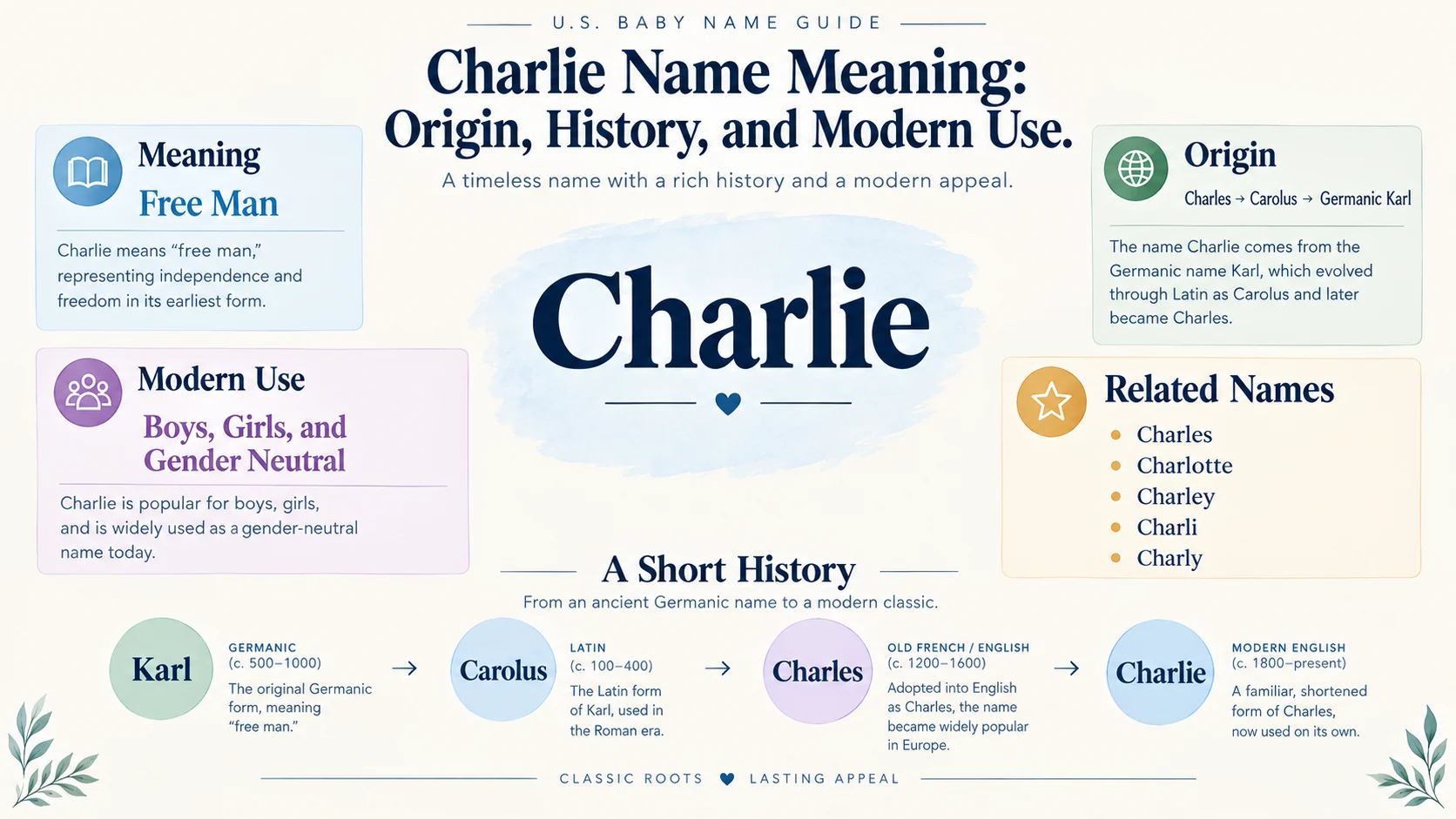
Charlie’s name meaning is commonly given as “free man.” Charlie developed as a familiar form of Charles and can also relate to feminine names such as Charlotte. Today, Charlie is widely used as a standalone gender neutral first name in English speaking countries.
The Charlie name meaning is most commonly explained as “free man,” through the older name Charles and its Germanic roots.
However, the name has become much more than a traditional nickname. Charlie now works comfortably as a complete first name. It can be masculine, feminine, or gender neutral, depending on the person and cultural setting.
Furthermore, Charlie has a remarkably long history. Its roots connect to Charles, the French and English form of the Latin Carolus, which developed from the Germanic name Karl.
In the United States, the name also feels familiar because generations of English speakers have encountered it in literature, entertainment, sports, history, and everyday life.
Today, parents may choose Charlie because it sounds friendly and approachable. Others like its traditional roots. Still others prefer it because it feels contemporary without sounding invented.
Therefore, understanding Charlie requires looking at more than a dictionary definition. Its history, pronunciation, gender usage, cultural associations, spelling variations, and modern popularity all contribute to its identity.
QUICK ANSWER BOX
| Category | Answer |
| Meaning | Commonly interpreted as “free man” |
| Origin | English form associated with Charles; Charles ultimately traces to Germanic Karl |
| Context | Given name, nickname, family name, fictional name, cultural reference |
| Primary Platforms | Everyday speech, social media, texting, entertainment, online profiles |
| Example | “Charlie is coming over after school.” |
| Tone | Friendly, familiar, casual, warm, and versatile |
| Gender | Traditionally masculine, but widely used as a gender neutral name |
| Pronunciation | Usually “CHAR lee” in American English |
| Related names | Charles, Charlotte, Charley, Charli, Charly |
| Common nickname use | Often used as a short form of Charles |
What Does Charlie Name Meaning Mean?
The Charlie name meaning is generally associated with “free man.” That interpretation comes from the history of Charles and the Germanic name Karl.
There is, however, an important linguistic detail. Etymology is not always a single straight line. Behind the Name explains Charles as the French and English form of Carolus, the Latin form of Karl, while noting that an alternative theory connects the name to a Germanic element meaning “army.”
Consequently, “free man” is the standard modern explanation, but historical name origins can contain competing linguistic theories.
Charlie as a Form of Charles
Charlie traditionally developed as a familiar or diminutive form of Charles. Behind the Name identifies it as a diminutive or feminine form of Charles.
In everyday English, diminutives often become independent names. For example, William can produce Will or Billy. Robert can produce Rob or Bobby. Likewise, Charles can produce Charlie.
Over time, Charlie became comfortable as a legal first name rather than merely a nickname.
That distinction matters today. Someone named Charlie does not necessarily have Charles on their birth certificate.
The Historical Root Behind Charles
Charles traces through French Charles and Latin Carolus to the Germanic Karl. One commonly cited interpretation connects Karl with a word meaning “man.”
The name gained enormous historical visibility through Charlemagne, whose name was essentially Charles the Great. His influence helped spread forms of Charles across Europe.
Later, Charles became associated with European royalty and prominent historical figures. As a result, Charlie inherits a surprisingly substantial historical background despite its informal sound.
Why “Free Man” Is the Common Interpretation
Modern baby name references commonly describe Charlie as meaning “free man.” Nameberry, The Bump, and BabyNames.com all use this interpretation.
The phrase is therefore useful when someone asks for the basic meaning of the name.
Still, it should not be treated as a personality prediction. A name’s meaning does not scientifically determine whether someone will be independent, kind, adventurous, confident, or any other personality trait.
Contextual Dynamics and Nuances of the Name
The meaning of a name changes slightly depending on how people encounter it.
Charlie can sound traditional in one setting and modern in another. It can also sound affectionate when used as a nickname.
Charlie as a Formal First Name
Many people now use Charlie as the complete given name.
This gives the name a simple structure. It does not require Charles as a formal version.
Modern naming culture increasingly accepts traditional nicknames as standalone names. Charlie fits this pattern particularly well.
Charlie as a Nickname
Charlie can still function as a nickname for Charles.
In that context, it may communicate familiarity or affection. For example, a person named Charles might be called Charlie by family members, classmates, or friends.
However, the relationship is not automatic. Someone called Charlie may prefer that name and may not use Charles at all.
Charlie for Boys
Historically, Charlie has strong masculine associations because of its relationship with Charles.
It remains popular for boys in the United States. Current U.S. data reported by Nameberry, based on Social Security Administration records, place Charlie at number 145 for boys in 2025, with 2,460 recorded births.
Charlie for Girls
Charlie is also established as a girl’s name.
It can function independently or connect with feminine names such as Charlotte. Behind the Name lists Charlie as a name used across genders, while Nameberry currently lists it at number 133 for girls in U.S. births.
Therefore, calling Charlie exclusively a boys’ name would not accurately describe contemporary American usage.
Charlie as a Gender Neutral Name
Modern usage makes Charlie particularly flexible.
The Bump describes Charlie as a gender neutral name, while BabyNames.com also categorizes it as gender neutral.
This flexibility explains why the name works across many naming styles.
It can sound classic without feeling formal. It can sound modern without feeling trendy. It can also work naturally across different age groups.
Real Life Conversation Examples Using Charlie Name Meaning
The name appears differently depending on the conversation. Here are five realistic examples.
Example 1: Asking About a Baby Name
Person A: “We’re thinking about naming our son Charlie.”
Person B: “That’s a classic choice. Do you know what it means?”
Person A: “I read that it means ‘free man’ and comes from Charles.”
Person B: “That makes sense. It sounds traditional but still modern.”
Example 2: Explaining the Name to a Child
Child: “Why did you name me Charlie?”
Parent: “Charlie is connected to Charles, and the traditional meaning is often given as ‘free man.’”
Child: “So does that mean I’m supposed to be free?”
Parent: “It’s a historical meaning, not a rule about who you have to become.”
Example 3: Asking Whether Charlie Is a Nickname
Person A: “Is Charlie short for Charles?”
Person B: “It can be, but it doesn’t have to be.”
Person A: “So Charlie can be the actual first name?”
Person B: “Exactly.”
Example 4: Discussing Gender Usage
Person A: “I thought Charlie was only a boy’s name.”
Person B: “It has traditionally been associated with Charles, but Charlie is also widely used for girls.”
Person A: “So it’s basically gender neutral now?”
Person B: “In many modern English speaking contexts, yes.”
Example 5: Asking About Social Media
Person A: “Why does everyone call her Charlie when her profile says Charlotte?”
Person B: “Charlie can be a nickname for Charlotte.”
Person A: “That explains it.”
Person B: “Exactly. Nicknames often become more casual versions of longer names.”
Platform Specific Breakdown
The name Charlie does not have a special universal slang definition on social media. Its interpretation normally depends on context.
That distinction is important because online searches sometimes mix a person’s name with unrelated slang meanings. A search for Charlie on a platform does not automatically indicate that the user means slang.
How It Is Used on Snapchat
On Snapchat, Charlie can simply identify a person.
For example, someone might write:
“Charlie sent me a snap.”
Here, Charlie functions as a personal name.
A username may also contain Charlie. Someone might use variations such as Charlie123, Charli, or Charley.
Therefore, the surrounding message matters more than the platform itself.
If someone says “Ask Charlie,” they almost certainly mean a person. If they use Charlie inside a joke, meme, or coded phrase, the surrounding content determines the meaning.
The Role of Charlie on TikTok
TikTok creates another layer because names often appear in captions, usernames, comments, fictional characters, and trends.
For example:
“Charlie is literally me.”
That sentence could refer to a friend, creator, fictional character, or another person named Charlie.
Consequently, TikTok should not be treated as having one special definition for the name.
The platform can amplify cultural references, but it does not replace the ordinary meaning of the name.
Instagram and Texting Dynamics
Instagram commonly uses names in profile handles, captions, comments, and direct messages.
Texting works similarly.
Someone might write:
“Charlie said he’ll be here at 8.”
The meaning is straightforward.
However, people sometimes ask about “Charlie” because they saw the word in a meme or unfamiliar phrase. In those situations, context becomes essential.
The safest approach is to examine the full sentence before assigning a slang meaning.
Alternative Meanings and NLP Variations of the Phrase
The Charlie name meaning has several closely related linguistic forms.
| Variation | Typical interpretation |
| Charlie | Common English given name or nickname |
| Charley | Spelling variant |
| Charli | Modern spelling variant |
| Charly | Alternative spelling |
| Charles | Traditional related formal name |
| Charlotte | Feminine name that can use Charlie as a nickname |
| Carl | Related European name form |
| Karl | Germanic name related to Charles |
| Carolus | Latin form associated with Charles |
| Carlo | Italian form of Charles |
| Carlos | Spanish form of Charles |
Behind the Name lists Charley, Charli, and Charly among related variants of Charlie.
Charlie and Charles
The strongest linguistic relationship is between Charlie and Charles.
Charles is the longer traditional form. Charlie is the familiar form.
However, modern naming practice allows Charlie to stand independently.
Charlie and Charlotte
Charlie can also serve as a nickname for Charlotte.
This has helped the name become more gender flexible.
It also means that hearing “Charlie” does not necessarily tell you whether someone’s full name is Charles, Charlotte, or simply Charlie.
Charlie and Charli
Charli is primarily a spelling variation.
The pronunciation can remain essentially the same in ordinary English speech.
Parents may choose Charli because they prefer the visual style of the spelling. However, spelling preferences vary considerably by family and culture.
Charlie and Charley
Charley is another established variant.
The difference is mainly orthographic. In most everyday American contexts, the two forms are pronounced similarly.
Misinterpretations: When Not to Use Charlie Name Meaning
Understanding context prevents many mistakes.
The Charlie name meaning should not be treated as a universal explanation for every appearance of the word Charlie.
Do Not Assume Every “Charlie” Refers to a Person’s Name
English contains several historical and slang uses of Charlie.
Some are now dated, regional, offensive, or unrelated to the personal name. Etymonline documents several historical senses, including military terminology.
Therefore, context matters.
If someone asks, “What does Charlie mean as a baby name?” The answer should focus on the personal name.
If someone asks, “What does Charlie mean in this movie scene?” The specific dialogue may require a different interpretation.
Do Not Treat Name Meaning as Personality Science
A historical meaning does not establish a person’s personality.
For example, “free man” does not mean every person named Charlie is independent.
Likewise, a name associated with strength does not prove that its bearer has a particular personality.
Name meanings describe linguistic history. They do not provide psychological diagnoses or guaranteed character traits.
Do Not Assume Charlie Is Always Short for Charles
It can be short for Charles.
However, it can also be the person’s complete legal first name.
It can also relate to Charlotte or other names in particular families.
Do Not Confuse Historical Slang With Modern Baby Name Usage
Some dictionaries record older meanings of Charlie that have nothing to do with naming.
Etymonline documents historical slang applications, while Dictionary.com also records specific historical senses.
Those meanings should not be automatically transferred into modern conversations about baby names.
How to Respond in Chat Comfortably
If someone asks you about the meaning of the name Charlie, a short answer usually works best.
You could say:
“Charlie usually means ‘free man’ and comes from Charles. It’s also used as a standalone gender neutral name.”
If someone asks whether Charlie is a nickname, you can respond:
“Yes, traditionally it’s a nickname for Charles, but Charlie is also commonly used as a full first name.”
If someone asks whether Charlie is a boy’s or girl’s name, a balanced response is:
“Both. It has traditional masculine roots through Charles, but Charlie is widely used for girls too.”
If someone asks about the origin:
“It comes through Charles, from the Germanic name Karl, via Latin Carolus.”
If the context is unclear, ask:
“Do you mean the baby name, a nickname, or slang usage?”
That question prevents an incorrect interpretation.
Short Answers for Texting
| Question | Comfortable response |
| “What does Charlie mean?” | “It’s traditionally associated with ‘free man.’” |
| “Is Charlie short for Charles?” | “It can be, but Charlie is also a full name.” |
| “Is Charlie a girl’s name?” | “Yes. It’s widely used for both boys and girls.” |
| “What is Charlie short for?” | “Usually Charles, though it can also relate to names such as Charlotte.” |
| “Where does Charlie come from?” | “It developed from Charles and ultimately traces to Germanic roots.” |
| “Is Charlie an old name?” | “Yes. Its history connects to the much older Charles name family.” |
Charlie Name Meaning in American Naming Culture
The Charlie name meaning becomes especially interesting when viewed through contemporary American naming culture.
American parents often balance tradition with informality. Charlie fits that pattern unusually well.
It has a recognizable historical connection. At the same time, it does not sound excessively formal.
This combination makes it suitable for several generations.
A child named Charlie can have a name that sounds natural on a preschool playground. The same name can also sound professional later in adulthood.
Popularity in the United States
Current U.S. data demonstrate that Charlie remains an established choice.
Nameberry’s U.S. listing based on Social Security Administration records shows Charlie at number 145 for boys in 2025. The same source reports 2,460 boys given the name that year.
For girls, Nameberry reports Charlie at number 133 in its current U.S. data. It also notes that the name reached number 122 for girls in 2020.
These figures show that the name has meaningful usage across genders.
However, rankings change from year to year. Therefore, a current ranking should not be interpreted as a permanent measure of popularity.
Why the Name Feels Both Classic and Modern
Charlie benefits from a linguistic paradox.
Its history is old.
Its sound is informal.
Its spelling is simple.
Its use as a standalone name feels contemporary.
Consequently, the name can satisfy parents who want something recognizable without choosing a highly formal traditional name.
Famous Cultural Associations
Names also gain cultural familiarity through recognizable people and fictional characters.
One of the most famous historical bearers of Charlie is Charlie Chaplin, the British comic actor and filmmaker. Behind the Name also identifies Charlie Brown as a major fictional association through the Peanuts comic strip.
These associations can affect how a name feels to different generations.
For some people, Charlie may immediately suggest classic comedy. For others, it may suggest childhood literature or animation.
That cultural familiarity can make the name feel approachable.
Still, cultural associations vary from person to person. No single reference defines the name.
Pronunciation and Spelling Guide
In American English, Charlie is generally pronounced approximately CHAR lee.
Its phonetic form is commonly represented as /ˈtʃɑrli/ in American English.
| Form | Common pronunciation |
| Charlie | CHAR lee |
| Charley | CHAR lee |
| Charli | CHAR lee |
| Charly | CHAR lee |
| Charles | CHARLZ |
The spelling may change, but pronunciation often remains very similar.
Why Spelling Variants Matter
Parents sometimes choose alternative spellings to create a slightly different visual identity.
Charli, for example, is increasingly recognizable as a contemporary spelling.
Charley feels closer to a traditional nickname spelling.
Charly appears less commonly in American naming contexts but remains recognizable.
None of these variants automatically creates a different underlying etymology.
Related Names Across Languages
The name family surrounding Charlie extends well beyond English.
Charles has related forms across European languages, including Carlo in Italian and Carlos in Spanish. Behind the Name lists a broad collection of related forms across European languages and cultures.
| Language or tradition | Related form |
| English | Charles, Charlie |
| French | Charles |
| German | Karl, Carl |
| Italian | Carlo |
| Spanish | Carlos |
| Portuguese | Carlos |
| Dutch | Karel |
| Polish | Karol |
| Swedish | Karl |
| Danish | Carl, Karl |
| Norwegian | Karl |
| Czech | Karel |
| Hungarian | Károly |
This linguistic network demonstrates why Charlie cannot be understood only as a modern American nickname.
It belongs to a much broader European name family.
Choosing Charlie as a Baby Name
Parents considering Charlie may want to think about several practical factors.
First, pronunciation is straightforward.
Second, spelling is familiar.
Third, the name works across age groups.
Fourth, it can function independently without requiring a longer formal name.
Fifth, it offers gender flexibility.
However, parents should also consider the popularity of the name. A familiar name can be an advantage, but families seeking something extremely rare may prefer a less established choice.
Possible Full Name Combinations
Charlie works with many naming styles.
For example:
| Style | Example |
| Traditional | Charlie James |
| Classic | Charlie William |
| Short | Charlie Jack |
| Modern | Charlie Mason |
| Soft | Charlie Ellis |
| Formal middle name | Charlie Alexander |
| Vintage | Charlie Theodore |
These examples demonstrate style rather than a ranking of names.
The Difference Between Meaning and Association
A key distinction often gets lost in baby name discussions.
Meaning describes linguistic origin.
Association describes what a culture or individual connects with the name.
For Charlie, “free man” belongs to the first category.
Charlie Chaplin belongs to the second.
Charlie Brown belongs to the second.
A friendly, casual impression also belongs to association rather than literal etymology.
This distinction produces a more accurate understanding of names.
FAQs
1. What is the Charlie name meaning?
The Charlie name meaning is commonly given as “free man.” The name developed as a familiar form of Charles and is now also used independently.
2. Is Charlie a boy’s or girl’s name?
Charlie can be used for boys and girls. It has traditional masculine roots through Charles, but contemporary English usage treats it as a gender neutral name in many contexts.
3. Is Charlie short for Charles?
Traditionally, yes. Charlie developed as a familiar form of Charles. However, Charlie is now frequently given as a complete first name.
4. Can Charlie be short for Charlotte?
Yes. Charlie can function as a nickname for Charlotte, particularly in modern English speaking naming practices.
5. What is the origin of Charlie?
Charlie has an English usage history and connects to Charles. Charles developed through French Charles and Latin Carolus from the Germanic Karl.
6. Does Charlie mean “free”?
The traditional interpretation is closer to “free man.” Modern baby name sources commonly shorten this explanation to “free man” or describe the name as carrying that meaning.
7. Is Charlie a modern name?
Charlie is modern in its current standalone use, but its linguistic family is centuries old. Charles and related forms have deep European historical roots.
8. Is Charlie popular in the United States?
Yes. Charlie appears in current U.S. baby name rankings for both boys and girls. Nameberry’s presentation of Social Security Administration data places Charlie at number 145 for boys in 2025 and number 133 for girls in its current U.S. listing.
9. What are common spellings of Charlie?
Common variants include Charlie, Charley, Charli, and Charly.
10. Does the meaning of Charlie determine personality?
No. A name’s etymological meaning describes its linguistic history. It does not scientifically predict someone’s personality, behavior, or future.
Conclusion
The Charlie name meaning ultimately connects a familiar modern first name with a much older European naming tradition.
Its standard interpretation is “free man.” Its linguistic history leads through Charles, Carolus, and Germanic Karl.
Yet Charlie has evolved beyond its original role as a nickname.
Today, it can stand alone as a first name. It can be used for boys and girls. It can also function as a nickname for Charles or, in some contexts, Charlotte.
Furthermore, its use on Snapchat, TikTok, Instagram, and messaging platforms usually remains ordinary name usage rather than a special piece of internet slang. Context determines whether a particular appearance has another meaning.
The name also demonstrates how language changes over time. A familiar nickname can become a formal first name. A traditionally masculine name can become gender neutral. An old European name can acquire a distinctly modern American identity.
Therefore, Charlie offers a useful example of how personal names preserve history while adapting to contemporary culture.
For anyone researching the name, the most accurate summary is simple: Charlie is a historically rooted English name associated with Charles, commonly interpreted as “free man,” and now widely used as a standalone gender neutral name.
