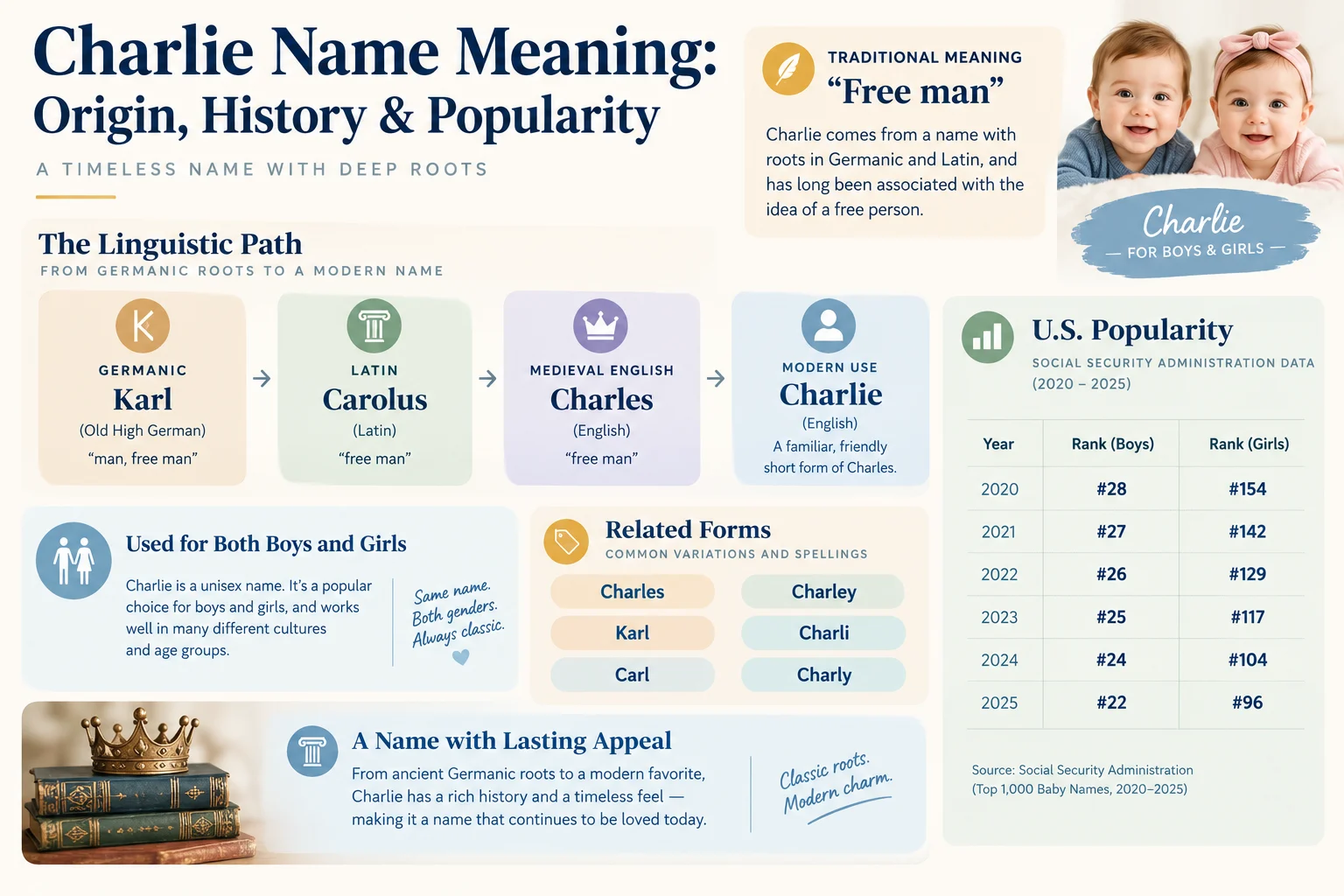
Charlie’s name meaning is commonly explained as “free man,” through Charles and the Germanic name Karl. Charlie began as a familiar form of Charles and is now widely used as a standalone name for both boys and girls.
Charlie name meaning is most often connected with the idea of a “free man,” although the deeper etymology has some scholarly uncertainty. The name comes through Charles, the English and French form of Latin Carolus. Carolus traces back to the Germanic name Karl.
Today, Charlie feels friendly, familiar, and modern. However, its history reaches much further back. The name belongs to a large family of related forms, including Charles, Karl, Carl, Carla, Charlotte, and Charley.
In English, Charlie works as both a nickname and a formal given name. Furthermore, it is now used for people of different genders. Behind the Name lists Charlie as both masculine and feminine in English usage.
The name also has strong cultural recognition. Charlie Chaplin helped establish the name in global popular culture. Charlie Brown later made it familiar to generations of English-speaking audiences.
For American parents, the name also remains current. U.S. Social Security Administration data shows Charlie among the more frequently used names in recent U.S. birth data.
QUICK ANSWER BOX
| Meaning | Context | Primary Platforms | Example | Tone |
| Free man | Traditional name meaning | Baby naming, social profiles, everyday speech | “Her name is Charlie.” | Friendly |
| Man or free person | Germanic etymological interpretation | Historical naming | “Charlie comes from Charles.” | Informative |
| Diminutive of Charles | Traditional English usage | Names, family, introductions | “Charles is called Charlie.” | Casual |
| Feminine or masculine given name | Modern English usage | U.S. names and social settings | “Charlie is her first name.” | Contemporary |
| Short form of Charles | Nickname usage | Family, school, work | “Everyone calls him Charlie.” | Familiar |
What Does Charlie Name Meaning Mean?
The simplest explanation is “free man.” This interpretation comes from the Germanic root associated with Karl and Charles. However, historical linguistics is more nuanced than many baby-name websites suggest.
Behind the Name explains Charles as the English and French form of Latin Carolus. Carolus developed from the Germanic name Karl, which is connected to a Proto-Germanic word meaning “man.” An alternative etymological theory connects the name with the Germanic element harjaz, meaning “army.”
Therefore, “free man” is a widely used traditional interpretation, not a perfectly settled one-word translation.
The Connection With Charles
Charlie is traditionally a diminutive of Charles. It can also function as a feminine form of Charles in English.
A diminutive is a shortened or familiar form of a longer name. English has many examples:
| Full Name | Familiar Form |
| Charles | Charlie |
| William | Billy |
| Robert | Bobby |
| Elizabeth | Lizzie |
| Katherine | Katie |
| Joseph | Joey |
Over time, diminutives can become independent given names. Charlie is a clear example of this development.
The Germanic Root
The historical path can be summarized as:
| Stage | Form | Significance |
| Germanic | Karl | Root associated with Charles |
| Latin | Carolus | Latin form |
| French and English | Charles | Established European form |
| English | Charlie | Diminutive and later standalone name |
The exact historical development involves multiple languages and centuries. Consequently, simplified claims such as “Charlie directly means free” leave out important linguistic context.
Why Charlemagne Matters
The Charles name family gained major historical visibility through Charlemagne, also known as Charles the Great. He ruled the Franks and became one of the most influential rulers of early medieval Europe.
Behind the Name notes that the popularity of Charles across continental Europe was connected to Charlemagne, who lived from 742 to 814.
This historical connection helped the Charles family of names spread across European languages.
Contextual Dynamics & Nuances of the Term
The meaning of a personal name is different from the meaning of an internet expression.
Charlie is primarily a personal name. It is not inherently modern slang. Therefore, context matters when someone searches for the phrase online.
A person may search for the meaning because they are:
- Choosing a baby name
- Researching a family name
- Explaining their own name
- Looking for a nickname
- Comparing Charles and Charlie
- Researching gender-neutral names
- Studying name origins
- Interpreting a character’s name
- Creating a username
- Understanding a person’s nickname
The same word can also appear in unrelated contexts. For example, “Charlie” can be a person’s first name, a nickname, a fictional character’s name, or part of a cultural reference.
Is Charlie a Boy’s or Girl’s Name?
Charlie is used for both boys and girls in English-speaking contexts.
Behind the Name explicitly classifies Charlie as masculine and feminine in English usage.
U.S. naming data also reflects this broader use. The Social Security Administration’s recent data lists Charlie among names used for both boys and girls. Its 2020–2025 data records 12,649 boys and 10,053 girls named Charlie during that period.
This makes Charlie a genuinely unisex choice in contemporary American naming.
What Does Charlie Symbolize?
The traditional meaning suggests freedom. However, symbolic interpretations should not be confused with historical definitions.
People often associate Charlie with qualities such as:
| Association | Why It May Occur |
| Freedom | Traditional interpretation of the root |
| Warmth | Friendly sound and nickname history |
| Familiarity | Longstanding English usage |
| Simplicity | Short, easy pronunciation |
| Versatility | Used across genders and ages |
| Tradition | Connection with Charles |
| Modernity | Increasing use as a standalone name |
These are cultural associations rather than proven personality traits.
A person’s name does not determine their character. Therefore, descriptions such as “Charlie means a kind person” should be treated as symbolic rather than literal.
How Is Charlie Pronounced?
In American English, Charlie is commonly pronounced CHAR-lee.
Behind the Name gives the American English pronunciation as /ˈt͡ʃɑɹ.li/.
The pronunciation is straightforward because each syllable is familiar to English speakers.
Real-Life Conversation Examples Using Charlie Name Meaning
People rarely use the full search phrase in ordinary conversation. Instead, they ask natural questions such as “What does Charlie mean?” or “Is Charlie short for Charles?”
Example 1: Baby Name Discussion
Maya: We are thinking about Charlie for our baby.
Jordan: That is a classic choice.
Maya: Do you know the meaning?
Jordan: It is traditionally connected with Charles and is commonly explained as “free man.”
Maya: I like that meaning. It feels positive without sounding too formal.
This conversation demonstrates a typical naming context.
Example 2: Asking About a Nickname
Alex: Is Charlie your real name?
Sam: Yes, actually. My parents put Charlie on my birth certificate.
Alex: I thought it was short for Charles.
Sam: It can be, but Charlie is also used as a full name.
That distinction is important. Charlie does not have to be a nickname.
Example 3: Discussing a Girl Named Charlie
Nina: Her name is Charlie.
Emma: Is it short for Charlotte?
Nina: No. Charlie is her full first name.
Emma: That makes sense. I have heard it used for girls too.
This reflects modern English naming patterns.
Example 4: Historical Curiosity
David: Why is Charlie connected to Charles?
Ryan: Charlie developed as a familiar form of Charles.
David: And Charles comes from Karl?
Ryan: Yes. The name family goes back through Latin Carolus to the Germanic Karl.
This version focuses on etymology rather than personality or symbolism.
Example 5: Choosing Between Names
Parent 1: Should we use Charles or Charlie?
Parent 2: Charles feels more formal.
Parent 1: Charlie feels more relaxed.
Parent 2: We could use Charles officially and Charlie at home.
That approach preserves both forms. However, parents can also choose Charlie as the official first name.
Platform-Specific Breakdown
A name can behave differently across digital platforms. However, the underlying meaning does not change simply because someone types it on a social network.
How It Is Used on Snapchat
On Snapchat, Charlie may appear as:
- A display name
- A username
- A friend’s name
- A nickname
- A story mention
- A character name
- A private contact label
If someone asks, “What does Charlie mean on Snapchat?” The answer usually depends on context.
There is no universal Snapchat-specific definition that changes the traditional meaning of the personal name.
For example:
“Charlie added you.”
Here, Charlie is almost certainly a person’s display name.
By contrast:
“My dog is called Charlie.”
Here, Charlie is a pet name.
Therefore, the surrounding message matters more than the platform.
The Role of Charlie Name Meaning on TikTok
TikTok can introduce additional cultural references. A creator may use Charlie as:
- A personal name
- A character name
- A username
- A fictional persona
- A reference to a celebrity
- Part of a trend
- Part of a video title
However, TikTok does not create a single alternative definition for Charlie.
Search results may sometimes make a familiar name appear like slang. This happens because users attach names to trends, memes, characters, or communities.
The safest approach is to examine the specific video or caption.
Instagram and Texting Dynamics
Instagram commonly uses names as handles, display names, captions, and profile identities.
For example:
“Happy birthday, Charlie!”
The meaning is simple. Charlie identifies the person receiving the message.
Texting follows the same principle:
“Ask Charlie if she is coming.”
Here, Charlie is simply someone’s name.
However, a message such as:
“That was such a Charlie move.”
requires more context. The writer may be using Charlie as a reference to a specific person or character.
Consequently, the name itself does not provide enough information to interpret every phrase containing it.
Alternative Meanings
Search engines and language models may encounter many variations around the same topic.
Common variations include:
- What does Charlie mean?
- What is the meaning of Charlie?
- Charlie name origin
- Charlie name meaning and origin
- Meaning of the name Charlie
- Charlie baby name meaning
- Charlie meaning for a boy
- Charlie meaning for a girl
- Is Charlie a unisex name?
- Is Charlie short for Charles?
- Charlie nickname meaning
- Charlie name history
- Charlie Germanic origin
- Charles and Charlie relationship
- Charlie etymology
These queries have overlapping search intent. Nevertheless, each one emphasizes a slightly different information need.
Semantic Variations
Semantic search may connect Charlie with:
| Semantic Entity | Relationship |
| Charles | Root and traditional full form |
| Karl | Germanic name connected to Charles |
| Carolus | Latin form of Charles |
| Charley | Spelling variant |
| Charli | Variant spelling |
| Charly | Variant spelling |
| Charlotte | Related feminine name |
| Carl | Related form |
| Karl | German and Scandinavian form |
Behind the Name lists several related forms and variants, including Charley, Charli, and Charly.
Charlie Versus Charles
Charles generally sounds more formal. Charlie sounds more familiar.
| Feature | Charles | Charlie |
| Historical depth | Very strong | Strong |
| Formal tone | Higher | Lower |
| Casual tone | Moderate | High |
| Traditional connection | Direct | Through Charles |
| Gender usage | Traditionally masculine | Masculine and feminine |
| Standalone use | Common | Common |
Neither form has to be treated as superior. The choice depends on personal naming preferences.
Charlie Versus Charley
Charley is an established spelling variant. However, Charlie is the more familiar spelling in many English-speaking contexts.
The pronunciation can be identical.
The visual difference is therefore mainly orthographic rather than semantic.
Misinterpretations:
The phrase can become misleading when people assume every appearance of “Charlie” refers to etymology.
Do Not Treat It as a Universal Slang Term
Charlie is not automatically slang.
If someone writes:
“I met Charlie yesterday.”
they are probably using a person’s name.
There is no reason to reinterpret the sentence as internet slang.
Do Not Assign Personality Traits as Facts
You may encounter claims that people named Charlie are automatically:
- Brave
- Independent
- Kind
- Intelligent
- Adventurous
- Free-spirited
Such descriptions are symbolic associations.
They are not linguistic definitions.
A name can carry cultural associations, but it does not scientifically determine personality.
Do Not Assume Charlie Always Means Charles
Charlie often comes from Charles. However, modern parents can choose Charlie independently.
The Social Security Administration’s birth-name data demonstrates that Charlie appears as its own recorded given name.
Therefore, asking “What is Charlie short for?” does not always have one answer.
Do Not Assume Gender From the Name
Charlie can refer to a boy or a girl.
Recent U.S. Social Security data confirms substantial use of the name for both sexes.
Therefore, the name alone does not establish someone’s gender.
How to Respond in Chat Comfortably
If someone asks you about the name, keep your response natural.
If Someone Asks “What Does Charlie Mean?”
You can say:
“Charlie is traditionally derived from Charles and is commonly interpreted as ‘free man.’”
That gives the essential answer without overexplaining.
If Someone Asks “Is Charlie Short for Charles?”
A natural response is:
“Yes, Charlie is traditionally a nickname or diminutive of Charles, although it is also used as a full first name.”
This answer handles both traditional and modern usage.
If Someone Asks “Is Charlie a Girl Name?”
You could respond:
“It can be. Charlie is used for both boys and girls in English-speaking countries.”
This avoids assuming someone’s gender.
If Someone Asks About the Historical Meaning
Try:
“Charlie comes through Charles, which traces to Latin Carolus and the Germanic Karl. The traditional interpretation is ‘free man,’ although the deeper etymology has some uncertainty.”
This is more precise than presenting the meaning as an undisputed translation.
If Someone Uses Charlie as a Username
Do not assume the username has a hidden meaning.
A username may simply represent the person’s real name.
For example:
@charlie123
could mean almost anything chosen by the account owner.
Context remains essential.
FAQs
1. What is the Charlie name meaning?
The traditional explanation is “free man.” The name comes through Charles and ultimately connects with the Germanic name Karl. However, historical etymology has competing theories.
2. Is Charlie short for Charles?
Yes. Charlie traditionally developed as a diminutive of Charles. However, Charlie can now be used independently as a formal given name.
3. Is Charlie a unisex name?
Yes. Modern English usage includes both masculine and feminine use. U.S. birth data also records Charlie for boys and girls.
4. What does Charlie mean for a girl?
The traditional etymological meaning does not change because Charlie is given to a girl. The same name history applies.
5. What is the origin of Charlie?
Charlie developed through English usage from Charles. Charles comes from French and English forms of Latin Carolus, which connects to the Germanic Karl.
6. Is Charlie a modern name?
Charlie is modern in its current standalone use, but its naming history is much older. The name connects to the longstanding Charles and Karl family.
7. Is Charlie a popular name in the United States?
Yes. Recent U.S. Social Security data places Charlie among commonly used names. From 2020 through 2025, Charlie was recorded 12,649 times for boys and 10,053 times for girls.
8. What are alternative spellings of Charlie?
Common variants include Charley, Charli, and Charly.
9. Is Charlie a nickname or a full name?
It can be either. Traditionally, it served as a familiar form of Charles. Today, parents also use Charlie as the child’s official given name.
10. What names are related to Charlie?
Related names include Charles, Karl, Carl, Charley, Charli, Charly, and several feminine forms within the broader Charles name family.
Conclusion:
The history behind Charlie is much older than modern social media. The name developed within the broader Charles and Karl naming family and became a familiar English form of Charles.
The traditional interpretation is “free man.” Still, responsible name research should acknowledge the complexity of historical etymology. Some linguistic sources connect the root with “man,” while another theory links it with a Germanic element associated with “army.”
Modern usage has also expanded.
Charlie can function as a nickname. It can also stand alone as a first name. Furthermore, it is used for both boys and girls in English-speaking contexts.
In the United States, recent Social Security data confirms continued use across both groups. The name appeared 12,649 times for boys and 10,053 times for girls in the agency’s 2020–2025 data.
Therefore, the most useful way to understand charlie name meaning is through several layers: traditional meaning, linguistic origin, historical development, modern gender usage, and cultural familiarity.
Most importantly, Charlie is not simply a word with one fixed interpretation. It is a living personal name. Its meaning comes from its history, while its significance can be shaped by the people who carry it.
