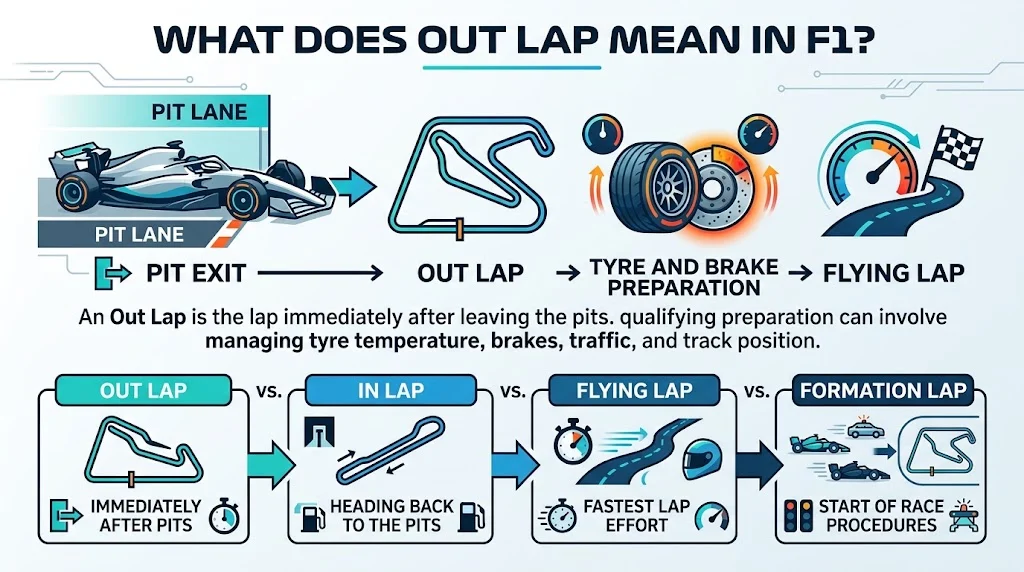
An out lap is the lap a Formula 1 driver completes immediately after leaving the pits. In qualifying, it prepares the tyres, brakes, and car for a fast flying lap. During a race, it follows a pit stop and helps the driver regain racing pace.
What does out lap mean in F1? It means the lap a driver completes after leaving the pit lane and before returning to a normal racing or qualifying rhythm. The term sounds simple. However, its importance changes depending on whether you are watching practice, qualifying, or a Grand Prix.
In qualifying, the lap usually prepares the car for a flying lap. The driver works to bring the tyres and brakes into their useful operating range. The team also manages traffic, battery energy, fuel, and track position.
During a race, the situation is different. A driver has normally just stopped for tires. The first lap after the stop therefore begins with a different tyre condition and a new strategic objective. The driver must build performance while managing the gap to nearby competitors.
For new F1 viewers, the easiest way to remember the term is simple: out means going out of the pits.
The opposite concept is an in lap. That is the lap on which a driver heads into the pits. A flying lap, meanwhile, is the lap where the driver pushes for a competitive time.
Quick Answer Box
| Meaning | Context | Primary Platforms | Example | Tone |
| Lap immediately after leaving the pits | Practice, qualifying, or race | F1 broadcasts, live timing, social media, fan discussions | “He is on his out lap before the push lap.” | Technical and conversational |
| Preparation lap before a fast lap | Qualifying | TV, radio, live timing | “The tires need another preparation lap.” | Strategic |
| First lap after a pit stop | Race | Broadcasts and race commentary | “His out lap will be important.” | Strategic |
| A non representative pace lap | Any session | Timing apps and fan analysis | “Ignore that time because it was an out lap.” | Analytical |
What Does Out Lap Mean in F1?
The basic definition is straightforward. An out lap is the lap a car completes after leaving the pit lane. Formula 1 itself defines it as the lap when a driver makes their way out of the pits. In qualifying, it generally comes before a flying lap. During a race, it normally follows a pit stop.
That definition explains why the word “out” matters. The driver is going out onto the circuit rather than coming in toward the garage.
The distinction becomes important when you read timing screens. An out lap is normally not a representative measure of a car’s maximum pace. The driver may still be preparing the tyres, controlling energy usage, creating space from another car, or respecting traffic conditions.
Why Drivers Need an Out Lap
Modern F1 cars depend heavily on tyre performance. Temperature affects grip, braking behavior, cornering confidence, and overall lap time.
After a car spends time in the pits, the tyres can lose temperature. The brakes can also cool. Therefore, the driver needs to prepare the car before attacking a fast lap.
That preparation can involve controlled acceleration, braking, cornering, and other techniques. Drivers may also weave across the track in certain situations. The goal is not simply to make the car look busy. Teams are trying to manage the tyre preparation process without creating unnecessary tyre wear.
However, preparation is not always identical at every circuit.
Track temperature matters. Air temperature matters. Asphalt characteristics matter. Tyre compound matters. Traffic matters too. Consequently, the ideal preparation approach can change from one session to another.
Out Lap vs Flying Lap
A flying lap is the competitive lap that follows preparation. Formula 1 describes it as the lap when the driver pushes as hard as possible to set a fast time. It can also be called a hot lap or push lap.
The difference can be summarized like this:
| Lap Type | Main Purpose | Typical Pace |
| Out lap | Prepare the car | Usually below maximum |
| Flying lap | Set a competitive time | Maximum attack |
| In lap | Return to the pits | Variable |
| Formation lap | Prepare for the race start | Controlled |
This distinction prevents a common viewing mistake. A driver may appear several seconds slower than a rival. Yet that difference may mean very little if one driver is preparing tires while the other is completing a flying lap.
Contextual Dynamics and Nuances of the Term
The meaning remains consistent, but the strategic purpose changes with the session.
In Practice
Practice sessions give teams time to learn about the car and tyres. Drivers may complete several different types of runs.
An out lap can begin a longer stint. The driver then completes several representative laps while the team gathers information.
The first timed lap may still differ from the later laps. Tire condition changes with every corner. Fuel load also changes as the car burns fuel. Track conditions can evolve throughout the session.
Therefore, analysts rarely treat one lap in isolation.
In Qualifying
Qualifying makes preparation especially important.
A driver may leave the garage, complete the preparation lap, create a suitable gap to another car, and then begin a flying lap. Every part of that sequence can affect the final result.
Traffic creates another challenge. A driver needs enough clear space to attack. However, leaving too much space can allow the tires to cool or waste valuable session time.
The 2026 tyre environment adds further complexity. Motorsport reporting has highlighted situations where drivers may need additional preparation because tyre temperature and available electrical energy must be balanced carefully.
That means an out lap can involve much more than simply driving slowly around the circuit.
During a Race
After a pit stop, the first lap back on track becomes strategically important.
The driver has fresh tires, but those tires may not immediately deliver their full performance. At the same time, the driver may need to defend against a competitor or build a gap.
This is where the out lap connects with pit stop strategy.
Suppose Driver A pits before Driver B. Driver A returns to the circuit and begins the first lap on fresh tyres. Driver A needs to produce enough pace to gain a strategic advantage before Driver B eventually stops.
That situation forms part of the logic behind an undercut. A driver pits earlier than a rival and uses the performance of the fresh tyres to gain time while the rival remains on older rubber.
Consequently, the first lap after a stop can have a major strategic effect.
Why an Out Lap May Look Slow
A slow lap does not automatically indicate a problem.
The driver may deliberately reduce speed because the tires need preparation. The driver may also encounter traffic. A team might ask the driver to conserve energy. Alternatively, the car could simply be completing a cooldown or preparation sequence.
Timing systems therefore identify these laps differently from representative push laps. Some live timing systems explicitly warn viewers that an out lap is not representative of normal pace.
This distinction is especially useful for fantasy players, casual viewers, and people learning to interpret live timing.
Real Life Conversation Examples Using Out Lap
The phrase appears naturally in conversations among F1 fans. It is usually used as technical shorthand rather than internet slang.
Example 1: Qualifying
Alex: “Why is Norris so slow on that lap?”
Sam: “That is his out lap. He is preparing the tires.”
Alex: “So the next one counts?”
Sam: “Exactly. Watch the flying lap.”
Example 2: Race Strategy
Alex: “Leclerc just came out of the pits.”
Sam: “His out lap could be important.”
Alex: “Because he needs to get ahead of the cars behind?”
Sam: “Right. He needs to use the fresh tires and build the gap.”
Example 3: Watching Live Timing
Alex: “Why does his timing look so bad?”
Sam: “Check the status. He is on an out lap.”
Alex: “Ah, so that time isn’t useful for comparing pace.”
Sam: “Exactly.”
Example 4: Qualifying Traffic
Alex: “Why did the team tell him to slow down?”
Sam: “They are trying to create space before the flying lap.”
Alex: “Doesn’t that hurt the out lap?”
Sam: “It can. They have to balance tire preparation with traffic.”
Example 5: Understanding a Pit Stop
Alex: “He gained three seconds after the stop.”
Sam: “The new tires helped, but the out lap was important too.”
Alex: “So the lap after the pit stop can affect the strategy?”
Sam: “Definitely. Especially when the cars are close.”
Platform Specific Breakdown
The term is primarily motorsport vocabulary. However, its meaning can appear differently across digital platforms.
How It Is Used on Snapchat
Snapchat conversations tend to be short. An F1 fan might send a screenshot from qualifying with a caption such as “out lap” or “tyres warming.”
The phrase works because fans already understand the context. It does not need a long explanation when both people follow Formula 1.
For newer viewers, however, the term can be confusing. A screenshot showing a driver several seconds off the pace might look like evidence of poor performance. In reality, the driver could simply be preparing for the next timed lap.
Short social posts therefore benefit from context.
For example:
“Hamilton is on his lap. Next one should be the push.”
That sentence gives a reader enough information to understand why the current lap may look slow.
The Role of Out Lap on TikTok
TikTok often turns technical F1 concepts into short educational videos.
Creators may use clips showing a car leaving the pits and then explain what happens next. A common educational structure is simple: pit exit, preparation, tyre temperature, flying lap.
The phrase also appears in captions and comments. Users might ask why drivers weave, why a lap appears unusually slow, or why the fastest lap follows a slower one.
This creates an opportunity for clear explanations.
A useful short explanation would be:
“The out lap happens after the car leaves the pits. The driver prepares the tires and brakes before attacking the next lap.”
The important point is accuracy. The term is not a general slang expression with an unrelated social meaning. It is established motorsport terminology.
Instagram and Texting Dynamics
Instagram comments often compress technical language.
A fan might write:
“Out lap. Wait for the push.”
Another might say:
“He needs another prep lap.”
Both statements communicate similar information.
Texting is even more flexible. Friends who already understand F1 may simply write “out lap” without explanation.
For beginners, adding one short phrase helps:
“Out lap, so he is warming everything up.”
That approach keeps the conversation natural while making the meaning clear.
Alternative Meanings and NLP Variations of the Phrase
The term has several closely related linguistic forms.
| Phrase | Meaning |
| Out lap | Lap after leaving the pits |
| Outlap | Informal spelling of the same term |
| Pit exit lap | Descriptive alternative |
| Preparation lap | Lap used to prepare for a fast run |
| Prep lap | Short informal version |
| Warm up lap | Sometimes used conversationally, though it can be confused with a formation lap |
| Push lap | Fast competitive lap |
| Flying lap | Timed lap driven at maximum competitive pace |
| Hot lap | Another term for a fast lap |
| In lap | Lap used to return to the pits |
One important distinction concerns the phrase “warm up lap.”
In everyday conversation, people may use it to describe preparation. However, Formula 1 also has a specific formation lap. That lap takes place immediately before the race start and allows drivers to bring the car toward the desired starting conditions before returning to the grid.
Therefore, “formation lap” is more precise when discussing the lap before the Grand Prix starts.
Out Lap and Outlap
You may see both “out lap” and “outlap.”
The spaced form is common in official explanations and general writing. The closed form appears in some motorsport discussions.
The meaning remains the same.
For SEO content, natural usage matters more than forcing one spelling into every sentence. Search engines can understand related terminology and semantic relationships.
Misinterpretations:
The phrase has a narrow technical meaning. It should not describe every slow lap.
A driver can produce a slow lap for many reasons. Traffic, yellow flags, tyre conservation, mistakes, damage, fuel saving, or team instructions can all affect pace.
Calling every slow lap an out lap would therefore be inaccurate.
Do Not Confuse It With a Formation Lap
A formation lap occurs immediately before the race starts. Drivers leave their grid positions, circulate, and return to the grid.
An out lap happens after a driver leaves the pits.
Those are different situations.
Do Not Confuse It With an In Lap
An in lap takes the driver toward the pits. An out lap takes the driver away from the pits.
The distinction is especially important during strategic analysis.
| Term | Direction | Typical Situation |
| Out lap | Away from pits | After leaving the pit lane |
| In lap | Toward pits | Before entering the pit lane |
| Flying lap | Around the circuit at maximum pace | Qualifying |
| Formation lap | Around the circuit before the start | Race start |
Do Not Assume Every Out Lap Is Slow
An out lap is often slower than a flying lap. However, its exact pace varies.
A driver may push relatively hard to generate tyre temperature. Track layout also affects the time lost. Some circuits have long pit lanes or unusual pit exit positions.
Therefore, “out lap equals very slow lap” is an oversimplification.
How to Respond in Chat Comfortably
If someone uses the term in a conversation, you do not need a complicated response.
A simple reply can acknowledge the strategy:
“Yeah, he is preparing for the push lap.”
If you are unsure, ask:
“You mean the lap after leaving the pits?”
If someone asks you to explain it, use one sentence:
“It is the lap after a car leaves the pits, usually used to prepare for the next fast lap.”
You can also connect the term to what viewers see.
For example:
“That is why the timing looks slow right now. The driver is still on the out lap.”
This style works particularly well in group chats because it explains the concept without interrupting the conversation.
Beginner Friendly Response
“Out lap” means the lap after leaving the pits. The driver uses it to get the car ready before pushing.”
More Technical Response
“The driver is using the out lap to manage tyre and brake preparation before the flying lap.”
Casual Fan Response
“It is just the lap before they go for it.”
All three can be appropriate. The best choice depends on how much F1 knowledge the other person has.
FAQs
1. What does out lap mean in F1?
It refers to the lap a driver completes immediately after leaving the pit lane. In qualifying, the driver normally uses it to prepare for a flying lap. In a race, it usually follows a pit stop.
2. Why do F1 drivers do an out lap?
The main purpose is preparation. Drivers need to manage tyre and brake temperatures while also positioning the car correctly for the next phase of the session.
In qualifying, the objective is usually to arrive at the flying lap with the tyres ready to deliver maximum grip.
3. Is an out lap timed in F1?
The car can complete a timed circuit lap, but the resulting time is normally not representative of its maximum pace.
Timing systems often distinguish the lap from a competitive push lap because the driver is preparing the car rather than attacking for the fastest possible time.
4. What happens during an out lap?
The driver manages several factors. These can include tyre preparation, brake temperature, traffic, energy use, and track position.
The exact procedure depends on the circuit and session.
5. Is an out lap the same as a flying lap?
No.
A flying lap is the competitive lap where the driver pushes for a fast time. An out lap normally prepares the car for that attempt.
6. Why do drivers sometimes weave on the out lap?
Weaving can help generate tyre temperature through repeated loading and movement of the tyres. However, preparation methods vary by conditions and tyre behavior.
It should not be interpreted as a simple universal rule that drivers must always weave.
7. What is the difference between an out lap and an in lap?
The direction is the easiest way to remember it.
An out lap follows a car leaving the pits. An in lap takes a car toward the pits.
The two laps also have different strategic purposes.
8. Does an out lap matter during a race?
Yes. After a pit stop, the driver needs to extract useful performance from the new tyres while managing nearby competitors.
The lap can therefore influence whether an undercut works and whether a driver emerges ahead or behind a rival after the strategy cycle.
9. Is an out lap the same as a formation lap?
No.
A formation lap happens before the race begins. An out lap occurs after a car leaves the pits.
They can both involve tyre and brake preparation, but they happen at different points in an F1 session.
10. Why does live timing show “OUT”?
“OUT” generally indicates that the driver has left the pit lane and is completing an out lap.
It helps viewers understand why the driver’s current lap time may not represent the car’s true competitive pace.
Conclusion
What does out lap mean in F1? At its core, it is a simple piece of motorsport terminology. The driver has left the pits and is completing the lap that follows the pit exit.
Yet the practical meaning goes deeper.
In qualifying, the lap can prepare tyres and brakes for a flying lap. It can also involve traffic management, energy planning, and careful positioning. During a race, the lap follows a pit stop and can become part of a larger strategic battle.
That is why commentators pay attention to it.
For new fans, the easiest mental model is simple. Out means leaving the pits. It means heading toward the pits. Flying means pushing for the time. Formation means preparing for the race start.
Once those four concepts become familiar, F1 timing screens become much easier to understand.
The term also demonstrates why Formula 1 vocabulary can seem complicated at first. Many words describe very specific moments in a session. However, those terms become intuitive once viewers connect them with what the car is actually doing.
An out lap is therefore more than a slow lap before qualifying. It is a preparation phase that connects pit lane activity with competitive performance.
And when you hear a commentator say that a driver is on an out lap, you now know what comes next: the car is getting ready to push.
