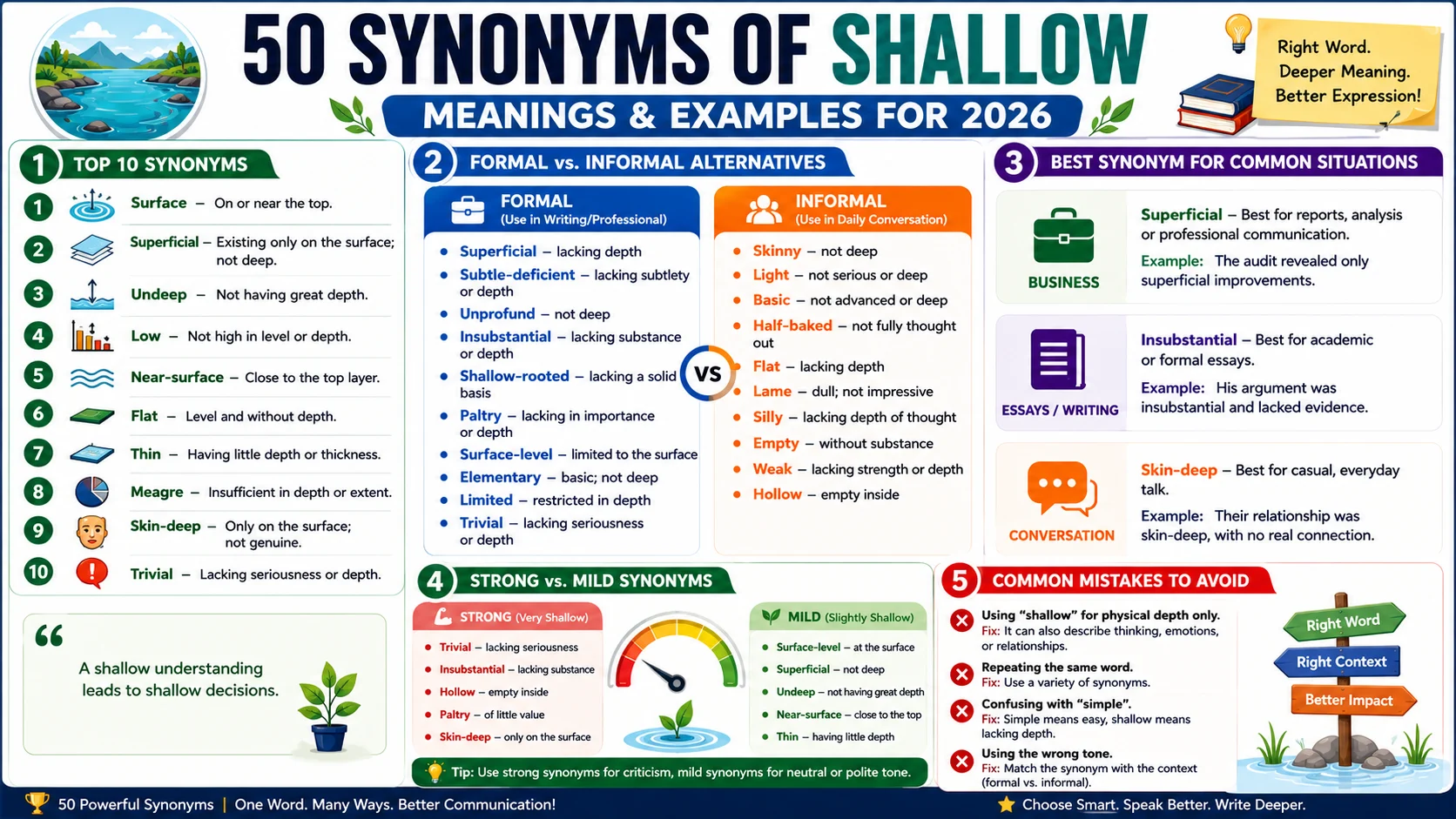
Shallow” means not deep, either physically or in terms of thinking. The best synonyms are superficial, surface-level, skin-deep, trivial, and empty. “Superficial” is the most common alternative. Each synonym has a slightly different meaning and context where it fits best.
Top 10 Synonyms
- Superficial
- Surface-level
- Skin-deep
- Trivial
- Empty
- Vapid
- Frivolous
- Hollow
- Simple
- Limited
Shallow” is a word with two important meanings. It can describe physical depth, like shallow water. But more often, it describes people who lack depth of character or thought. Calling someone shallow means they only care about surface appearances.
Using this word too much can make your English feel repetitive. The good news is there are many alternatives that capture different types of shallowness.
In this guide, you’ll learn 35 powerful synonyms for “shallow.” You’ll discover exactly when to use each one, how formal they are, and what common mistakes to avoid. Let’s begin!
What Does “Shallow” Mean?
Definition
Shallow” means not deep. In physical terms, it describes water or containers with little depth. In personal terms, it describes someone who lacks serious thinking or emotional depth. Shallow people focus on superficial things like appearance, money, or status instead of meaningful values.
Pronunciation
| Feature | Value |
|---|---|
| US IPA | /ˈʃæloʊ/ |
| UK IPA | /ˈʃæləʊ/ |
| Syllables | 2 (shal-low) |
| Tip | Stress the first syllable: “SHAL-oh” |
Grammar
| Grammar Feature | Information |
|---|---|
| Part of Speech | Adjective |
| Common Position | Before a noun or after a linking verb |
| Typical Pattern | Shallow + noun / Subject + be + shallow |
Examples:
- “The water is too shallow to swim.” (physical)
- “She’s so shallow she only cares about looks.” (character)
- “His understanding of the topic is quite shallow.” (knowledge)
Grammar Note: “Shallow” can be used for both physical and non-physical contexts. The meaning changes based on what you’re describing.
Word Family
| Word | Part of Speech | Meaning |
|---|---|---|
| Shallow | Adjective | Not deep |
| Shallowly | Adverb | In a shallow way |
| Shallowness | Noun | The quality of being shallow |
| Shallow-minded | Adjective | Having limited thinking |
15 Synonyms of “Shallow”
Superficial
Meaning: Existing only on the surface; not deep or serious.
Best Used For: People, opinions, knowledge, relationships.
Formality: Formal
Tone: Critical, Analytical
Frequency: ⭐⭐⭐⭐⭐ (Very Common)
CEFR Level: B2
Example Sentence 1: “He has only a superficial understanding of the subject.”
Example Sentence 2: “She’s so superficial she only cares about designer clothes.”
Usage Tip: “Superficial” is the most common synonym for non-physical shallowness. It describes anything that lacks depth or substance.
Common Confusion: Superficial vs Shallow. “Superficial” usually describes lack of substance. “Shallow” can describe physical depth too.
Surface-level
Meaning: Dealing only with the most basic or obvious aspects.
Best Used For: Knowledge, analysis, relationships, discussions.
Formality: Neutral
Tone: Analytical, Critical
Frequency: ⭐⭐⭐⭐ (Common)
CEFR Level: B2
Example Sentence 1: “The analysis was only surface-level and missed important details.”
Example Sentence 2: “They had a surface-level conversation about the weather.”
Usage Tip: “Surface-level” emphasizes that something doesn’t go deeper than the obvious. Use it for knowledge and conversations.
Skin-deep
Meaning: Only on the surface; not having any real depth.
Best Used For: Beauty, appearances, relationships.
Formality: Neutral
Tone: Critical, Honest
Frequency: ⭐⭐⭐ (Moderate)
CEFR Level: B2
Example Sentence 1: “Her beauty is only skin-deep she’s not a nice person.
Example Sentence 2: “Their friendship was skin-deep and didn’t last.”
Usage Tip: “Skin-deep” is often used about appearances. It means something looks good on the surface but isn’t real or meaningful.
Trivial
Meaning: Of little importance or value.
Best Used For: Problems, concerns, details.
Formality: Formal
Tone: Dismissive, Analytical
Frequency: ⭐⭐⭐⭐ (Common)
CEFR Level: B2
Example Sentence 1: “Stop worrying about such trivial matters.”
Example Sentence 2: “The argument was about something completely trivial.
Usage Tip: “Trivial” means something is unimportant or not worth serious attention. Use it for minor concerns.
Empty
Meaning: Lacking meaning, substance, or value.
Best Used For: Promises, words, lives, feelings.
Formality: Neutral
Tone: Sad, Critical
Frequency: ⭐⭐⭐⭐⭐ (Very Common)
CEFR Level: A2
Example Sentence 1: “His promises were empty he never kept them.”
Example Sentence 2: “She felt her life was empty and meaningless.”
Usage Tip: “Empty” suggests a lack of substance or meaning. It’s a strong word for emotional shallowness.
Vapid
Meaning: Offering nothing interesting; dull and lacking depth.
Best Used For: Conversations, people, content.
Formality: Formal
Tone: Critical, Dismissive
Frequency: ⭐⭐ (Rare)
CEFR Level: C1
Example Sentence 1: “The conversation was vapid and boring.”
Example Sentence 2: “She found his comments vapid and uninteresting.”
Usage Tip: “Vapid” is a formal, literary word. Use it when you want to describe something dull and lacking substance.
Frivolous
Meaning: Not having any serious purpose or value.
Best Used For: Behavior, spending, entertainment, concerns.
Formality: Formal
Tone: Dismissive, Critical
Frequency: ⭐⭐⭐ (Moderate)
CEFR Level: C1
Example Sentence 1: “She wasted her money on frivolous purchases.”
Example Sentence 2: “The court dismissed the frivolous lawsuit.”
Usage Tip: “Frivolous” suggests silliness or lack of seriousness. It’s often used about money or behavior.
Hollow
Meaning: Empty inside; lacking real substance.
Best Used For: Promises, victories, feelings, lives.
Formality: Neutral
Tone: Sad, Critical
Frequency: ⭐⭐⭐ (Moderate)
CEFR Level: B2
Example Sentence 1: “His victory felt hollow without his family there.”
Example Sentence 2: “They made hollow promises they never intended to keep.”
Usage Tip: “Hollow” suggests emptiness inside. It’s often used for emotional shallowness or empty victories.
Simple (in this context)
Meaning: Lacking complexity; not deep or sophisticated.
Best Used For: Understanding, explanations, minds.
Formality: Neutral
Tone: Analytical, Neutral
Frequency: ⭐⭐⭐⭐ (Common)
CEFR Level: A2
Example Sentence 1: “His view of the world is too simple.”
Example Sentence 2: “The explanation was overly simple for such a complex topic.”
Usage Tip: “Simple” can be neutral or critical. Use it carefully when describing someone’s thinking as simple.
Limited
Meaning: Not extensive; restricted in scope.
Best Used For: Understanding, knowledge, experience.
Formality: Neutral
Tone: Analytical, Honest
Frequency: ⭐⭐⭐⭐ (Common)
CEFR Level: B1
Example Sentence 1: “She has a limited understanding of the issue.”
Example Sentence 2: “His experience is quite limited.”
Usage Tip: “Limited” is a gentler way to say shallow. It suggests someone just hasn’t had enough exposure or knowledge.
Narrow
Meaning: Limited in range or scope.
Best Used For: Views, opinions, thinking.
Formality: Neutral
Tone: Critical, Analytical
Frequency: ⭐⭐⭐ (Moderate)
CEFR Level: B2
Example Sentence 1: “He has a very narrow view of the world.”
Example Sentence 2: “Her thinking is too narrow to see other possibilities.
Usage Tip: “Narrow” describes someone who only sees things from one perspective. It’s a criticism of limited thinking.
Thoughtless
Meaning: Not thinking about consequences or others’ feelings.
Best Used For: Actions, comments, people.
Formality: Neutral
Tone: Critical, Disappointed
Frequency: ⭐⭐⭐⭐ (Common)
CEFR Level: B1
Example Sentence 1: “His thoughtless comment hurt her feelings.”
Example Sentence 2: “It was a thoughtless thing to say.”
Usage Tip: “Thoughtless” focuses on lack of consideration, not necessarily lack of depth in thinking.
Insignificant
Meaning: Not important or worthwhile.
Best Used For: Details, problems, matters.
Formality: Formal
Tone: Dismissive, Analytical
Frequency: ⭐⭐⭐ (Moderate)
CEFR Level: B2
Example Sentence 1: “Don’t waste time on insignificant details.”
Example Sentence 2: “The problem seemed insignificant at the time.”
Usage Tip: “Insignificant” means unimportant. Use it for things that don’t matter.
Unimportant
Meaning: Not having significance or value.
Best Used For: Matters, details, people.
Formality: Neutral
Tone: Direct, Practical
Frequency: ⭐⭐⭐⭐ (Common)
CEFR Level: B1
Example Sentence 1: “That detail is unimportant to the main issue.”
Example Sentence 2: “She made him feel unimportant.”
Usage Tip: “Unimportant” is a direct, simple word for things that don’t matter.
Shallow-minded
Meaning: Having a narrow, limited way of thinking.
Best Used For: People, opinions, thinking.
Formality: Informal
Tone: Critical, Disappointed
Frequency: ⭐⭐ (Rare)
CEFR Level: C1
Example Sentence 1: “His shallow-minded views offended many people.”
Example Sentence 2: “Don’t be so shallow-minded try to understand their perspective.”
Usage Tip: “Shallow-minded” is a more direct way to describe someone who thinks narrowly. It’s quite critical.
Synonyms Comparison Table
| Synonym | Best Context | Formality | Tone | Frequency |
|---|---|---|---|---|
| Superficial | Lack of depth | Formal | Critical | ⭐⭐⭐⭐⭐ |
| Surface-level | Basic understanding | Neutral | Analytical | ⭐⭐⭐⭐ |
| Skin-deep | Appearances | Neutral | Critical | ⭐⭐⭐ |
| Trivial | Unimportant details | Formal | Dismissive | ⭐⭐⭐⭐ |
| Empty | Lack of meaning | Neutral | Sad | ⭐⭐⭐⭐⭐ |
| Vapid | Dull conversation | Formal | Critical | ⭐⭐ |
| Frivolous | Silliness | Formal | Dismissive | ⭐⭐⭐ |
| Hollow | Empty inside | Neutral | Sad | ⭐⭐⭐ |
| Simple | Lacking complexity | Neutral | Neutral | ⭐⭐⭐⭐ |
| Limited | Restricted scope | Neutral | Honest | ⭐⭐⭐⭐ |
Best Synonyms by Situation
| Situation | Best Synonym | Why It Works |
|---|---|---|
| Daily Conversation | Superficial | Clear and common |
| Business Email | Surface-level | Professional and precise |
| Academic Writing | Superficial | Formal and widely used |
| School Assignment | Limited | Shows honest assessment |
| Professional Meeting | Surface-level | Professional tone |
| Presentation | Superficial | Clear and academic |
| Creative Writing | Hollow / Empty | Adds emotional depth |
| Social Media | Skin-deep | Casual and relatable |
| Literary Review | Vapid | Sophisticated and precise |
Formal vs Informal Synonyms
Formal Alternatives
| Synonym | Best Used For |
|---|---|
| Superficial | Academic, professional contexts |
| Vapid | Literary, sophisticated writing |
| Frivolous | Legal, formal contexts |
| Trivial | Analytical, academic contexts |
Neutral Alternatives
| Synonym | Best Used For |
|---|---|
| Surface-level | Most professional situations |
| Empty | Emotional contexts |
| Limited | Honest assessments |
| Hollow | Emotional, meaningful contexts |
Informal Alternatives
| Synonym | Best Used For |
|---|---|
| Skin-deep | Casual, everyday conversation |
| Shallow-minded | Informal criticism |
| Simple | Describing limited understanding |
Choosing the Right Level: Use “superficial” for formal, academic contexts. Use “surface-level” for professional but not too formal situations. Use “skin-deep” with friends.
Strong vs Mild Synonyms
Mild
Suitable for everyday situations with less intensity.
- Simple
- Limited
- Unimportant
Moderate
More critical or analytical alternatives.
- Superficial
- Surface-level
- Trivial
- Narrow
Strong
High-intensity alternatives suggesting significant shallowness.
- Vapid (intellectually empty)
- Hollow (emotionally empty)
- Frivolous (silly and worthless)
- Empty (completely meaningless)
How Intensity Changes Meaning: “His understanding is limited” is mild. “His understanding is superficial” is more critical. “His understanding is vapid” is very harsh. Choose based on how strongly you want to criticize.
Real-Life Examples
School: “The student’s essay was superficial and lacked original thought.”
Office: “The presentation was only surface-level and didn’t address key issues.”
Business Email: “We need deeper analysis than this superficial review.”
Meetings: “The discussion was too shallow to solve real problems.”
Presentations: “Avoid superficial content in your presentation.”
Daily Conversations: “He’s so shallow he only cares about money.”
Social Media: “Stop with the superficial posts about appearance.”
Academic Writing: “The theory was criticized as superficial and incomplete.”
Common Collocations
| Common Phrase | Better Alternative |
|---|---|
| Shallow person | Superficial person |
| Shallow understanding | Surface-level understanding |
| Shallow water | Not deep |
| Shallow thinking | Superficial thinking |
| Shallow conversation | Vapid conversation |
Common Phrases
Only skin-deep: Not real or meaningful. (e.g., “His charm is only skin-deep.”)
All surface and no depth: Completely shallow. (e.g., “The article is all surface and no depth.”)
In the shallow end: Sticking to simple things. (e.g., “He stays in the shallow end of intellectual discussions.”)
Not much going on upstairs: Not very intelligent (informal). (e.g., “He’s nice, but there’s not much going on upstairs.”)
Empty suit: Someone who looks important but lacks substance. (e.g., “He’s just an empty suit.”)
Context Guide
| Situation | Best Synonym | Reason |
|---|---|---|
| Essay | Superficial | Academic and formal |
| Speech | Superficial | Clear and critical |
| Business Email | Surface-level | Professional and precise |
| Novel | Hollow / Empty | Adds literary depth |
| Presentation | Surface-level | Professional and clear |
| Conversation | Superficial | Natural and relatable |
| Academic Writing | Superficial | Precise and analytical |
| Marketing Copy | Avoid (too negative) | Not appropriate |
Related Words
Near Synonyms
- Cursory: Done quickly and without attention. (e.g., “She gave the report a cursory glance.”)
- Perfunctory: Done without real effort. (e.g., “He made a perfunctory attempt.”)
- Hasty: Done quickly without care. (e.g., “Her hasty conclusion was wrong.”)
- Slight: Small and not important. (e.g., “It was only a slight issue.”)
Antonyms
- Deep: Having great depth.
- Profound: Very deep and meaningful.
- Thoughtful: Showing deep thinking.
- Meaningful: Having real significance.
- Complex: Having many parts and layers.
Related Adjectives
- Deep: Having significant depth.
- Profound: Intellectually deep.
- Thoughtful: Showing careful consideration.
- Substantial: Having real substance.
- Meaningful: Having importance and depth.
Related Nouns
- Shallowness: The quality of being shallow.
- Superficiality: Lack of depth.
- Depth: The quality of being deep.
- Substance: Real meaning and value.
- Profundity: Deep insight or meaning.
Related Verbs
- Shallow: To make less deep (rare).
- Superficialize: To make superficial (rare).
Frequently Asked Questions
What is another word for shallow?
Common synonyms include superficial, surface-level, skin-deep, trivial, and empty. “Superficial” is the most common and versatile alternative.
Which synonym sounds the most professional?
Superficial and surface-level sound the most professional. “Superficial” is widely used in academic and professional contexts.
What is the strongest synonym for shallow?
Vapid is one of the strongest synonyms. It suggests something is completely empty and dull. “Hollow” is also very strong for emotional emptiness.
Which synonym is best for essays?
Superficial is the best choice for academic essays. It’s formal, precise, and widely used in academic writing.
What’s the difference between shallow and superficial?
“Shallow” can describe physical depth (shallow water) and character. “Superficial” is almost always used for non-physical shallowness lack of depth in thinking, character, or knowledge.
Which synonym is most common in everyday English?
“Superficial” and “empty” are very common. “Skin-deep” is also frequently used in casual conversation.
What is the opposite of shallow?
Common opposites are deep, profound, thoughtful, and meaningful. These words describe things with real depth and substance.
Conclusion
“Shallow” is a useful word, but now you have 35 fantastic alternatives. Each synonym adds a different shade of meaning to your language.
Remember, the key is understanding the context. Use “superficial” for formal situations. Use “skin-deep” when talking about appearances. Use “hollow” and “empty” for emotional shallowness. Use “vapid” for literary contexts.
The best way to improve is practice. Try using one or two new synonyms each day. Listen for these words in conversations and books. Your vocabulary will become richer and more expressive with time.
