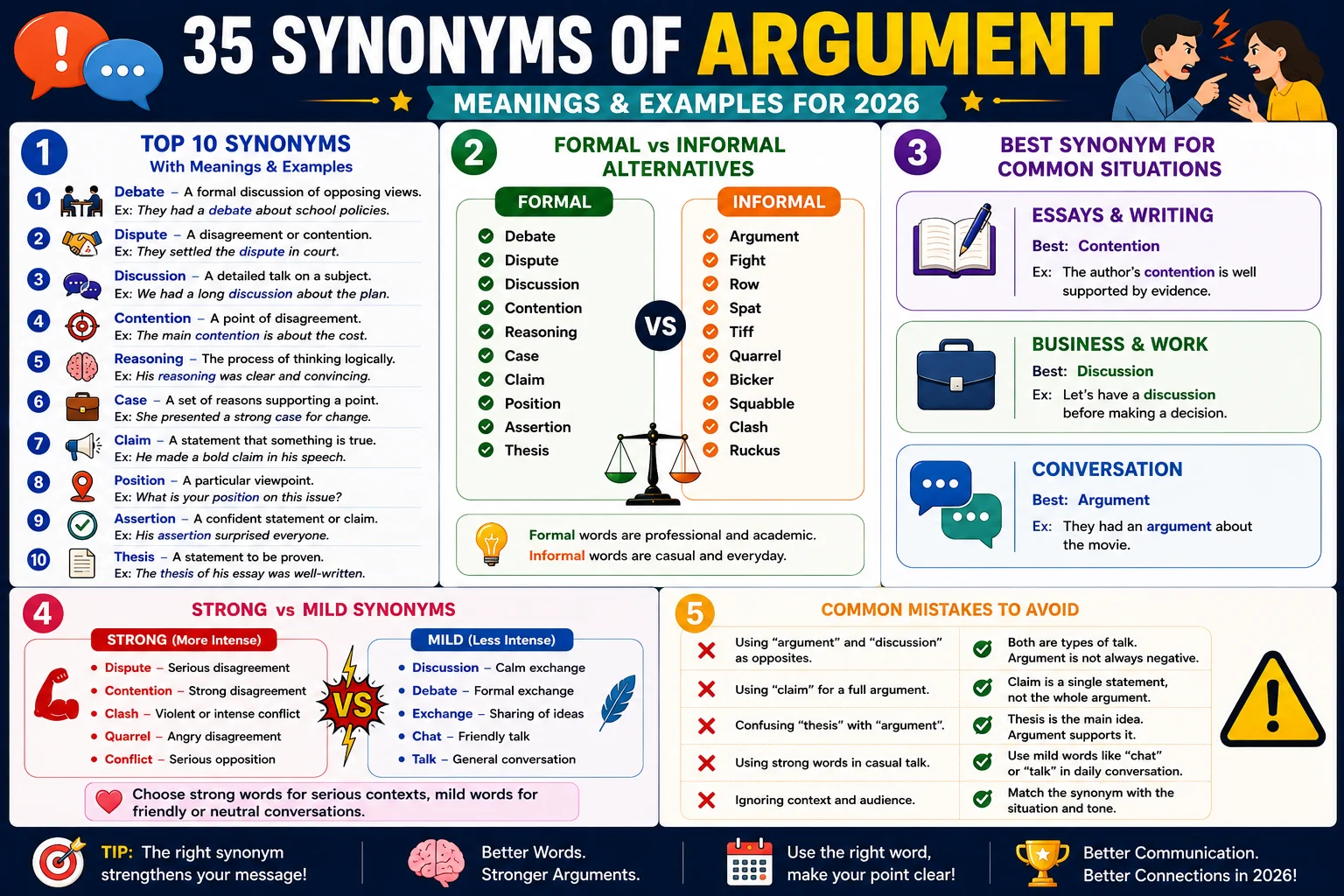
“Argument” means a disagreement between people or a reason given to support an idea. The best synonyms are disagreement, debate, dispute, quarrel, and reasoning. “Disagreement” is the most common neutral alternative. Each synonym has a slightly different meaning and context.
Top 10 Synonyms
- Disagreement
- Debate
- Dispute
- Quarrel
- Reasoning
- Discussion
- Controversy
- Conflict
- Exchange
- Altercation
“Argument” is a word we use all the time. Sometimes it’s a heated fight with someone. Sometimes it’s the logical reasons you give to support an opinion. These two meanings are very different, and English has wonderful words for both.
Think about it. You might have an argument with your friend about where to eat. Or you might present an argument in an essay about climate change. Each situation deserves a different word.
In this guide, you’ll learn 35 powerful synonyms for “argument.” You’ll discover exactly when to use each one, how formal they are, and what common mistakes to avoid. Let’s get started!
What Does “Argument” Mean?
Definition
Argument” has two main meanings. First, it means a disagreement or fight between people. Second, it means a reason or set of reasons used to support an idea. When people argue, they either disagree strongly or present their reasons for something.
Pronunciation
| Feature | Value |
|---|---|
| US IPA | /ˈɑːrɡjəmənt/ |
| UK IPA | /ˈɑːɡjəmənt/ |
| Syllables | 3 (ar-gu-ment) |
| Tip | Stress the first syllable: “AR-gyuh-ment” |
Grammar
| Grammar Feature | Information |
|---|---|
| Part of Speech | Noun |
| Common Position | Subject or object |
| Typical Pattern | Argument + about/between/with |
Examples:
- “They had an argument about money.” (disagreement)
- “His argument was well-reasoned.” (logical reasoning)
- “There was an argument between the two neighbors.” (disagreement)
Grammar Note: “Argument” can be countable. You can have one argument or several arguments. It works for both disagreements and logical reasons.
Word Family
| Word | Part of Speech | Meaning |
|---|---|---|
| Argue | Verb | To disagree or give reasons |
| Argument | Noun | A disagreement or reason |
| Arguable | Adjective | Open to debate |
| Arguably | Adverb | Possibly true |
| Argumentative | Adjective | Tending to argue |
15 Synonyms of “Argument”
Disagreement
Meaning: A situation where people have different opinions or cannot agree.
Best Used For: Everyday disagreements, differences of opinion.
Formality: Neutral
Tone: Neutral, Factual
Frequency: ⭐⭐⭐⭐⭐ (Very Common)
CEFR Level: B1
Example Sentence 1: “They had a minor disagreement about which movie to watch.”
Example Sentence 2: “There’s a disagreement between the two departments.”
Usage Tip: “Disagreement” is the most neutral and common alternative. Use it when you want to describe a difference of opinion without sounding dramatic.
Common Confusion: Argument vs Disagreement. “Argument” often implies stronger emotion. “Disagreement” can be calm and civil.
Debate
Meaning: A formal discussion where people present opposing viewpoints.
Best Used For: Politics, academic topics, formal discussions.
Formality: Formal
Tone: Intellectual, Structured
Frequency: ⭐⭐⭐⭐ (Common)
CEFR Level: B2
Example Sentence 1: “The presidential debate was watched by millions.”
Example Sentence 2: “We had a lively debate about the best approach.”
Usage Tip: “Debate” is formal and structured. Use it for political, academic, or public discussions where both sides are presented.
Dispute
Meaning: A serious disagreement, often involving strong feelings.
Best Used For: Legal matters, business disagreements, serious conflicts.
Formality: Formal
Tone: Serious, Confrontational
Frequency: ⭐⭐⭐⭐ (Common)
CEFR Level: B2
Example Sentence 1: “The labor dispute lasted for three months.”
Example Sentence 2: “They’re in a dispute over the property boundary.”
Usage Tip: “Dispute” suggests a serious disagreement, often involving legal or official matters.
Quarrel
Meaning: An angry argument or disagreement, usually between people close to each other.
Best Used For: Personal relationships, family, friends.
Formality: Informal
Tone: Emotional, Personal
Frequency: ⭐⭐⭐ (Moderate)
CEFR Level: B1
Example Sentence 1: “They had a quarrel about money last night.”
Example Sentence 2: “The couple’s quarrels were becoming more frequent.”
Usage Tip: “Quarrel” is personal and emotional. Use it for arguments between people who know each other well.
Reasoning
Meaning: The process of thinking logically to support a conclusion.
Best Used For: Academic writing, logic, explanations.
Formality: Formal
Tone: Logical, Analytical
Frequency: ⭐⭐⭐ (Moderate)
CEFR Level: B2
Example Sentence 1: “His reasoning for the decision was clear.
Example Sentence 2: “I don’t understand the reasoning behind that rule.”
Usage Tip: “Reasoning” is about logic, not emotion. Use it when you’re talking about the thought process behind an idea.
Discussion
Meaning: A conversation about something, often with different viewpoints.
Best Used For: Meetings, classroom, everyday conversations.
Formality: Neutral
Tone: Calm, Open
Frequency: ⭐⭐⭐⭐⭐ (Very Common)
CEFR Level: A2
Example Sentence 1: “We had a productive discussion about the project.”
Example Sentence 2: “The discussion lasted for over an hour.”
Usage Tip: “Discussion” is calmer than “argument.” Use it when people are talking without fighting.
Controversy
Meaning: A disagreement that involves many people and gets public attention.
Best Used For: Public issues, politics, media topics.
Formality: Formal
Tone: Public, Heated
Frequency: ⭐⭐⭐⭐ (Common)
CEFR Level: B2
Example Sentence 1: “The new policy caused great controversy.
Example Sentence 2: “She’s at the center of a public controversy.”
Usage Tip: “Controversy” is for public disagreements that attract attention. It’s about issues, not just personal fights.
Conflict
Meaning: A serious disagreement or struggle between people or groups.
Best Used For: War, serious disputes, interpersonal problems.
Formality: Neutral
Tone: Serious, Confrontational
Frequency: ⭐⭐⭐⭐⭐ (Very Common)
CEFR Level: B1
Example Sentence 1: “The conflict between the two countries lasted years.”
Example Sentence 2: “They’re in conflict over the new policy.”
Usage Tip: “Conflict” suggests serious disagreement, often at a larger scale than just two individuals.
Exchange
Meaning: A short argument or discussion, often heated.
Best Used For: Brief disagreements, verbal exchanges.
Formality: Neutral
Tone: Sharp, Quick
Frequency: ⭐⭐⭐ (Moderate)
CEFR Level: B2
Example Sentence 1: “There was a heated exchange between the two politicians.”
Example Sentence 2: “They had a sharp exchange of words.”
Usage Tip: “Exchange” often describes a brief, sharp argument. It’s a quick back-and-forth.
Altercation
Meaning: A noisy argument or fight, often physical.
Best Used For: Physical fights, loud arguments.
Formality: Formal
Tone: Aggressive, Physical
Frequency: ⭐⭐ (Rare)
CEFR Level: C1
Example Sentence 1: “The police were called to a noisy altercation.”
Example Sentence 2: “He was involved in a minor altercation.”
Usage Tip: “Altercation” is a formal word for a physical or very loud argument. It suggests more than just words.
Spat
Meaning: A short, unimportant argument.
Best Used For: Minor disagreements, trivial fights.
Formality: Informal
Tone: Trivial, Light
Frequency: ⭐⭐⭐ (Moderate)
CEFR Level: B2
Example Sentence 1: “They had a little spat over dinner plans.”
Example Sentence 2: “It was just a spat, nothing serious.”
Usage Tip: “Spat” is a casual word for a small, unimportant argument. Use it for minor disagreements.
Tiff
Meaning: A small, silly argument.
Best Used For: Minor disagreements, often between couples.
Formality: Informal
Tone: Playful, Minor
Frequency: ⭐⭐ (Rare)
CEFR Level: C1
Example Sentence 1: “They had a tiff about who left the dishes out.”
Example Sentence 2: “It was just a tiff; they’re friends again.”
Usage Tip: “Tiff” is similar to “spat” but even lighter. It’s a minor, temporary argument.
Feud
Meaning: A long, bitter argument between families or groups.
Best Used For: Family conflicts, long-term disputes.
Formality: Neutral
Tone: Bitter, Long-lasting
Frequency: ⭐⭐⭐ (Moderate)
CEFR Level: B2
Example Sentence 1: “The two families have been in a feud for generations.”
Example Sentence 2: “Their feud has lasted for decades.”
Usage Tip: “Feud” suggests a long, bitter conflict. It’s often between families or groups.
Contention
Meaning: A point in an argument, or the act of arguing.
Best Used For: Formal writing, debates, legal contexts.
Formality: Very Formal
Tone: Intellectual, Argumentative
Frequency: ⭐⭐ (Rare)
CEFR Level: C1
Example Sentence 1: “His main contention is that the policy is flawed.”
Example Sentence 2: “The issue is a matter of contention.”
Usage Tip: “Contention” is very formal. Use it in academic or legal writing.
Skirmish
Meaning: A small, brief argument or fight.
Best Used For: Minor conflicts, small arguments.
Formality: Neutral
Tone: Brief, Minor
Frequency: ⭐⭐ (Rare)
CEFR Level: C1
Example Sentence 1: “There was a brief skirmish outside the meeting room.”
Example Sentence 2: “The skirmish was quickly resolved.
Usage Tip: “Skirmish” suggests a short, minor fight or argument. It’s often used for physical fights.
Synonyms Comparison Table
| Synonym | Best Context | Formality | Tone | Frequency |
|---|---|---|---|---|
| Disagreement | General differences | Neutral | Neutral | ⭐⭐⭐⭐⭐ |
| Discussion | Calm conversations | Neutral | Calm | ⭐⭐⭐⭐⭐ |
| Conflict | Serious disputes | Neutral | Serious | ⭐⭐⭐⭐⭐ |
| Debate | Formal discussions | Formal | Intellectual | ⭐⭐⭐⭐ |
| Dispute | Legal, business | Formal | Serious | ⭐⭐⭐⭐ |
| Quarrel | Personal relationships | Informal | Emotional | ⭐⭐⭐ |
| Controversy | Public issues | Formal | Heated | ⭐⭐⭐⭐ |
| Exchange | Brief arguments | Neutral | Sharp | ⭐⭐⭐ |
| Spat | Minor arguments | Informal | Light | ⭐⭐⭐ |
| Feud | Long-term conflicts | Neutral | Bitter | ⭐⭐⭐ |
Best Synonyms by Situation
| Situation | Best Synonym | Why It Works |
|---|---|---|
| Daily Conversation | Disagreement | Natural and neutral |
| Business Email | Discussion | Professional and calm |
| Academic Writing | Reasoning | Formal and logical |
| School Assignment | Debate | Shows formal debate skills |
| Professional Meeting | Discussion | Positive and collaborative |
| Presentation | Reasoning | Clear and convincing |
| Creative Writing | Quarrel | Adds drama and emotion |
| Social Media | Spat | Casual and relatable |
| Legal Context | Dispute | Formal and appropriate |
Formal vs Informal Synonyms
Formal Alternatives
| Synonym | Best Used For |
|---|---|
| Debate | Formal discussions, politics |
| Dispute | Legal, business conflicts |
| Contention | Academic arguments |
| Controversy | Public disagreements |
| Reasoning | Logical arguments |
Neutral Alternatives
| Synonym | Best Used For |
|---|---|
| Disagreement | General differences |
| Discussion | Calm conversations |
| Conflict | Serious disagreements |
| Exchange | Brief arguments |
Informal Alternatives
| Synonym | Best Used For |
|---|---|
| Quarrel | Personal fights |
| Spat | Minor arguments |
| Tiff | Silly disagreements |
| Row | Loud argument (UK) |
Choosing the Right Level: In academic writing, use “debate” or “reasoning.” In business, use “discussion” or “dispute.” With friends, use “quarrel” or “spat.”
Strong vs Mild Synonyms
Mild
Suitable for calm, minor disagreements.
- Disagreement
- Discussion
- Spat
- Tiff
Moderate
More serious but not extreme.
- Debate
- Conflict
- Quarrel
- Exchange
Strong
High-intensity alternatives suggesting serious conflict.
- Dispute (formal, serious)
- Feud (long-term)
- Altercation (physical)
- Controversy (public)
How Intensity Changes Meaning: “We had a disagreement” is calm. “We had a dispute” sounds more serious. “We had an altercation” suggests something physical. Choose based on how serious the argument is.
Real-Life Examples
School: “The students had a disagreement about the homework.”
Office: “We need to resolve this dispute before it escalates.”
Business Email: “Let’s have a discussion about the new policy.”
Meetings: “The debate about the budget lasted for hours.”
Presentations: “His reasoning for the new strategy was compelling.”
Daily Conversations: “We had a silly spat about what to eat.”
Social Media: “The controversy online grew very quickly.”
Academic Writing: “The author’s main contention is well-supported.”
Common Collocations
| Common Phrase | Better Alternative |
|---|---|
| Have an argument | Have a disagreement |
| Get into an argument | Get into a dispute |
| Win an argument | Win a debate |
| Start an argument | Start a conflict |
| Heated argument | Heated exchange |
| Point of argument | Point of contention |
Common Phrases
Matter of opinion: Something open to disagreement. (e.g., “That’s a matter of opinion.”)
Playing devil’s advocate: Arguing for the opposite side. (e.g., “She was just playing devil’s advocate.”)
A bone of contention: A point of disagreement. (e.g., “Money was a bone of contention.”)
Have words with: To argue with someone. (e.g., “I need to have words with him.”)
Go at it: To argue fiercely. (e.g., “They were really going at it.”)
Context Guide
| Situation | Best Synonym | Reason |
|---|---|---|
| Essay | Reasoning / Contention | Formal and academic |
| Speech | Debate | Clear and structured |
| Business Email | Discussion | Professional and calm |
| Novel | Quarrel / Feud | Adds drama and emotion |
| Presentation | Reasoning | Logical and convincing |
| Conversation | Disagreement | Natural and neutral |
| Academic Writing | Contention | Precise and formal |
| Marketing Copy | Discussion | Positive and engaging |
Related Words
Near Synonyms
- Clash: A violent argument. (e.g., “There was a clash between protesters.”)
- Row: A loud argument (UK). (e.g., “They had a terrible row.”)
- Set-to: A brief argument. (e.g., “They had a set-to about the bill.”)
- Run-in: A brief argument. (e.g., “I had a run-in with my neighbor.”)
Antonyms
- Agreement: When people agree.
- Consensus: General agreement.
- Harmony: Peaceful relationship.
- Accord: An agreement.
- Reconciliation: Restoring friendly relations.
Related Adjectives
- Argumentative: Tending to argue.
- Contentious: Causing disagreement.
- Controversial: Causing strong disagreement.
- Debatable: Open to argument.
- Polemical: Strongly critical.
Related Nouns
- Argue: To disagree.
- Argumentation: The act of arguing.
- Debate: Formal argument.
- Dispute: Serious disagreement.
Related Verbs
- Argue: To disagree.
- Disagree: To have different opinions.
- Debate: To discuss formally.
- Quarrel: To argue angrily.
- Dispute: To argue about something.
Frequently Asked Questions
What is another word for argument?
Common synonyms include disagreement, debate, dispute, quarrel, and discussion. The best choice depends on whether you mean a fight or logical reasoning.
Which synonym sounds the most professional?
Debate and dispute sound very professional. “Discussion” is also excellent for business contexts.
What is the strongest synonym for argument?
Dispute and feud are among the strongest. “Feud” suggests a long-term bitter conflict. “Altercation” suggests a physical fight.
Which synonym is best for essays?
Reasoning and contention are excellent for academic essays. “Debate” is also strong for argumentative essays.
What’s the difference between argument and disagreement?
“Argument” often implies stronger emotion and conflict. “Disagreement” can be calm and civil.
Which synonym is most common in everyday English?
“Disagreement” and “discussion” are very common in everyday speech. “Quarrel” is also frequently used.
What is the opposite of argument?
Common opposites are agreement, consensus, and harmony. These words describe situations where people are in agreement.
Conclusion
Argument” is a versatile word, but now you have 35 powerful alternatives. Each synonym adds a different shade of meaning to your language.
Remember, the key is understanding the context. Use “disagreement” for calm differences. Use “debate” for formal discussions. Use “quarrel” for personal fights. Use “reasoning” for logical explanations. Use “discussion” for positive conversations.
The best way to improve is practice. Try using one or two new synonyms each day. Listen for these words in conversations, books, and movies. Your vocabulary will become richer and more impressive with time.
