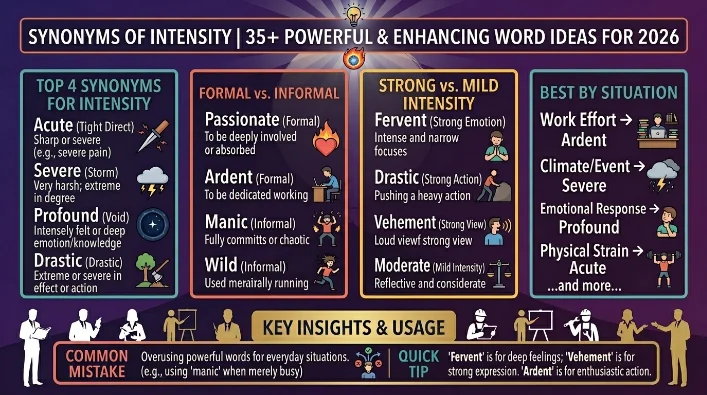
Intensity means having great strength, force, or concentration. The best synonyms include passion, fervor, vigor, vehemence, fury, earnestness, ardor, enthusiasm, and determination. The most common everyday synonym is passion, while fervor works well for emotional intensity. Each synonym carries a slightly different tone and fits different situations.
Top 10 Synonyms
- Passion
- Fervor
- Vigor
- Vehemence
- Fury
- Earnestness
- Ardor
- Enthusiasm
- Determination
- Strength
Every synonym has a slightly different meaning, tone, or context, so choose carefully based on your situation.
Do you find yourself always using the word “intensity” to describe strong emotions, effort, or energy? You’re missing a chance to sound more natural and expressive in English.
Learning synonyms for “intensity” helps you describe feelings and actions with greater precision. Whether you’re writing about emotions, describing someone’s work ethic, or talking about a powerful experience, having the right word makes your message clearer.
In this guide, you’ll discover 35 powerful alternatives to “intensity.” You’ll learn their meanings, when to use them, and which ones native speakers prefer in different situations. Let’s dive in!
What Does “Intensity” Mean?
Definition
Intensity refers to the quality of being strong, forceful, or concentrated. It describes how much power, energy, or emotion something has.
Think of it like a dimmer switch on a light. When the intensity is low, the light is soft and gentle. When the intensity is high, the light is bright and powerful. The same idea applies to emotions, effort, sounds, and colors.
Intensity can describe:
- Strong emotions (“She spoke with great intensity”)
- Physical force (“The storm’s intensity increased”)
- Concentration of effort (“He worked with intense focus”)
- Color or light (“The sunset’s intensity was stunning”)
Pronunciation
| Feature | Value |
|---|---|
| US IPA | /ɪnˈtɛn.sə.ti/ |
| UK IPA | /ɪnˈten.sə.ti/ |
| Syllables | 4 (in-ten-si-ty) |
| Tip | Stress the second syllable: in-TEN-si-ty |
Grammar
| Grammar Feature | Information |
|---|---|
| Part of Speech | Noun |
| Common Position | Subject or object of a sentence |
| Typical Pattern | intensity + of + noun |
| Plural | Intensities |
Example Sentences:
- “The intensity of her stare made me nervous.”
- “He was surprised by the intensity of his feelings.”
- “The workout’s intensity increased as the session went on.”
Word Family
| Word | Part of Speech | Meaning |
|---|---|---|
| Intense | Adjective | Very strong or powerful |
| Intensely | Adverb | In a very strong or extreme way |
| Intensify | Verb | To make or become stronger |
| Intensification | Noun | The act of becoming more intense |
| Intensity | Noun | The quality of being strong or concentrated |
| Intenser | Adjective (comparative) | More intense |
| Intensest | Adjective (superlative) | Most intense |
35 Synonyms of “Intensity”
1. Passion
Meaning: Very strong emotion or enthusiasm for something or someone.
Best Used For: Describing love, hobbies, work, or any strong emotional connection.
Formality: Neutral
Tone: Emotional, Positive
Frequency: ⭐⭐⭐⭐⭐ Very Common
CEFR Level: B1
Example Sentence 1: “She spoke with such passion about her art that everyone listened.”
Example Sentence 2: “His passion for teaching inspired his students.”
Usage Tip: “Passion” suggests deep emotional connection. Use it for love, interests, or work you truly care about. It’s one of the most natural alternatives for everyday use.
2. Fervor
Meaning: Strong, sincere feeling or enthusiasm, often about a cause or belief.
Best Used For: Political speeches, religious contexts, describing strong beliefs.
Formality: Neutral to Formal
Tone: Emotional, Committed
Frequency: ⭐⭐⭐ Moderate
CEFR Level: B2
Example Sentence 1: “The crowd cheered with patriotic fervor.”
Example Sentence 2: “She argued her point with remarkable fervor.”
Usage Tip: “Fervor” suggests sincere, burning enthusiasm. It’s slightly more formal than “passion” and often relates to causes or beliefs.
3. Vigor
Meaning: Physical or mental strength, energy, and enthusiasm.
Best Used For: Describing health, work ethic, or someone’s energetic approach.
Formality: Neutral to Formal
Tone: Energetic, Positive
Frequency: ⭐⭐⭐⭐ Common
CEFR Level: B2
Example Sentence 2: “She tackled the project with youthful vigor.”
Usage Tip: “Vigor” emphasizes energy and strength. It’s great for describing physical activity, determination, or someone’s lively spirit.
4. Vehemence
Meaning: Showing strong, forceful emotion or opinion.
Best Used For: Arguments, debates, when someone feels strongly about something.
Formality: Formal
Tone: Forceful, Strong
Frequency: ⭐⭐⭐ Moderate
CEFR Level: C1
Example Sentence 1: “She argued with such vehemence that no one dared to disagree.”
Example Sentence 2: “He denied the accusation with great vehemence.
Usage Tip: “Vehemence” is quite formal and often used in writing or speeches. It suggests strong emotions, especially anger or opposition.
5. Fury
Meaning: Extreme, violent anger or wild force.
Best Used For: Describing anger, storms, or anything destructive.
Formality: Neutral
Tone: Negative, Intense
Frequency: ⭐⭐⭐⭐ Common
CEFR Level: B1
Example Sentence 1: “She trembled with fury at his unfair words.”
Example Sentence 2: “The hurricane struck with full fury.”
Usage Tip: “Fury” describes extreme anger or power. Use it for strong negative emotions or powerful natural forces.
6. Earnestness
Meaning: Sincere and serious intention or feeling.
Best Used For: Describing genuine efforts, promises, or requests.
Formality: Neutral to Formal
Tone: Sincere, Serious
Frequency: ⭐⭐⭐ Moderate
CEFR Level: B2
Example Sentence 1: “He spoke with such earnestness that everyone believed him.”
Example Sentence 2: “Her earnestness about the project impressed the manager.
Usage Tip: “Earnestness” suggests genuine sincerity without exaggeration. It’s a positive word that indicates someone is trustworthy and serious.
7. Ardor
Meaning: Great passion, enthusiasm, or devotion.
Best Used For: Romantic situations, describing love, or deep commitment.
Formality: Formal
Tone: Romantic, Committed
Frequency: ⭐⭐ Rare
CEFR Level: C1
Example Sentence 1: “He pursued her with the ardor of a true romantic.”
Example Sentence 2: “Her ardor for environmental causes never faded.”
Usage Tip: “Ardor” is a formal, somewhat old-fashioned word. It’s often used in literature to describe love or deep passion.
8. Enthusiasm
Meaning: Lively interest and excitement about something.
Best Used For: Daily conversation, work, hobbies, any positive interest.
Formality: Neutral
Tone: Positive, Cheerful
Frequency: ⭐⭐⭐⭐⭐ Very Common
CEFR Level: A2
Example Sentence 1: “She showed great enthusiasm for the new project.”
Example Sentence 2: “The kids sang with infectious enthusiasm.”
Usage Tip: This is the most common everyday synonym for positive intensity. It suggests excitement and joy, not serious or angry emotion.
9. Determination
Meaning: Having a strong purpose and not giving up.
Best Used For: Resumes, describing ambitious people, overcoming challenges.
Formality: Neutral
Tone: Strong, Admirable
Frequency: ⭐⭐⭐⭐⭐ Very Common
CEFR Level: B1
Example Sentence 1: “Her determination to succeed inspired everyone around her.”
Example Sentence 2: “He showed incredible determination despite the obstacles.”
Usage Tip: “Determination” focuses on persistence and willpower. It’s perfect for resumes and describing people who don’t give up.
10. Strength
Meaning: The quality of being strong physically, mentally, or emotionally.
Best Used For: Describing people, materials, arguments, or beliefs.
Formality: Neutral
Tone: Strong, Positive
Frequency: ⭐⭐⭐⭐⭐ Very Common
CEFR Level: A2
Example Sentence 1: “She found the strength to overcome her fears.”
Example Sentence 2: “The strength of his argument convinced the committee.”
Usage Tip: “Strength” is a versatile word. It can describe physical power, mental resilience, or the force of an argument.
11. Force
Meaning: Power or strength, often causing movement or change.
Best Used For: Physics, describing powerful effects, or compelling arguments.
Formality: Neutral
Tone: Strong, Objective
Frequency: ⭐⭐⭐⭐⭐ Very Common
CEFR Level: A2
Example Sentence 1: “The force of the explosion shattered the windows.”
Example Sentence 2: “She spoke with such force that everyone listened.”
Usage Tip: “Force” often implies physical or compelling power. It can suggest pressure or influence in arguments.
12. Power
Meaning: Ability to do something or act effectively.
Best Used For: Describing influence, energy, or capability.
Formality: Neutral
Tone: Strong, Authoritative
Frequency: ⭐⭐⭐⭐⭐ Very Common
CEFR Level: A2
Example Sentence 1: “The power of her speech moved the audience.”
Example Sentence 2: “He channeled his power into helping others.”
Usage Tip: “Power” is broader than “intensity.” It describes ability, control, or strength in many forms.
13. Energy
Meaning: The capacity to be active or the power behind action.
Best Used For: Describing lively people, workouts, or enthusiasm.
Formality: Neutral
Tone: Lively, Positive
Frequency: ⭐⭐⭐⭐⭐ Very Common
CEFR Level: A2
Example Sentence 1: “The children played with boundless energy.
Example Sentence 2: “She brought fresh energy to the team.”
Usage Tip: “Energy” often describes active enthusiasm. It’s different from “intensity” but connected to strength of effort.
14. Fierceness
Meaning: The quality of being violent, forceful, or extremely strong.
Best Used For: Describing animals, competition, or strong emotions.
Formality: Neutral
Tone: Intense, Sometimes Negative
Frequency: ⭐⭐⭐ Moderate
CEFR Level: B2
Example Sentence 1: “The fierceness of the competition surprised everyone.”
Example Sentence 2: “She argued with fierceness and conviction.”
Usage Tip: “Fierceness” suggests aggression or strength that can be intimidating. Use it carefully, as it can sound negative.
15. Severity
Meaning: The quality of being very harsh, serious, or strong.
Best Used For: Describing punishment, illness, or weather.
Formality: Formal
Tone: Serious, Negative
Frequency: ⭐⭐⭐⭐ Common
CEFR Level: B2
Example Sentence 1: “The severity of the storm forced everyone to stay inside.”
Example Sentence 2: “He didn’t understand the severity of his mistake.”
Usage Tip: “Severity” often implies seriousness that causes concern. It’s not usually positive.
16. Depth
Meaning: The quality of being deep, thorough, or strong.
Best Used For: Describing feelings, knowledge, or thinking.
Formality: Neutral
Tone: Profound, Serious
Frequency: ⭐⭐⭐⭐ Common
CEFR Level: B1
Example Sentence 1: “The depth of her love for her children was clear.”
Example Sentence 2: “His understanding showed great depth and wisdom.”
Usage Tip: “Depth” suggests something is not just strong but also complex and meaningful.
17. Profundity
meaning: Great depth of feeling, thinking, or meaning.
Best Used For: Philosophical discussions, deep emotions, serious writing.
Formality: Formal
Tone: Profound, Intellectual
Frequency: ⭐⭐ Rare
CEFR Level: C1
Example Sentence 1: “The profundity of his words stayed with her for years.”
Example Sentence 2: “Her music has a profundity that touches the soul.
Usage Tip: This is a formal, sophisticated word. Use it to describe very deep, meaningful emotions or ideas.
18. Fullness
Meaning: The quality of being rich, complete, and strong.
Best Used For: Describing flavors, sounds, or emotions.
Formality: Neutral
Tone: Rich, Complete
Frequency: ⭐⭐⭐ Moderate
CEFR Level: B1
Example Sentence 1: “She lived life with fullness and joy.”
Example Sentence 2: “The wine’s fullness made it unforgettable.”
Usage Tip: “Fullness” suggests being complete and satisfying. It’s often used for sensory experiences.
19. Richness
Meaning: The quality of being deep, varied, and satisfying.
Best Used For: Describing colors, flavors, emotions, or experiences.
Formality: Neutral
Tone: Positive, Luxurious
Frequency: ⭐⭐⭐⭐ Common
CEFR Level: B1
Example Sentence 1: “The richness of her voice captivated the audience.”
Example Sentence 2: “His life had a richness that inspired others.”
Usage Tip: “Richness” suggests variety and depth. It’s usually positive and describes satisfying experiences.
20. Volume
Meaning: The amount of sound or physical substance.
Best Used For: Describing sound, quantity, or physical presence.
Formality: Neutral
Tone: Objective, Practical
Frequency: ⭐⭐⭐⭐ Common
CEFR Level: A2
Example Sentence 1: “The volume of the music was overwhelming.”
Example Sentence 2: “The volume of work required intense effort.”
Usage Tip: “Volume” works best for sound or quantity. It’s connected to intensity but more specific.
21. Magnitude
Meaning: Great size, extent, or importance.
Best Used For: Earthquakes, problems, accomplishments.
Formality: Formal
Tone: Serious, Impressive
Frequency: ⭐⭐⭐⭐ Common
CEFR Level: B2
Example Sentence 1: “The magnitude of the problem became clear.”
Example Sentence 2: “Everyone understood the magnitude of her achievement.”
Usage Tip: “Magnitude” suggests something is not just strong but also large in scale or importance.
22. Gravity
Meaning: Seriousness and importance.
Best Used For: Describing serious situations, decisions, or consequences.
Formality: Formal
Tone: Serious, Important
Frequency: ⭐⭐⭐⭐ Common
CEFR Level: B2
Example Sentence 1: “He understood the gravity of the situation.”
Example Sentence 2: “She spoke with gravity and conviction.”
Usage Tip: “Gravity” implies moral seriousness. Use it for important decisions or serious consequences.
23. Weight
Meaning: The quality of being important or serious.
Best Used For: Arguments, decisions, emotional matters.
Formality: Neutral
Tone: Serious, Important
Frequency: ⭐⭐⭐⭐ Common
CEFR Level: B1
Example Sentence 1: “His words carried great weight in the meeting.”
Example Sentence 2: “The weight of her responsibilities exhausted her.”
Usage Tip: “Weight” suggests importance or seriousness that is felt emotionally.
24. Excitement
Meaning: A feeling of great enthusiasm and eagerness.
Best Used For: Positive experiences, happy events, anticipation.
Formality: Neutral
Tone: Happy, Enthusiastic
Frequency: ⭐⭐⭐⭐⭐ Very Common
CEFR Level: A2
Example Sentence 1: “The children’s excitement was contagious.”
Example Sentence 2: “She felt a thrill of excitement before her speech.”
Usage Tip: “Excitement” is always positive. It describes happy anticipation or energetic enthusiasm.
25. Zeal
Meaning: Great enthusiasm and energy for a cause or goal.
Best Used For: Describing activists, reformers, or anyone passionate about a cause.
Formality: Neutral to Formal
Tone: Passionate, Committed
Frequency: ⭐⭐⭐ Moderate
CEFR Level: B2
Example Sentence 1: “He campaigned with religious zeal.”
Example Sentence 2: “Her zeal for justice inspired the community.
Usage Tip: “Zeal” suggests energetic commitment, often to a cause or belief.
26. Eagerness
Meaning: Showing strong interest and excitement about something.
Best Used For: Learning, new opportunities, shows of enthusiasm.
Formality: Neutral
Tone: Positive, Enthusiastic
Frequency: ⭐⭐⭐⭐ Common
CEFR Level: B1
Example Sentence 1: “The students showed eagerness to learn.”
Example Sentence 2: “She accepted the challenge with eagerness.”
Usage Tip: “Eagerness” suggests strong interest and willingness. It’s more about readiness than force.
27. Animation
Meaning: Liveliness and energy in expression or movement.
Best Used For: Describing performances, speeches, or personality.
Formality: Neutral
Tone: Lively, Engaging
Frequency: ⭐⭐⭐ Moderate
CEFR Level: B2
Example Sentence 1: “She spoke with animation that held the audience’s attention.”
Example Sentence 2: “His face lit up with animation at the memory.”
Usage Tip: “Animation” suggests visible energy and excitement in how someone moves or speaks.
28. Vitality
Meaning: Energy and liveliness that makes life enjoyable.
Best Used For: Describing health, relationships, or communities.
Formality: Neutral
Tone: Positive, Energetic
Frequency: ⭐⭐⭐⭐ Common
CEFR Level: B2
Example Sentence 1: “The city has a vitality that attracts young people.”
Example Sentence 2: “She maintained her vitality well into her eighties.”
Usage Tip: “Vitality” suggests life energy. It’s always positive and often describes healthy, active things.
29. Spirit
Meaning: The strong, active nature of something.
Best Used For: Teams, communities, competition, or enthusiasm.
Formality: Neutral
Tone: Positive, Energetic
Frequency: ⭐⭐⭐⭐⭐ Very Common
CEFR Level: A2
Example Sentence 1: “The team played with great spirit.”
Example Sentence 2: “Her spirit never broke despite the challenges.”
Usage Tip: “Spirit” suggests lively attitude and resilience. It often describes collective energy.
30. Drive
Meaning: Inner energy and determination to achieve something.
Best Used For: Careers, goals, describing ambitious people.
Formality: Neutral
Tone: Ambitious, Focused
Frequency: ⭐⭐⭐⭐ Common
CEFR Level: B1
Example Sentence 1: “His drive to succeed was remarkable.”
Example Sentence 2: “She had the drive and talent to become a leader.”
Usage Tip: “Drive” describes internal motivation. It’s perfect for resumes and professional contexts.
31. Devotion
Meaning: Deep love, loyalty, and commitment.
Best Used For: Relationships, religion, causes, or work.
Formality: Neutral
Tone: Loyal, Committed
Frequency: ⭐⭐⭐⭐ Common
CEFR Level: B1
Example Sentence 1: “Her devotion to her family was inspiring.”
Example Sentence 2: “He showed complete devotion to his work.”
Usage Tip: “Devotion” suggests dedication with emotional depth. It implies strong commitment.
32. Conviction
Meaning: Strong belief or opinion that you’re sure about.
Best Used For: Arguments, political opinions, moral beliefs.
Formality: Formal
Tone: Confident, Strong
Frequency: ⭐⭐⭐⭐ Common
CEFR Level: B2
Example Sentence 1: “She spoke with conviction about human rights.”
Example Sentence 2: “His conviction in his beliefs never wavered.”
Usage Tip: “Conviction” describes certainty and confidence in beliefs. It’s about inner strength.
33. Passionateness
Meaning: The quality of having strong emotions or feelings.
Best Used For: Creative work, relationships, describing emotional people.
Formality: Neutral
Tone: Emotional, Intense
Frequency: ⭐⭐⭐ Moderate
CEFR Level: B2
Example Sentence 1: “The passionateness of her speech moved the crowd.”
Example Sentence 2: “He loved her with incredible passionateness.”
Usage Tip: This is a less common variation of “passion” that emphasizes the intensity of emotion.
34. Potency
Meaning: The power or strength of something to have an effect.
Best Used For: Medicine, arguments, solutions, or influence.
Formality: Formal
Tone: Strong, Effective
Frequency: ⭐⭐⭐ Moderate
CEFR Level: B2
Example Sentence 1: “The potency of his argument convinced everyone.”
Example Sentence 2: “The drug’s potency was carefully tested.”
Usage Tip: “Potency” suggests effectiveness and strength of impact. It often refers to substances or arguments.
35. Acuteness
Meaning: The quality of being sharp, serious, or severe.
Best Used For: Describing pain, feelings, or observations.
Formality: Formal
Tone: Sharp, Intense
Frequency: ⭐⭐ Rare
CEFR Level: C1
Example Sentence 1: “The acuteness of her pain made her cry out.”
Example Sentence 2: “He noticed the acuteness of the problem immediately.”
Usage Tip: “Acuteness” describes sharpness and severity. It’s formal and often used for pain or urgent matters.
Synonyms Comparison Table
| Synonym | Best Context | Formality | Tone | Frequency |
|---|---|---|---|---|
| Passion | Emotions, hobbies | Neutral | Emotional | ⭐⭐⭐⭐⭐ |
| Enthusiasm | Daily positivity | Neutral | Cheerful | ⭐⭐⭐⭐⭐ |
| Determination | Goals, work | Neutral | Strong | ⭐⭐⭐⭐⭐ |
| Strength | Physical/mental | Neutral | Strong | ⭐⭐⭐⭐⭐ |
| Energy | Activity, life | Neutral | Lively | ⭐⭐⭐⭐⭐ |
| Spirit | Teams, attitudes | Neutral | Positive | ⭐⭐⭐⭐⭐ |
| Excitement | Positive events | Neutral | Happy | ⭐⭐⭐⭐⭐ |
| Drive | Ambition | Neutral | Focused | ⭐⭐⭐⭐ |
| Vigor | Health, effort | Neutral | Energetic | ⭐⭐⭐⭐ |
| Fervor | Beliefs, causes | Neutral | Committed | ⭐⭐⭐ |
| Zeal | Causes, goals | Neutral | Passionate | ⭐⭐⭐ |
| Vehemence | Arguments | Formal | Forceful | ⭐⭐⭐ |
| Fury | Anger, storms | Neutral | Negative | ⭐⭐⭐⭐ |
| Earnestness | Sincerity | Neutral | Serious | ⭐⭐⭐ |
Best Synonyms by Situation
| Situation | Best Synonym | Why It Works |
|---|---|---|
| Describing love | Passion, Ardor | Suggests deep emotion |
| Resume/Career | Drive, Determination | Shows ambition |
| Sports performance | Energy, Vigor | Suggests physical power |
| Political speech | Fervor, Zeal | Shows commitment to cause |
| Describing anger | Fury, Vehemence | Expresses strong negative emotion |
| Describing weather | Severity, Intensity | Suggests dangerous power |
| Art/music review | Passion, Richness | Captures emotional depth |
| Academic writing | Magnitude, Gravity | Sounds serious and precise |
| Daily conversation | Enthusiasm, Excitement | Natural and positive |
| Describing a cause | Devotion, Conviction | Shows deep commitment |
Formal vs Informal Synonyms
Formal Alternatives
| Synonym | Best Used For |
|---|---|
| Vehemence | Arguments, debates |
| Ardor | Romantic or devoted love |
| Profundity | Deep ideas or feelings |
| Magnitude | Scale and importance |
| Gravity | Serious situations |
| Acuteness | Sharp pain or problems |
| Potency | Effectiveness, arguments |
Neutral Alternatives
| Synonym | Best Used For |
|---|---|
| Passion | Most emotional contexts |
| Enthusiasm | Positive interests |
| Determination | Goals and work |
| Energy | Activity and life |
| Strength | Power and resilience |
Informal Alternatives
| Synonym | Best Used For |
|---|---|
| Excitement | Happy events |
| Spirit | Teams and fun |
| Drive | Ambition and goals |
| Fire | Strong passion (metaphorical) |
When to choose each level: Use formal synonyms in academic papers, professional reports, and serious speeches. Use neutral synonyms for everyday writing and conversation. Use informal synonyms with friends, colleagues, and on social media.
Strong vs Mild Synonyms
Mild (Everyday Situations)
These describe gentle or moderate intensity.
- Enthusiasm
- Excitement
- Interest
- Energy
- Spirit
Moderate (More Expressive)
These describe stronger emotions or effort.
- Passion
- Determination
- Vigor
- Devotion
- Earnestness
Strong (High-Intensity)
These describe extreme emotion, force, or seriousness.
- Fury
- Vehemence
- Ardor
- Severity
- Magnitude
- Profundity
- Potency
Remember: Stronger isn’t always better. Choose the intensity level that fits your situation. In a casual conversation, “excitement” sounds natural. In a formal speech, “ardor” or “vehemence” might be more appropriate.
Real-Life Examples
- In the Office
- “Her drive and determination helped her become the youngest manager in the company.”
- In a Business Email
- “I appreciate the enthusiasm and energy you bring to this project every day.”
- In a Classroom
- “The students participated with such excitement and eagerness to learn.”
During a Presentation
“He delivered his speech with great conviction and passion, inspiring everyone present.”
In a Performance Review
“Your zeal for customer satisfaction has made a significant difference to our team.”
In Daily Conversation
“The intensity of the workout left everyone exhausted but energized.”
On Social Media
“The excitement for the concert is absolutely incredible! 🎉”
Academic Writing
“The magnitude of the discovery changed our understanding of the subject.”
Common Collocations
| Common Phrase | Better Alternative |
|---|---|
| Very strong emotion | Intense passion, Deep emotion |
| Strong feeling | Deep conviction, Firm belief |
| Lots of energy | Boundless energy, Infinite vitality |
| Very serious | Extreme severity, Great gravity |
| Strong argument | Powerful potency, Forceful conviction |
| Deep love | Profound ardor, Deep devotion |
| Great effort | Intense determination, Strong drive |
Common Phrases
- “Full of fire” – Meaning: Very passionate or energetic. Instead of “intense,” say “fiery” or “full of fire.”
- “Burning passion” – Meaning: Very strong emotion. Instead of “intensity,” say “burning passion” or “burning desire.”
- “Unbridled enthusiasm” – Meaning: Uncontrolled, very strong excitement. Instead of “intensity,” say “unbridled enthusiasm.”
- “Fiery spirit” – Meaning: Strong, energetic personality. Instead of “intensity,” say “fiery spirit” or “fiery determination.”
- “With all your might” – Meaning: With all possible strength. Instead of “intensity,” say “with all your might.”
Context Guide
| Situation | Best Synonym | Reason |
|---|---|---|
| Essay | Magnitude, Gravity | Formal and serious |
| Speech | Fervor, Passion | Inspiring and emotional |
| Business Email | Drive, Determination | Professional and positive |
| Novel | Ardor, Fury, Richness | Vivid and descriptive |
| Presentation | Conviction, Zeal | Energetic and persuasive |
| Conversation | Enthusiasm, Excitement | Natural and easy to understand |
| Academic Writing | Profundity, Severity | Precise and scholarly |
| Marketing Copy | Passion, Energy | Positive and compelling |
Related Words
Near Synonyms
- Passion: Strong emotion or enthusiasm for something.
- Fervor: Sincere, burning enthusiasm, often for a cause.
- Vigor: Physical or mental strength and energy.
Antonyms
- Apathy: Lack of interest, emotion, or concern.
- Indifference: Having no interest or concern.
- Lethargy: Lack of energy or enthusiasm.
Related Adjectives
- Intense: Having or showing strong feelings or effort.
- Vigorous: Strong, healthy, and full of energy.
- Fervent: Having or showing strong emotion.
- Related Nouns
- Focus: The center of attention or concentration.
- Concentration: The ability to direct your attention.
- Dedication: Commitment to a task or purpose.
- Related Verbs
- Intensify: To make or become more intense.
- Strengthen: To make stronger or more powerful.
- Heighten: To increase or make stronger.
Frequently Asked Questions
What is another word for intensity?
The best alternatives are passion, fervor, vigor, vehemence, fury, earnestness, ardor, enthusiasm, and determination. Your choice depends on the context. For everyday situations, “passion” or “enthusiasm” are safe choices. For formal writing, “vehemence” or “magnitude” work well.
Which synonym sounds the most professional?
Determination, drive, conviction, and earnestness sound most professional in workplace settings. For formal writing, magnitude, gravity, and severity are excellent choices. Avoid informal words like “excitement” or “spirit” in formal contexts.
What is the strongest synonym for intensity?
Fury, vehemence, ardor, and severity are among the strongest alternatives. Fury suggests extreme anger or destructive force. Vehemence implies forceful emotion or opinion. Ardor suggests deep, passionate devotion. Use these words carefully, as they can sound dramatic.
Which synonym is best for essays?
Magnitude, gravity, severity, and profundity are best for academic essays. They sound formal and serious. Avoid informal alternatives like “excitement” or “spirit” in academic writing.
What’s the difference between passion and fervor?
Passion is broader and more common. It can describe love, interest, or enthusiasm for almost anything. Fervor is more specific to causes, beliefs, or intense emotion expressed publicly. Fervor often implies burning, sincere commitment that others can see.
Which synonym is most common in everyday English?
Enthusiasm and passion are the most common everyday synonyms. Native speakers also frequently use excitement, energy, and drive. These words appear naturally in conversation and are easy for all English learners to understand.
What is the opposite of intensity?
The direct opposite is apathy or indifference. Other opposites include weakness, mildness, gentleness, and moderation. These words describe low levels of emotion, force, or concentration.
Is “fervor” a positive or negative word?
Fervor is generally positive or neutral. It suggests sincere enthusiasm and commitment. However, it can be negative if someone shows excessive fervor for a destructive cause. Context determines its tone. In most cases, it’s a positive word.
Conclusion
Learning to describe intensity accurately makes your English more expressive and natural. The best alternative to “intensity” depends entirely on your situation.
- For everyday conversation, enthusiasm and passion are your safest choices. For professional writing and resumes, determination, drive, and conviction will help you sound impressive. For describing deep, serious situations, magnitude, gravity, or severity work beautifully.
Remember these key principles:
- Formal situations need formal words like vehemence and profundity
- Informal situations let you use excitement, spirit, or energy
- Positive emotions call for passion, enthusiasm, or zeal
- Negative intensity needs fury, severity, or vehemence
The most important thing is to choose words that match your situation and sound natural. Practice using these synonyms in your writing and conversation. The more you use them, the more natural they’ll become.
Start by picking just three or four synonyms that feel comfortable. Use them in your next email, conversation, or post. Before you know it, you’ll have expanded your vocabulary and become a more confident English speaker.
