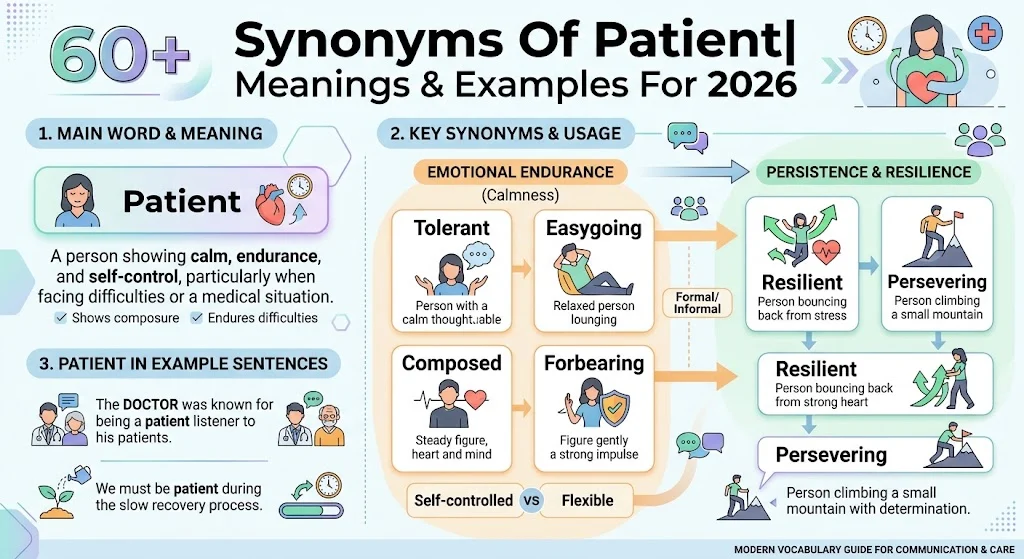
“Patient” can describe someone who remains calm during waiting or difficulty, or it can refer to a person receiving medical treatment. For a calm person, use tolerant or forbearing. For a medical context, use sufferer or client. For a child learning patience, use calm or composed.
Meaning, Tone and Context
The word “patient” is a versatile adjective and noun. Its core function is to describe either a quality of calm endurance or a person under medical care. The tone is generally positive when describing a personality trait and neutral when used as a medical term.
1. Simple Definition: As an adjective, patient means able to accept delays or problems without becoming annoyed. As a noun, it means a person receiving medical treatment.
2. Part of Speech: Patient is both an adjective and a noun.
- Adjective: “She was very patient with the slow learner.”
- Noun: “The patient was discharged from the hospital.”
3. Tone: The tone is positive when describing a personality trait, as it suggests self-control and maturity. It is neutral when used as a medical term.
4. Formality: “Patient” is a neutral word. It is appropriate for both casual conversation and professional medical contexts.
5. Common Use Cases: You will encounter “patient” in many situations.
- Everyday Conversation: “Please be patient. The bus will arrive soon.”
- Medical Context: “The doctor examined the patient carefully.”
- Teaching Context: “Good teachers are patient with their students.”
- Professional Context: “We ask for your patience during this transition.”
6. Important Word Forms:
- Noun: patience. “She showed great patience during the delay.”
- Adjective: patient. “He is a patient man.”
- Adverb: patiently. “She waited patiently for her turn.”
- Adjective (opposite): impatient. “He was impatient with the slow service.”
When and How to Use “Patient”
Knowing when to use “patient” is about understanding its dual meaning. It can describe a character trait or a medical role. Here are several scenarios where it is the perfect choice.
- Medical Context: To refer to a person receiving care.
Example: “The nurse checked on every patient in the ward.” - Personal Context: To describe someone who tolerates difficulty well.
Example: “My grandmother is the most patient person I know.” - Professional Context: To request calm during a difficult situation.
Example: “We appreciate your patience as we resolve this technical issue.” - Academic Context: To describe a student’s approach to learning.
Example: “Learning a new language requires a patient mindset.” - Parenting Context: To describe a parent’s approach to raising children.
Example: “You need to be patient with a toddler who is learning to walk.” - Email Context: To politely ask for understanding.
Example: “Thank you for your patience regarding the delayed shipment.” - Resume Context: To highlight a valuable workplace skill.
Example: “I am a patient communicator who works well with diverse teams.” - Storytelling Context: To describe a character’s virtue.
Example: “The old fisherman was patient, waiting hours for a single bite.”
Another Word for “Patient”
Choosing the best replacement for “patient” depends entirely on the context and meaning. Here are the most effective alternatives categorized by use.
- Professional Writing: “Tolerant” or “Composed.” “She remained composed during the difficult negotiation.”
- Academic Writing: “Forbearing” or “Long suffering.” “The forbearing teacher worked with the struggling student.”
- Casual Conversation: “Calm” or “Easygoing.” “He is so easygoing about everything.”
- Emotional Writing: “Enduring” or “Steadfast.” “Her enduring spirit carried her through the crisis.”
- Creative Writing: “Serene” or “Unwavering.” “His serene demeanor calmed everyone around him.”
- Resume or Workplace: “Resilient” or “Adaptable.” “I am a resilient professional who thrives under pressure.”
- Social Media Captions: “Chill” or “Patient vibes.” “Sending patient vibes to everyone stuck in traffic.”
- Stronger Meaning: “Long suffering.” This implies enduring hardship for a very long time.
- Softer Meaning: “Mild” or “Gentle.” “She has a gentle and mild temperament.”
When Not to Use “Patient”
While “patient” is a useful word, it can be too broad or vague in certain situations. Using a more precise synonym can improve clarity and impact.
- When You Need Specificity: If you are describing a specific type of calmness, use a more precise word. “He was patient” is vague. “He was unflappable in the face of criticism” is much clearer.
- When Describing a Medical Professional: Do not confuse “patient” (the person receiving care) with “doctor” or “nurse” (the providers).
- When Criticizing Directly: Using “patient” can sound neutral when you want to be critical. Instead of “He was too patient with the bad behavior,” try “He was too permissive with the bad behavior.”
Example of Precision: Compare these two sentences.
- Vague: “She was patient during the meeting.”
- Precise: “She remained composed during the heated debate.”
The second sentence is more specific and provides a clearer picture of her behavior.
Words Commonly Confused With “Patient”
Understanding the differences between these related words will significantly refine your English.
- Patient vs. Patience: “Patient” is the adjective and the noun (the person). “Patience” is the noun that describes the quality. You can have patience, and you can be patient.
- Patient vs. Tolerant: “Tolerant” means accepting differences or things you do not like. “Patient” means accepting delays or difficulties without getting annoyed. Tolerance is about acceptance. Patience is about endurance.
- Patient vs. Calm: “Calm” means not excited, nervous, or upset. “Patient” specifically means enduring a delay or problem. You can be calm without waiting for anything.
- Patient vs. Passive: “Passive” means accepting what happens without active response. “Patient” means actively choosing to wait calmly. Passive can imply weakness. Patient implies strength.
- Patient vs. Forbearing: “Forbearing” is a more formal synonym for patient. It means patiently enduring provocation. It is very similar but sounds more formal and literary.
- Patient vs. Sufferer: “Sufferer” is another word for a medical patient. It emphasizes the pain or difficulty the person is experiencing. It is often used for chronic conditions.
Best Synonym by Context for “Patient”
| Context | Best Synonym | Why It Works | Example |
|---|---|---|---|
| Formal Writing | Forbearing | It sounds sophisticated and precise. | “The forbearing teacher continued to help the struggling student.” |
| Academic Writing | Tolerant | It is precise and suitable for analysis. | “The study examined how tolerant leaders manage crises.” |
| Professional/Business | Composed | It shows professionalism under pressure. | “She remained composed during the difficult client call.” |
| Resume | Resilient | It highlights your ability to handle challenges. | “A resilient professional who thrives under pressure.” |
| Casual Conversation | Easygoing | It is simple and friendly. | “He is so easygoing about everything.” |
| Creative Writing | Serene | It adds a poetic, peaceful quality. | “Her serene presence calmed the entire room.” |
| Emotional Tone | Long suffering | It conveys deep, prolonged endurance. | “His long suffering wife supported him through years of illness.” |
| Strong Intensity | Unflappable | It implies complete and impressive calmness. | “The unflappable pilot landed the plane safely.” |
| Soft/Moderate Tone | Mild | It suggests a gentle, calm nature. | “She has a mild temperament and rarely gets upset.” |
| Social Media Captions | Chill | It is modern, casual, and friendly. | “Just staying chill while waiting for the update.” |
| US/UK Usage | Patient (US/UK) / Sufferer (UK medical) | Both are common, but context matters. | US: “The patient is stable.” UK: “The sufferer reported chronic pain.” |
Which Synonym Should You Choose?
Choosing the right word can seem difficult, but this simple guide will help you decide. It is all about matching the word to your goal, audience, and the message you want to send.
- Is your goal to describe a calm person? Use “patient,” “tolerant,” or “composed.” These are the most direct and common terms.
- Is your goal to describe a medical role? Use “patient,” “sufferer,” or “client.” These are standard medical terms.
- Is your goal to highlight a workplace skill? Use “resilient,” “adaptable,” or “composed.” These are valuable resume words.
- Are you describing someone who endures a lot? Use “long suffering” or “forbearing.” These suggest deep, prolonged endurance.
- Are you using a casual or social media tone? Use “easygoing,” “chill,” or “calm.” These are perfect for informal communication.
- Do you want to be very formal? Use “forbearing” or “unflappable.” These are sophisticated and impressive.
Real Life Examples of “Patient” in Sentences
Here are examples of how “patient” and its stronger synonyms can be used in different real world scenarios.
- School: “The teacher was patient with the students who needed extra help.” Stronger: “The forbearing teacher worked tirelessly with each student.”
- Workplace: “Please be patient while we process your request.” Stronger: “We appreciate your patience as we process your request.”
- Writing: “The character was patient and kind.” Stronger: “The character was unflappable and serene.”
- Conversation: “I am not patient enough to wait in long lines.” Stronger: “I lack the patience to wait in long lines.”
- Social Media: “Sending patient vibes to everyone waiting for their results.” Stronger: “Sending calm and collected vibes to everyone.”
- Resume: “I am a patient worker who handles stress well.” Stronger: “I am a resilient professional who thrives under pressure.”
- Email: “Thank you for your patience regarding this matter.” Stronger: “Thank you for your forbearance regarding this matter.”
- Storytelling: “The old man was patient as he waited for the fish to bite.” Stronger: “The old man was serene as he waited for the fish to bite.”
60 Synonyms for “Patient”
The following table lists 25 accurate and practical synonyms for “patient.
| Synonym | Simple Meaning | Best Used For | Example Sentence |
|---|---|---|---|
| Tolerant | Accepting of differences or delays. | General use, formal. | “She is tolerant of different opinions.” |
| Calm | Not excited or upset. | Everyday, emotional. | “He remained calm during the emergency.” |
| Composed | In control of your feelings. | Professional, formal. | “She was composed during the interview.” |
| Easygoing | Relaxed and not easily worried. | Casual, personal. | “My friend is very easygoing.” |
| Forbearing | Patiently enduring difficulty. | Formal, literary. | “The forbearing parent handled the tantrum well.” |
| Long suffering | Enduring hardship for a long time. | Emotional, descriptive. | “His long suffering wife supported him.” |
| Resilient | Able to recover quickly from difficulties. | Professional, resume. | “She is a resilient leader.” |
| Adaptable | Able to adjust to new conditions. | Professional, resume. | “He is adaptable to any work environment.” |
| Serene | Calm and peaceful. | Creative, emotional. | “Her serene smile reassured everyone.” |
| Unflappable | Impossible to upset. | Strong, descriptive. | “The unflappable pilot saved the day.” |
| Mild | Gentle and not severe. | Soft, casual. | “He has a mild and gentle nature.” |
| Steadfast | Firm and unwavering. | Emotional, formal. | “She remained steadfast in her support.” |
| Enduring | Lasting for a long time. | Emotional, literary. | “His enduring patience was remarkable.” |
| Sufferer | A person experiencing pain or illness. | Medical, formal. | “The sufferer reported chronic pain.” |
| Client | A person using a service. | Professional, medical. | “The clinic sees over fifty clients a day.” |
| Case | A person receiving medical care. | Medical, formal. | “The doctor reviewed the new case.” |
| Chill | Relaxed and calm. | Slang, social media. | “He is a chill guy who never stresses.” |
| Stoic | Enduring pain without showing feelings. | Formal, literary. | “She was stoic during the difficult treatment.” |
| Placid | Calm and not easily upset. | Formal, descriptive. | “The placid lake reflected the sky.” |
| Meek | Quiet and gentle. | Literary, soft. | “He was meek and never argued.” |
| Patiently waiting | Waiting with calmness. | Descriptive, general. | “She was patiently waiting for her turn.” |
| Good natured | Friendly and pleasant. | Casual, personal. | “He is a good natured person.” |
| Understanding | Sympathetic and tolerant. | Professional, personal. | “The manager was understanding of my situation.” |
| Accepting | Willing to tolerate. | Formal, general. | “She was accepting of the changes.” |
| Even tempered | Calm and not easily angered. | Professional, personal. | “He is an even tempered leader.” |
Synonym Groups and Usage Differences
Professional vs. Personal Synonyms
In a professional setting, like a business report or a resume, choose “composed,” “resilient,” or “adaptable.” These words sound polished and appropriate. In a personal setting, “easygoing,” “calm,” or “chill” are more natural and friendly. For example, you would tell a colleague “She is composed under pressure,” but a friend “He is so easygoing.”
Formal vs. Conversational Synonyms
Formal Synonyms: “Forbearing,” “stoic,” and “unflappable” are perfect for academic papers, legal documents, or formal speeches.
Conversational Synonyms: “Calm,” “easygoing,” and “chill” are the best choices for everyday conversations and emails to friends.
Academic Synonyms
In essays and research papers, “tolerant,” “forbearing,” and “stoic” are powerful and precise terms. These words allow you to discuss the endurance of characters or historical figures.
Professional and Business Synonyms
“Composed” is a safe and professional choice for almost any workplace communication. “Resilient” is effective for resumes and interviews. “Adaptable” is great for discussing flexibility. “Understanding” is useful for customer service contexts.
Creative or Literary Synonyms
These words add a layer of artistry to your descriptions.
- Serene: Suggests a peaceful, almost spiritual calm.
- Stoic: Implies enduring pain without complaint, often with dignity.
- Placid: Perfect for describing calm water or a calm personality.
Slang or Modern Synonyms
Chill” is a modern and casual synonym. It is acceptable in social media captions, text messages, and very informal conversations. It should be avoided in academic or professional writing.
Strongest vs. Weaker Synonyms
Here is an intensity scale from mild to strongest:
- Mild: Gentle, calm.
- Moderate: Patient, tolerant.
- Strong: Composed, resilient.
- Strongest: Unflappable, stoic.
Emotional vs. Neutral Synonyms
Emotional Synonyms: “Long suffering,” “enduring,” and “steadfast” carry strong emotional weight. They suggest deep personal sacrifice.
Neutral Synonyms: “Tolerant,” “patient,” and “composed” are factual and free of excessive emotional charge.
Antonyms of “Patient”
Here are 15 clear antonyms for “patient,” which are words that mean the opposite: lacking calmness, easily annoyed, or unable to wait.
| Antonym | Meaning | Example Sentence |
|---|---|---|
| Impatient | Unable to wait calmly. | “He was impatient with the slow service.” |
| Restless | Unable to rest or relax. | “The children were restless on the long trip.” |
| Agitated | Feeling or appearing troubled. | “She became agitated while waiting for news.” |
| Irritable | Easily annoyed. | “He was irritable after the long delay.” |
| Annoyed | Slightly angry. | “I was annoyed by the constant interruptions.” |
| Frustrated | Feeling upset because of inability to change something. | “She was frustrated by the lack of progress.” |
| Anxious | Feeling worried or nervous. | “He was anxious about the test results.” |
| Hasty | Acting with excessive speed. | “A hasty decision led to problems.” |
| Impulsive | Acting without thinking. | “His impulsive behavior caused issues.” |
| Intolerant | Not accepting differences. | “He was intolerant of other viewpoints.” |
| Demanding | Asking for more than is reasonable. | “The demanding customer wanted immediate service.” |
| Restive | Unable to stay still or quiet. | “The crowd grew restive as they waited.” |
| Edgy | Tense and nervous. | “She felt edgy before the interview.” |
| Testy | Irritated and impatient. | “He was testy after a long day.” |
| Short tempered | Easily angered. | “The short tempered manager yelled at the staff.” |
Comparison: “Patient” vs. Similar Words
Patient vs. Patience
Main Difference: “Patient” is the adjective and the noun (the person). “Patience” is the noun that describes the quality.
Which One Is Stronger: They are different parts of speech. You cannot compare them directly.
Which One Is More Formal: Both are neutral.
Example Sentence with Patient: “She is a patient person.”
Example Sentence with Patience: “She has a lot of patience.
Patient vs. Tolerant
Main Difference: “Tolerant” means accepting differences or things you do not like. “Patient” means accepting delays or difficulties without getting annoyed.
Which One Is Stronger: “Tolerant” is a broader concept, while “patient” is more specific to waiting.
Which One Is More Formal: Both are neutral.
Example Sentence with Patient: “He was patient with the slow internet.
Example Sentence with Tolerant: “She is tolerant of different cultures.”
Patient vs. Calm
Main Difference: “Calm” means not excited, nervous, or upset. “Patient” specifically means enduring a delay or problem.
Which One Is Stronger: “Calm” is a broader emotional state.
Which One Is More Formal: Both are neutral.
Example Sentence with Patient: “She was patient while waiting for the doctor.”
Example Sentence with Calm: “He remained calm during the storm.”
Patient vs. Passive
Main Difference: “Passive” means accepting what happens without active response. “Patient” means actively choosing to wait calmly.
Which One Is Stronger: “Patient” implies strength and choice. “Passive” can imply weakness.
Which One Is More Formal: Both are neutral.
Example Sentence with Patient: “He was patient and waited for his turn.”
Example Sentence with Passive: “She was passive and let others make decisions.”
Patient vs. Forbearing
Main Difference: “Forbearing” is a more formal synonym for patient. It means patiently enduring provocation.
Which One Is Stronger: “Forbearing” is stronger and more formal.
Which One Is More Formal: “Forbearing” is more formal.
Example Sentence with Patient: “She was patient with the noisy neighbors.”
Example Sentence with Forbearing: “The forbearing teacher tolerated the disruptive student.”
Patient vs. Sufferer
Main Difference: “Sufferer” is another word for a medical patient. It emphasizes the pain or difficulty the person is experiencing.
Which One Is Stronger: “Sufferer” is more specific and emotional.
Which One Is More Formal: “Sufferer” is more formal in medical contexts.
Example Sentence with Patient: “The patient is recovering well.”
Example Sentence with Sufferer: “The sufferer reported chronic pain.
Common Phrases and Expressions with “Patient”
1. Be Patient
Meaning: To wait calmly without getting annoyed.
Example Sentence: “Please be patient. The results will be ready soon.”
2. Patient as a Saint
Meaning: Extremely patient.
Example Sentence: “She is patient as a saint with those children.”
3. Lose Patience
Meaning: To become annoyed after waiting.
Example Sentence: “He lost patience with the slow service.”
4. Test Someone’s Patience
Meaning: To make someone feel impatient.
Example Sentence: “The constant delays tested our patience.”
5. Have the Patience of a Saint
Meaning: To be extremely patient.
Example Sentence: “You need the patience of a saint to teach that class.”
6. Patient Care
Meaning: Medical treatment given to a patient.
Example Sentence: “The hospital is known for its excellent patient care.
7. Patient Zero
Meaning: The first person infected in an outbreak.
Example Sentence: “Scientists traced the virus back to patient zero.”
8. Patience is a Virtue
Meaning: Being patient is a good quality.
Example Sentence: “Remember, patience is a virtue.”
Common Mistakes to Avoid
1. Using “Patient” When a More Precise Synonym Is Better
Mistake: “He was patient during the meeting.”
Better: “He was composed during the meeting.” This is more specific to professional settings.
2. Confusing “Patient” with “Patience”
Mistake: “She has a lot of patient.”
Better: “She has a lot of patience.” “Patience” is the noun. “Patient” is the adjective.
3. Using a Casual Synonym in Formal Writing
Mistake: “The doctor was chill with the patient.”
Better: “The doctor was composed with the patient.” “Chill” is too casual for a medical setting.
4. Using an Overly Dramatic Synonym for a Simple Situation
Mistake: “He was long suffering while waiting for his coffee.”
Better: “He was patient while waiting for his coffee.” “Long suffering” is too dramatic for a simple wait.
5. Repeating the Same Word Too Often
Mistake: “She was patient. He was patient. They were patient.”
Better: “She was patient. He was composed. They were tolerant.” This variation makes the writing more engaging.
6. Choosing a Synonym with the Wrong Emotional Tone
Mistake: “I appreciated the stoic waiter.”
Better: “I appreciated the patient waiter.” “Stoic” implies enduring pain, which is too strong for a waiter.
7. Using Slang in Academic or Professional Writing
Mistake: “The study analyzed chill leadership styles.”
Better: “The study analyzed composed leadership styles.” “Chill” is too casual for academic writing.
FAQs
1. What is the best synonym for patient?
- The best synonym depends on your context. For general use, “tolerant” is a safe choice. For professional settings, use “composed.” For casual conversation, use “easygoing.”
2. What is a formal synonym for patient?
A formal synonym for patient is “forbearing” or “stoic.” Both are appropriate for formal writing and professional communication.
3. What is an informal synonym for patient?
An informal synonym for patient is “chill” or “easygoing.” These words are perfect for everyday conversation and social media.
4. What is another word for patient in professional writing?
In professional writing, “composed” is an excellent choice. “Resilient” is also effective for resumes. “Understanding” works well in customer service contexts.
5. What is the difference between patient and tolerant?
“Patient” means enduring delays without annoyance. “Tolerant” means accepting differences or things you do not like. Patience is about waiting. Tolerance is about acceptance.
6. What is the opposite of patient?
The opposite of patient is “impatient,” “restless,” or “irritable.” These words describe someone who cannot wait calmly or is easily annoyed.
Conclusion
The word “patient” is a simple but powerful term. It can describe a person who calmly endures difficulty, or it can refer to someone receiving medical care. Choosing the right synonym depends entirely on your context, audience, and the tone you wish to convey.
For a professional setting, “composed” or “resilient” work well. For a formal context, “forbearing” or “stoic” are excellent choices. In casual conversation, “easygoing” or “chill” are natural and friendly. For medical contexts, “sufferer” or “client” are appropriate.
The best advice is to think about your purpose and your audience before you choose a word. Do you want to be professional, casual, formal, or empathetic? Matching your word to your intention will make your communication more effective and your English more precise.
A practical vocabulary tip: Try replacing “patient” with a more specific synonym in your writing this week. If you are writing a resume, use “resilient.” If you are writing a story, use “serene.” This small change will significantly improve the clarity and sophistication of your English.
