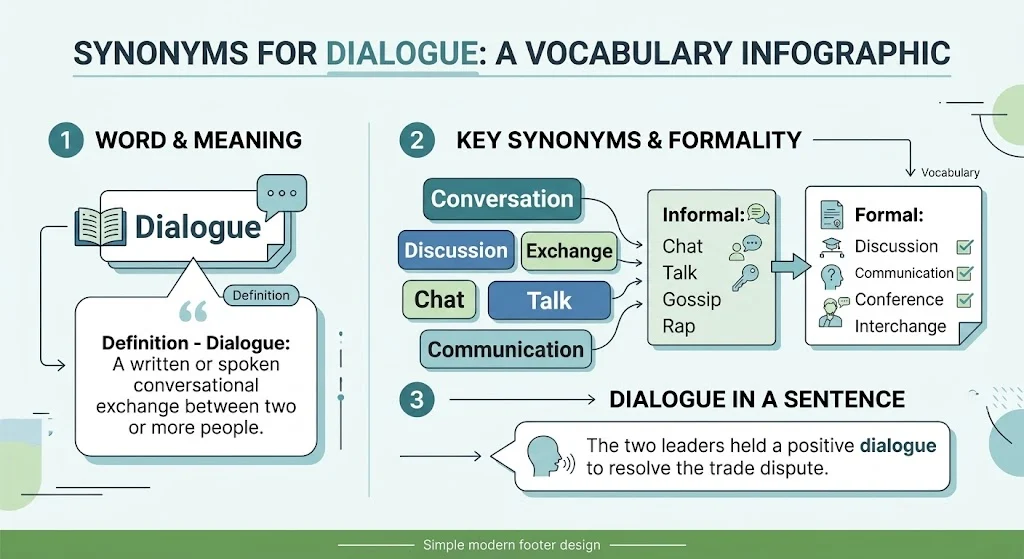
Dialogue means a conversation between two or more people. It can also refer to a discussion aimed at resolving a problem or an exchange of ideas. The best synonyms for dialogue include “conversation” for casual use, “discussion” for professional settings, “exchange” for formal writing, and “banter” for playful situations.
Meaning, Tone and Context
The word “dialogue” is a noun that describes a spoken exchange between two or more people. Its meaning extends beyond simple conversation to include formal discussions, literary techniques, and problem solving exchanges.
1. Simple Definition: Dialogue is a conversation between two or more people. It can also mean a discussion or exchange of ideas.
2. Part of Speech: Dialogue is primarily used as a noun. It can also be used as a verb in some contexts.
- Noun: “The dialogue between the two leaders was productive.”
- Verb: “The author dialogues with the reader throughout the book.”
3. Tone: The tone of dialogue is generally neutral. It can be positive in the context of productive discussions or problem solving. It can be negative in the context of political or failed negotiations.
4. Formality: “Dialogue” is a neutral to formal word. It is appropriate in professional writing, academic papers, and everyday conversation. In casual settings, “conversation” or “chat” are more common.
5. Common Use Cases: You will encounter dialogue in many situations.
- Literature and Film: The spoken words between characters in a story.
- Business and Politics: Formal discussions aimed at resolving issues.
- Education: Socratic dialogue or classroom discussions.
- Everyday Life: Casual conversations between friends, family, or colleagues.
- Problem Solving: A dialogue between opposing parties.
6. Important Word Forms:
- Noun: Dialogue. “The dialogue in the play was brilliant.”
- Verb: Dialogue or Dialog. “The two companies dialogued for months.”
- Adjective: Dialogic. “The dialogic nature of the classroom encouraged participation.”
When and How to Use “Dialogue”
Knowing when to use “dialogue” is about understanding its formal and structured nature. Here are several scenarios where it is the perfect choice.
- Professional Context: To describe formal communication between parties or departments.
Example: “The CEO emphasized the importance of open dialogue between management and staff.” - Personal Context: To describe a meaningful conversation, though “conversation” is more common.
Example: “We had a wonderful dialogue about our future plans over dinner.” - Academic Context: To describe the discussion format in a class or a Socratic exchange.
Example: “The seminar encouraged dialogue between students and the visiting professor.” - Literary Context: To describe the spoken words of characters in a novel, play, or script.
Example: “The author’s dialogue felt incredibly natural and authentic.” - Political or Diplomatic Context: To describe formal negotiations or peace talks.
Example: “The two countries agreed to engage in a constructive dialogue to resolve their differences.” - Business Communication: To describe an exchange of ideas during a meeting or negotiation.
Example: “The stakeholder dialogue helped align everyone’s expectations.”
Another Word for “Dialogue”
Choosing the best replacement for “dialogue” depends on the situation. Here are the most effective single word alternatives categorized by use.
- Professional Writing: “Discussion” or “Deliberation.” “The board entered into deliberations about the merger.”
- Academic Writing: “Exchange” or “Discourse.” “The academic discourse on this topic is well documented.”
- Casual Conversation: “Chat” or “Talk.” “We had a nice chat about our vacation plans.”
- Emotional Writing: “Heart to Heart” or “Exchange.” “They had a heart to heart about their relationship issues.”
- Creative Writing: “Interchange” or “Banter.” “The witty banter between the characters kept the audience laughing.”
- Resume or Workplace: “Collaboration” or “Communication.” “My role required strong communication and collaboration with cross functional teams.”
- Social Media Captions: “Conversation” or “Talk.” “Join the conversation about sustainable living on our page.”
- Stronger Meaning: “Debate” or “Negotiation.” “The debate between the two candidates lasted over two hours.”
- Softer Meaning: “Chat” or “Small Talk.” “We engaged in some polite small talk before the meeting began.”
When Not to Use “Dialogue”
While useful, “dialogue” can sound too formal or structured in certain situations. Using a more casual synonym can improve the tone of your communication.
- When Describing Casual Conversation: Using “dialogue” for a simple chat with a friend sounds unnatural. “We had a dialogue about the weather” sounds strange. Use “conversation” or “chat” instead.
- When Describing One Sided Communication: Dialogue requires at least two participants. Use “monologue” or “lecture” when only one person is speaking.
- When You Mean Written Communication: Dialogue is spoken. Use “correspondence” or “email exchange” for written communication.
Example of Precision: Compare these two sentences.
- Too Formal: “We had a dialogue about what to eat for lunch.”
- Natural: “We chatted about what to eat for lunch.”
The second sentence is more natural for a casual situation.
Words Commonly Confused With “Dialogue”
Understanding the differences between these related words will significantly refine your English.
- Dialogue vs. Conversation: “Dialogue” often implies a more formal or structured exchange with a specific purpose. “Conversation” is a broader, more general term for any spoken exchange. You have a conversation with a friend; you engage in dialogue with a diplomat.
- Dialogue vs. Discussion: “Discussion” is often goal oriented. You discuss a specific topic or problem to reach a conclusion. “Dialogue” can be an open exchange of ideas without a specific goal.
- Dialogue vs. Debate: A debate is a formal argument where opposing sides argue for their position. A dialogue is a cooperative exchange of ideas. Debate is adversarial; dialogue is collaborative.
- Dialogue vs. Monologue: A dialogue involves two or more people. A monologue involves one person speaking. A monologue is a long speech by a single character.
- Dialogue vs. Soliloquy: A soliloquy is a speech in a play where a character speaks their thoughts aloud to themselves. It is a type of monologue. Dialogue involves interaction; a soliloquy is internal.
- Dialogue vs. Discourse: “Discourse” is a more formal, academic term. It refers to a serious and structured conversation or debate on a particular subject, often extending over time.
Best Synonym by Context for “Dialogue”
| Context | Best Synonym | Why It Works | Example |
|---|---|---|---|
| Formal Writing | Discourse | It sounds sophisticated and academic. | “The political discourse was intense during the election.” |
| Academic Writing | Exchange | It is precise and neutral. | “The exchange of ideas between the two theorists was groundbreaking.” |
| Professional/Business | Discussion | It is clear and widely accepted. | “We will have a discussion about the quarterly results.” |
| Resume | Collaboration | It highlights your teamwork skills. | “I facilitated collaboration between multiple departments.” |
| Casual Conversation | Chat | It is friendly and natural. | “We had a nice chat over coffee.” |
| Creative Writing | Banter | It adds a playful, witty tone. | “The banter between the friends was hilarious.” |
| Emotional Tone | Heart to Heart | It conveys deep, personal connection. | “They had a heart to heart about their feelings.” |
| Strong Intensity | Debate | It suggests a passionate exchange. | “The debate about the policy lasted for hours.” |
| Soft/Moderate Tone | Talk | It is simple and understated. | “We need to have a talk about your progress.” |
| Social Media Captions | Conversation | It is engaging and inclusive. | “Join the conversation about mental health awareness.” |
| US/UK Usage | Chat or Discussion | Both are widely understood. | “Let us have a chat about the project.” |
Which Synonym Should You Choose?
Choosing the right word can seem difficult, but this simple guide will help you decide. It is all about matching the word to your goal, audience, and the message you want to send.
- Is your exchange formal and structured? Use “Dialogue,” “Discourse,” or “Deliberation.” These words are appropriate for professional and academic settings.
- Is your exchange casual and friendly? Use “Chat,” “Talk,” or “Conversation.” These are natural for social situations.
- Is your exchange about solving a problem? Use “Discussion” or “Negotiation.” These words suggest a goal oriented conversation.
- Is your exchange playful and witty? Use “Banter” or “Interchange.” These words are perfect for creative writing.
- Is your exchange deeply emotional and personal? Use “Heart to Heart.” This conveys genuine emotional connection.
Real Life Examples of “Dialogue” in Sentences
Here are examples of how “dialogue” and its stronger synonyms can be used in different real world scenarios.
- School: “The Socratic dialogue in class helped me understand the philosophical concepts.”
- Workplace: “The CEO encouraged an open dialogue between employees and management.” Stronger: “The CEO fostered a transparent discourse between employees and management.”
- Writing: “The author’s use of dialogue made the characters feel incredibly real.” Stronger: “The author’s masterful use of banter brought the characters to life.”
- Conversation: “We had a brief dialogue about the upcoming election.” Stronger: “We had a spirited debate about the upcoming election.”
- Social Media: “We are starting a global dialogue about climate change.” Stronger: “We are starting a global conversation about climate change.”
- Resume: “I facilitated dialogue between clients and our development team.” Stronger: “I facilitated collaboration and open communication between clients and our development team.”
- Email: “I would like to open a dialogue about the proposed timeline.” Stronger: “I would like to discuss the proposed timeline in more detail.”
- Storytelling: “The dialogue in the scene was tense and full of conflict.” Stronger: “The charged exchange in the scene was full of conflict.”
25 Synonyms for “Dialogue”
The following table lists 25 accurate and practical synonyms for “dialogue.”
| Synonym | Simple Meaning | Best Used For | Example Sentence |
|---|---|---|---|
| Conversation | An informal spoken exchange. | General use, casual. | “We had a pleasant conversation about the weather.” |
| Discussion | A conversation about a specific topic. | Professional, problem solving. | “The board had a lengthy discussion about the budget.” |
| Exchange | A mutual giving and receiving of ideas. | Formal, academic. | “The exchange of ideas was very productive.” |
| Chat | A friendly, informal conversation. | Casual, personal. | “We had a nice chat over lunch.” |
| Talk | A general term for a conversation. | Versatile, neutral. | “We need to have a talk about your performance.” |
| Banter | Playful, teasing conversation. | Creative writing, friends. | “Their playful banter made the party more fun.” |
| Discourse | Formal and structured communication. | Academic, political. | “The public discourse on the issue has been heated.” |
| Deliberation | Careful, thoughtful discussion. | Formal decision making. | “After long deliberation, the jury reached a verdict.” |
| Negotiation | Discussion aimed at reaching an agreement. | Business, diplomacy. | “The negotiation between the two companies was tense.” |
| Debate | A formal discussion of opposing views. | Politics, academics. | “The debate between the candidates was televised.” |
| Colloquy | A formal, high level conversation. | Very formal, literary. | “The colloquy between the scientists lasted for hours.” |
| Interchange | An exchange of ideas or words. | Creative writing. | “The interchange between the two characters revealed their conflict.” |
| Dialectic | A dialogue aimed at finding truth. | Philosophy, academics. | “The Socratic dialectic is a method of intellectual inquiry.” |
| Conference | A formal meeting for discussion. | Business, professional. | “The annual conference provided opportunities for dialogue.” |
| Consultation | A discussion for advice or information. | Professional, medical. | “The doctor had a consultation with the patient.” |
| Parley | A discussion between enemies or rivals. | Military, diplomacy. | “The generals called for a parley to negotiate a ceasefire.” |
| Gossip | Casual talk about other people. | Informal, social. | “The office gossip was about the new manager.” |
| Small Talk | Polite, casual conversation about minor topics. | Social gatherings. | “The awkward small talk at the party was unbearable.” |
| Heart to Heart | An intimate, honest conversation. | Emotional, personal. | “They had a heart to heart about their relationship.” |
| Soliloquy | A speech by one character. | Theater, literature. | “Hamlet’s famous soliloquy is one of the most famous in literature.” |
| Monologue | A long speech by one person. | Literature, conversation. | “His monologue went on for over twenty minutes.” |
| Repartee | Quick, witty conversation. | Creative writing. | “The witty repartee between the characters was charming.” |
| Argument | A discussion with conflicting views. | Conflict, debate. | “They had a heated argument about politics.” |
| Dialogue | A formal exchange of ideas. | General use. | “The play had excellent dialogue.” |
| Speech | A formal talk given to an audience. | Public speaking. | “The president delivered an important speech.” |
Synonym Groups and Usage Differences
Professional vs. Personal Synonyms
In a professional setting, choose “discussion,” “negotiation,” or “consultation.” These words sound polished and appropriate for business communication. In a personal setting, “chat” or “conversation” are more natural. For example, you would tell a colleague “We need a discussion about the project,” but a friend “Let us have a chat about our weekend plans.”
Formal vs. Conversational Synonyms
Formal Synonyms: “Dialogue,” “discourse,” “deliberation,” and “colloquy” are perfect for academic papers, legal documents, or formal speeches.
Conversational Synonyms: “Chat,” “talk,” “conversation,” and “banter” are the best choices for everyday conversations and emails to friends.
Academic Synonyms
In essays and research papers, “discourse,” “exchange,” and “dialectic” are powerful words. “Discourse” allows you to discuss structured communication. “Dialectic” is useful for philosophical discussions.
Professional and Business Synonyms
“Discussion” is a safe and professional choice for almost any workplace communication. “Negotiation” is effective when discussing contracts or deals. “Consultation” is great for professional advice.
Creative or Literary Synonyms
These words add a layer of artistry to your descriptions.
- Banter: Adds a playful, witty tone.
- Repartee: Quick, clever dialogue.
- Interchange: A thoughtful exchange.
- Dialogue: The standard for scripts and novels.
Slang or Modern Synonyms
There are fewer slang terms for dialogue. “Chit chat” is a casual term for light conversation. It is acceptable in casual writing and social media but should be avoided in formal academic or professional writing.
Strongest vs. Weaker Synonyms
Here is an intensity scale from mild to strongest:
- Small Talk, Chat: Very mild, used for casual conversations.
- Conversation, Talk: Mild to moderate, used for general exchanges.
- Discussion: Moderate, used for focused exchanges.
- Debate, Argument: Strong, used for passionate or adversarial exchanges.
- Dialogue, Discourse: Strong, used for formal, structured exchanges.
Emotional vs. Neutral Synonyms
Emotional Synonyms: “Heart to heart” and “argument” carry strong emotional weight. “Heart to heart” is positive and intimate. “Argument” is negative and conflict driven.
Neutral Synonyms: “Conversation,” “discussion,” “exchange,” and “dialogue” are factual and free of emotional charge.
Antonyms of “Dialogue”
Here are 15 clear antonyms for “dialogue,” which are words that mean the opposite: a one sided or non interactive communication.
| Antonym | Meaning | Example Sentence |
|---|---|---|
| Monologue | A long speech by one person. | “His monologue bored the audience.” |
| Soliloquy | A speech by a character speaking their thoughts. | “The soliloquy revealed the character’s inner conflict.” |
| Silence | Complete absence of speech. | “An awkward silence filled the room.” |
| Speech | A formal talk to an audience. | “The politician gave a speech to the crowd.” |
| Lecture | An educational speech to students. | “The professor gave a lecture on ancient history.” |
| Declaration | A formal public statement. | “The company issued a declaration of its new policy.” |
| Proclamation | An official public announcement. | “The king issued a proclamation.” |
| Rant | A lengthy, angry speech. | “His rant about the service was unprofessional.” |
| Tirade | A long, angry speech of criticism. | “She launched into a tirade about the poor service.” |
| Diatribe | A forceful and bitter verbal attack. | “The article was a diatribe against the government.” |
| Harangue | A lengthy and aggressive speech. | “The manager gave a harangue about the new rules.” |
| Sermon | A religious speech or moral lecture. | “The pastor delivered a powerful sermon.” |
| Edict | An official order or proclamation. | “The emperor issued an edict.” |
| Manifesto | A public declaration of intentions. | “The group published a political manifesto.” |
| Dictation | Speaking for someone else to write down. | “The secretary took dictation from the boss.” |
Comparison: “Dialogue” vs. Similar Words
Dialogue vs. Conversation
Main Difference: “Dialogue” often implies a more formal, purposeful exchange. “Conversation” is a broader, more general term for any spoken interaction.
Which One Is Stronger: “Dialogue” is stronger in formal contexts. “Conversation” is better for casual use.
Which One Is More Formal: “Dialogue” is more formal.
Example Sentence with Dialogue: “The diplomatic dialogue lasted for three hours.”
Example Sentence with Conversation: “We had a lovely conversation about our children.”
Dialogue vs. Discussion
Main Difference: A discussion is usually focused on a specific topic to reach a decision or conclusion. A dialogue can be a more open exchange of ideas without a specific goal.
Which One Is Stronger: Both are strong, but “discussion” implies a more focused goal.
Which One Is More Formal: They are similar in formality.
Example Sentence with Dialogue: “We engaged in a dialogue about the future of the company.”
Example Sentence with Discussion: “We had a productive discussion about the budget.”
Dialogue vs. Debate
Main Difference: A debate is a formal argument between opposing sides. A dialogue is a cooperative exchange. Debate is adversarial; dialogue is collaborative.
Which One Is Stronger: “Debate” is stronger and implies conflict.
Which One Is More Formal: Both are formal, but “debate” is often structured.
Example Sentence with Dialogue: “The dialogue between the leaders was peaceful.”
Example Sentence with Debate: “The debate between the candidates was fierce.”
Dialogue vs. Discourse
Main Difference: “Discourse” is a broader, more academic term. It refers to a serious and structured conversation or debate on a particular subject over time.
Which One Is Stronger: “Discourse” is more powerful and academic.
Which One Is More Formal: “Discourse” is more formal.
Example Sentence with Dialogue: “The dialogue in the play was realistic.”
Example Sentence with Discourse: “The public discourse on climate change has evolved.”
Dialogue vs. Monologue
Main Difference: A dialogue involves two or more people. A monologue involves one person speaking.
Which One Is Stronger: They are different, not stronger or weaker.
Which One Is More Formal: Both are neutral.
Example Sentence with Dialogue: “The dialogue between the two characters was intense.”
Example Sentence with Monologue: “The comedian’s monologue was hilarious.”
Dialogue vs. Banter
Main Difference: Banter is playful, witty, and teasing conversation. Dialogue is a more general or formal term.
Which One Is Stronger: “Banter” is more specific and evokes a different tone.
Which One Is More Formal: “Dialogue” is more formal.
Example Sentence with Dialogue: “The dialogue in the play was realistic.”
Example Sentence with Banter: “The banter between the friends kept the party lively.”
Common Phrases and Expressions with “Dialogue”
1. Open a Dialogue
Meaning: To begin a conversation or discussion.
Example Sentence: “The company opened a dialogue with its employees about the new policy.”
2. Engage in Dialogue
Meaning: To participate in a conversation or discussion.
Example Sentence: “The two leaders agreed to engage in dialogue to resolve their differences.”
3. Constructive Dialogue
Meaning: A productive and positive discussion.
Example Sentence: “The meeting was a constructive dialogue about improving workplace culture.”
4. Socratic Dialogue
Meaning: A form of dialogue where questions are used to stimulate critical thinking.
Example Sentence: “The professor used the Socratic dialogue to engage students in the lecture.”
5. Dialogue of the Deaf
Meaning: A conversation where neither party is listening to the other.
Example Sentence: “Their argument was a dialogue of the deaf, with no one willing to compromise.”
6. Inner Dialogue
Meaning: A conversation one has with oneself.
Example Sentence: “Her inner dialogue was filled with doubt and uncertainty.”
7. Dialogue Box
Meaning: A box on a computer screen that displays information or asks for input.
Example Sentence: “A dialogue box appeared asking for my password.”
8. Written Dialogue
Meaning: Dialogue presented in written form in a book, script, or play.
Example Sentence: “The written dialogue in the play was very natural and realistic.”
Common Mistakes to Avoid
1. Using “Dialogue” When a More Precise Synonym Is Better
Mistake: “We had a dialogue about what to eat for lunch.”
Better: “We had a conversation about what to eat for lunch.” This sounds more natural for a casual situation.
2. Confusing “Dialogue” with “Monologue”
Mistake: “The dialogue went on for twenty minutes” when only one person is speaking.
Correction: Use “monologue” or “soliloquy” when only one person is speaking.
3. Using a Casual Synonym in Formal Writing
Mistake: “The academic dialogue was a friendly chat.”
Better: “The academic discourse was a thoughtful exchange.” “Chat” is too informal for academic writing.
4. Using an Overly Formal Synonym for a Simple Situation
Mistake: “We engaged in a colloquy about the weekend.”
Better: “We had a chat about the weekend.” “Colloquy” is too formal for a casual situation.
5. Repeating the Same Word Too Often
Mistake: “The dialogue was excellent. The dialogue between the characters was realistic. The dialogue kept the story moving.”
Better: “The dialogue was excellent. The banter between the characters was realistic. The exchange kept the story moving.” This variation makes the writing more engaging.
6. Choosing a Synonym with the Wrong Emotional Tone
Mistake: “I am looking forward to our argument about the project.”
Better: “I am looking forward to our discussion about the project.” “Argument” has a negative connotation.
7. Using “Dialogue” for Written Communication
Mistake: “I had a dialogue with my colleague over email.”
Better: “I had a correspondence with my colleague over email.” Dialogue is spoken; correspondence is written.
FAQs
1. What is the best synonym for dialogue?
- The best synonym depends on your context. For general use, “conversation” is a safe choice. For professional use, “discussion” is excellent. For playful exchanges, use “banter.”
2. What is a formal synonym for dialogue?
A formal synonym for dialogue is “discourse.” Another good option is “colloquy.” Both are appropriate for formal writing and professional communication.
3. What is an informal synonym for dialogue?
An informal synonym for dialogue is “chat.” “Talk” is also a good casual choice. These words are perfect for everyday conversation.
4. What is another word for dialogue in professional writing?
In professional writing, “discussion” is an excellent choice. “Negotiation” is effective when discussing contracts or deals. “Consultation” is great for professional advice.
5. What is the difference between dialogue and conversation?
Dialogue often implies a more formal or structured exchange. Conversation is a broader, more general term for any spoken interaction between people.
6. What is the opposite of dialogue?
The opposite of dialogue is “monologue,” “soliloquy,” or “silence.” These words all describe a one sided or non interactive form of communication.
Conclusion
The word “dialogue” is a powerful and versatile part of the English language. It allows us to describe meaningful, structured, and purposeful exchanges. However, using it in every situation can make your writing sound repetitive and overly formal.
Choosing the best synonym depends entirely on your context, audience, and tone. For a professional setting, “discussion” or “negotiation” work well. For a casual setting, “chat” or “conversation” are excellent choices. In creative writing, “banter” or “repartee” add life to your characters. For a formal or academic context, “discourse” or “exchange” convey the right level of sophistication.
The best advice is to think about your purpose and your audience before you choose a word. Do you want to be formal, casual, playful, or serious? Matching your word to your intention will make your communication more effective and your English more precise.
A practical vocabulary tip: Try replacing “dialogue” with a more specific synonym in your writing this week. If you are writing a script, use “banter” for playful moments. If you are writing a report, use “discussion” for professional exchanges. This small change will significantly improve the clarity and sophistication of your English.
