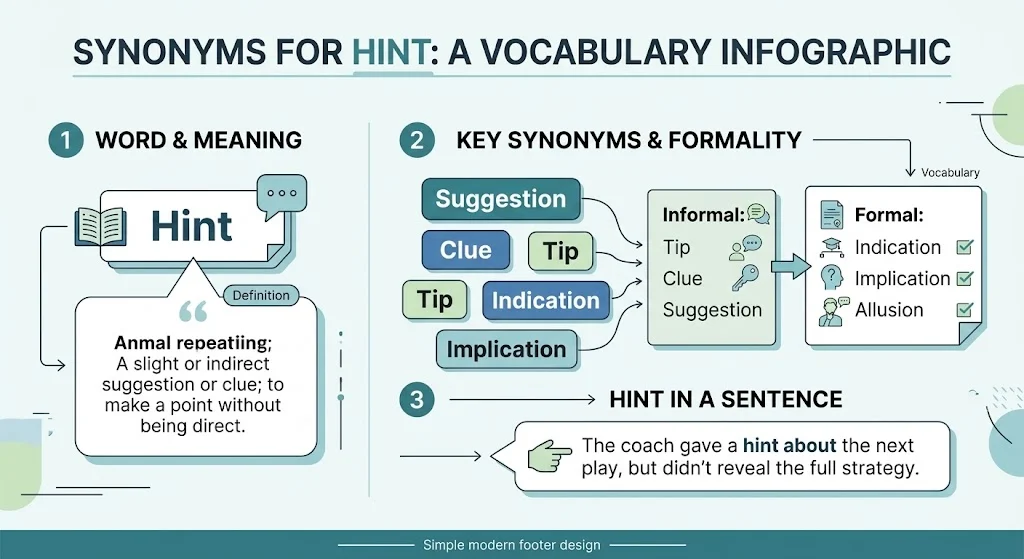
A hint is an indirect suggestion or subtle piece of information. It can also mean a small amount of something or a helpful piece of advice. The best synonyms depend on your context. For a subtle suggestion, try “intimation” or “suggestion.” For a small amount, use a “touch” or “trace.” For helpful advice, use a “tip” or “pointer.”
Meaning, Tone and Context
The word “hint” is a versatile noun and verb with several related meanings. Its core function is to communicate an idea or piece of information indirectly. The tone is generally neutral but can shift depending on context. It can be helpful and polite, or secretive and even slightly manipulative.
1. Simple Definition: A hint is an indirect suggestion, a slight indication, or a small amount of something.
2. Part of Speech: Hint is used as both a noun and a verb.
- Noun: “She gave me a hint about the surprise party.”
- Verb: “He hinted that he might be leaving the company.”
3. Tone: The tone is usually neutral. It can become positive when offering helpful advice, like “fashion hints.” It can become negative when used for subtle criticism or insinuation, like a “hint of scandal.”
4. Formality: “Hint” is a neutral word. It is appropriate for both casual conversation and professional writing. For very formal contexts, you might choose “intimation.”
5. Common Use Cases: You will encounter “hint” in many situations.
- Indirect Suggestions: “I dropped a hint that I wanted a new book for my birthday.”
- Small Amounts: “Add a hint of cinnamon to the recipe.”
- Helpful Advice: “This article is full of useful hints for home gardeners.”
6. Important Word Forms:
- Verb: to hint. “She hinted at the answer.”
- Noun: a hint. “I will give you a hint.”
- Adjective: hinting. “He gave a hinting smile.” “Hinted” is also used. “The hinted solution was correct.”
When and How to Use “Hint”
Knowing when to use “hint” is about understanding indirect communication. Here are several scenarios where it is the perfect choice.
- Professional Context: To subtly suggest a course of action without being forceful.
Example: “In the meeting, the project manager hinted that we might need to work overtime to meet the deadline.” - Personal Context: To gently remind someone of something or express a wish.
Example: “I have been hinting to my husband that I would love a new watch for our anniversary.” - Academic Context: To point a student toward an answer without giving it away directly.
Example: “The professor hinted at the key themes we should focus on for the final exam.” - Emotional Context: To convey a feeling indirectly, like disappointment or concern.
Example: “There was a hint of sadness in her voice as she talked about her childhood.” - Creative Writing: To create suspense or mystery by dropping clues.
Example: “The detective hinted at a larger conspiracy but revealed no details.” - Social Media Captions: To create intrigue or engagement with a post.
Example: “Just a little hint about what is coming next week. Stay tuned.” - Professional Email: To politely share information or expectations.
Example: “Please find the attached draft. I have included some hints for areas that may need revision.” - Resume or Cover Letter: To showcase your skills or experience in a nuanced way.
Example: “My success in this role is hinted at by the 20 percent increase in sales my team achieved in 2023.”
Another Word for “Hint”
Choosing the best replacement for “hint” depends entirely on the context. Here are the most effective single word alternatives categorized by use.
- Professional Writing: “Suggestion” or “Indication.” “The report was a strong indication of the company’s financial health.”
- Academic Writing: “Implication” or “Intimation.” “The study’s findings have significant implications for future research.”
- Casual Conversation: “Clue” or “Tip.” “Can you give me a clue about the surprise?”
- Emotional Writing: “Innuendo” or “Suspicion.” “The article was full of scandalous innuendo.”
- Creative Writing: “Allusion” or “Whisper.” “Her remark was an allusion to their secret past.”
- Resume or Workplace: “Idea” or “Pointer.” “His keynote speech provided some useful pointers for the future of the industry.”
- Social Media Captions: “Teaser” or “Sneak Peek.”
- Stronger Meaning: “Insinuation.” This word implies a negative, often manipulative hint. “She made an insinuation about his honesty.”
- Softer Meaning: “Trace” or “Touch.” These are used when talking about a small amount. “There was a trace of sarcasm in his voice.”
When Not to Use “Hint”
While versatile, the word “hint” can be too vague or soft in certain situations. Using a more direct synonym can improve clarity and impact.
- When You Need Directness: If you need to state something clearly, do not hint. “The manager hinted that my performance needed improvement” is weaker than “The manager told me my performance needed improvement.”
- When Providing Detailed Instructions: “Hint” is not suitable for comprehensive explanations. “The manual gives you hints on assembly” is less clear than “The manual provides detailed assembly instructions.”
- When Criticizing Directly: Using “hint” or “insinuate” can feel dishonest. Instead of saying “He hinted that I was wrong,” try “He argued that my point was incorrect.”
Example of Precision: Compare these two sentences.
- Vague: “I gave a hint about the new policy.”
- Precise: “I provided a brief overview of the new policy.”
The second sentence is more direct, professional, and clear. It leaves no room for misinterpretation.
Words Commonly Confused With “Hint”
Understanding the differences between these related words will significantly refine your English.
- Hint vs. Suggestion: “Suggestion” is a broader term. A hint is a type of suggestion that is deliberately indirect. You can make a direct suggestion, but a hint is almost always subtle.
- Hint vs. Imply: To imply is for the speaker or writer to convey meaning indirectly. To infer is for the listener or reader to deduce the meaning from a hint or implication. The speaker implies; the listener infers.
- Hint vs. Insinuate: To insinuate is to hint in a negative, subtle, and often unpleasant or manipulative way. Insinuation carries a negative connotation that “hint” does not.
- Hint vs. Intimate: “Intimate” is a more formal synonym for hint. It suggests a very delicate, barely perceptible hint, often used to influence action. It is pronounced differently from the adjective “intimate.”
- Hint vs. Allude: To allude is to make an indirect reference to something, usually in a conversation or a piece of writing. It is more about referencing than suggesting.
- Hint vs. Clue: A clue is information that helps you solve a problem or mystery. A hint can be a clue, but it can also be a piece of advice. A clue is usually objective; a hint is given by someone to help another person.
Best Synonym by Context for “Hint”
| Context | Best Synonym | Why It Works | Example |
|---|---|---|---|
| Formal Writing | Intimation | It sounds sophisticated and precise. | “The memo contained an intimation of upcoming layoffs.” |
| Academic Writing | Implication | It highlights the logical consequences of an idea. | “The study has significant implications for public policy.” |
| Professional/Business | Suggestion | It is clear, professional, and polite. | “I have a suggestion for improving our workflow.” |
| Resume | Contribution | It focuses on your positive impact. | “My work contributed to a 15 percent rise in sales.” |
| Casual Conversation | Clue | It is simple and easily understood. | “Give me a clue, please.” |
| Creative Writing | Whisper or Allusion | It adds a poetic, mysterious element. | “There was a whisper of trouble on the horizon.” |
| Emotional Tone | Innuendo | It conveys negativity or suspicion effectively. | “The article was filled with malicious innuendo.” |
| Strong Intensity | Insinuation | It suggests a deliberate, often negative, implication. | “She resented his insinuation that she was lazy.” |
| Soft/Moderate Tone | Touch or Trace | It is perfect for describing a small, gentle amount. | “There was just a touch of sadness in his voice.” |
| Social Media Captions | Teaser | It is a common term to build online anticipation. | “Here is a quick teaser for tomorrow’s big reveal.” |
| US/UK Usage | Tip or Pointer | Both are common in all English dialects. | “Could you give me some pointers on the presentation?” |
Which Synonym Should You Choose?
Choosing the right word can seem difficult, but this simple guide will help you decide. It is all about matching the word to your goal, audience, and the message you want to send.
- Is your message positive and helpful? Use “Tip,” “Suggestion,” or “Pointer.” These words are constructive and supportive.
- Is your message neutral and professional? Use “Suggestion,” “Indication,” or “Implication.” These are safe bets for business and academic settings.
- Is your message negative or suspicious? Use “Insinuation” or “Innuendo.” Be careful with these, as they carry a strong negative tone.
- Are you describing a small, physical amount? Use “Touch,” “Trace,” or “Suggestion.”
- Do you want to be direct and clear? Use “Explanation” or “Statement.” These are the opposites of a subtle hint.
Real Life Examples of “Hint” in Sentences
Here are examples of how “hint” and its stronger synonyms can be used in different real world scenarios.
- School: “The teacher gave us a hint about the pop quiz. ‘Review chapter five.'”
- Workplace: “The warning signs in the report were a distinct hint of the looming financial crisis.” Stronger: “The report was a clear intimation of the looming crisis.”
- Writing: “The author gave no hint of the surprise ending in the first chapter.” Stronger: “The author offered no clue to the story’s shocking denouement.”
- Conversation: “I dropped a few hints about wanting a new coffee maker for my birthday.” Stronger: “I made a direct suggestion that I wanted a new coffee maker.”
- Social Media: “This post is just a tiny hint of the amazing content we have coming next week.” Stronger: “This post is a direct teaser for next week’s content.”
- Resume: “My success in the role is hinted at by my consistent performance reviews.” Stronger: “My success is proven by my consistent performance reviews.”
- Email: “I am writing to give you a hint about the project’s new direction.” Stronger: “I am writing to inform you of the project’s new direction.”
- Storytelling: “She could hear a hint of fear in his voice.” Stronger: “She could detect a trace of fear in his trembling voice.”
25 Synonyms for “Hint”
The following table lists 25 accurate and practical synonyms for “hint.”
| Synonym | Simple Meaning | Best Used For | Example Sentence |
|---|---|---|---|
| Suggestion | An idea or plan put forward for consideration. | General use, professional. | “I have a suggestion for where we should eat dinner.” |
| Clue | A piece of evidence that helps solve a problem. | Mysteries, puzzles, investigations. | “The detective found a vital clue at the crime scene.” |
| Tip | A small, useful piece of advice. | Giving helpful advice. | “Here is a tip: always proofread your emails before sending them.” |
| Indication | A sign or piece of information that suggests something. | Formal writing, data analysis. | “The early sales figures are a good indication of success.” |
| Implication | A likely consequence or suggested meaning. | Academic writing, reasoning. | “The new policy has serious implications for our budget.” |
| Intimation | A subtle, formal, or barely perceptible hint. | Very formal writing. | “The ambassador gave an intimation that negotiations were progressing.” |
| Insinuation | A negative, indirect suggestion. | Expressing suspicion or negativity. | “She resented the insinuation that she had cheated.” |
| Innuendo | An indirect remark about someone’s character. | Gossip, scandalous talk. | “The celebrity interview was full of innuendo and speculation.” |
| Allusion | An indirect reference to something. | Literary analysis, creative writing. | “The poet’s work is full of allusions to classical mythology.” |
| Pointer | A piece of advice or a hint. | Giving helpful, constructive advice. | “He gave me some useful pointers for my job interview.” |
| Trace | A tiny, barely detectable amount. | Describing small amounts. | “There was a trace of cinnamon in the dessert.” |
| Touch | A small amount of a quality or substance. | Describing small amounts. | “The soup could use just a touch of salt.” |
| Whiff | A faint smell or slight trace. | Describing subtle smells or hints. | “I caught a whiff of her expensive perfume.” |
| Undertone | A quiet or hidden quality or feeling. | Describing emotions, conversations. | “There was an undertone of anger in her voice.” |
| Tinge | A slight trace of a color or quality. | Describing subtle colors or emotions. | “His voice had a tinge of bitterness.” |
| Dash | A small amount of an ingredient. | Cooking, recipes. | “Add a dash of soy sauce to the stir fry.” |
| Breath | A tiny amount or slight suggestion. | Describing faint qualities. | “There was a breath of fresh air in the room.” |
| Suspicion | A very small trace or hint. | Formal descriptions. | “She added a suspicion of cinnamon.” |
| Soupçon | A very small amount. | Fancy, sophisticated descriptions. | “He used a soupçon of garlic in the dish.” |
| Impression | An idea or feeling about something. | Describing general feelings. | “I had the impression that he was not happy.” |
| Key | A crucial piece of information for understanding. | Explaining complex ideas. | “The key to understanding the puzzle is simple.” |
| Lead | Information that may help solve a problem. | Detective work, investigations. | “The police are following up on several new leads.” |
| Idea | A general thought or suggestion. | Casual conversation, brainstorming. | “I have a rough idea of what we should do.” |
| Hinting | The act of suggesting indirectly. | Describing communication. | “Her hinting at the surprise got on my nerves.” |
| Teaser | An announcement intended to arouse interest. | Marketing, social media. | “The movie trailer was a great teaser for what is to come.” |
Synonym Groups and Usage Differences
Professional vs. Personal Synonyms
In a professional setting, like an email or a report, choose “suggestion,” “indication,” or “implication.” These words sound polished and appropriate for business communication. In a personal setting, “clue” or “tip” are more natural and friendly. For example, you would tell a colleague “I have a suggestion for the project,” but a friend “I have a tip for finding a great deal.”
Formal vs. Conversational Synonyms
Formal Synonyms: “Intimation” and “implication” are perfect for academic papers, legal documents, or formal speeches.
Conversational Synonyms: “Tip,” “clue,” and “suggestion” are the best choices for everyday conversations and emails to friends.
Academic Synonyms
In essays and research papers, “implication” is a powerful word. It allows you to discuss the consequences or deeper meaning of findings. “Allusion” is also useful for analyzing literary works.
Professional and Business Synonyms
“Suggestion” is a safe and professional choice for almost any workplace communication. “Indication” is effective when discussing data or trends. “Pointer” is a great word for giving constructive feedback or advice.
Creative or Literary Synonyms
These words add a layer of artistry to your descriptions.
- Allusion: An indirect reference that adds depth.
- Whisper: Suggests a secret or quiet hint.
- Undertone: Perfect for describing hidden emotions in a scene.
Slang or Modern Synonyms
“Teaser” is a modern and effective synonym for a hint, especially in online content. It is acceptable in casual writing, social media, and marketing, but should be avoided in formal academic or professional writing.
Strongest vs. Weaker Synonyms
Here is an intensity scale from mild to strongest:
- Trace, Touch, Soupçon: Very mild, used for small amounts.
- Suggestion, Indication: Mild to moderate, used for general hints.
- Hint: Moderate, the standard word.
- Insinuation, Innuendo: Strong, used for negative or suggestive hints.
- Implication: Strong, suggests a logical, often weighty, conclusion.
Emotional vs. Neutral Synonyms
Emotional Synonyms: “Innuendo,” “insinuation,” and “undertone” all carry strong emotional weight, often negative. “Whisper” can also be emotional, suggesting something secret or delicate.
Neutral Synonyms: “Suggestion,” “indication,” “tip,” and “clue” are factual and free of emotional charge.
Antonyms of “Hint”
Here are 15 clear antonyms for “hint,” which are words that mean the opposite: a direct, explicit, and full statement of information.
| Antonym | Meaning | Example Sentence |
|---|---|---|
| Explanation | A clear, detailed statement that makes something clear. | “He gave a full explanation of how the machine works.” |
| Information | Facts provided or learned about something or someone. | “The police are appealing for more information.” |
| Detail | An individual fact or item of information. | “Please provide more details about your proposal.” |
| Direct Answer | A clear and straightforward response. | “She gave me a direct answer to my question.” |
| Clarification | A statement that makes something less confusing. | “Thank you for the clarification on the new policy.” |
| Declaration | A formal or explicit statement. | “The company issued a declaration of its new mission.” |
| Statement | A clear expression of something in speech or writing. | “The president made a statement about the economy.” |
| Announcement | A formal public statement about a fact or event. | “The school sent out an announcement about the schedule change.” |
| Revelation | The act of making something known that was secret. | “The revelation of the truth shocked everyone.” |
| Evidence | Facts or information that prove something. | “The detective needed concrete evidence, not just hints.” |
| Proof | Facts or information that prove something is true. | “She needed proof of his identity.” |
| Instruction | A detailed explanation of how to do something. | “The manual gives clear instructions for assembly.” |
| Direction | An order or instruction. | “We followed the manager’s directions for the project.” |
| Full Disclosure | The complete revelation of all relevant information. | “The lawyer demanded full disclosure of all documents.” |
| Confirmation | The act of confirming or verifying something. | “We are waiting for confirmation of the flight details.” |
Comparison: “Hint” vs. Similar Words
Hint vs. Suggestion
Main Difference: A hint is always indirect. A suggestion can be direct or indirect. “Suggestion” is a broader and more neutral term.
Which One Is Stronger: “Hint” implies subtlety. “Suggestion” is more direct.
Which One Is More Formal: “Suggestion” is slightly more formal and versatile.
Example Sentence with Hint: “She dropped a hint that she was tired.”
Example Sentence with Suggestion: “I have a suggestion for where we should go.”
Hint vs. Imply
Main Difference: To hint is to suggest indirectly. To imply is to express or indicate something indirectly. The speaker implies; the listener infers.
Which One Is Stronger: “Imply” is stronger because it is about the intention of the speaker.
Which One Is More Formal: “Imply” is more formal.
Example Sentence with Hint: “He hinted that he was unhappy with the result.”
Example Sentence with Imply: “Her tone implied that she was angry.”
Hint vs. Insinuate
Main Difference: “Insinuate” has a negative connotation. It suggests something unpleasant or manipulative. “Hint” is neutral.
Which One Is Stronger: “Insinuate” is much stronger and carries more weight.
Which One Is More Formal: “Insinuate” is more formal but often used in a negative context.
Example Sentence with Hint: “She hinted that there might be a problem.”
Example Sentence with Insinuate: “He insinuated that she was not qualified for the job.”
Hint vs. Allude
Main Difference: To hint is to suggest something indirectly. To allude is to refer to something indirectly, often a person, event, or piece of literature.
Which One Is Stronger: They are similar in strength, but “allude” is more specific.
Which One Is More Formal: “Allude” is more formal and is common in academic or literary contexts.
Example Sentence with Hint: “He hinted that he might be leaving.”
Example Sentence with Allude: “The author alluded to Shakespeare in her poem.”
Hint vs. Clue
Main Difference: A clue is a piece of information that helps solve a puzzle or problem. A hint can be a piece of advice or a subtle suggestion.
Which One Is Stronger: A clue is usually more objective and factual. A hint is subjective and given by someone to assist.
Which One Is More Formal: Both are neutral, but “clue” is often used in the context of investigations.
Example Sentence with Hint: “I gave him a hint about the surprise party.”
Example Sentence with Clue: “The detective followed every clue.”
Hint vs. Tip
Main Difference: A tip is a small, helpful piece of advice. A hint is a subtle suggestion or clue. A tip is meant to be helpful; a hint can be helpful or manipulative.
Which One Is Stronger: “Tip” is more constructive and positive.
Which One Is More Formal: “Tip” is casual but widely used in professional contexts as well.
Example Sentence with Hint: “She dropped a hint that she wanted a raise.”
Example Sentence with Tip: “Here is a tip for saving money on groceries.”
Common Phrases and Expressions with “Hint”
1. Drop a Hint
Meaning: To give a subtle suggestion without saying it directly.
Example Sentence: “She kept dropping hints that she wanted a new phone for her birthday.”
2. Take a Hint
Meaning: To understand an indirect suggestion and act accordingly.
Example Sentence: “He finally took the hint and stopped talking about the subject.”
3. Hint at
Meaning: To suggest something indirectly.
Example Sentence: “The report hinted at possible job cuts in the coming months.”
4. Get the Hint
Meaning: To understand what someone is suggesting indirectly.
Example Sentence: “I think she finally got the hint that I was not interested.”
5. Broad Hint
Meaning: A hint that is almost direct and not very subtle.
Example Sentence: “His comment was a broad hint that we should leave.”
6. Subtle Hint
Meaning: A very delicate, barely noticeable suggestion.
Example Sentence: “She gave a subtle hint that she was unhappy with the arrangement.”
7. Heavy Hint
Meaning: An obvious and not very subtle suggestion.
Example Sentence: “His heavy hints about the promotion were getting annoying.”
8. Hint of Something
Meaning: A small amount or slight trace of something.
Example Sentence: “There was a hint of cinnamon in the apple pie.”
Common Mistakes to Avoid
1. Using “Hint” When a More Precise Synonym Is Better
Mistake: “I gave a hint about the procedure.”
Better: “I provided a brief overview of the procedure.” This is more direct and professional.
2. Confusing “Hint” with “Imply”
Mistake: “I inferred that she was tired” when you mean “I implied that she was tired.”
Correction: Remember, the speaker implies; the listener infers.
3. Using a Casual Synonym in Formal Writing
Mistake: “The report gave a clue about the company’s future.”
Better: “The report offered an indication of the company’s future strategy.” “Clue” is too informal for this context.
4. Using an Overly Dramatic Synonym for a Simple Situation
Mistake: “He insinuated that we should get coffee.”
Better: “He suggested that we get coffee.” “Insinuated” is too strong and negative for a simple suggestion.
5. Repeating the Same Word Too Often
Mistake: “She hinted at the answer. Then she hinted at the solution. Finally, she hinted at the conclusion.”
Better: “She hinted at the answer. Then she suggested the solution. Finally, she implied the conclusion.” This variation makes the writing more engaging.
6. Choosing a Synonym with the Wrong Emotional Tone
Mistake: “I appreciate your innuendo about my performance.”
Better: “I appreciate your suggestion about my performance.” “Innuendo” has a negative connotation, while “suggestion” is positive and helpful.
7. Using Slang in Academic or Professional Writing
Mistake: “The article is a teaser for the upcoming study.”
Better: “The article offers a preview of the upcoming study.” “Teaser” is too casual for professional writing.
FAQs
1. What is the best synonym for hint?
- The best synonym depends on your context. For general use, “suggestion” is a safe choice. For a small amount, use “trace.” For a negative hint, use “insinuation.”
2. What is a formal synonym for hint?
A formal synonym for hint is “intimation.” Another good option is “implication.” Both are appropriate for formal writing and professional communication.
3. What is an informal synonym for hint?
An informal synonym for hint is “clue.” “Tip” is also a good casual choice. These words are perfect for everyday conversation and friendly emails.
4. What is another word for hint in professional writing?
In professional writing, “suggestion” is an excellent choice. “Indication” is also effective when discussing data or trends. “Pointer” is useful for giving constructive feedback.
5. What is the difference between hint and imply?
To hint is to suggest something indirectly. To imply is to express or indicate something indirectly. The speaker implies; the listener infers the meaning.
6. What is the opposite of hint?
The opposite of hint is “explanation,” “statement,” or “declaration.” These words are direct and explicit, leaving no room for interpretation or subtlety.
Conclusion
The word “hint” is a useful and versatile part of the English language. It allows us to communicate with subtlety and nuance, whether we are giving advice, suggesting a course of action, or describing a small amount of something.
Choosing the best synonym depends entirely on your context, audience, and the tone you wish to convey. For a professional setting, “suggestion” or “indication” work well. For a formal context, “intimation” or “implication” are excellent choices. In casual conversation, “clue” or “tip” are natural and friendly. For a negative or critical hint, “insinuation” or “innuendo” convey the right tone.
The best advice is to think about your purpose and your audience before you choose a word. Do you want to be helpful, neutral, negative, or suggestive? Matching your word to your intention will make your communication more effective and your English more precise.
A practical vocabulary tip: Try replacing “hint” with a more specific synonym in your writing this week. If you are giving advice, use “tip.” If you are analyzing a text, use “implication.” This small change will significantly improve the clarity and sophistication of your English.
