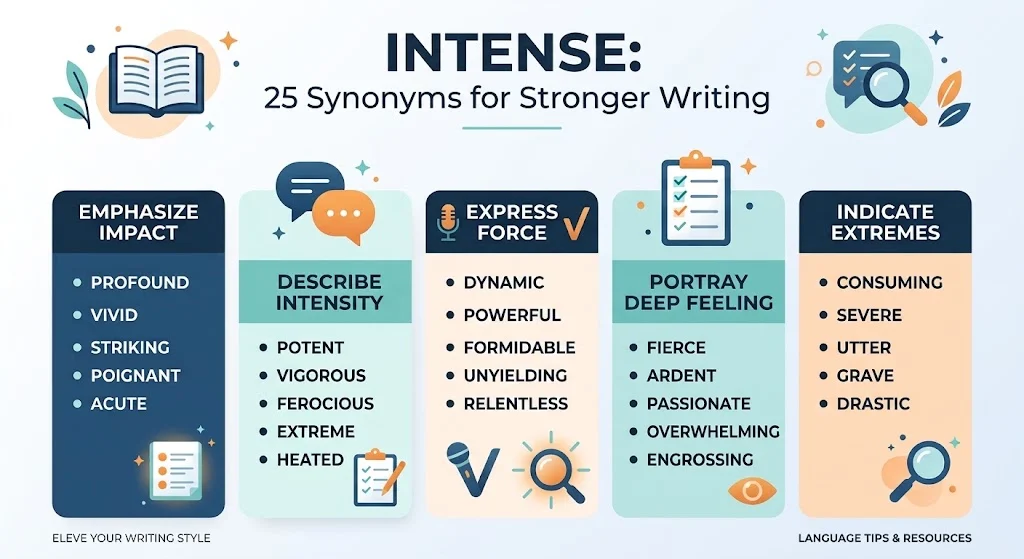
The word “intense” describes something that is very strong, powerful, or extreme in degree. It can be used for feelings, physical conditions, or effort. The best synonym depends on your context. For a professional setting, try “substantial.” For casual conversation, “fierce” works well. In academic writing, “profound” is a strong choice. For creative writing, “passionate” or “overwhelming” is often a great fit.
Meaning, Tone and Context
- Simple definition: Intense describes a situation, feeling, or quality that is very strong or extreme.
- Part of speech: It is an adjective.
- Tone: The tone is neutral but can lean positive or negative depending on the context. An intense workout is positive. Intense criticism is negative.
- Formality level: It is neutral and can be used in almost any setting, from casual chats to professional reports.
- Common use cases: You will hear it used to describe weather (“intense heat”), emotions (“intense anger”), effort (“intense concentration”), and colors (“intense blue”).
- Important word forms: The noun form is “intensity.” The adverb is “intensely.”
When and How to Use “Intense”
“Intense” is best used when you want to emphasize that something is at the very top of the scale, whether it is heat, emotion, or difficulty. It tells the listener that this is not a mild or average experience. However, because it is so general, it is often better to use a more specific word.
Here are some realistic examples:
- Professional: “The negotiations were intense, requiring a high level of focus from both teams.”
- Personal: “I felt an intense wave of relief when I heard the good news.”
- Academic: “The intense scrutiny of the research data led to a breakthrough.”
- Emotional: “The movie was so intense that I had to look away from the screen.”
- Social Media: “This was the most intense workout I have ever done.”
- Resume: “I thrived in the intense, fast-paced environment of the newsroom.”
Another Word for “Intense”
The best single replacement for “intense” is often “fierce” for feelings like emotion or competition, “profound” for ideas, and “severe” for unpleasant situations .
- Professional writing: Consider “substantial” or “concentrated.”
- Academic writing: Try “profound” or “exhaustive.”
- Casual conversation: “Fierce,” “powerful,” or “heavy” are good options.
- Emotional writing: “Passionate” and “overwhelming” are strong choices .
- Creative writing: “Consuming,” “burning,” or “impassioned” add depth .
- Resume or workplace: Use “driven,” “intensive,” or “committed.”
- Social media captions: Try “wild,” “wild,” or “serious.”
- Stronger meaning: For more intensity, use “vehement” or “uncontrollable.”
- Softer meaning: For less intensity, use “keen” or “substantial.”
When Not to Use “Intense”
Avoid “intense” when you need to be precise. Saying something is “intense” is vague. A more exact word can make your writing much clearer.
- Vague: “The training was intense.”
- Precise: “The training was rigorous.”
- Vague: “She had an intense look.”
- Precise: “She had a piercing look.”
- Vague: “The heat was intense.”
- Precise: “The heat was oppressive.”
If you’re describing a feeling of displeasure or pain, “intense” is often a weaker choice than “excruciating” or “overwhelming.”
Words Commonly Confused With “Intense”
Here are some words that are often mixed up with “intense.”
- Intensive vs. Intense: “Intensive” describes an activity that requires a lot of effort or concentration over a short time. “Intense” describes the strength of a feeling or quality. You attend an “intensive training course,” but you feel an “intense” emotion .
- Fierce vs. Intense: “Fierce” often implies aggression or a strong, wild nature. “Intense” is more general. A “fierce competitor” suggests someone who is aggressive, while an “intense competitor” is someone who is deeply focused and determined .
- Severe vs. Intense: “Severe” is used for things that are very bad, serious, or unpleasant. “Intense” is more neutral. You can have “severe pain” or “severe weather.” “Intense pain” is also correct but “severe” often sounds more clinical or serious .
- Profound vs. Intense: “Profound” is often used for deep, serious, or intellectual matters. You would use “profound effect” rather than “intense effect” when discussing an idea’s impact .
- Extreme vs. Intense: “Extreme” usually refers to the furthest point possible, while “intense” focuses on the force or strength .
Best Synonym by Context for “Intense”
Which Synonym Should You Choose?
Choosing the right synonym means thinking about the meaning, the formality of your situation, and the emotional impact.
- Check the meaning: Are you talking about strong emotions, a difficult situation, or a deep idea? For emotions, think “passionate.” For a tough situation, think “severe.” For a deep idea, think “profound.”
- Consider the formality: Are you writing a text to a friend or a cover letter? Use “fierce” or “heavy” with friends. Use “substantial” or “extensive” in a cover letter.
- Think about emotional intensity: Do you need to sound dramatic or professional? For drama, choose “overwhelming.” For professionalism, choose “concentrated.”
- Look at the sentence context: What is the word describing? You would use “intense” for “color,” but “acute” for “pain.”
Real Life Examples of “Intense” in Sentences
- School: “The final exams required an intense level of preparation from all the students.”
- Workplace: “Working with that client was extremely intense, but we learned a lot from the experience.”
- Writing: “To make my essay more persuasive, I tried to use a more powerful synonym for ‘intense’ like ‘profound’.”
- Conversation: “My commute was absolutely wild today.”
- Social Media: “This coffee is serious. It is the strongest brew I have ever tasted.”
- Resume: “I am accustomed to working in an intensive, deadline-driven environment.”
- Email: “Thank you for your passionate support of this initiative.”
- Storytelling: “As she walked into the room, she felt an overwhelming wave of anxiety.”
25 Synonyms for “Intense”
Synonym Groups and Usage Differences
Professional vs. Personal Synonyms
In a professional context, you want to sound measured and reliable. Words like “substantial,” “intensive,” and “concentrated” show a high level of effort without being overly emotional . In a personal context, you can be more emotive with words like “fierce,” “overwhelming,” or “burning.”
Formal vs. Conversational Synonyms
In formal settings like reports or academic essays, choose words like “profound,” “extensive,” or “exhaustive.” These add a level of sophistication . In casual writing, texts, and everyday emails, “fierce,” “serious,” or even “heavy” sound more natural and relatable.
Academic Synonyms
Academic work values precision and depth. “Profound” is used for ideas and their impact. “Exhaustive” is used for research and analysis. “Acute” is used for specific, sharp observations .
Professional and Business Synonyms
In the business world, action and results matter. Words like “driven” (for people), “substantial” (for progress), and “intensive” (for training or projects) are effective. They show commitment and scale.
Creative or Literary Synonyms
If you want to add flair to your writing, “impassioned,” “consuming,” and “fervent” are excellent choices . They create vivid imagery and emotional depth.
Slang or Modern Synonyms
While not traditional synonyms, words like “wild,” “wild,” or “wild” are often used in casual, modern speech to describe a high level of intensity. These are only acceptable in very informal contexts, like social media or conversations with friends.
Strongest vs. Weaker Synonyms
This scale shows a gradual increase in strength:
Mild: Keen, Strong
Moderate: Powerful, Fierce, Severe
Strong: Extreme, Profound, Acute
Strongest: Vehement, Uncontrollable, Overwhelming
Emotional vs. Neutral Synonyms
- Emotional: “Passionate,” “overwhelming,” “burning,” and “fervent” add a layer of feeling.
- Neutral: “Substantial,” “concentrated,” “extensive,” and “severe” are more factual and objective.
Antonyms of “Intense”
Comparison: Intense vs. Similar Words
Intense vs. Severe
The main difference is that “intense” is often positive or neutral, while “severe” is almost always negative. “Severe” is stronger for unpleasant things .
- Which is stronger? Severe is stronger for bad situations.
- Which is more formal? Both are formal, but “severe” is often used in clinical or official reports.
- Example: “The intense competition pushed us to be better.” vs. “The severe weather caused a power outage.”
Intense vs. Fierce
“Fierce” implies aggression, wildness, or a protective nature. “Intense” is broader and more general .
- Which is stronger? “Fierce” is often emotionally stronger for living things.
- Which is more formal? “Intense” is generally more formal.
- Example: “The intense sunlight was blinding.” vs. “The lion let out a fierce roar.”
Intense vs. Profound
“Profound” is used for deep, intellectual, or emotional matters that have significant meaning .
- Which is stronger? “Profound” suggests a deeper level of impact.
- Which is more formal? “Profound” is more formal and often used in academic contexts.
- Example: “The intense heat was exhausting.” vs. “His words had a profound impact on me.”
Intense vs. Acute
“Acute” is usually used for sharp physical pain or a critical problem that requires immediate attention .
- Which is stronger? “Acute” is often stronger for physical sensations.
- Which is more formal? Both are formal, but “acute” is frequently used in medical contexts.
- Example: “She felt an intense desire to travel.” vs. “He suffered from acute abdominal pain.”
Intense vs. Extreme
“Extreme” refers to being at the furthest limit, while “intense” refers to strong force or strength .
- Which is stronger? “Extreme” can be stronger as it denotes the outer limits.
- Which is more formal? Both are neutral.
- Example: “The heat was intense today.” vs. “The conditions were extreme.”
Intense vs. Overwhelming
“Overwhelming” specifically means something is so strong it feels impossible to resist or handle .
- Which is stronger? “Overwhelming” implies a sense of being overcome.
- Which is more emotional? “Overwhelming” has a stronger emotional connotation.
- Example: “He had an intense interest in art.” vs. “She felt an overwhelming sense of loss.”
Common Phrases and Expressions with “Intense”
1. Intense Heat
Meaning: This phrase describes extreme, often uncomfortable warmth .
Example sentence: “The explorers struggled to survive the intense heat of the desert.”
2. Intense Pain
Meaning: This describes very strong, often unbearable physical suffering.
Example sentence: “She experienced intense pain after the injury.”
3. Intense Pressure
Meaning: This phrase refers to a high level of stress or demands.
Example sentence: “He works well under intense pressure.”
4. Intense Workout
Meaning: This describes a period of very vigorous and demanding physical exercise.
Example sentence: “I need a rest day after that intense workout.”
5. Intense Competition
Meaning: This phrase describes a situation where rivals are very determined to succeed .
Example sentence: “The company faces intense competition in the global market.”
6. Intense Concentration
Meaning: This phrase describes a state of complete focus and attention.
Example sentence: “His job requires intense concentration for hours at a time.”
7. Intense Color
Meaning: This describes a color that is very strong and highly saturated .
Example sentence: “The artist used an intense shade of blue in the painting.”
Common Mistakes to Avoid
- Using “Intense” when a more precise synonym is better: Calling everything “intense” is a common crutch. Be specific. Instead of “intense effort,” use “rigorous.” Instead of “intense anger,” use “fury.”
- Confusing “Intense” with “Intensive”: “Intensive” is for activities. “Intense” is for qualities and feelings. You attend an “intensive course,” but you feel an “intense emotion.”
- Using a casual synonym in formal writing: Avoid slang like “wild” or “wild” in professional reports or academic essays.
- Using an overly dramatic synonym for a simple situation: Calling a mildly difficult task “overwhelming” is an exaggeration that can sound insincere.
- Repeating the same word: If you use “intense” in a paragraph, find a synonym to vary your vocabulary.
- Choosing a synonym with the wrong emotional tone: “Severe” has a negative connotation, while “profound” is neutral or positive. Make sure the tone matches the situation.
- Using slang in academic or professional writing: Save words like “wild” and “wild” for social media and casual conversations.
FAQs
- What is the best synonym for intense?
- The best synonym depends on the context. For strong feelings, “passionate” is excellent. For serious situations, “severe” is often the best choice . For deep ideas, “profound” is the strongest synonym .
What is a formal synonym for intense?
For formal writing, use “profound,” “concentrated,” or “exhaustive.” These words sound academic and professional . “Substantial” is also a strong choice for business or professional contexts.
What is an informal synonym for intense?
In casual conversation, you can use words like “fierce,” “heavy,” “wild,” or “serious.” These words are common and sound natural when speaking to friends.
What is another word for intense in professional writing?
In professional writing, consider “driven,” “substantial,” “intensive,” or “concentrated.” These words show dedication and scale without being overly emotional.
What is the difference between intense and severe?
“Intense” describes a strong force, quality, or feeling, which can be positive or neutral. “Severe” is used for things that are very bad, unpleasant, or serious .
What is the opposite of intense?
Common opposites of intense include “mild,” “moderate,” “weak,” and “soft.” A mild heat is the opposite of an intense heat .
Conclusion
The word “intense” is a valuable part of the English language, but it should not be your only tool. As you have seen, there is a wealth of more precise and powerful alternatives available.
- The key to using these words well is to think about your context. Choose “profound” when you mean deep and meaningful. Choose “severe” when things are serious and unpleasant. Choose “fierce” when there is a competitive or aggressive element. The best word is the one that fits the situation and your message perfectly.
My final advice is to pick two or three synonyms from this list and use them in your writing this week. The more you practice, the more natural they will become. Good luck with your vocabulary journey.
