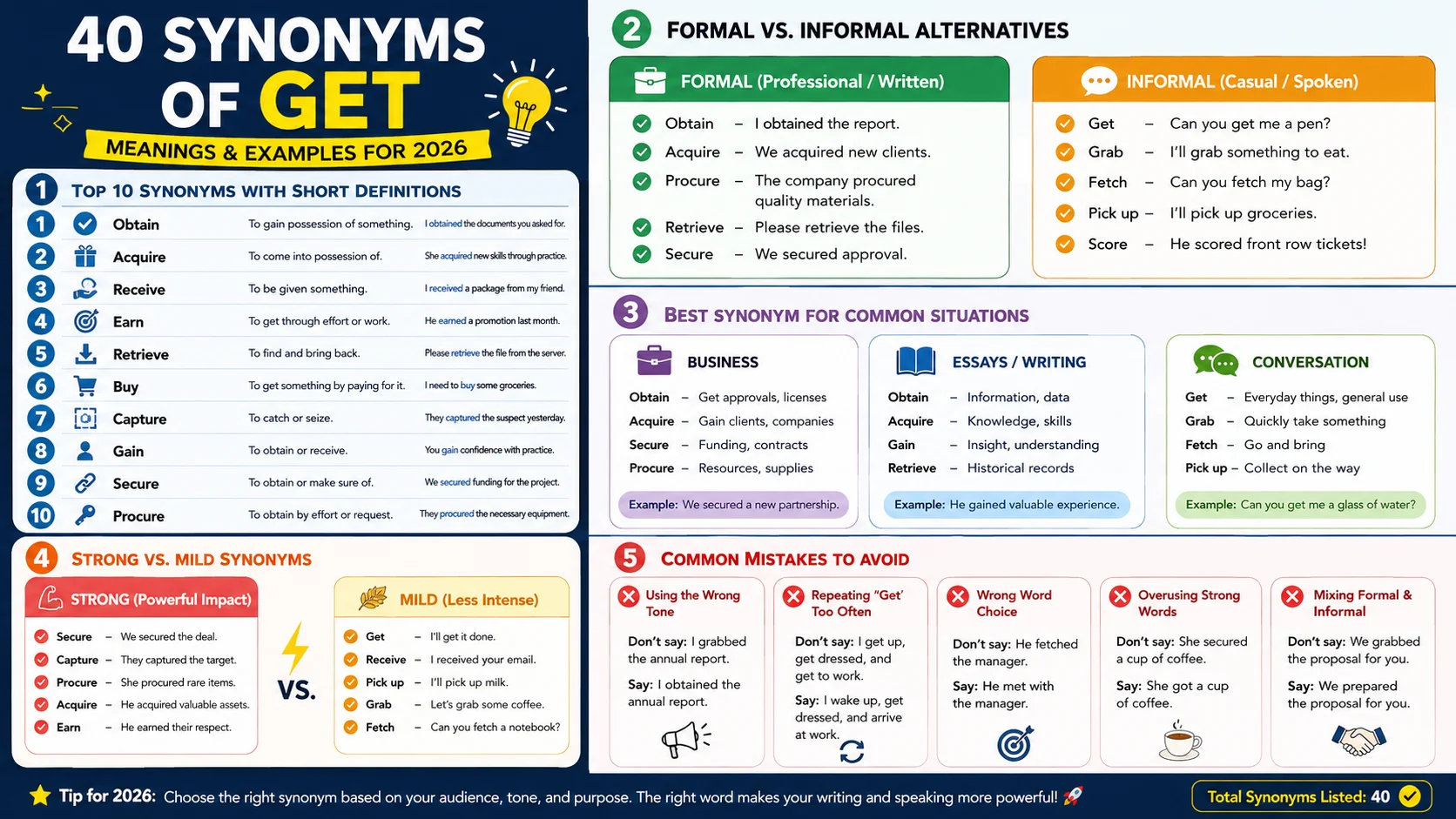
“Get” is one of the most common verbs in English. It can mean to receive, obtain, or become. The best synonyms are receive, obtain, acquire, gain, and secure. Receive” is the most common alternative, but each synonym works in different situations. The right choice depends on your context and tone.
Top 10 Synonyms
- Receive
- Obtain
- Acquire
- Gain
- Secure
- Attain
- Earn
- Collect
- Retrieve
- Pick up
Do you find yourself using the word “get” all the time? You’re not alone! “Get” is one of the most frequently used words in English. It’s useful and versatile, but using it too much can make your English sound repetitive and basic.
The good news is that English is full of wonderful alternatives. Each one adds a different flavor to your sentences. Some are formal, some are casual, and some describe a specific type of getting.
In this guide, you’ll discover 40 powerful synonyms for “get.” You’ll learn exactly when to use each one, how formal they are, and what mistakes to avoid. By the end, you’ll have a rich vocabulary that will impress native speakers in any situation.
What Does “Get” Mean?
Definition
Get” is a very common verb with many meanings. The main meanings are to receive something, to obtain something, to become something, or to understand something. For example, you can get a gift, get a job, get tired, or get the joke. It’s a flexible word used in almost every situation.
Pronunciation
| Feature | Value |
|---|---|
| US IPA | /ɡɛt/ |
| UK IPA | /ɡɛt/ |
| Syllables | 1 |
| Tip | Short and sharp. Say it like “get” not “git.” |
Grammar
| Grammar Feature | Information |
|---|---|
| Part of Speech | Verb (transitive and intransitive) |
| Common Position | After the subject |
| Typical Pattern | Subject + get + object / adjective |
Examples:
- “I get your point.” (understand)
- “She gets nervous before exams.” (becomes)
- “We need to get some milk.” (obtain)
- “He got a promotion last week.” (received)
Grammar Note: “Get” is incredibly versatile. It can mean “obtain,” “become,” “receive,” “understand,” and more. That’s why it’s so common, but also why it’s helpful to have alternatives.
Word Family
| Word | Part of Speech | Meaning |
|---|---|---|
| Get | Verb | To receive, obtain, or become |
| Getting | Gerund | The act of obtaining |
| Got | Verb (past) | Past tense of get |
| Gotten | Verb (past participle) | Past participle (US) |
| Getter | Noun | A person who gets things |
15 Synonyms of “Get”
Receive
Meaning: To be given something; to accept something that is sent or offered.
Best Used For: Daily conversation, business writing, describing mail, gifts, or information.
Formality: Neutral
Tone: Passive, Neutral
Frequency: ⭐⭐⭐⭐⭐ (Very Common)
CEFR Level: A2
Example Sentence 1: “I received a beautiful birthday card from my grandmother.
Example Sentence 2: “She received a warm welcome from her new colleagues.”
Usage Tip: “Receive” is the most direct and common alternative. Use it when you are on the receiving end of something. It doesn’t imply effort, just that you got it.
Common Confusion: Receive vs Get. “Receive” is slightly more formal and often used for gifts, mail, and official communications.
Obtain
Meaning: To get something through effort or a specific process.
Best Used For: Formal writing, academic contexts, official documents.
Formality: Formal
Tone: Professional, Structured
Frequency: ⭐⭐⭐⭐ (Common)
CEFR Level: B2
Example Sentence 1: “You must obtain a permit before starting construction.”
Example Sentence 2: “The researchers obtained valuable data from the experiment.”
Usage Tip: “Obtain” is a formal word that suggests you had to work or follow steps to get something. It’s perfect for official situations.
Acquire
Meaning: To get something over time, especially skills, knowledge, or valuable items.
Best Used For: Business, academic writing, personal development.
Formality: Formal
Tone: Professional, Gradual
Frequency: ⭐⭐⭐⭐ (Common)
CEFR Level: B2
Example Sentence 1: “She acquired a lot of experience during her years abroad.
Example Sentence 2: “The museum acquired a rare collection of paintings.”
Usage Tip: “Acquire” suggests a process of building up. You don’t just acquire something; you earn it over time.
Gain
Meaning: To get something useful or beneficial, often through effort.
Best Used For: Professional writing, personal growth, describing advantages.
Formality: Neutral
Tone: Positive, Motivating
Frequency: ⭐⭐⭐⭐ (Common)
CEFR Level: B1
Example Sentence 1: “You will gain confidence as you practice more.
Example Sentence 2: “The company gained a lot of new customers this year.”
Usage Tip: “Gain” is perfect when you receive something positive. It has a very optimistic and encouraging tone.
Secure
Meaning: To get something that requires extra effort, often overcoming challenges.
Best Used For: Business, job hunting, formal settings.
Formality: Formal
Tone: Professional, Confident
Frequency: ⭐⭐⭐⭐ (Common)
CEFR Level: B2
Example Sentence 1: “She secured a position at a top law firm.”
Example Sentence 2: “We need to secure funding for our project.”
Usage Tip: “Secure” implies that getting something was a real accomplishment. It’s a great word for resumes and interviews.
Attain
Meaning: To successfully reach or achieve a goal after a lot of effort.
Best Used For: Academic writing, formal speeches, describing major achievements.
Formality: Formal
Tone: Inspirational, Academic
Frequency: ⭐⭐⭐ (Moderate)
CEFR Level: B2
Example Sentence 1: “He attained the rank of colonel after twenty years of service.”
Example Sentence 2: “Her goal was to attain a perfect score on the exam.”
Usage Tip: “Attain” is for big accomplishments. You don’t attain a glass of water; you get it. You attain a degree or a high position.
Earn
Meaning: To get something because of your work, good behavior, or effort.
Best Used For: Work, finance, describing rewards.
Formality: Neutral
Tone: Fair, Deserved
Frequency: ⭐⭐⭐⭐⭐ (Very Common)
CEFR Level: A2
Example Sentence 1: “He earned a promotion because of his dedication.”
Example Sentence 2: “She earns a good salary at her new job.”
Usage Tip: “Earn” emphasizes that you deserved what you got. It’s about being rewarded for your efforts.
Collect
Meaning: To gather things from different places or over time.
Best Used For: Hobbies, research, organized tasks.
Formality: Neutral
Tone: Organized, Practical
Frequency: ⭐⭐⭐⭐ (Common)
CEFR Level: A2
Example Sentence 1: “She collects rare coins from around the world.”
Example Sentence 2: “We collected data from over 500 participants.”
Usage Tip: “Collect” works well when you’re gathering multiple items from different sources. It’s perfect for hobbies and research.
Retrieve
Meaning: To find and bring something back, especially something lost or out of reach.
Best Used For: Technology, finding lost items, describing actions in stories.
Formality: Neutral
Tone: Action-oriented, Practical
Frequency: ⭐⭐⭐ (Moderate)
CEFR Level: B1
Example Sentence 1: “The dog retrieved the ball from the lake.”
Example Sentence 2: “I need to retrieve my files from the backup drive.”
Usage Tip: “Retrieve” is for getting something that is currently somewhere else. It implies effort to bring it back.
Pick up
Meaning: To collect or buy something, or to learn something informally.
Best Used For: Daily conversation, shopping, informal contexts.
Formality: Informal
Tone: Casual, Easy
Frequency: ⭐⭐⭐⭐⭐ (Very Common)
CEFR Level: A2
Example Sentence 1: “Can you pick up some bread on your way home?”
Example Sentence 2: “I picked up a few French phrases during my trip.”
Usage Tip: “Pick up” is extremely natural in casual speech. Use it for buying small things or learning skills informally.
Come by
Meaning: To get something, especially when it’s not easy to find.
Best Used For: Informal conversation, describing rare finds.
Formality: Informal
Tone: Casual, Direct
Frequency: ⭐⭐⭐ (Moderate)
CEFR Level: B1
Example Sentence 1: “Good jobs are hard to come by in this small town.”
Example Sentence 2: “How did you come by that antique painting?”
Usage Tip: “Come by” is a great phrasal verb for everyday speech. It’s often used to say something is rare or hard to find.
Access
Meaning: To get or use something, especially information or technology.
Best Used For: Technology, digital contexts, rights and permissions.
Formality: Neutral
Tone: Modern, Practical
Frequency: ⭐⭐⭐⭐ (Common)
CEFR Level: B1
Example Sentence 1: “You need a password to access the website.”
Example Sentence 2: “Students can access the library’s online resources.”
Usage Tip: “Access” is the go-to word for digital contexts. It’s becoming more and more common in daily life.
Derive
meaning: To get something from a specific source, often enjoyment or meaning.
Best Used For: Academic writing, formal contexts, analytical writing.
Formality: Formal
Tone: Analytical, Intellectual
Frequency: ⭐⭐⭐ (Moderate)
CEFR Level: B2
Example Sentence 1: “He derives great satisfaction from helping others.”
Example Sentence 2: “Many English words derive from Latin.
Usage Tip: “Derive” is a formal word that works well in essays. It often describes where something comes from.
Reap
Meaning: To receive benefits as a result of previous actions.
Best Used For: Metaphors, literary writing, describing rewards.
Formality: Informal/Literary
Tone: Metaphorical, Thoughtful
Frequency: ⭐⭐ (Rare)
CEFR Level: B2
Example Sentence 1: “You will reap the rewards of your hard work.”
Example Sentence 2: “She reaped the benefits of her healthy lifestyle.
Usage Tip: “Reap” comes from farming. You reap what you sow. It’s great for metaphorical language about rewards.
Procure
Meaning: To get something, especially through effort or official channels.
Best Used For: Business, official contexts, formal situations.
Formality: Formal
Tone: Official, Business-like
Frequency: ⭐⭐ (Rare)
CEFR Level: C1
Example Sentence 1: “We need to procure new equipment for the factory.”
Example Sentence 2: “The government procured supplies for the relief effort.”
Usage Tip: “Procure” is a very formal word. It’s used in business and official contexts. You’ll rarely hear it in everyday conversation.
Land
Meaning: To get a job or opportunity, often unexpectedly.
Best Used For: Informal conversation, job hunting, describing lucky opportunities.
Formality: Informal
Tone: Casual, Lucky
Frequency: ⭐⭐⭐ (Moderate)
CEFR Level: B1
Example Sentence 1: “She landed a fantastic job at a tech company.”
Example Sentence 2: “He landed the lead role in the school play.
Usage Tip: “Land” is a great informal word for getting something desirable, especially a job or position. It suggests a bit of luck.
Synonyms Comparison Table
| Synonym | Best Context | Formality | Tone | Frequency |
|---|---|---|---|---|
| Receive | Gifts, mail, information | Neutral | Passive | ⭐⭐⭐⭐⭐ |
| Obtain | Official processes | Formal | Structured | ⭐⭐⭐⭐ |
| Acquire | Skills, knowledge | Formal | Professional | ⭐⭐⭐⭐ |
| Gain | Benefits, advantages | Neutral | Positive | ⭐⭐⭐⭐ |
| Secure | Jobs, funding | Formal | Confident | ⭐⭐⭐⭐ |
| Earn | Work, rewards | Neutral | Deserved | ⭐⭐⭐⭐⭐ |
| Collect | Hobbies, research | Neutral | Organized | ⭐⭐⭐⭐ |
| Retrieve | Lost items, files | Neutral | Practical | ⭐⭐⭐ |
| Access | Technology, data | Neutral | Modern | ⭐⭐⭐⭐ |
| Attain | Major goals | Formal | Inspirational | ⭐⭐⭐ |
| Pick up | Errands, shopping | Informal | Casual | ⭐⭐⭐⭐⭐ |
| Land | Jobs, opportunities | Informal | Lucky | ⭐⭐⭐ |
Best Synonyms by Situation
| Situation | Best Synonym | Why It Works |
|---|---|---|
| Daily Conversation | Pick up | Natural, casual, and friendly |
| Business Email | Obtain | Professional and clear |
| Academic Writing | Acquire | Formal and precise |
| School Assignment | Attain | Shows effort toward goals |
| Professional Meeting | Secure | Sounds confident and capable |
| Presentation | Gain | Positive and motivating |
| Creative Writing | Reap | Adds literary flair |
| Social Media | Get/Pick up | Casual and fits the platform |
| Job Interview | Land/Secure | Shows ambition and professionalism |
Formal vs Informal Synonyms
Formal Alternatives
| Synonym | Best Used For |
|---|---|
| Obtain | Official documents, permits, formal requests |
| Acquire | Skills, knowledge, valuable items |
| Procure | Business supplies, official procurement |
| Attain | Achieving high-level goals or positions |
| Secure | Getting a job, funding, or competitive advantage |
Neutral Alternatives
| Synonym | Best Used For |
|---|---|
| Receive | Gifts, information, mail |
| Gain | Benefits, experience, knowledge |
| Collect | Data, stamps, items over time |
| Access | Digital content and information |
Informal Alternatives
| Synonym | Best Used For |
|---|---|
| Pick up | Shopping, learning informally |
| Come by | Rare items, hard-to-find things |
| Land | Getting a job or opportunity |
| Get | Almost any casual conversation |
Choosing the Right Level: In a business email, use “obtain” or “secure.” In an essay, use “acquire” or “attain.” With friends, use “pick up” or “land.” The context decides the right word.
Strong vs Mild Synonyms
Mild
Suitable for everyday situations with no special effort.
- Get
- Receive
- Pick up
Moderate
Suggest some effort or a professional context.
- Obtain
- Acquire
- Gain
- Collect
- Access
Strong
Suggest significant effort, formality, or high achievement.
- Secure (implies overcoming challenges)
- Attain (implies reaching a major milestone)
- Procure (implies complex arrangements)
- Reap (implies benefiting from past actions)
How Intensity Changes Meaning: “I got a job” is simple. “I secured a position” sounds much more impressive. Think about how much effort you want to emphasize and choose accordingly.
Real-Life Examples
School: “The students need to acquire the textbook before the class starts.”
Office: “We need to secure approval from the manager before we proceed.”
Business Email: “Please obtain the necessary documents for the meeting.”
Meetings: “Our goal this quarter is to gain more market share.”
Presentations: “If you work hard, you will attain your sales targets.”
Daily Conversations: “I need to pick up some groceries on my way home.”
Social Media: “I came by this amazing recipe on TikTok!”
Academic Writing: “The scientists derived their conclusions from the data.”
Job Interview: “I’m hoping to land a position in marketing.”
Common Collocations
| Common Phrase | Better Alternative |
|---|---|
| Get a job | Secure a position / Land a job |
| Get a degree | Earn a degree / Attain a degree |
| Get information | Access information |
| Get permission | Obtain permission (more formal) |
| Get experience | Gain experience / Acquire experience |
| Get a reward | Receive a reward |
| Get a skill | Acquire a skill |
| Get knowledge | Gain knowledge |
Common Phrases
Get a move on: To hurry up. (e.g., “We need to get a move on or we’ll be late.”)
Get the hang of: To learn how to do something. (e.g., “I’m finally getting the hang of this software.”)
Get away with: To avoid punishment. (e.g., “He got away with being late.”)
Come by honestly: To get something fairly. (e.g., “His success was hard to come by.”)
Reap the benefits: To receive rewards. (e.g., “You’ll reap the benefits of your hard work.”)
Land on your feet: To get a good result after a difficult situation.
Context Guide
| Situation | Best Synonym | Reason |
|---|---|---|
| Essay | Acquire / Attain | Formal and academic |
| Speech | Attain / Secure | Ambitious and inspiring |
| Business Email | Obtain / Procure | Professional and official |
| Novel | Reap / Gain | Adds literary variety |
| Presentation | Gain / Secure | Positive and motivating |
| Conversation | Pick up / Come by | Natural and casual |
| Academic Writing | Derive / Acquire | Precise and analytical |
| Marketing Copy | Gain / Access | Highlights customer benefits |
Related Words
Near Synonyms
- Land: To get a job or opportunity (informal). (e.g., “She landed a great internship.”)
- Score: To get something good (slang). (e.g., “I scored free tickets to the concert!”)
- Wrangle: To get something through negotiation. (e.g., “He wrangled a better deal.”)
- Net: To get or earn after deductions. (e.g., “She netted a profit from the sale.”)
Antonyms
- Lose: To no longer have something.
- Give up: To stop trying to get something.
- Miss: To fail to get something.
- Forfeit: To lose something as a penalty.
- Surrender: To give up possession of something.
Related Adjectives
- Obtainable: Possible to get. (e.g., “The product is easily obtainable online.”)
- Unattainable: Impossible to get. (e.g., “An unattainable dream.”)
- Acquired: Gotten or developed. (e.g., “An acquired taste.”)
- Available: Able to be gotten or used.
Related Nouns
- Acquisition: The act of acquiring something.
- Procurement: The formal process of obtaining supplies.
- Gain: An increase or advantage.
- Receipt: The act of receiving something.
- Access: The right or ability to get something.
Related Verbs
- Gather: To collect from different places.
- Purchase: To buy something.
- Seize: To take hold of something suddenly.
- Capture: To take something by force or skill.
Frequently Asked Questions
What is another word for get?
Common synonyms for get include receive, obtain, acquire, gain, secure, earn, and collect. The best choice depends on your context and how much effort you want to imply.
Which synonym sounds the most professional?
Secure and obtain sound the most professional. “Secure” implies you successfully got something despite difficulty, while “obtain” is a safe choice for formal writing.
What is the strongest synonym for get?
Attain is one of the strongest synonyms. It suggests reaching a significant goal after a lot of effort. “Secure” is also strong, implying you overcame obstacles.
Which synonym is best for essays?
Acquire and attain are excellent for essays. They sound formal and academic. “Derive” is also great for analytical writing when discussing sources or conclusions.
What’s the difference between get and receive?
“Get” is more general and informal. “Receive” is slightly more formal and specifically means you were given something without needing to seek it out.
Which synonym is most common in everyday English?
“Receive” is very common, but native speakers also use “pick up” and “earn” frequently. “Get” itself is still the most used word in casual speech.
What is the opposite of get?
The most common opposites are lose, give up, and miss. In formal contexts, “forfeit” is another opposite meaning to lose something as a penalty.
Conclusion
“Get” may be a small word, but it’s incredibly powerful and versatile. By learning these 40 synonyms, you now have the ability to express yourself with more precision and style.
The key takeaway is this: there is no perfect synonym for every situation. The right word depends on context, formality, and what you want to emphasize. Use “receive” for gifts and information. Use “acquire” for skills and knowledge. Use “secure” for jobs and accomplishments. Use “pick up” for everyday tasks.
The best way to improve is to practice. Try using one or two new synonyms each day. Listen for these words in movies, podcasts, and conversations with native speakers. Your vocabulary will grow stronger and more natural with time.
