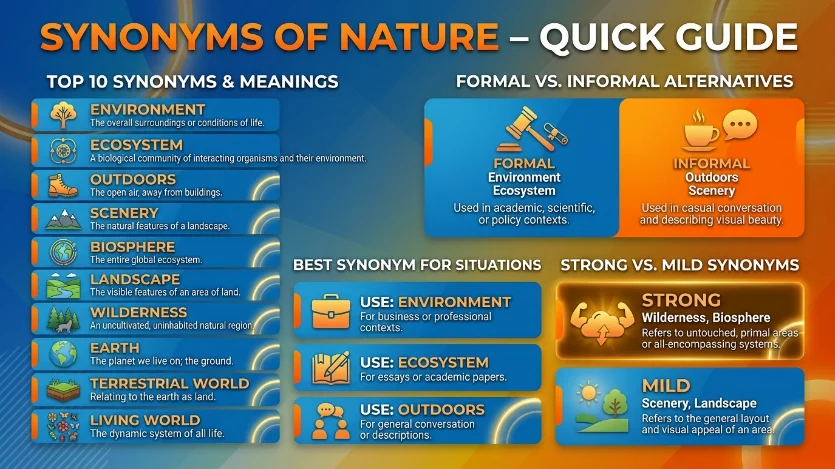
Nature refers to the physical world, including plants, animals, landscapes, and natural forces. The best synonyms are environment, scenery, landscape, wilderness, and ecosystem. “Environment” is the most common and versatile. Each synonym has a slightly different meaning, tone, or context.
Top 10 Synonyms
- Environment
- Scenery
- Landscape
- Wilderness
- Ecosystem
- Countryside
- Habitat
- Outdoors
- World
- Creation
Do you love talking about the natural world but feel stuck using the same word over and over? Many English learners struggle with this. The word “nature” is useful, but using it too often can make your writing and speaking sound repetitive and dull.
Learning different ways to say “nature” helps you describe the world more vividly and accurately. Each synonym paints a different picture. Some focus on the beauty of a view, others on wild places, and some on the living systems that connect everything.
In this guide, you will learn 30 powerful alternatives. You will also discover when to use each one, how formal they are, and common mistakes to avoid. Let’s dive in!
What Does “Nature” Mean?
Definition
Nature is everything in the physical world that is not made by humans. This includes all plants, animals, mountains, oceans, forests, and the weather. It also refers to the forces that control the physical world, like gravity and the changing seasons. When we talk about nature, we are talking about the world as it exists on its own.
Pronunciation
| Feature | Value |
|---|---|
| US IPA | /ˈneɪtʃər/ |
| UK IPA | /ˈneɪtʃə/ |
| Syllables | 2 (na-ture) |
| Tip | Stress the first syllable: “NAY-chur” |
Grammar
| Grammar Feature | Information |
|---|---|
| Part of Speech | Noun |
| Common Position | Subject or Object |
| Typical Pattern | Nature + of + something / Nature + is |
Examples:
- “Nature provides us with everything we need.”
- “The nature of the problem was unclear.”
- “She loves spending time in nature.”
Grammar Note: “Nature” can be used in two ways. It can mean the natural world (uncountable) or the basic qualities of something (the nature of the problem). This second meaning is important to understand.
Word Family
| Word | Part of Speech | Meaning |
|---|---|---|
| Nature | Noun | The physical world and its forces |
| Natural | Adjective | Existing in or caused by nature |
| Naturally | Adverb | In a natural way; of course |
| Naturalist | Noun | A person who studies nature |
| Naturalize | Verb | To make something natural or accepted |
15 Synonyms of “Nature”
Environment
Meaning: The surroundings or conditions in which people, animals, or plants live.
Best Used For: Academic writing, science, formal discussions about ecology.
Formality: Formal
Tone: Scientific, Neutral
Frequency: ⭐⭐⭐⭐⭐ (Very Common)
CEFR Level: B1
Example Sentence 1: “We must protect the environment for future generations.
Example Sentence 2: “The environment in the city is very polluted.”
Usage Tip: “Environment” is the most common and formal synonym. Use it when talking about ecological issues, pollution, or general living conditions.
Scenery
Meaning: The natural features of a place that you can see, especially beautiful ones.
Best Used For: Travel writing, tourism, describing beautiful views.
Formality: Neutral
Tone: Beautiful, Descriptive
Frequency: ⭐⭐⭐⭐ (Common)
CEFR Level: B1
Example Sentence 1: “The scenery in the mountains is breathtaking.”
Example Sentence 2: “We stopped the car to admire the scenery.
Usage Tip: “Scenery” focuses on the visual beauty of a place. It’s perfect for travel and descriptions of views.
Landscape
Meaning: The visible features of an area of land, including hills, valleys, and trees.
Best Used For: Art, geography, photography, travel writing.
Formality: Neutral
Tone: Descriptive, Artistic
Frequency: ⭐⭐⭐⭐ (Common)
CEFR Level: B1
Example Sentence 1: “The landscape of the desert is vast and empty.”
Example Sentence 2: “She painted a beautiful landscape of the countryside.
Usage Tip: “Landscape” is a great word for describing the shape and features of the land. It’s often used in art and geography.
Common Confusion: Landscape vs Scenery. “Landscape” focuses on the physical features of the land, while “scenery” focuses on the visual beauty of what you can see.
Wilderness
Meaning: A wild, natural area that has not been changed by humans.
Best Used For: Adventure writing, environmental activism, describing remote places.
Formality: Neutral
Tone: Adventurous, Untamed
Frequency: ⭐⭐⭐ (Moderate)
CEFR Level: B2
Example Sentence 1: “They spent a week exploring the Alaskan wilderness.”
Example Sentence 2: “Large areas of wilderness have been destroyed by development.”
Usage Tip: “Wilderness” describes places that are truly wild and untouched. It suggests adventure, danger, and beauty.
Ecosystem
Meaning: A community of living things and their physical environment, working together as a system.
Best Used For: Science, academic writing, environmental studies.
Formality: Formal
Tone: Scientific, Technical
Frequency: ⭐⭐⭐ (Moderate)
CEFR Level: B2
Example Sentence 1: “The coral reef is a fragile ecosystem.”
Example Sentence 2: “Human activity is destroying many ecosystems.”
Usage Tip: “Ecosystem” is a scientific term. Use it when talking about how plants, animals, and the environment interact.
Countryside
Meaning: Land outside towns and cities, especially farmland and rural areas.
Best Used For: Travel, describing rural life, tourism.
Formality: Neutral
Tone: Peaceful, Rural
Frequency: ⭐⭐⭐⭐ (Common)
CEFR Level: A2
Example Sentence 1: “We moved to the countryside to escape the city noise.”
Example Sentence 2: “The English countryside is famous for its rolling hills.”
Usage Tip: “Countryside” is a very common word for rural areas. It’s a peaceful, pleasant word.
Habitat
Meaning: The natural home or environment of an animal, plant, or organism.
Best Used For: Science, ecology, conservation.
Formality: Formal
Tone: Scientific, Concerned
Frequency: ⭐⭐⭐ (Moderate)
CEFR Level: B2
Example Sentence 1: “The forest is the natural habitat of many animals.”
Example Sentence 2: “We must protect the habitat of endangered species.”
Usage Tip: “Habitat” is a specific term about where living things live. It’s used in science and conservation.
Outdoors
Meaning: The natural world outside buildings, especially in the open air.
Best Used For: Everyday conversation, activities, describing being outside.
Formality: Informal
Tone: Casual, Active
Frequency: ⭐⭐⭐⭐⭐ (Very Common)
CEFR Level: A2
Example Sentence 1: “We enjoy spending time in the outdoors.”
Example Sentence 2: “Children need to play outdoors more often.
Usage Tip: “Outdoors” is a very common, informal word. It’s perfect for everyday conversation about being outside.
World
Meaning: The earth and all its people, places, and natural features.
Best Used For: General conversation, formal and informal writing.
Formality: Neutral
Tone: Broad, Inclusive
Frequency: ⭐⭐⭐⭐⭐ (Very Common)
CEFR Level: A1
Example Sentence 1: “The natural world is full of wonders.”
Example Sentence 2: “We need to protect the world we live in.”
Usage Tip: “World” is a very broad word. In the context of nature, it often means “the natural world” or the earth itself.
Creation
Meaning: The world and everything in it, especially as seen as having been made by God or nature.
Best Used For: Poetry, literary writing, spiritual contexts.
Formality: Formal/Literary
Tone: Spiritual, Poetic
Frequency: ⭐⭐ (Rare)
CEFR Level: B2
Example Sentence 1: “The beauty of creation is all around us.”
Example Sentence 2: “He found peace in the wonders of creation.”
Usage Tip: “Creation” is a beautiful word with a spiritual tone. It’s used in poetry and philosophical writing.
Terrain
Meaning: The physical features of a piece of land, like hills, rocks, or valleys.
Best Used For: Geography, hiking, military, describing land.
Formality: Neutral
Tone: Practical, Specific
Frequency: ⭐⭐⭐ (Moderate)
CEFR Level: B2
Example Sentence 1: “The terrain in the mountains is difficult to cross.”
Example Sentence 2: “The map shows the different types of terrain.”
Usage Tip: “Terrain” is a specific word about the physical features of the land. It’s practical and often used for navigation.
Wildlife
Meaning: All the animals and plants that live in the wild.
Best Used For: Conservation, documentaries, travel, science.
Formality: Neutral
Tone: Protective, Fascinated
Frequency: ⭐⭐⭐⭐ (Common)
CEFR Level: B1
Example Sentence 1: “The island has incredible wildlife, including rare birds.”
Example Sentence 2: “Wildlife populations are declining due to climate change.”
Usage Tip: “Wildlife” specifically refers to the living creatures in nature. It’s a very common and important word.
Greenery
Meaning: Green plants and leaves, especially as a feature of a place.
Best Used For: Describing cities, gardening, peaceful descriptions.
Formality: Neutral
Tone: Peaceful, Pleasant
Frequency: ⭐⭐⭐ (Moderate)
CEFR Level: B1
Example Sentence 1: “The city has a lot of greenery in its parks.
Example Sentence 2: “We bought a house surrounded by greenery.”
Usage Tip: “Greenery” is a positive word about plants and leaves. It suggests something pleasant, peaceful, and alive.
Biosphere
Meaning: The parts of the earth where living things exist.
Best Used For: Science, academic writing, formal ecology.
Formality: Formal
Tone: Scientific, Global
Frequency: ⭐⭐ (Rare)
CEFR Level: C1
Example Sentence 1: “Human activity is changing the biosphere.”
Example Sentence 2: “The biosphere includes all living things on earth.
Usage Tip: “Biosphere” is a scientific term for the global ecosystem. It’s used in serious academic writing.
Flora and Fauna
Meaning: The plants (flora) and animals (fauna) of a particular area.
Best Used For: Travel writing, science, describing biodiversity.
Formality: Formal
Tone: Scientific, Appreciative
Frequency: ⭐⭐ (Rare)
CEFR Level: B2
Example Sentence 1: “The island is famous for its unique flora and fauna.”
Example Sentence 2: “The report described the area’s flora and fauna in detail.”
Usage Tip: “Flora and fauna” is a formal term used in science and travel writing. It’s a great way to sound knowledgeable about a place’s nature.
Synonyms Comparison Table
| Synonym | Best Context | Formality | Tone | Frequency |
|---|---|---|---|---|
| Environment | Ecology, daily life | Formal | Neutral | ⭐⭐⭐⭐⭐ |
| Scenery | Travel, views | Neutral | Beautiful | ⭐⭐⭐⭐ |
| Landscape | Art, geography | Neutral | Descriptive | ⭐⭐⭐⭐ |
| Countryside | Rural life | Neutral | Peaceful | ⭐⭐⭐⭐ |
| Wildlife | Animals, conservation | Neutral | Protective | ⭐⭐⭐⭐ |
| Outdoors | Activities, casual | Informal | Active | ⭐⭐⭐⭐⭐ |
| World | General conversation | Neutral | Broad | ⭐⭐⭐⭐⭐ |
| Wilderness | Adventure, untouched | Neutral | Untamed | ⭐⭐⭐ |
| Ecosystem | Science | Formal | Technical | ⭐⭐⭐ |
| Habitat | Science, animals | Formal | Scientific | ⭐⭐⭐ |
| Terrain | Geography, hiking | Neutral | Practical | ⭐⭐⭐ |
| Greenery | Gardens, cities | Neutral | Pleasant | ⭐⭐⭐ |
| Creation | Poetry, spiritual | Literary | Poetic | ⭐⭐ |
| Biosphere | Science, global | Formal | Scientific | ⭐⭐ |
| Flora and Fauna | Science, travel | Formal | Scientific | ⭐⭐ |
Best Synonyms by Situation
| Situation | Best Synonym | Why It Works |
|---|---|---|
| Daily Conversation | Outdoors or Environment | Both are natural and easy to say . |
| Business Email | Environment | It sounds professional and clear . |
| Academic Writing | Ecosystem or Environment | Both are formal and scientific . |
| School Assignment | Landscape or Environment | These are common and understandable . |
| Professional Meeting | Environment | It is serious and widely used . |
| Presentation | Environment or Ecosystem | They sound professional and credible . |
| Creative Writing | Scenery or Creation | They are beautiful and descriptive . |
| Social Media | Scenery or Outdoors | Perfect for sharing photos and experiences . |
| Movie Review | Scenery or Landscape | Great for describing beautiful film settings . |
| Book Review | Nature or Environment | These fit most book topics well . |
Formal vs Informal Synonyms
Formal Alternatives
| Synonym | Best Used For |
|---|---|
| Environment | Academic, scientific, and business contexts . |
| Ecosystem | Scientific and ecological writing . |
| Habitat | Scientific discussion of animal homes . |
| Biosphere | Very formal scientific writing . |
Neutral Alternatives
| Synonym | Best Used For |
|---|---|
| Landscape | Describing the land . |
| Countryside | Describing rural areas . |
| Wildlife | Talking about animals and plants . |
| Terrain | Describing the physical land . |
Informal Alternatives
| Synonym | Best Used For |
|---|---|
| Outdoors | Talking about being outside . |
| Scenery | Talking about a beautiful view . |
| Greenery | Talking about plants in a pleasant way . |
Choosing the Right Level: In a university essay, choose “environment” or “ecosystem.” In a text to a friend, say “the outdoors” or “nature.” In a travel article, “scenery” is a perfect choice.
Strong vs Mild Synonyms
Mild
These are gentle, common words for everyday use.
- Outdoors
- Countryside
- Greenery
Moderate
These are more descriptive and specific.
- Scenery
- Landscape
- Environment
- Wildlife
Strong
These words have a powerful or very specific meaning.
- Wilderness (suggests untamed, wild places)
- Ecosystem (suggests complex natural systems)
- Creation (suggests a spiritual or poetic wonder)
How Intensity Changes Meaning: Saying “I love the outdoors” is simple and casual. Saying “I love the wilderness” suggests you love a more extreme, untamed nature. Saying “I love creation” suggests a deep spiritual connection.
Real-Life Examples
School: “The science class studied the local environment.”
Office: “Our company wants to reduce its impact on the environment.”
Business Email: “The new office will be in a beautiful part of the countryside.”
Meetings: “The team discussed ways to protect the local ecosystem.”
Presentations: “The presentation showed stunning images of the landscape.”
Books: “The novel described the wilderness with incredible detail.”
Movies: “The film’s breathtaking scenery made it unforgettable.”
Daily Conversations: “Let’s go for a walk and enjoy the outdoors.”
Social Media: “Just enjoying the beautiful scenery today! 🌿”
Academic Writing: “The research focused on the fragile ecosystem of the coral reef.”
Common Collocations
| Common Phrase | Better Alternative |
|---|---|
| Nature walk | Walk in the outdoors |
| Nature lover | Nature enthusiast |
| Nature reserve | Wildlife reserve or natural habitat |
| Natural beauty | Scenic beauty |
| Mother Nature | The natural world (more formal) |
Common Phrases
Back to nature: A phrase meaning to return to a simpler way of life, closer to the natural world. (e.g., “He quit his job and went back to nature.”)
Natural beauty: A phrase describing someone or something beautiful without artificial help. Try “scenic beauty” for places.
Call of nature: A humorous phrase for the need to use the bathroom. (Not a synonym for nature itself!)
Force of nature: A powerful person or natural event. Try “natural force” or “elemental power.”
Context Guide
| Situation | Best Synonym | Reason |
|---|---|---|
| Essay | Environment or Ecosystem | These are formal and academic . |
| Speech | Nature or Environment | They are clear and widely understood . |
| Business Email | Environment | It is professional and serious . |
| Novel | Scenery or Wilderness | These are descriptive and atmospheric . |
| Presentation | Environment or Landscape | They are professional and visual . |
| Conversation | Outdoors or Scenery | These are casual and friendly . |
| Academic Writing | Ecosystem or Biosphere | These are precise and scientific . |
| Marketing Copy | Environment or Outdoors | These are positive and appealing . |
Related Words
Near Synonyms
- Earth: The planet we live on. (e.g., “We must protect the earth.”)
- Planet: The world we live on. (e.g., “We live on a beautiful planet.”)
- The wild: Untamed places. (e.g., “The animals live in the wild.”)
Antonyms
- City: A large town, the opposite of the countryside.
- Urban: Relating to a city.
- Artificial: Made by humans, not natural.
- Synthetic: Made by humans, not natural.
Related Adjectives
- Natural: Existing in nature. (e.g., “The river is a natural border.”)
- Picturesque: Beautiful, like a picture. (e.g., “A picturesque village.”)
- Lush: Growing thickly and beautifully. (e.g., “Lush green forests.”)
- Rural: Relating to the countryside.
- Sublime: Of such beauty that it inspires awe.
Related Nouns
- Wildlife: Animals and plants in the wild.
- Ecology: The study of living things and their environment.
- Conservation: The protection of the natural world.
- Biodiversity: The variety of life in a habitat or ecosystem.
Related Verbs
- Flourish: To grow well. (e.g., “The plants flourished in the rain.”)
- Thrive: To grow and do well. (e.g., “The wildlife thrives here.”)
- Conserve: To protect from harm. (e.g., “We must conserve our forests.”)
Frequently Asked Questions
What is another word for nature?
Common synonyms include environment, scenery, landscape, wilderness, and ecosystem. “Environment” is the most common and versatile.
Which synonym sounds the most professional?
Environment and ecosystem sound the most professional. “Environment” is great for business, while “ecosystem” is excellent for science and formal writing.
What is the strongest synonym for nature?
Wilderness is one of the strongest synonyms. It suggests places that are truly untamed and untouched by humans, carrying a sense of adventure and awe.
Which synonym is best for essays?
Environment and ecosystem are the best choices for essays. They sound formal and academic. “Ecosystem” is especially good for science essays.
What’s the difference between scenery and landscape?
Scenery focuses on the visual beauty of a place, while landscape focuses on the physical features of the land. Scenery is about what you see; landscape is about what the land is like.
Which synonym is most common in everyday English?
Environment and outdoors are the most common. “Environment” is used everywhere, and “outdoors” is very common in casual conversation.
What is the opposite of nature?
The opposites are urban, city, and artificial. City is the opposite of nature in a physical sense, while artificial is the opposite in a material sense.
Conclusion
Exploring the world of nature through its different synonyms is a wonderful way to improve your English. Each word gives you a different way to describe and appreciate the world around you.
Remember, the best synonym depends on the situation. Use “environment” for formal and general topics. Use “scenery” for travel and beauty. Use “wilderness” for adventure and untamed places. And use “outdoors” for everyday conversation.
The next time you write or speak, think about which shade of meaning you want to express. Are you describing the physical land, the living creatures, or the visual beauty? Choosing the right word will make your English more vivid and powerful. Start practicing today and watch your vocabulary grow.
