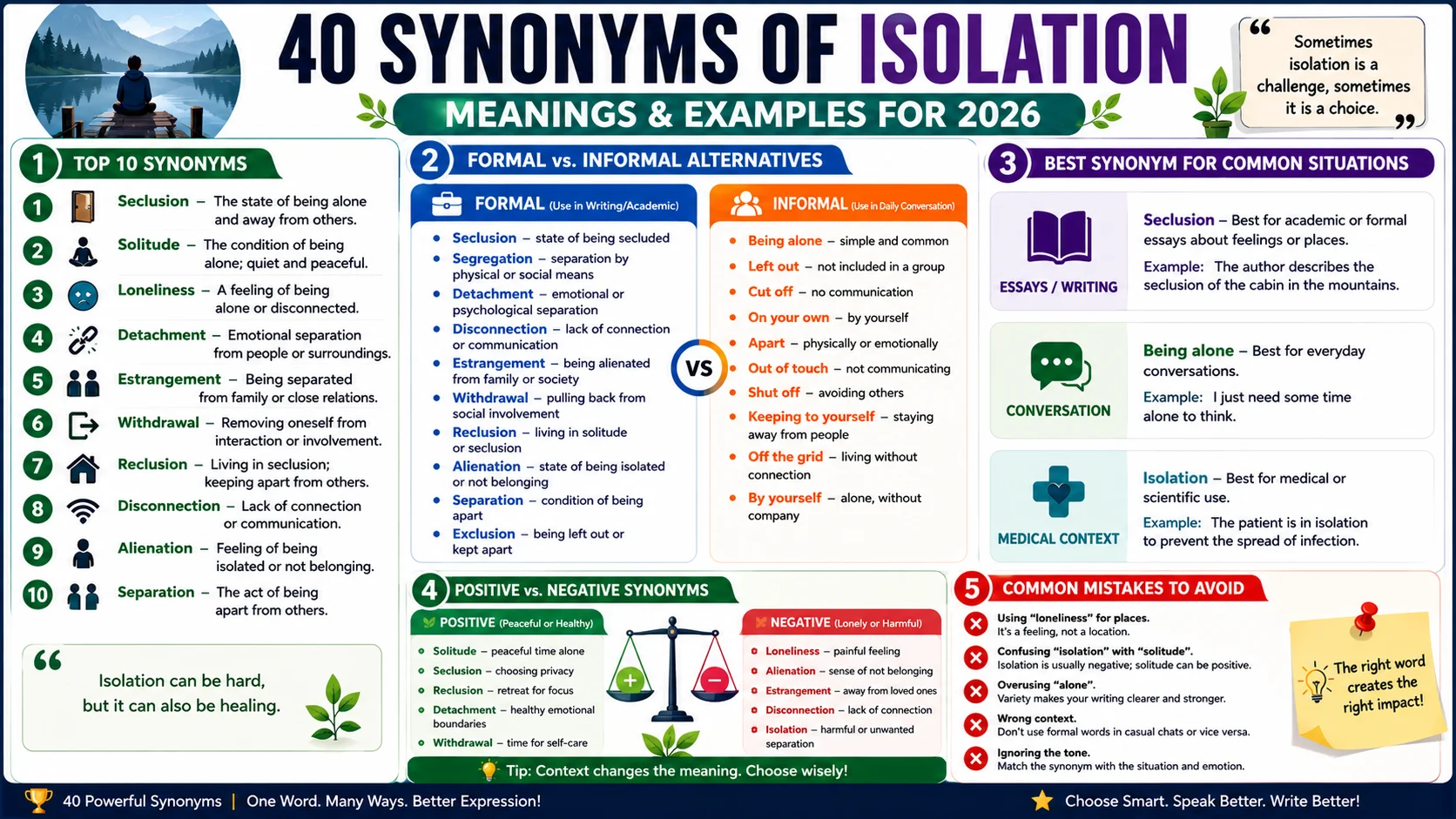
“Isolation” means being alone or separated from others. The best synonyms are seclusion, solitude, loneliness, segregation, and quarantine. “Seclusion” is the most common professional alternative. Each synonym has a slightly different meaning and context where it fits best.
Top 10 Synonyms
- Seclusion
- Solitude
- Loneliness
- Segregation
- Quarantine
- Separation
- Withdrawal
- Retreat
- Aloneness
- Confinement
“Isolation” is a word we hear a lot these days. It describes being alone, cut off from others. But using it too often can make your English feel repetitive and limited.
Think about it. You can be isolated from friends, isolated from society, isolated in a room, or isolated from technology. Each situation might need a different word that captures the specific type of being alone.
Some types of isolation are positive, like enjoying solitude in nature. Others are negative, like loneliness or forced quarantine. This guide will help you choose the right word for every situation.
In this guide, you’ll learn 35 powerful synonyms for “isolation.” You’ll discover exactly when to use each one, how formal they are, and what common mistakes to avoid. Let’s begin!
What Does “Isolation” Mean?
Definition
Isolation” means the state of being alone, separated, or cut off from other people. It can be physical, like being in a remote place. It can also be social, like feeling disconnected from others. Isolation can be chosen (like a quiet retreat) or forced (like quarantine).
Pronunciation
| Feature | Value |
|---|---|
| US IPA | /ˌaɪsəˈleɪʃən/ |
| UK IPA | /ˌaɪsəˈleɪʃən/ |
| Syllables | 4 (i-so-la-tion) |
| Tip | Stress the third syllable: “eye-so-LAY-shun” |
Grammar
| Grammar Feature | Information |
|---|---|
| Part of Speech | Noun (uncountable) |
| Common Position | Subject or object |
| Typical Pattern | Isolation + from + something |
Examples:
- “Isolation from friends made her sad.”
- “He lives in complete isolation.”
- “The patient was kept in isolation.”
Grammar Note: “Isolation” is usually uncountable. We don’t say “isolations” except in very specific contexts.
Word Family
| Word | Part of Speech | Meaning |
|---|---|---|
| Isolate | Verb | To separate from others |
| Isolation | Noun | The state of being isolated |
| Isolated | Adjective | Far away from others |
| Isolating | Adjective | Causing isolation |
| Isolationist | Noun | Someone who supports isolation |
15 Synonyms of “Isolation”
Seclusion
Meaning: The state of being private and away from other people, often by choice.
Best Used For: Peaceful retreats, privacy, choosing to be alone.
Formality: Formal
Tone: Peaceful, Private
Frequency: ⭐⭐⭐⭐ (Common)
CEFR Level: B2
Example Sentence 1: “The writer rented a cottage in seclusion to finish her novel.”
Example Sentence 2: “He lives in seclusion on a remote island.”
Usage Tip: “Seclusion” often has a positive tone. It suggests choosing to be alone for peace or privacy.
Common Confusion: Seclusion vs Isolation. “Seclusion” is usually chosen and positive. “Isolation” is often forced and negative.
Solitude
Meaning: The state of being alone, especially when you enjoy it.
Best Used For: Peaceful alone time, reflection, enjoying quiet.
Formality: Neutral
Tone: Peaceful, Reflective
Frequency: ⭐⭐⭐⭐ (Common)
CEFR Level: B2
Example Sentence 1: “She enjoys the solitude of her morning walks.”
Example Sentence 2: “He found peace in the solitude of the mountains.”
Usage Tip: “Solitude” usually has a positive feeling. It suggests choosing to be alone and enjoying it.
Loneliness
Meaning: The sad feeling of being alone and wanting company.
Best Used For: Emotional pain, missing others, sad situations.
Formality: Neutral
Tone: Sad, Emotional
Frequency: ⭐⭐⭐⭐⭐ (Very Common)
CEFR Level: A2
Example Sentence 1: “Loneliness can be very hard on older people.”
Example Sentence 2: “She felt a deep loneliness after moving to a new city.”
Usage Tip: “Loneliness” is always negative. It describes the painful feeling of being alone, not the physical state.
Segregation
Meaning: The act of separating people based on race, gender, or other characteristics.
Best Used For: History, social issues, discrimination contexts.
Formality: Formal
Tone: Serious, Negative
Frequency: ⭐⭐⭐ (Moderate)
CEFR Level: B2
Example Sentence 1: “Racial segregation was abolished in the 1960s.”
Example Sentence 2: “Gender segregation in schools is still practiced in some countries.”
Usage Tip: “Segregation” is a serious word for forced separation, often involving discrimination.
Quarantine
Meaning: Isolation to prevent the spread of disease.
Best Used For: Health, pandemics, travel restrictions.
Formality: Neutral
Tone: Medical, Serious
Frequency: ⭐⭐⭐⭐ (Common)
CEFR Level: B2
Example Sentence 1: “Travelers had to stay in quarantine for two weeks.”
Example Sentence 2: “The sick patient was placed in quarantine.
Usage Tip: “Quarantine” is specifically about preventing disease. It became very common during the pandemic.
Separation
Meaning: The act of being apart from others or the process of dividing.
Best Used For: Relationships, physical distance, divisions.
Formality: Neutral
Tone: Neutral, Factual
Frequency: ⭐⭐⭐⭐⭐ (Very Common)
CEFR Level: A2
Example Sentence 1: “Separation from her family was very difficult.”
Example Sentence 2: “The separation of church and state is important.”
Usage Tip: “Separation” is a general word for being apart. It can be physical, emotional, or organizational.
Withdrawal
Meaning: The act of removing yourself from others or from a situation.
Best Used For: Mental health, addiction, social retreat.
Formality: Formal
Tone: Serious, Withdrawn
Frequency: ⭐⭐⭐ (Moderate)
CEFR Level: B2
Example Sentence 1: “His withdrawal from friends was a sign of depression.”
Example Sentence 2: “He suffered from withdrawal after quitting smoking.
Usage Tip: “Withdrawal” often suggests pulling away from others, sometimes as a response to stress or addiction.
Retreat
Meaning: A quiet place to go when you want to be alone.
Best Used For: Peaceful getaways, reflection, relaxation.
Formality: Neutral
Tone: Peaceful, Calm
Frequency: ⭐⭐⭐⭐ (Common)
CEFR Level: B1
Example Sentence 1: “She went to a mountain retreat for the weekend.”
Example Sentence 2: “The retreat offered complete isolation from the outside world.
Usage Tip: “Retreat” is often positive. It suggests a quiet place to rest and think.
Aloneness
Meaning: The simple state of being alone, without emotional judgment.
Best Used For: Simple descriptions, neutral observations.
Formality: Neutral
Tone: Neutral, Factual
Frequency: ⭐⭐ (Rare)
CEFR Level: B2
Example Sentence 1: “Aloneness doesn’t have to mean loneliness.
Example Sentence 2: “She valued her aloneness after a busy week.”
Usage Tip: “Aloneness” is a neutral word. It describes being alone without saying whether it’s good or bad.
Confinement
Meaning: Being kept in a small space with limited freedom.
Best Used For: Prisons, hospitals, physical restrictions.
Formality: Formal
Tone: Restrictive, Serious
Frequency: ⭐⭐⭐ (Moderate)
CEFR Level: B2
Example Sentence 1: “The prisoner lived in confinement for years.”
Example Sentence 2: “His confinement to a wheelchair frustrated him.”
Usage Tip: “Confinement” suggests being forced to stay somewhere, often against your will.
Exclusion
Meaning: Being kept out of a group or activity.
Best Used For: Social situations, clubs, organizations.
Formality: Formal
Tone: Negative, Rejecting
Frequency: ⭐⭐⭐ (Moderate)
CEFR Level: B2
Example Sentence 1: “She felt a sense of exclusion from the group.”
Example Sentence 2: “Exclusion from the team hurt his confidence.”
Usage Tip: “Exclusion” is about being left out or denied access. It’s always negative.
Reclusion
Meaning: Living a life of isolation, away from society.
Best Used For: Hermits, extreme privacy seekers.
Formality: Formal
Tone: Withdrawn, Secretive
Frequency: ⭐ (Very Rare)
CEFR Level: C1
Example Sentence 1: “He lived in reclusion after his wife passed away.”
Example Sentence 2: “The artist’s reclusion became famous.”
Usage Tip: “Reclusion” is very formal and rare. It describes living completely separate from society.
Shutdown
Meaning: A complete closing or isolation from the outside.
Best Used For: Technology, emotional isolation.
Formality: Informal
Tone: Closed off, Final
Frequency: ⭐⭐⭐ (Moderate)
CEFR Level: B2
Example Sentence 1: “After the argument, he went into emotional shutdown.
Example Sentence 2: “The government ordered a shutdown of all non-essential services.”
Usage Tip: “Shutdown” is casual. Use it for emotional withdrawal or when something closes completely.
Hermitage
Meaning: A place of seclusion and isolation.
Best Used For: Religious retreats, historical contexts.
Formality: Formal
Tone: Religious, Quiet
Frequency: ⭐ (Very Rare)
CEFR Level: C1
Example Sentence 1: “The monk lived in a hermitage in the desert.”
Example Sentence 2: “The hermitage was surrounded by forest.”
Usage Tip: “Hermitage” is a very specific word for a place where a hermit lives.
Insulation
Meaning: Being protected from outside influence or contact.
Best Used For: Protection, soundproofing, emotional protection.
Formality: Formal
Tone: Protective, Shielded
Frequency: ⭐⭐⭐ (Moderate)
CEFR Level: B2
Example Sentence 1: “His wealth provided insulation from the real world.
Example Sentence 2: “The building has good sound insulation.”
Usage Tip: “Insulation” suggests being protected from outside, not just being alone.
Synonyms Comparison Table
| Synonym | Best Context | Formality | Tone | Frequency |
|---|---|---|---|---|
| Loneliness | Emotional pain | Neutral | Sad | ⭐⭐⭐⭐⭐ |
| Separation | General distance | Neutral | Factual | ⭐⭐⭐⭐⭐ |
| Solitude | Peaceful alone time | Neutral | Peaceful | ⭐⭐⭐⭐ |
| Seclusion | Chosen privacy | Formal | Private | ⭐⭐⭐⭐ |
| Quarantine | Health, disease | Neutral | Medical | ⭐⭐⭐⭐ |
| Retreat | Quiet getaways | Neutral | Calm | ⭐⭐⭐⭐ |
| Segregation | Discrimination | Formal | Serious | ⭐⭐⭐ |
| Withdrawal | Mental health | Formal | Serious | ⭐⭐⭐ |
| Confinement | Forced restriction | Formal | Restrictive | ⭐⭐⭐ |
| Exclusion | Being left out | Formal | Negative | ⭐⭐⭐ |
Best Synonyms by Situation
| Situation | Best Synonym | Why It Works |
|---|---|---|
| Daily Conversation | Loneliness / Solitude | Natural and common |
| Business Email | Separation | Professional and clear |
| Academic Writing | Segregation / Withdrawal | Formal and precise |
| School Assignment | Solitude / Seclusion | Shows vocabulary depth |
| Professional Meeting | Separation | Professional tone |
| Presentation | Solitude | Positive and clear |
| Creative Writing | Reclusion / Hermitage | Adds literary depth |
| Social Media | Loneliness | Relatable and honest |
| Medical Context | Quarantine | Accurate and specific |
Formal vs Informal Synonyms
Formal Alternatives
| Synonym | Best Used For |
|---|---|
| Segregation | Social, racial, or gender separation |
| Seclusion | Chosen privacy and withdrawal |
| Confinement | Forced physical restriction |
| Exclusion | Being left out of groups |
| Withdrawal | Mental health, addiction contexts |
Neutral Alternatives
| Synonym | Best Used For |
|---|---|
| Solitude | Peaceful alone time |
| Separation | General being apart |
| Loneliness | Emotional pain of being alone |
| Quarantine | Health isolation |
Informal Alternatives
| Synonym | Best Used For |
|---|---|
| Alone time | Casual, positive |
| Shutdown | Emotional or physical isolation |
| Time out | Taking a break from others |
Choosing the Right Level: Use “segregation” or “confinement” for serious, formal situations. Use “solitude” and “seclusion” for positive alone time. Use “loneliness” for everyday emotional situations.
Strong vs Mild Synonyms
Mild
Suitable for everyday situations with less intensity.
- Aloneness
- Separation
- Solitude
Moderate
More specific or emotional alternatives.
- Seclusion
- Loneliness
- Retreat
- Withdrawal
Strong
High-intensity alternatives suggesting serious isolation.
- Segregation (forced separation based on identity)
- Confinement (forced restriction)
- Reclusion (complete separation from society)
- Exclusion (being deliberately left out)
How Intensity Changes Meaning: “She enjoys solitude” is positive. “She suffers from loneliness” is negative and sad. “She was placed in confinement” suggests force and restriction. Choose based on the type and severity of isolation.
Real-Life Examples
School: “The shy student felt a sense of loneliness in the crowded cafeteria.”
Office: “Working from home created separation from colleagues.”
Business Email: “We need to address the isolation of remote workers.”
Meetings: “The retreat provided solitude for creative thinking.”
Presentations: “Social isolation can affect mental health.”
Daily Conversations: “Sometimes I just need some alone time.”
Social Media: “Many people struggle with loneliness these days.”
Academic Writing: “Racial segregation was a dark period in history.”
Common Collocations
| Common Phrase | Better Alternative |
|---|---|
| Social isolation | Social withdrawal |
| Feel isolation | Feel loneliness |
| Live in isolation | Live in seclusion |
| Isolation from others | Separation from others |
| Forced isolation | Compulsory confinement |
| Emotional isolation | Emotional withdrawal |
Common Phrases
Alone in a crowd: Feeling isolated even among people. (e.g., “She felt alone in a crowd at the party.”)
Off the grid: Completely isolated from technology. (e.g., “He went off the grid for a month.”)
Cabin fever: Feeling of isolation when stuck inside. (e.g., “The pandemic gave everyone cabin fever.”)
Fly solo: To do something alone. (e.g., “She decided to fly solo on the project.”)
Loner: A person who prefers being alone. (e.g., “He’s always been a bit of a loner.”)
Context Guide
| Situation | Best Synonym | Reason |
|---|---|---|
| Essay | Segregation / Withdrawal | Formal and academic |
| Speech | Solitude / Loneliness | Emotional and relatable |
| Business Email | Separation | Professional and clear |
| Novel | Reclusion / Hermitage | Adds literary depth |
| Presentation | Solitude | Positive and clear |
| Conversation | Alone time / Solitude | Natural and casual |
| Academic Writing | Segregation / Withdrawal | Precise and formal |
| Medical Context | Quarantine | Specific and accurate |
Related Words
Near Synonyms
- Loner: A person who prefers being alone.
- Hermit: Someone who lives in seclusion.
- Recluse: A person who lives in isolation.
- Outcast: Someone excluded from society.
- Introvert: Someone who prefers quiet, alone time.
Antonyms
- Community: A group of people living together.
- Togetherness: The state of being together.
- Socialization: Interacting with others.
- Inclusion: Being included in a group.
- Solidarity: Unity and mutual support.
Related Adjectives
- Isolated: Far away from others.
- Solitary: Done alone.
- Reclusive: Preferring isolation.
- Lonely: Feeling alone and sad.
- Secluded: Private and away from others.
Related Nouns
- Isolation: The state of being alone.
- Loneliness: The sad feeling of being alone.
- Solitude: Peaceful alone time.
- Seclusion: Chosen privacy.
- Quarantine: Health isolation.
Related Verbs
- Isolate: To separate from others.
- Separate: To divide or put apart.
- Withdraw: To pull away.
- Segregate: To separate based on characteristics.
- Quarantine: To isolate for health reasons.
Frequently Asked Questions
What is another word for isolation?
Common synonyms include seclusion, solitude, loneliness, segregation, and quarantine. “Solitude” and “seclusion” are positive alternatives, while “loneliness” describes the sad feeling of being alone.
Which synonym sounds the most professional?
Segregation and withdrawal sound the most professional. “Seclusion” is also excellent for formal contexts.
What is the strongest synonym for isolation?
Segregation is one of the strongest synonyms. It suggests forced separation based on identity. “Confinement” is also strong, suggesting being locked away.
Which synonym is best for essays?
Segregation and withdrawal are the best choices for academic essays. They are formal and precise.
What’s the difference between solitude and isolation?
“Solitude” is usually positive and chosen. You enjoy solitude. “Isolation” is often negative and can be forced. You suffer from isolation.
Which synonym is most common in everyday English?
“Loneliness” and “solitude” are very common in everyday speech. “Isolation” itself is also frequently used.
What is the opposite of isolation?
Common opposites are community, togetherness, inclusion, and socialization. These words describe being connected with others.
Conclusion
“Isolation” is a powerful word, but now you have 35 fantastic alternatives. Each synonym adds a different shade of meaning to your language.
Remember, the key is understanding the context. Use “solitude” and “seclusion” for positive alone time. Use “loneliness” for the sad feeling of being alone. Use “segregation” and “confinement” for serious, forced separation. Use “quarantine” for health contexts.
The best way to improve is practice. Try using one or two new synonyms each day. Listen for these words in conversations and books. Your vocabulary will become richer and more expressive with time.
