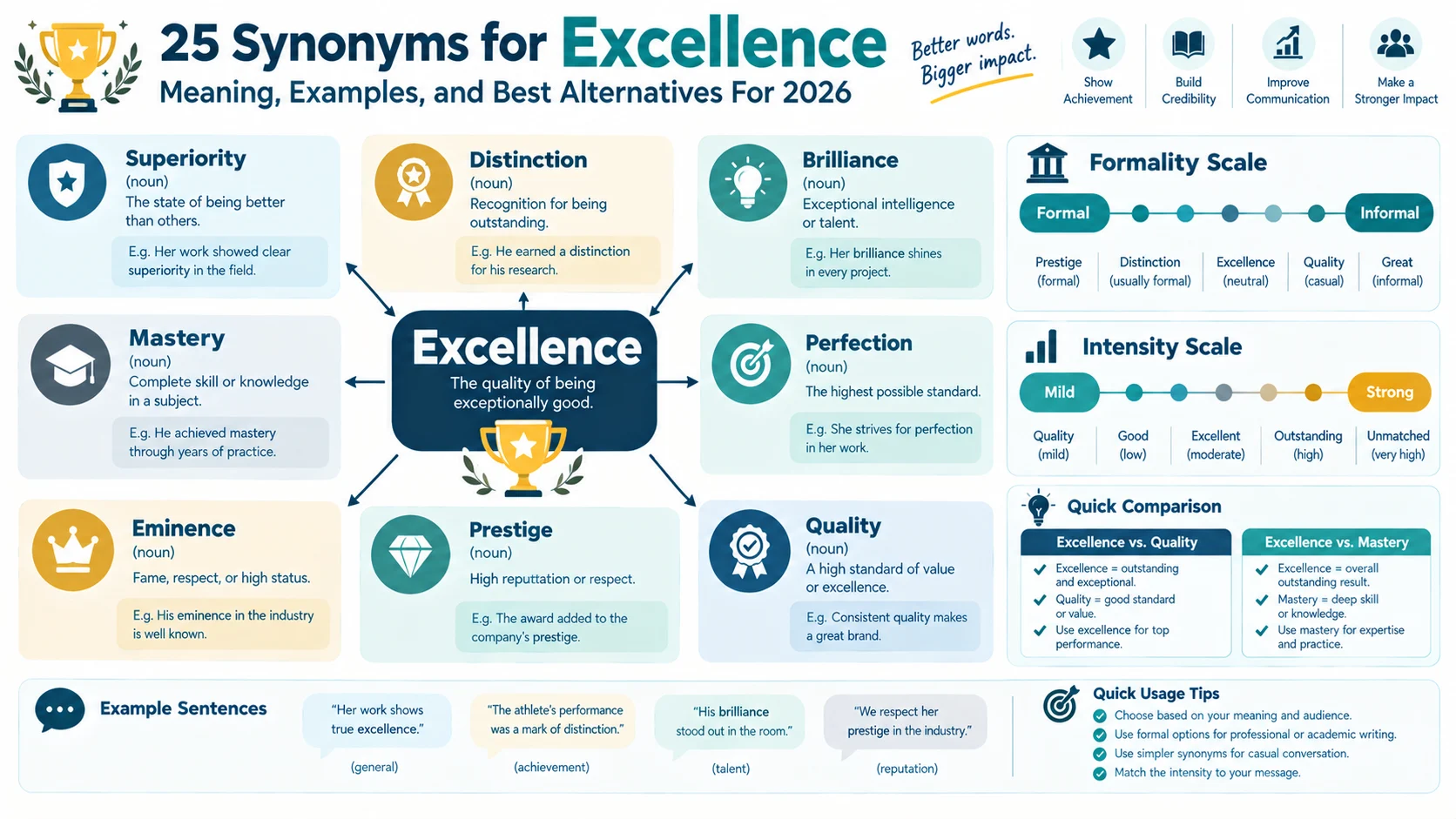
Excellence means the quality of being extremely good or outstanding. The best synonyms depend on context: use superiority for comparison, distinction for achievement, brilliance for intellect, and mastery for deep skill. Perfection is the most common but also the most extreme.Top 10 Synonyms:
- Superiority
- Distinction
- Brilliance
- Mastery
- Perfection
- Eminence
- Prestige
- Quality
- Merit
- Greatness
Every synonym carries a slightly different meaning, tone, or context. The right choice depends on what kind of excellence you are describing.
Have you ever tried to describe a person, product, or performance that stands far above the rest, and the only word you could find was “excellence”?
It is a powerful word. But it is also a broad one. Using it too often makes your praise sound generic and your writing feel flat.
Imagine you are writing a performance review for a standout employee. Or you are drafting a college recommendation letter. Or you are writing a product description for a premium brand. Each situation calls for a different kind of praise.
Some synonyms focus on skill. Others focus on reputation, quality, or moral character. A few sound formal and academic. Others work best in casual or creative writing.
This guide will teach you exactly which synonym for “excellence” fits every situation. You will learn the small but important differences between superiority, distinction, brilliance, mastery, and many other useful words. By the end, you will describe outstanding quality with confidence and precision.
What Does “Excellence” Mean?
Definition
“Excellence” describes the quality of being extremely good, far above average, or unusually impressive. It is not just about being good. It means standing out in a meaningful way.
The word carries a strong sense of achievement and high standards. You can show excellence in a skill, a product, a performance, or even a personal quality like honesty. It often suggests effort, discipline, and care.
In everyday English, “excellence” is a formal and slightly weighty word. It appears often in mission statements, award ceremonies, academic reports, and professional reviews. It is less common in casual conversation, where people usually say “great” or “amazing.”
Pronunciation
US IPA: /ˈɛk.sə.ləns/
UK IPA: /ˈɛk.səl.əns/
Syllables: 3 (ex-cel-lence)
Tip: Stress the first syllable “EX.” The middle syllable sounds like “suh,” not “sell.” The final syllable is soft and quick.
Grammar
| Grammar Feature | Information |
|---|---|
| Part of Speech | Noun (usually uncountable) |
| Common Position | Subject, object, or after prepositions like “of” and “in” |
| Typical Pattern | The excellence of + noun OR excellence in + field |
Example sentences:
- “Her excellence in mathematics earned her a full scholarship.”
- “The company is known for the excellence of its customer service.”
- “He pursued excellence in everything he did.”
Grammar note: “Excellence” is usually uncountable. You do not say “an excellence.” When you want to talk about a specific type, use phrases like “a level of excellence” or “a standard of excellence.” The adjective form is “excellent,” and the verb form is “excel,” which is followed by “in” or “at.”
Word Family
| Word | Part of Speech | Meaning |
|---|---|---|
| Excel | Verb | To be very good at something |
| Excellent | Adjective | Extremely good or of very high quality |
| Excellently | Adverb | In a very good or impressive way |
| Excellence | Noun | The quality of being outstanding |
| Excellency | Noun | A formal title of honor, or an old word for excellence |
12 Synonyms of “Excellence”
Superiority
Meaning: The state of being better than others. It focuses on comparison and rank.
Best Used For: Business writing, competitive analysis, academic argument, product comparisons.
Formality: Formal
Tone: Professional, Neutral, Confident
Frequency: ⭐⭐⭐⭐ Common
CEFR Level: B2
Example Sentence 1: “The team’s technical superiority gave them a clear advantage in the competition.”
Example Sentence 2: “The brand is known for the superiority of its engineering.”
Usage Tip: Use “superiority” when you are comparing one thing directly against another. It implies a ranking. Avoid it when you want to praise something on its own merits, because it always suggests something else is worse. In casual conversation, it can sound arrogant.
Common Confusion: Superiority vs Excellence. Excellence” means something is outstanding by itself. “Superiority” means it is better than something else. You can have excellence without comparison, but not superiority.
Distinction
Meaning: A special mark of honor or a clear difference that sets someone apart.
Best Used For: Academic writing, resumes, award descriptions, formal praise.
Formality: Formal
Tone: Professional, Respectful, Academic
Frequency: ⭐⭐⭐⭐ Common
CEFR Level: B2
Example Sentence 1: “She graduated with distinction in both law and economics.”
Example Sentence 2: “His work shows a rare distinction that few writers achieve.”
Usage Tip: “Distinction” works beautifully when describing academic honors or special recognition. It suggests that someone stands apart from the crowd. It is a formal word, so avoid it in casual conversation. It also has a second meaning: a clear difference between two things.
Brilliance
Meaning: Exceptional intelligence, talent, or brightness. It suggests a shining, standout quality.
Best Used For: Creative writing, reviews, academic praise, descriptions of intellect or performance.
Formality: Neutral to Formal
Tone: Positive, Admiring, Energetic
Frequency: ⭐⭐⭐⭐ Common
CEFR Level: B2
Example Sentence 1: “The brilliance of her performance left the audience speechless.”
Example Sentence 2: “His scientific brilliance was recognized around the world.”
Usage Tip: “Brilliance” often refers to mental sharpness or artistic talent. It is warmer and more exciting than “excellence.” Use it when you want to express admiration with energy. It works less well for describing products, where words like “quality” or “craftsmanship” are more natural.
Mastery
Meaning: Complete skill or deep knowledge in a subject or craft. It comes from long practice.
Best Used For: Professional writing, skill descriptions, resumes, artistic reviews.
Formality: Neutral to Formal
Tone: Professional, Respectful, Admiring
Frequency: ⭐⭐⭐⭐ Common
CEFR Level: B2
Example Sentence 1: “Her mastery of the violin was clear from the very first note.”
Example Sentence 2: “He has achieved mastery in three different programming languages.”
Usage Tip: “Mastery” emphasizes skill gained through effort and time. It is perfect for describing experts, craftspeople, and performers. It is less suitable for describing abstract qualities like moral excellence. Use it when the focus is on learned ability.
Common Confusion: Mastery vs Excellence. “Excellence” is a general quality of being outstanding. Mastery” specifically means complete control over a skill.
Perfection
Meaning: The state of being completely free from flaws. It is an absolute ideal.
Best Used For: Product descriptions, artistic reviews, creative writing, informal praise.
Formality: Neutral
Tone: Strong, Admiring, Sometimes Idealistic
Frequency: ⭐⭐⭐⭐⭐ Very Common
CEFR Level: B1
Example Sentence 1: “The chef’s plating was pure perfection.”
Example Sentence 2: “No one achieves perfection, but we should always aim for it.”
Usage Tip: “Perfection” is stronger and more absolute than “excellence.” It means nothing could be improved. Use it carefully, because it leaves no room for improvement. In formal writing, “excellence” is often safer because it allows for a high standard without claiming flawlessness.
Eminence
Meaning: A high rank or respected position, often because of great achievement.
Best Used For: Formal writing, biographical descriptions, historical analysis, official titles.
Formality: Formal
Tone: Respectful, Serious, Academic
Frequency: ⭐⭐ Rare
CEFR Level: C1
Example Sentence 1: “The professor achieved eminence in the field of neuroscience.”
Example Sentence 2: “His eminence as a judge was recognized across the country.”
Usage Tip: “Eminence” describes a person’s high standing and reputation, not just their skill. It is a formal and somewhat old-fashioned word. It works well in biographies and formal tributes. Avoid it in everyday conversation, where “fame” or “respect” sounds more natural.
Prestige
Meaning: Respect and admiration earned through success, quality, or high status.
Best Used For: Business writing, marketing, brand descriptions, university profiles.
Formality: Neutral to Formal
Tone: Professional, Admiring, Aspirational
Frequency: ⭐⭐⭐⭐ Common
CEFR Level: B2
Example Sentence 1: “The award added great prestige to her already impressive career.”
Example Sentence 2: “The university is known for the prestige of its medical program.”
Usage Tip: “Prestige” focuses on reputation and status rather than actual quality. It is common in marketing and academic writing. Use it when you want to highlight how others perceive something. Avoid it when describing personal skill, since it is more about how something is viewed.
Quality
Meaning: The standard of how good or bad something is. In this context, it means a high standard.
Best Used For: Business writing, product reviews, everyday descriptions, all contexts.
Formality: Neutral
Tone: Professional, Measured, Neutral
Frequency: ⭐⭐⭐⭐⭐ Very Common
CEFR Level: A2
Example Sentence 1: “The quality of the fabric is obvious the moment you touch it.”
Example Sentence 2: “They are committed to quality in every stage of production.”
Usage Tip: “Quality” is the most flexible and safest synonym. It works in almost any context, from casual conversation to formal reports. It is less dramatic than “excellence,” but it is clear and natural. When in doubt, “quality” is a reliable choice.
Merit
Meaning: Value or worth based on real ability or achievement. It focuses on deserving praise.
Best Used For: Academic writing, formal evaluations, award discussions, fair assessment.
Formality: Formal
Tone: Neutral, Fair, Objective
Frequency: ⭐⭐⭐ Moderate
CEFR Level: B2
Example Sentence 1: “She was promoted on merit, not on connections.”
Example Sentence 2: “The proposal has real merit and deserves serious consideration.”
Usage Tip: “Merit” is about earned worth rather than natural talent or reputation. It is a fair, objective word used in academic and professional settings. It works well when discussing awards, promotions, or arguments. Avoid it in casual praise, where it might sound cold.
Greatness
Meaning: A very high level of importance, ability, or achievement. It often suggests lasting impact.
Best Used For: Historical writing, inspirational speeches, creative writing, biographies.
Formality: Neutral to Formal
Tone: Inspirational, Emotional, Grand
Frequency: ⭐⭐⭐ Moderate
CEFR Level: B2
Example Sentence 1: “True greatness comes from service to others, not from personal gain.”
Example Sentence 2: “The novel explores the greatness and flaws of its central character.”
Usage Tip: “Greatness” is grand and emotional. It suggests significance that lasts beyond the moment. Use it in speeches, biographies, and inspirational writing. It can sound exaggerated in everyday contexts, where “excellence” or “quality” fits better.
Craftsmanship
Meaning: Skill and care in making something, especially by hand or with great attention to detail.
Best Used For: Product descriptions, artisan brands, reviews, creative writing.
Formality: Neutral to Formal
Tone: Respectful, Warm, Admiring
Frequency: ⭐⭐⭐ Moderate
CEFR Level: B2
Example Sentence 1: “The craftsmanship of this wooden table is truly remarkable.”
Example Sentence 2: “The brand is famous for the craftsmanship behind every watch.”
Usage Tip: “Craftsmanship” is specifically about making things well, usually physical objects. It highlights care, patience, and skill. It works beautifully for furniture, watches, clothing, and art. It is not suitable for abstract qualities like moral excellence.
Prowess
Meaning: Outstanding skill or ability, especially in a demanding activity.
Best Used For: Sports writing, academic praise, military history, creative writing.
Formality: Formal to Neutral
Tone: Admiring, Strong, Slightly Dramatic
Frequency: ⭐⭐ Rare
CEFR Level: C1
Example Sentence 1: “Her athletic prowess made her a legend in the sport.”
Example Sentence 2: “The general was known for his strategic prowess on the battlefield.”
Usage Tip: “Prowess” is a strong, slightly dramatic word. It often appears in sports and military contexts. It suggests impressive, tested ability. It is rare in casual conversation, so use it when you want to sound vivid or poetic.
Synonyms Comparison Table
| Synonym | Best Context | Formality | Tone | Frequency |
|---|---|---|---|---|
| Superiority | Comparisons, business | Formal | Confident | ⭐⭐⭐⭐ |
| Distinction | Academic, awards | Formal | Respectful | ⭐⭐⭐⭐ |
| Brilliance | Reviews, intellect | Neutral to Formal | Admiring | ⭐⭐⭐⭐ |
| Mastery | Skills, professions | Neutral to Formal | Respectful | ⭐⭐⭐⭐ |
| Perfection | Products, art | Neutral | Strong | ⭐⭐⭐⭐⭐ |
| Eminence | Biographies, tributes | Formal | Serious | ⭐⭐ |
| Prestige | Brands, institutions | Neutral to Formal | Aspirational | ⭐⭐⭐⭐ |
| Quality | General use, all contexts | Neutral | Measured | ⭐⭐⭐⭐⭐ |
| Merit | Evaluations, awards | Formal | Objective | ⭐⭐⭐ |
| Greatness | Speeches, history | Neutral to Formal | Grand | ⭐⭐⭐ |
| Craftsmanship | Products, artisan work | Neutral to Formal | Warm | ⭐⭐⭐ |
| Prowess | Sports, military | Formal to Neutral | Dramatic | ⭐⭐ |
Best Synonyms by Situation
| Situation | Best Synonym | Why It Works |
|---|---|---|
| Daily Conversation | Quality or Perfection | These are simple and widely understood. |
| Business Email | Superiority or Quality | These sound professional and clear. |
| Academic Writing | Distinction or Merit | These sound precise and objective. |
| School Assignment | Quality or Excellence | These are easy for teachers to understand. |
| Professional Meeting | Mastery or Superiority | These communicate competence clearly. |
| Presentation | Brilliance or Prestige | These are engaging and memorable. |
| Creative Writing | Brilliance or Greatness | These add emotional and descriptive depth. |
| Social Media | Perfection or Quality | These are punchy and shareable. |
| Movie Review | Brilliance or Craftsmanship | These suit artistic evaluation. |
| Book Review | Greatness or Distinction | These suit literary praise. |
Formal vs Informal Synonyms
Formal Alternatives
| Synonym | Best Used For |
|---|---|
| Eminence | Biographies, formal tributes, official documents |
| Distinction | Academic honors, award citations |
| Merit | Evaluations, promotions, fair assessments |
| Superiority | Competitive analysis, business reports |
Neutral Alternatives
| Synonym | Best Used For |
|---|---|
| Quality | General use in all contexts |
| Excellence | Professional and academic writing |
| Mastery | Skills and professional descriptions |
| Prestige | Branding and institutional writing |
| Brilliance | Reviews and intellectual praise |
| Craftsmanship | Product and artisan descriptions |
Informal Alternatives
| Synonym | Best Used For |
|---|---|
| Perfection | Casual praise, social media, conversations |
| Greatness | Inspirational posts, motivational writing |
| Prowess | Sports talk, dramatic storytelling |
Choosing the right level of formality: Formal writing like academic papers and official reports demands words like eminence, distinction, and merit. These carry weight and precision. Everyday conversation welcomes perfection and greatness. When you are unsure, “quality” and “excellence” work safely in nearly every situation.
Strong vs Mild Synonyms
Mild
These alternatives are calm and measured.
- Quality
- Merit
- Craftsmanship
Moderate
These are expressive and clearly positive.
- Excellence
- Distinction
- Mastery
- Prestige
- Superiority
Strong
These are intense and dramatic.
- Brilliance
- Perfection
- Greatness
- Prowess
- Eminence
How intensity changes meaning: Mild words like “quality” describe a high standard without drama. Moderate words like “mastery” and “distinction” express strong respect. Strong words like “perfection” and “brilliance” create a powerful impression but can sound exaggerated if used for small things. Always match intensity to the real importance of what you are describing.
Real-Life Examples
School Context:
“The principal praised the student for her academic distinction. Her teachers noted her excellence in science and mathematics throughout the year.”
Office Context:
“Our team’s mastery of the new software helped us finish the project two weeks early. The manager recognized our collective brilliance during the quarterly meeting.”
Business Email:
“We are proud to be recognized for the quality of our service. This award reflects our ongoing commitment to excellence in every customer interaction.”
Professional Meeting:
“The client was impressed by the craftsmanship of our design. They said the attention to detail showed true mastery.”
Presentation:
“The prestige of this partnership will strengthen our brand for years. We believe this collaboration reflects the brilliance of both teams.”
Daily Conversation:
“Her cooking is pure perfection. I don’t know how she does it every single time.”
Social Media:
“Congratulations to the entire team on this well-deserved recognition! True excellence in action. So proud of everyone involved. 🏆”
Creative Writing:
“He had spent his whole life chasing greatness, only to find it in the quiet devotion of his craft.”
Common Collocations
| Common Phrase | Better Alternative |
|---|---|
| Academic excellence | Academic distinction, Scholarly brilliance |
| Pursuit of excellence | Commitment to quality, Drive for mastery |
| Excellence award | Award for distinction, Recognition of merit |
| Center of excellence | Hub of expertise, Center of mastery |
| Operational excellence | Business superiority, Operational mastery |
| Personal excellence | Personal mastery, Individual brilliance |
| Standard of excellence | Benchmark of quality, High standard of merit |
| Excellence in service | Superiority in service, Quality of service |
Common Phrases
Pursuit of excellence
Meaning: The ongoing effort to reach the highest standards.
Better alternative: “Commitment to mastery” or “Drive for quality.”
Example: “The school’s motto is the pursuit of excellence in every subject.”
A paragon of excellence
Meaning: A perfect example of outstanding quality.
Better alternative: “A model of quality” or “A shining example.”
Example: “The hospital is considered a paragon of excellence in patient care.”
Committed to excellence
Meaning: Dedicated to maintaining the highest standards.
Better alternative: “Devoted to mastery” or “Focused on quality.”
Example: “Our company has been committed to excellence for over fifty years.”
Excellence in all things
Meaning: A philosophy of giving your best effort in every area.
Better alternative: “Mastery in every task” or “Quality without compromise.”
Example: “Her grandmother always believed in excellence in all things, no matter how small.”
Context Guide
| Situation | Best Synonym | Reason |
|---|---|---|
| Essay | Distinction or Merit | Objective and academic |
| Speech | Greatness or Brilliance | Inspiring and memorable |
| Business Email | Quality or Superiority | Professional and clear |
| Novel | Brilliance or Greatness | Adds literary depth |
| Presentation | Mastery or Prestige | Impressive and confident |
| Conversation | Quality or Perfection | Natural and easy to understand |
| Academic Writing | Merit or Distinction | Precise and fair |
| Marketing Copy | Prestige or Quality | Aspirational and attractive |
Related Words
Near Synonyms
Skill, talent, ability, competence, proficiency, caliber
These words describe high ability. “Skill” is general. “Caliber” suggests a measured level of quality.
Antonyms
- Inferiority
- Mediocrity
- Weakness
- Flaw
- Failure
- Incompetence
Related Adjectives
- Excellent
- Outstanding
- Superior
- Exceptional
- Remarkable
- Flawless
Related Nouns
- Expertise
- Talent
- Skill
- Achievement
- Reputation
- Standard
Related Verbs
- Excel
- Surpass
- Outperform
- Achieve
- Master
- Shine
Frequently Asked Questions
What is another word for excellence?
The most common alternatives are quality, superiority, distinction, brilliance, and mastery. “Quality” is the safest choice in most contexts. “Mastery” works best for learned skills. “Distinction” fits academic and formal praise.
Which synonym sounds the most professional?
“Superiority,” “distinction,” and “merit” sound the most professional. These words are common in business reports, academic writing, and formal evaluations. “Quality” is also professional but more general and easier to use in casual professional settings.
What is the strongest synonym for excellence?
Perfection” is the strongest synonym. It means something has no flaws at all. “Brilliance” and “greatness” are also very strong. These words should be used carefully, because they can sound exaggerated for small achievements.
Which synonym is best for essays?
“Distinction” and “merit” work best in academic essays. Both sound objective and precise. “Excellence” is also acceptable but appears more often in personal and professional writing than in formal analysis.
What’s the difference between excellence and perfection?
“Excellence” means being extremely good and far above average. Perfection” means being completely free from flaws. Excellence allows for tiny imperfections, but perfection does not.
Which synonym is most common in everyday English?
“Quality” and “perfection” are the most common in everyday English. “Quality” is neutral and safe. “Perfection” is dramatic and often used for praise. “Excellence” is more common in written and formal English than in casual speech.
What is the opposite of excellence?
The opposite of excellence is mediocrity. Other useful opposites include inferiority, incompetence, and failure. “Mediocrity” specifically means average or unremarkable quality, which is the direct opposite of outstanding excellence.
Conclusion
“Excellence” is a powerful word for describing outstanding quality, but it works best when paired with more precise alternatives. Choosing the right synonym helps you express exactly what kind of quality you mean.
Use “quality” for general descriptions. Use “mastery” for learned skills and deep expertise. Use “distinction” for academic honors and formal praise. Use “brilliance” for intellect and artistic talent. Use “prestige” for reputation and status. Use “perfection” when something truly has no flaws.
Tone and formality matter just as much as meaning. Formal writing benefits from words like “eminence,” “merit,” and “distinction.” Casual conversation welcomes “perfection” and “quality.” Always consider your reader before you choose.
The next time you want to praise something truly outstanding, pause and pick the word that fits best. A precise vocabulary makes your praise more believable and your writing more memorable. Keep building your word bank, and your English will grow stronger with every sentence.
