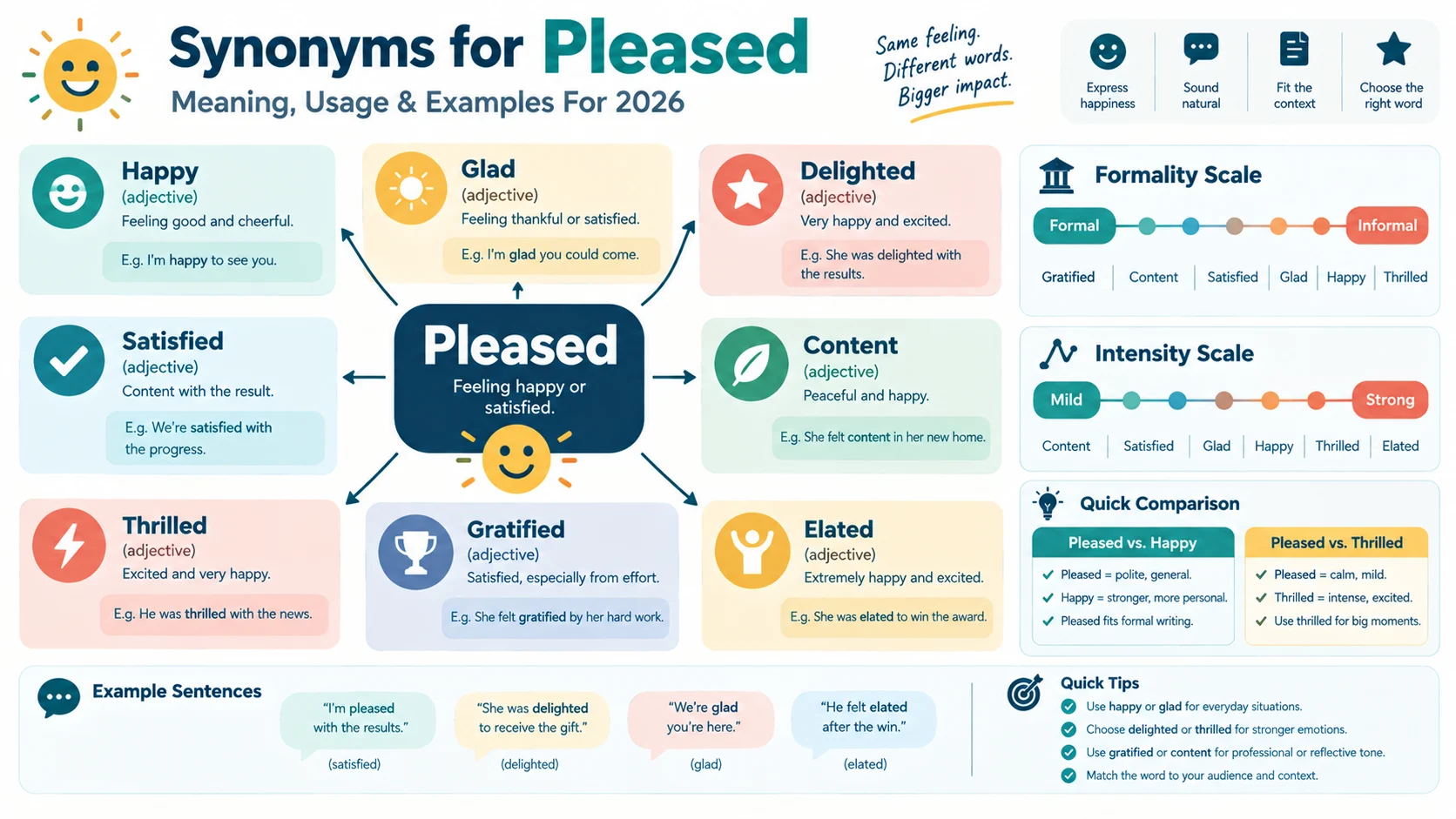
Pleased means feeling happy or satisfied about something. The best synonyms depend on context: use happy for general use, delighted for strong joy, satisfied for achievement, and content for quiet peace. Glad is the most common everyday alternative.Top 10 Synonyms:
- Happy
- Glad
- Delighted
- Satisfied
- Content
- Thrilled
- Gratified
- Cheerful
- Elated
- Appreciative
Every synonym has a slightly different meaning, tone, or context. The right choice depends on how strong the feeling is and where you are using it.
Have you ever written an email that starts with “I am pleased to inform you” and then realized you used “pleased” three more times before the end?
You are not alone. “Pleased” is one of the most useful words in English. It works in business letters, thank-you notes, casual conversations, and formal announcements. But its flexibility is also its weakness. Overuse makes your writing sound stiff and repetitive.
Imagine you are writing a customer service reply, a cover letter, or a simple text to a friend. Each situation needs a slightly different word. Some synonyms sound warm and personal. Others sound formal and professional. A few sound intense and dramatic.
This guide will teach you exactly which synonym for “pleased” fits every situation. You will learn the small differences between glad, delighted, satisfied, content, and many other useful words. By the end, you will express satisfaction with confidence and precision.
What Does “Pleased” Mean?
Definition
“Pleased” describes a feeling of happiness or satisfaction. You feel pleased when something good happens, when someone does something nice for you, or when a result meets your expectations.
The word often carries a polite, measured tone. It is warmer than “satisfied” but calmer than “thrilled.” This is why it appears so often in business writing and formal announcements.
In everyday English, “pleased” usually means you are happy about a specific event or situation. It is not a deep, lasting emotion like joy. It is a quiet, pleasant reaction to something good.
You can feel pleased about a gift, a promotion, a kind comment, or a job well done. The feeling is positive but not overwhelming.
Pronunciation
US IPA: /pliːzd/
UK IPA: /pliːzd/
Syllables: 1
Tip: The “ea” sounds like the “ee” in “see.” The final “sed” sounds like “zd,” not “ssed.” Say it smoothly as one syllable.
Grammar
| Grammar Feature | Information |
|---|---|
| Part of Speech | Adjective (past participle of the verb “please”) |
| Common Position | After linking verbs like “am,” “is,” “are,” “was,” “were,” or before a noun |
| Typical Pattern | Subject + be + pleased + (with / about / to + verb) |
Example sentences:
- “I am pleased with the final results of the project.”
- “She was pleased to hear the good news.”
- “The manager seemed pleased about the team’s progress.”
Grammar note: “Pleased” is almost always used with a linking verb. You do not say “I pleased.” You say “I am pleased.” When you want to say what caused the feeling, use “with,” “about,” or “to” plus a verb. For example, “pleased with the outcome,” “pleased about the change,” or “pleased to meet you.”
Word Family
| Word | Part of Speech | Meaning |
|---|---|---|
| Please | Verb | To make someone happy or satisfied |
| Pleased | Adjective | Feeling happy or satisfied |
| Pleasing | Adjective | Giving pleasure or satisfaction |
| Pleasantly | Adverb | In a way that is enjoyable or agreeable |
| Pleasure | Noun | A feeling of happiness or enjoyment |
| Displeased | Adjective | Feeling unhappy or unsatisfied |
12 Synonyms of “Pleased”
Happy
Meaning: Feeling good, joyful, or satisfied about something. It is the most general positive emotion word in English.
Best Used For: Daily conversation, casual writing, social media, almost every context.
Formality: Neutral
Tone: Positive, Warm, Casual
Frequency: ⭐⭐⭐⭐⭐ Very Common
CEFR Level: A1
Example Sentence 1: “I’m so happy that you could come to the party.”
Example Sentence 2: “The customers were happy with the quick service.
Usage Tip: “Happy” is the safest and most natural choice in almost any situation. It is warmer and less formal than “pleased.” Native speakers use it constantly in speech. Use “pleased” when you want to sound slightly more polite or professional.
Glad
Meaning: Feeling pleased and relieved about something. It often carries a sense of thankfulness.
Best Used For: Daily conversation, personal messages, friendly emails, thank-you notes.
Formality: Neutral to Informal
Tone: Positive, Warm, Personal
Frequency: ⭐⭐⭐⭐⭐ Very Common
CEFR Level: A2
Example Sentence 1: “I’m glad you made it home safely.”
Example Sentence 2: “We’re glad to have you on the team.”
Usage Tip: “Glad” sounds warmer and more personal than “pleased.” It is perfect for friendly messages, texts, and casual emails. Avoid it in very formal business documents where “pleased” or “delighted” sounds more appropriate.
Common Confusion: Glad vs Pleased. “Glad” often includes relief. “Pleased” focuses more on satisfaction with a result. “I’m glad you’re okay” shows relief. “I’m pleased with your work” shows approval.
Delighted
Meaning: Feeling very happy and excited about something. It is stronger than “pleased.”
Best Used For: Formal letters, customer service replies, wedding speeches, business announcements.
Formality: Formal to Neutral
Tone: Positive, Warm, Enthusiastic
Frequency: ⭐⭐⭐⭐ Common
CEFR Level: B1
Example Sentence 1: “We are delighted to announce the opening of our new store.”
Example Sentence 2: “She was delighted to receive the scholarship.”
Usage Tip: “Delighted” works well when you want to sound warm and professional at the same time. It is common in British English and in customer service. It may sound slightly exaggerated in casual American conversation, where “happy” or “glad” feels more natural.
Satisfied
Meaning: Feeling that your needs or expectations have been met. It focuses on fulfillment rather than emotion.
Best Used For: Business writing, reviews, surveys, customer feedback, professional reports.
Formality: Neutral to Formal
Tone: Neutral, Professional, Measured
Frequency: ⭐⭐⭐⭐⭐ Very Common
CEFR Level: B1
Example Sentence 1: “Most customers reported that they were satisfied with the service.”
Example Sentence 2: “I’m satisfied with the outcome, even though it took longer than expected.”
Usage Tip: “Satisfied” is cooler and more analytical than “pleased.” It suggests that a standard has been met, not that you feel emotional joy. Use it in business contexts, reviews, and surveys. Avoid it when you want to sound warm or enthusiastic.
Common Confusion: Satisfied vs Pleased. Satisfied” means your expectations were met. “Pleased” means you feel happy about it. You can be satisfied without feeling excited.
Content
Meaning: Feeling quietly happy and at peace. It suggests a calm, steady form of satisfaction.
Best Used For: Literary writing, reflective essays, personal descriptions, storytelling.
Formality: Neutral to Formal
Tone: Positive, Calm, Peaceful
Frequency: ⭐⭐⭐ Moderate
CEFR Level: B2
Example Sentence 1: “After years of hard work, he felt content with his simple life.”
Example Sentence 2: “She was content to watch the sunset in silence.”
Usage Tip: “Content” describes a quiet, lasting happiness. It is not about a specific event but about overall peace. It is common in literature and reflective writing. Do not confuse it with the noun “content,” which means material or information.
Thrilled
Meaning: Extremely happy and excited. It is much stronger than “pleased.”
Best Used For: Social media, personal announcements, casual conversation, enthusiastic emails.
Formality: Informal to Neutral
Tone: Positive, Excited, Enthusiastic
Frequency: ⭐⭐⭐⭐ Common
CEFR Level: B1
Example Sentence 1: “I’m thrilled to share that I got the job!”
Example Sentence 2: “The kids were thrilled about the surprise trip to Disneyland.”
Usage Tip: “Thrilled” shows strong emotion. Use it when the feeling is intense and exciting. It works well on social media and in personal messages. It can sound exaggerated in formal business writing, where “delighted” or “pleased” fits better.
Gratified
Meaning: Feeling pleased because something you wanted or worked for has happened.
Best Used For: Formal writing, speeches, acceptance letters, reflective essays.
Formality: Formal
Tone: Positive, Professional, Reflective
Frequency: ⭐⭐ Rare
CEFR Level: C1
Example Sentence 1: “I am deeply gratified by the support I have received from my colleagues.”
Example Sentence 2: “She felt gratified to see her students succeed.”
Usage Tip: “Gratified” is a formal word. It suggests deep, thoughtful satisfaction. It is common in speeches and formal letters. It sounds unnatural in everyday conversation. Most native speakers would say “pleased” or “happy” instead.
Cheerful
Meaning: Showing happiness in a bright, visible way. It describes a mood or personality.
Best Used For: Descriptions of people, customer service, storytelling, character writing.
Formality: Neutral
Tone: Positive, Bright, Friendly
Frequency: ⭐⭐⭐⭐ Common
CEFR Level: B1
Example Sentence 1: “The cheerful receptionist greeted every guest with a smile.”
Example Sentence 2: “Despite the rain, she stayed cheerful all day.”
Usage Tip: “Cheerful” describes how someone appears or behaves. It is not a direct reaction to a specific event. It works well for describing people and atmospheres. Avoid using it when you mean a one-time feeling of satisfaction.
Elated
Meaning: Extremely happy and full of joy. It is one of the strongest positive emotion words.
Best Used For: Creative writing, personal stories, celebrations, emotional descriptions.
Formality: Neutral to Formal
Tone: Positive, Intense, Emotional
Frequency: ⭐⭐⭐ Moderate
CEFR Level: B2
Example Sentence 1: “She was elated when she heard she had passed the exam.”
Example Sentence 2: “The team felt elated after their unexpected victory.”
Usage Tip: “Elated” is very strong. Use it for big moments and major achievements. It sounds too dramatic for small, everyday situations. In casual conversation, “thrilled” is more common.
Appreciative
Meaning: Feeling grateful and thankful. It focuses on recognizing kindness or effort.
Best Used For: Thank-you notes, business emails, speeches, professional communication.
Formality: Formal to Neutral
Tone: Positive, Warm, Respectful
Frequency: ⭐⭐⭐⭐ Common
CEFR Level: B2
Example Sentence 1: “We are appreciative of your continued support.”
Example Sentence 2: “She felt appreciative of the extra help from her coworkers.”
Usage Tip: “Appreciative” adds a sense of gratitude. Use it when you want to thank someone or acknowledge effort. It is common in business writing and speeches. It is not a direct replacement for “pleased” when talking about a personal result.
Fulfilled
Meaning: Feeling deeply satisfied because your needs, goals, or hopes have been met.
Best Used For: Personal reflection, career writing, essays about life goals, storytelling.
Formality: Neutral to Formal
Tone: Positive, Deep, Reflective
Frequency: ⭐⭐⭐ Moderate
CEFR Level: B2
Example Sentence 1: “After years in the same job, he finally felt fulfilled.”
Example Sentence 2: “Volunteering at the shelter made her feel fulfilled.”
Usage Tip: “Fulfilled” describes a deep, long-term sense of satisfaction. It is about meaning and purpose, not a single event. Use it when you want to express that something meets a deeper need. Avoid it for quick, small moments.
Upbeat
Meaning: Feeling positive, cheerful, and full of energy.
Best Used For: Casual conversation, social media, motivational writing, descriptions of mood.
Formality: Informal
Tone: Positive, Energetic, Bright
Frequency: ⭐⭐⭐ Moderate
CEFR Level: B1
Example Sentence 1: “Even after a long week, she stayed upbeat and positive.”
Example Sentence 2: “The team’s upbeat attitude helped everyone get through the challenge.”
Usage Tip: “Upbeat” describes an energetic, positive mood. It is more about attitude than a specific feeling of satisfaction. It works well in casual and motivational writing. Avoid it in formal reports where a more precise word is needed.
Synonyms Comparison Table
| Synonym | Best Context | Formality | Tone | Frequency |
|---|---|---|---|---|
| Happy | General use, all contexts | Neutral | Warm | ⭐⭐⭐⭐⭐ |
| Glad | Daily conversation, friendly messages | Neutral to Informal | Personal | ⭐⭐⭐⭐⭐ |
| Delighted | Formal letters, customer service | Formal to Neutral | Enthusiastic | ⭐⭐⭐⭐ |
| Satisfied | Business, reviews, surveys | Neutral to Formal | Measured | ⭐⭐⭐⭐⭐ |
| Content | Literary, reflective writing | Neutral to Formal | Calm | ⭐⭐⭐ |
| Thrilled | Social media, personal news | Informal to Neutral | Excited | ⭐⭐⭐⭐ |
| Gratified | Formal writing, speeches | Formal | Reflective | ⭐⭐ |
| Cheerful | Descriptions of people | Neutral | Bright | ⭐⭐⭐⭐ |
| Elated | Big moments, celebrations | Neutral to Formal | Intense | ⭐⭐⭐ |
| Appreciative | Thank-you notes, business | Formal to Neutral | Respectful | ⭐⭐⭐⭐ |
| Fulfilled | Personal reflection, career | Neutral to Formal | Deep | ⭐⭐⭐ |
| Upbeat | Casual, motivational | Informal | Energetic | ⭐⭐⭐ |
Best Synonyms by Situation
| Situation | Best Synonym | Why It Works |
|---|---|---|
| Daily Conversation | Happy or Glad | These sound natural, warm, and friendly. |
| Business Email | Pleased or Delighted | These sound polite and professional. |
| Academic Writing | Satisfied or Content | These are measured and precise. |
| School Assignment | Happy or Glad | These are simple and easy to understand. |
| Professional Meeting | Pleased or Satisfied | These communicate approval clearly. |
| Presentation | Delighted or Thrilled | These add warmth and energy. |
| Creative Writing | Content or Elated | These add emotional depth. |
| Social Media | Thrilled or Happy | These are enthusiastic and shareable. |
| Movie Review | Satisfied or Delighted | These describe audience reactions well. |
| Book Review | Content or Fulfilled | These suit reflective analysis. |
Formal vs Informal Synonyms
Formal Alternatives
| Synonym | Best Used For |
|---|---|
| Gratified | Formal speeches, acceptance letters |
| Appreciative | Business correspondence, thank-you letters |
| Delighted | Customer service, official announcements |
| Satisfied | Reports, surveys, professional evaluations |
Neutral Alternatives
| Synonym | Best Used For |
|---|---|
| Pleased | Business emails, polite conversation |
| Happy | General use in all contexts |
| Content | Reflective and descriptive writing |
| Cheerful | Descriptions of mood and personality |
| Fulfilled | Career and personal reflection |
Informal Alternatives
| Synonym | Best Used For |
|---|---|
| Glad | Friendly messages, texts, casual emails |
| Thrilled | Social media, personal announcements |
| Upbeat | Motivational posts, casual conversation |
Choosing the right level of formality: Match your word choice to your audience. Formal business letters and official announcements call for “gratified,” “delighted,” or “satisfied.” Everyday conversation and texts welcome “glad,” “happy,” or “thrilled.” When unsure, “pleased” is safe in almost any context, and “happy” is the safest of all.
Strong vs Mild Synonyms
Mild
These alternatives are calm and understated.
- Content
- Satisfied
- Cheerful
Moderate
These are warm and clearly positive.
- Happy
- Glad
- Pleased
- Appreciative
Strong
These are intense and expressive.
- Delighted
- Thrilled
- Elated
- Fulfilled
How intensity changes meaning: Mild words like “content” describe quiet, steady satisfaction. Moderate words like “glad” and “happy” express clear but controlled happiness. Strong words like “thrilled” and “elated” show powerful, excited joy. Choose your intensity based on how big the moment really is. Using “elated” for a small everyday event sounds exaggerated.
Real-Life Examples
School Context:
“The teacher was pleased with how much the class improved this semester. The students felt proud and happy with their hard work.”
Office Context:
“Our manager was delighted with the team’s performance on the quarterly report. Everyone felt satisfied knowing their effort paid off.”
Business Email:
“We are pleased to confirm that your order has shipped. We are confident you will be satisfied with the final product.”
Professional Meeting:
“I’m glad we could resolve this issue quickly. The client seemed pleased with the solution we presented.”
Presentation:
“The audience was thrilled with the new product demo. Their enthusiastic response showed they were genuinely excited.”
Daily Conversation:
“I’m so glad you liked the gift. It makes me happy to see you smile.”
Social Media:
“Thrilled to announce that I’ve officially graduated! So grateful for everyone who supported me along the way. 🎓”
Creative Writing:
“After years of wandering, she finally felt content. The simple life she had once feared had become the source of her deepest joy.”
Common Collocations
| Common Phrase | Better Alternative |
|---|---|
| Very pleased | Delighted, Thrilled |
| Pleased with | Satisfied with, Happy with |
| Pleased to announce | Delighted to announce, Glad to share |
| Pleased to meet you | Glad to meet you, Nice to meet you |
| Pleased about | Happy about, Glad about |
| Extremely pleased | Thrilled, Elated |
| Quite pleased | Fairly happy, Rather satisfied |
| Pleased with myself | Proud of myself, Happy with myself |
Common Phrases
Pleased to meet you
Meaning: A polite greeting when meeting someone for the first time.
Better alternative: “Nice to meet you” or “Glad to meet you” in casual situations.
Example: “Pleased to meet you. I’ve heard wonderful things about your work.”
Pleased as punch
Meaning: Extremely happy and proud.
Better alternative: “Thrilled” or “Over the moon.”
Example: “She was pleased as punch when her son graduated at the top of his class.”
Pleased with yourself
Meaning: Feeling proud of something you did, sometimes in a slightly smug way.
Better alternative: “Proud of yourself.”
Example: “You look pleased with yourself. What did you do?”
Only too pleased to help
Meaning: Very willing and happy to help.
Better alternative: “Happy to help” or “Glad to help.”
Example: “I’d be only too pleased to help you with the project.”
Context Guide
| Situation | Best Synonym | Reason |
|---|---|---|
| Essay | Satisfied or Content | Measured and precise |
| Speech | Gratified or Delighted | Formal and warm |
| Business Email | Pleased or Delighted | Polite and professional |
| Novel | Content or Elated | Adds emotional depth |
| Presentation | Delighted or Thrilled | Engaging and energetic |
| Conversation | Glad or Happy | Natural and warm |
| Academic Writing | Satisfied | Objective and clear |
| Marketing Copy | Happy or Thrilled | Relatable and positive |
Related Words
Near Synonyms
Joyful, cheerful, glad, sunny, lighthearted
These words all describe positive feelings. “Joyful” is deeper than “pleased.” “Cheerful” describes a visible mood.
Antonyms
- Displeased
- Unhappy
- Dissatisfied
- Disappointed
- Upset
- Frustrated
Related Adjectives
- Joyful
- Thankful
- Grateful
- Proud
- Optimistic
Related Nouns
- Pleasure
- Satisfaction
- Joy
- Happiness
- Gratitude
- Contentment
Related Verbs
- Please
- Satisfy
- Delight
- Gratify
- Enjoy
Frequently Asked Questions
What is another word for pleased?
The most common alternatives are happy, glad, delighted, and satisfied. “Happy” is the safest and most natural choice. “Glad” sounds warmer and more personal. “Delighted” is stronger and more formal.
Which synonym sounds the most professional?
“Pleased” and “delighted” sound the most professional in business writing. “Satisfied” works well in reports and evaluations. “Gratified” is the most formal but also the least common in everyday business communication.
What is the strongest synonym for pleased?
Elated” is the strongest synonym. “Thrilled” and “delighted” are also strong. These words express intense happiness and excitement. Use them for big moments rather than small everyday events.
Which synonym is best for essays?
“Satisfied” and “content” work best in academic essays. They sound measured and thoughtful. “Pleased” is also acceptable, but it appears more often in personal and professional writing than in formal academic work.
What’s the difference between pleased and satisfied?
“Pleased” describes a feeling of happiness about something. “Satisfied” means your expectations or needs have been met. You can be satisfied with a product without feeling emotional joy about it.
Which synonym is most common in everyday English?
“Happy” and “glad” are the most common in everyday English. Both sound natural in almost any casual situation. “Pleased” is also common but sounds slightly more polite or formal.
What is the opposite of pleased?
The opposite of pleased is displeased, unhappy, or dissatisfied. “Disappointed” and “upset” also work when the feeling is about a specific event or result.
Conclusion
“Pleased” is a warm, polite word that describes quiet happiness and satisfaction. It fits beautifully in business emails, formal letters, and polite conversation. But using it too often makes your writing sound repetitive.
The best synonym depends on your context. Choose “happy” or “glad” for everyday warmth. Choose “delighted” for professional enthusiasm. Choose “satisfied” for measured, objective writing. Choose “content” for reflective, peaceful moments. Choose “thrilled” or “elated” for big, exciting news.
Tone and formality matter just as much as meaning. A word that sounds perfect in a text message may sound odd in a formal report. Always think about your reader before you choose.
The next time you write “pleased,” pause and ask yourself if another word would express your feeling more precisely. Small vocabulary choices make a big difference in how your writing sounds. Keep practicing, and your English will grow stronger every day.
