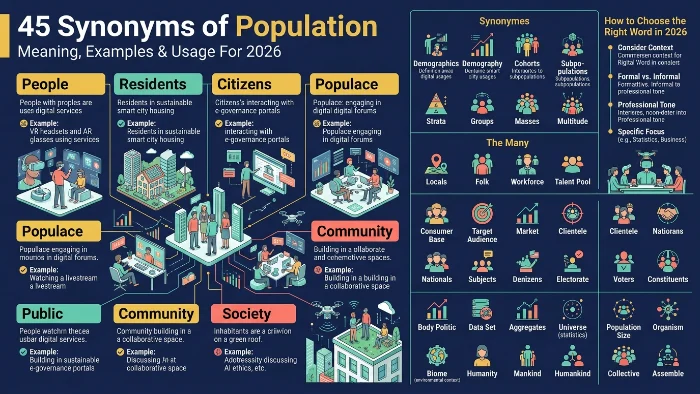
Population refers to all the people or inhabitants of a specific place. The best synonyms are inhabitants, residents, citizens, populace, and public. People is the most common everyday alternative. Community works well for groups with shared characteristics. Each synonym has a slightly different tone and context .
Why use the same word over and over? Learning synonyms for “population” will make your English sound more natural and professional . Whether you’re writing an essay, giving a presentation, or having a daily conversation, having alternative words at your fingertips helps you express yourself more precisely.
In this guide, you’ll learn 20 useful synonyms for “population.” We’ll explain their meanings, show you when to use each one, and give you practical example sentences. By the end, you’ll feel confident choosing the right word for any situation.
What Does “Population” Mean?
Definition
Population” has a few related meanings. Most commonly, it means all the people living in a particular country, city, or area . It can also refer to all the people of a specific group, like “the student population” or “the elderly population.” In statistics, it means the entire set of items or individuals being studied . In biology, it describes a group of animals or plants of the same species living in one place .
Pronunciation
US IPA: /ˌpɑːpjəˈleɪʃən/
UK IPA: /ˌpɒpjʊˈleɪʃən/
Syllables: 4 (pop-u-la-tion)
Tip: Stress the third syllable: pop-yuh-LAY-shun.
Grammar
| Feature | Information |
|---|---|
| Part of Speech | Noun (countable and uncountable) |
| Common Position | Subject or object of a sentence |
| Typical Pattern | The population of + place |
Examples:
- The population of Tokyo is over 13 million.
- Scientists studied the deer population in the forest.
- Population growth is a major global issue.
Word Family
| Word | Part of Speech | Meaning |
|---|---|---|
| Population | Noun | All the people living in a place |
| Populate | Verb | To live in or fill a place |
| Populated | Adjective | Having inhabitants |
| Populous | Adjective | Having a large population |
| Populace | Noun | Ordinary people in a country |
| Depopulate | Verb | To reduce the population of an area |
45 Synonyms of “Population”
1. Inhabitants
Meaning: The people or animals that live in a particular place .
Best Used For: General writing, reports, and descriptions.
Formality: Neutral
Tone: Neutral, factual
Frequency: ⭐⭐⭐⭐ Very Common
CEFR Level: B1
Example Sentence 1: The city’s inhabitants enjoy a high quality of life.
Example Sentence 2: The island has only 500 inhabitants.
Usage Tip: Use “inhabitants” when you want a slightly more formal word than “people” but still want to sound natural. It works well for both human and animal populations.
2. Residents
Meaning: People who live in a particular place, especially for a long time .
Best Used For: Official reports, news articles, community discussions.
Formality: Neutral
Tone: Neutral, professional
Frequency: ⭐⭐⭐⭐⭐ Very Common
CEFR Level: B1
Example Sentence 1: Local residents have complained about the noise.
Example Sentence 2: The residents of the neighborhood organized a clean-up event.
Usage Tip: “Residents” is one of the most natural alternatives. Use it when talking about people living in a specific area. It implies a more permanent connection to the place than “inhabitants” .
3. Citizens
Meaning: People who have legal rights and responsibilities in a country.
Best Used For: Political discussions, official documents, legal contexts.
Formality: Formal
Tone: Professional, official
Frequency: ⭐⭐⭐⭐ Very Common
CEFR Level: B1
Example Sentence 1: All citizens have the right to vote.
Example Sentence 2: The government must protect its citizens.
Usage Tip: “Citizens” is more specific than “population.” It only includes people who hold citizenship, not everyone living in an area. Use it when discussing rights, duties, or legal status .
4. Populace
Meaning: Ordinary people in a country or area, as a whole .
Best Used For: Formal writing, news, political analysis.
Formality: Formal
Tone: Professional, slightly academic
Frequency: ⭐⭐⭐ Moderate
CEFR Level: B2
Example Sentence 1: The new policy has angered the local populace.
Example Sentence 2: The populace demanded change after the election.
Usage Tip: “Populace” is a more sophisticated synonym. It refers to all the people of a place but often suggests “ordinary” or “everyday” people. It sounds more formal than “population” .
5. Public
Meaning: People in general, considered as a group .
Best Used For: News, announcements, public policy discussions.
Formality: Neutral to Formal
Tone: Neutral, professional
Frequency: ⭐⭐⭐⭐⭐ Very Common
CEFR Level: A2
Example Sentence 1: The public is concerned about safety issues.
Example Sentence 2: The museum is open to the public.
Usage Tip: “Public” focuses on the people’s collective interest or involvement. It works well when discussing services, policies, or information meant for everyone. It doesn’t specify location as clearly as “population” .
6. People
Meaning: Human beings in general or a specific group.
Best Used For: All situations – daily conversation, writing, and speaking.
Formality: Neutral
Tone: Neutral, natural
Frequency: ⭐⭐⭐⭐⭐ Very Common
CEFR Level: A1
Example Sentence 1: The people of this town are very friendly.
Example Sentence 2: People are the city’s greatest resource.
Usage Tip: “People” is the simplest and most common alternative . Use it when you want to sound natural and don’t need to be formal or technical. It works in almost every context.
7. Community
Meaning: People living in a particular area or sharing a common interest .
Best Used For: Social discussions, local news, charity work.
Formality: Neutral
Tone: Positive, inclusive
Frequency: ⭐⭐⭐⭐⭐ Very Common
CEFR Level: A2
Example Sentence 1: The entire community came together to help.
Example Sentence 2: Our community has grown rapidly over the past decade.
Usage Tip: “Community” emphasizes connection and shared interests. Use it when you want to highlight relationships between people, not just numbers. It’s a warmer, more human synonym.
8. Society
Meaning: People living together in an organized community .
Best Used For: Academic writing, sociology, political discussions.
Formality: Formal
Tone: Academic, professional
Frequency: ⭐⭐⭐⭐ Very Common
CEFR Level: B1
Example Sentence 1: Technology has transformed modern society.
Example Sentence 2: The society faces many challenges today.
Usage Tip: “Society” emphasizes social structures and organization. It’s more abstract than “population” and works well for discussing culture, institutions, and social change .
9. Masses
Meaning: Ordinary people considered as a large group.
Best Used For: Political discussions, historical writing, social commentary.
Formality: Formal to Neutral
Tone: Slightly dramatic
Frequency: ⭐⭐⭐ Moderate
CEFR Level: B2
Example Sentence 1: The government aimed to improve the lives of the masses.
Example Sentence 2: Masses of people gathered in the square.
Usage Tip: “Masses” can imply ordinary working people. It’s often used when discussing class differences or large-scale movements. Use it carefully – it can sound dramatic or political .
10. Citizenry
Meaning: The body of citizens in a country or area .
Best Used For: Formal writing, political analysis, official reports.
Formality: Very Formal
Tone: Official, professional
Frequency: ⭐⭐ Rare
CEFR Level: C1
Example Sentence 1: The citizenry must be informed about major issues.
Example Sentence 2: An educated citizenry is vital for democracy.
Usage Tip: “Citizenry” is a more formal version of “citizens.” It treats citizens as a collective group. It sounds official and should be reserved for formal contexts.
11. Inhabitants (Related variations)
Meaning: People who live in a place .
Best Used For: Geographic descriptions, scientific writing.
Formality: Formal
Tone: Neutral, factual
Frequency: ⭐⭐⭐⭐ Very Common
CEFR Level: B1
Example Sentence 1: The inhabitants of the coastal region are mainly fishermen.
Example Sentence 2: Small animals are the main inhabitants of this forest.
Usage Tip: This is one of the most direct synonyms. It works for both humans and animals, making it highly versatile .
12. Natives
Meaning: People born in a particular place.
Best Used For: Historical writing, geographic descriptions.
Formality: Neutral to Formal
Tone: Neutral
Frequency: ⭐⭐⭐ Moderate
CEFR Level: B2
Example Sentence 1: The natives of the island have their own traditions.
Example Sentence 2: Many natives left the village to find work.
Usage Tip: “Natives” can be sensitive when discussing Indigenous peoples. Use it carefully. In general contexts, it simply means people born in a place.
13. Residents (Repeated for emphasis)
Meaning: People living in a place .
Best Used For: Real estate, local news, urban planning.
Formality: Neutral
Tone: Professional, practical
Frequency: ⭐⭐⭐⭐⭐ Very Common
CEFR Level: B1
Example Sentence 1: New residents are welcome in the community.
Example Sentence 2: The residents voted on the new development plan.
Usage Tip: “Residents” focuses on where people live, not their legal status or origin. It’s a safe and natural alternative for almost any context .
14. Citizens (Repeated)
Meaning: People with legal rights in a country .
Best Used For: Government, law, policy.
Formality: Formal
Tone: Official
Frequency: ⭐⭐⭐⭐ Very Common
CEFR Level: B1
Example Sentence 1: Citizens have both rights and responsibilities.
Example Sentence 2: The city’s citizens voted on the new proposal.
Usage Tip: “Citizens” is ideal for official contexts. It gives a sense of belonging and legal status to the people you’re describing.
15. Folk
Meaning: People, especially from a particular area or social group.
Best Used For: Informal writing, storytelling, descriptions.
Formality: Informal
Tone: Warm, casual
Frequency: ⭐⭐⭐ Moderate
CEFR Level: B2
Example Sentence 1: The local folk are known for their hospitality.
Example Sentence 2: Folk from all over the region attended the festival.
Usage Tip: “Folk” sounds friendly and down-to-earth. It’s a great informal alternative. Avoid using it in academic or professional writing.
16. Denizens
Meaning: People or animals that live in a place .
Best Used For: Literary writing, journalism.
Formality: Formal
Tone: Literary, slightly dramatic
Frequency: ⭐⭐ Rare
CEFR Level: C1
Example Sentence 1: The denizens of the city were shocked by the announcement.
Example Sentence 2: This forest is home to many woodland denizens.
Usage Tip: “Denizens” has a literary, slightly poetic feel. It’s a good alternative for creative writing or vivid descriptions, but it’s too formal for daily conversation.
17. Electorate
Meaning: People who have the right to vote.
Best Used For: Politics, elections, government.
Formality: Formal
Tone: Professional, official
Frequency: ⭐⭐⭐ Moderate
CEFR Level: B2
Example Sentence 1: The electorate will decide the outcome of the election.
Example Sentence 2: Understanding the electorate is key to winning.
Usage Tip: “Electorate” is a specialized term. It only refers to voters, not all people. Use it when discussing politics and elections specifically.
18. Constituency
Meaning: People living in a particular political district who vote.
Best Used For: Politics, government, policy.
Formality: Formal
Tone: Professional, official
Frequency: ⭐⭐⭐ Moderate
CEFR Level: B2
Example Sentence 1: The politician listens carefully to her constituency.
Example Sentence 2: The constituency’s needs must be addressed.
Usage Tip: “Constituency” refers to both the voters and the area they live in. It’s very political and not a general synonym for all situations.
19. Multitude
Meaning: A large number of people.
Best Used For: Descriptive writing, dramatic situations.
Formality: Neutral to Formal
Tone: Dramatic, literary
Frequency: ⭐⭐ Rare
CEFR Level: B2
Example Sentence 1: A multitude gathered at the stadium.
Example Sentence 2: The politician addressed the multitude.
Usage Tip: “Multitude” emphasizes large numbers. It’s a great synonym when you want to highlight size and create a dramatic effect. It’s less specific about location or legal status.
20. Demography
Meaning: The characteristics of a population (age, income, education, etc.) .
Best Used For: Academic writing, business analysis, research.
Formality: Very Formal
Tone: Academic, technical
Frequency: ⭐⭐ Rare
CEFR Level: C1
Example Sentence 1: The demography of the city is changing rapidly.
Example Sentence 2: Marketers study the demography of their target audience.
Usage Tip: “Demography” refers to the characteristics of a population, not the people themselves. It’s a technical term for academic or professional use.
Synonyms Comparison Table
| Synonym | Best Context | Formality | Tone | Frequency |
|---|---|---|---|---|
| People | All situations | Neutral | Natural | ⭐⭐⭐⭐⭐ |
| Residents | Local news, reports | Neutral | Professional | ⭐⭐⭐⭐⭐ |
| Public | News, services | Neutral to Formal | Professional | ⭐⭐⭐⭐⭐ |
| Community | Social contexts | Neutral | Inclusive | ⭐⭐⭐⭐⭐ |
| Citizens | Politics, law | Formal | Official | ⭐⭐⭐⭐⭐ |
| Society | Academic writing | Formal | Academic | ⭐⭐⭐⭐ |
| Inhabitants | Geographic contexts | Formal | Factual | ⭐⭐⭐⭐ |
| Populace | Formal writing | Formal | Academic | ⭐⭐⭐ |
| Masses | Social commentary | Formal | Dramatic | ⭐⭐⭐ |
| Electorate | Politics | Formal | Official | ⭐⭐⭐ |
Best Synonyms by Situation
| Situation | Best Synonym | Why It Works |
|---|---|---|
| Daily Conversation | People | Simple and natural |
| Business Email | Residents or Community | Professional and clear |
| Academic Writing | Inhabitants or Society | Formal and precise |
| School Assignment | People or Inhabitants | Easy to understand |
| Professional Meeting | Public or Residents | Direct and appropriate |
| Presentation | Community or Society | Engaging and clear |
| Creative Writing | Denizens or Multitude | Literary and descriptive |
| Social Media | People or Community | Relatable and human |
| Political Discussion | Citizens or Electorate | Accurate and specific |
Formal vs Informal Synonyms
Formal Alternatives
| Synonym | Best Used For |
|---|---|
| Populace | Academic writing, reports |
| Society | Sociology, cultural analysis |
| Citizenry | Official documents, government |
| Electorate | Political analysis |
Neutral Alternatives
| Synonym | Best Used For |
|---|---|
| Residents | Most professional contexts |
| Inhabitants | Geography, reports |
| Community | Social discussions |
Informal Alternatives
| Synonym | Best Used For |
|---|---|
| People | All informal contexts |
| Folk | Casual conversations |
| Crowd | Social gatherings |
When to choose which: Choose formal synonyms for academic writing, official documents, and professional presentations. Choose neutral synonyms for most business contexts. Choose informal synonyms when you’re talking with friends or writing social media posts.
Strong vs Mild Synonyms
Mild
People, Residents, Public – These are everyday words suitable for any situation . They describe a group without making the description sound dramatic or political.
Moderate
Inhabitants, Citizens, Community, Populace – These are more specific and formal . They give a clearer picture of the type of group you’re describing without being overly intense.
Strong
Masses, Denizens, Citizenry, Multitude – These words have strong connotations . Use them carefully for dramatic effect, political discussions, or literary writing.
How intensity changes meaning: Mild words are safe and natural. Strong words make your description more vivid but can sound unnatural if used in the wrong context. Start with mild or moderate words for everyday use.
Real-Life Examples
In a business email:
“The local residents have shown strong support for our new project.”
In a presentation:
“Understanding our target community is essential to our marketing strategy.”
In an academic essay:
“The inhabitants of the region experienced significant economic changes.”
In a news report:
“The public has expressed concern over the new policy proposals.”
In daily conversation:
“The people in my neighborhood are really friendly.”
In a history book:
“The denizens of ancient Rome enjoyed a sophisticated urban lifestyle.”
In a political speech:
“The citizenry must be informed to make good decisions.”
Common Collocations
| Common Phrase | Better Alternative |
|---|---|
| Large population | Dense population (for areas) |
| Small population | Sparse population (for areas) |
| City population | Urban population |
| Country population | Rural population |
| Working population | Workforce |
| Student population | Student body |
Common Phrases
“Population boom” – A rapid increase in population.
- Better alternative: Population growth (more neutral)
“Population density” – Number of people per area.
- Use as a technical term in geography.
“General population” – Most people in a place.
- Use when distinguishing from a specific group.
“Native population” – People born in a place.
- Use for historical or demographic contexts.
Context Guide
| Situation | Best Synonym | Reason |
|---|---|---|
| Essay | Inhabitants or Citizens | Academic and clear |
| Speech | Community or Public | Engaging and inclusive |
| Business Email | Residents | Professional and direct |
| Novel | Denizens or Folk | Literary and descriptive |
| Presentation | Audience or Community | Relevant and engaging |
| Conversation | People | Simple and natural |
| Academic Writing | Population or Society | Precise and formal |
| Marketing Copy | Community | Relatable and appealing |
Related Words
Near Synonyms
Populace, Public, Residents – These have the closest meanings to “population” and can often be used interchangeably with the correct context.
Antonyms
- Individual – One person, not a group
- Empty – No people at all
- Depopulated – With the population removed
Related Adjectives
- Populous – Having a large population
- Populated – Having inhabitants
Related Nouns
- Census – An official count of the population
- Demographics – Statistical data about a population
Related Verbs
- Populate – To live in a place
- Settle – To establish a community
- Colonize – To establish a population in a new area
Frequently Asked Questions
What is another word for population?
The most common synonyms are people, inhabitants, residents, citizens, and populace. Your choice depends on the context and tone you need .
Which synonym sounds the most professional?
“Residents” and “citizens” sound the most professional and are widely used in business and official contexts . “Populace” is also formal but less common.
What is the strongest synonym for population?
Masses” and “multitude” are strong synonyms that emphasize large groups. However, they can sound dramatic and should be used carefully .
Which synonym is best for academic writing?
“Population” itself is the safest choice. If you need variety, “inhabitants,” “society,” or “community” work well in academic contexts.
What is the most common synonym in everyday English?
People” is the most common and natural synonym. It works in almost any situation and is understood by everyone.
What is the opposite of population?
Individual” is the closest opposite, meaning one person rather than a group. “Empty” describes a place without a population.
Conclusion
The word “population” has many useful alternatives. Knowing these synonyms helps you write and speak more naturally in English. Whether you choose “residents” for a professional email, “community” for a warm description, or “citizens” for a political discussion, your choice should always match your context, tone, and audience.
Don’t be afraid to experiment with different words as you practice. Start with the most common alternatives like “people,” “residents,” and “public.” As you become more comfortable, expand your vocabulary with more specific synonyms. The best way to learn is to read and listen to how native speakers use these words in real situations.
