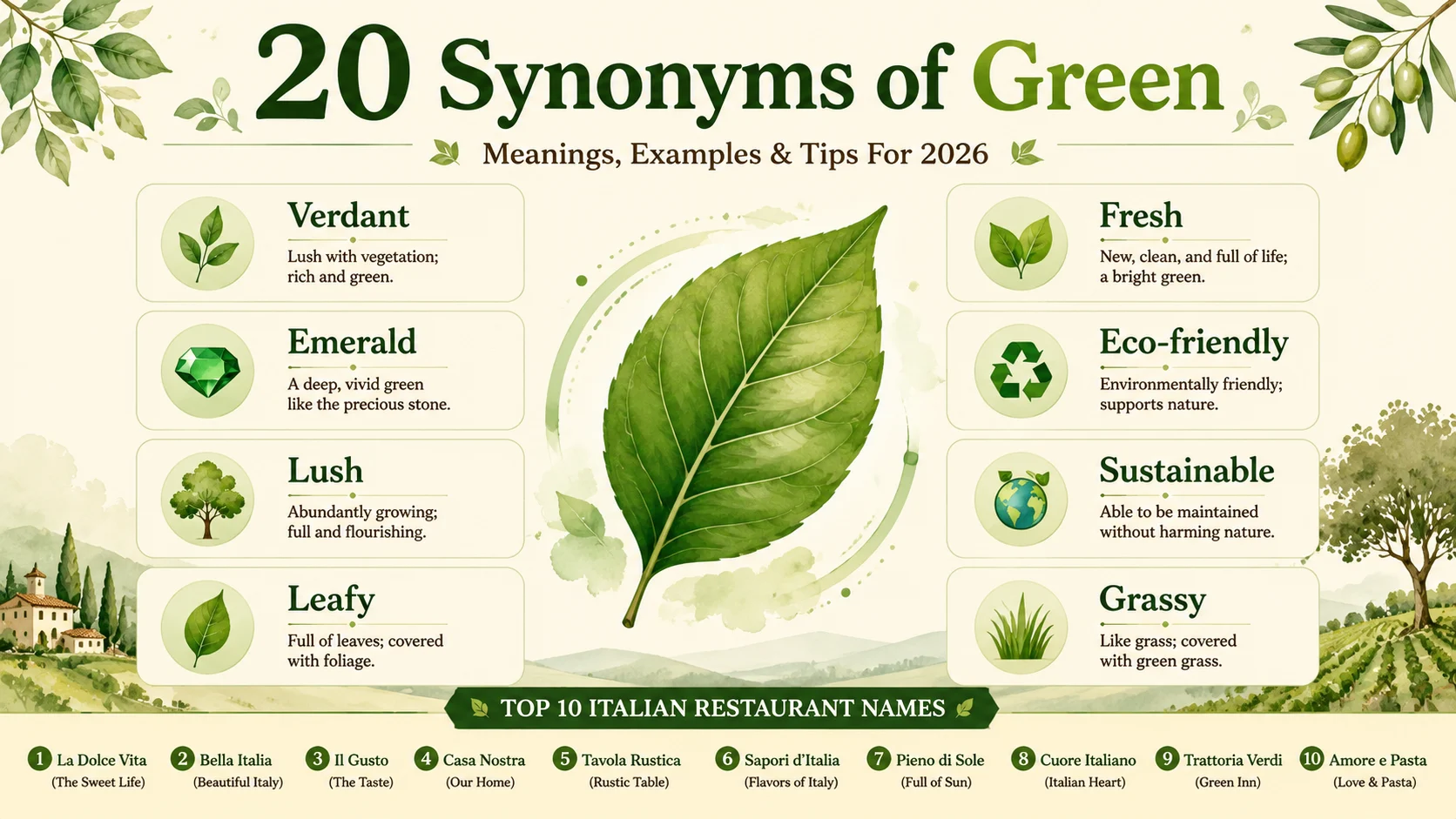
- Green is a color of nature, growth, and freshness. It also describes inexperience or environmental awareness. The best synonyms are verdant, emerald, lush, leafy, and fresh. Eco-friendly is common for environmental contexts. Each synonym has a different tone and works in different situations.
In this guide, you’ll learn 20 useful alternatives for “green.” We’ll explain their meanings, show you when to use them, and give you practical examples. By the end, you’ll feel confident choosing the perfect word for every situation.
What Does “Green” Mean?
Definition
Green” has three main meanings in English. First, it’s the color of grass and leaves – one of the basic colors we learn early. Second, it describes places full of plants, like forests or gardens. Third, it means being new or inexperienced at something. It can also describe things that are good for the environment.
Pronunciation
US IPA: /ɡriːn/
UK IPA: /ɡriːn/
Syllables: 1
Tip: Just one sound! Make the “ee” sound long, like in “see.” Your tongue stays high and forward in your mouth.
Grammar
| Feature | Information |
|---|---|
| Part of Speech | Adjective (most common), Noun, Verb |
| Common Position | Before a noun (a green apple) or after a linking verb (the apple is green) |
| Typical Pattern | Green + noun OR noun + be + green |
Examples:
- She wore a beautiful green dress to the party.
- The garden looks so green and healthy this year.
- He’s still green, but he’s learning fast.
Word Family
| Word | Part of Speech | Meaning |
|---|---|---|
| Green | Adjective/Noun/Verb | The color of grass; environmentally friendly; inexperienced |
| Greenery | Noun | Green plants and leaves |
| Greenish | Adjective | Slightly green in color |
| Greenness | Noun | The quality of being green |
| Greengage | Noun | A sweet green fruit |
| Greenhouse | Noun | A glass building for plants |
20 Synonyms of “Green”
1. Verdant
Meaning: Covered with healthy green plants or vegetation.
Best Used For: Creative writing, nature descriptions, travel writing.
Formality: Formal
Tone: Literary, positive
Frequency: ⭐⭐⭐ Moderate
CEFR Level: B2
Example Sentence 1: The verdant hills of Ireland are famous worldwide.
Example Sentence 2: They bought a house in the verdant countryside.
Usage Tip: “Verdant” is a beautiful word for lush, green landscapes. Use it when you want to sound poetic or create a vivid nature image. It’s too formal for casual daily conversation.
2. Emerald
Meaning: Bright green like the precious stone.
Best Used For: Color descriptions, creative writing, marketing.
Formality: Neutral
Tone: Positive, rich, luxurious
Frequency: ⭐⭐⭐⭐ Common
CEFR Level: B1
Example Sentence 1: The emerald sea sparkled in the afternoon sun.
Example Sentence 2: She had beautiful emerald eyes.
Usage Tip: “Emerald” suggests a rich, deep green. Use it for things that are very green and beautiful. It works well for describing eyes, water, or precious objects.
3. Lush
Meaning: Growing thickly and strongly, usually about plants.
Best Used For: Travel writing, nature descriptions, gardens.
Formality: Neutral
Tone: Positive, abundant, luxurious
Frequency: ⭐⭐⭐⭐ Common
CEFR Level: B1
- Example Sentence 1: The lush rainforest was full of exotic birds.
Example Sentence 2: Their garden is so lush after all the rain.
Usage Tip: “Lush” emphasizes thickness, health, and abundance. Use it for places where plants grow extremely well. It can also describe plants that are soft and juicy.
4. Leafy
Meaning: Having many leaves or covered with leaves.
Best Used For: Street descriptions, garden writing, daily conversation.
Formality: Neutral
Tone: Positive, natural
Frequency: ⭐⭐⭐⭐ Common
CEFR Level: A2
Example Sentence 1: They live on a leafy street in the suburbs.
Example Sentence 2: The park is so leafy and peaceful in summer.
Usage Tip: “Leafy” is simple and natural. Use it to describe places with many trees and leaves. It’s perfect for everyday English and sounds much more interesting than just “green.”
5. Fresh
Meaning: New, recent, or full of life.
Best Used For: Daily conversation, product descriptions, food.
Formality: Neutral
Tone: Positive, clean, lively
Frequency: ⭐⭐⭐⭐⭐ Very Common
CEFR Level: A2
Example Sentence 1: The air felt so fresh and green after the rain.
Example Sentence 2: I love the fresh, green smell of cut grass.
Usage Tip: “Fresh” combines the idea of green with newness and vitality. Use it when you want to describe something alive, energetic, and clean. It’s widely used and very natural.
6. Grassy
Meaning: Covered with grass.
Best Used For: Park descriptions, landscape writing, daily conversation.
Formality: Neutral
Tone: Neutral, descriptive
Frequency: ⭐⭐⭐⭐ Common
CEFR Level: A2
Example Sentence 1: The children played on the grassy hill.
Example Sentence 2: There’s a beautiful grassy area behind the school.
Usage Tip: “Grassy” is simple and direct. Use it when you want to specify that something is green because of grass, not other plants like trees or bushes.
7. Forested
Meaning: Covered with trees and forest.
Best Used For: Geography, travel writing, environmental descriptions.
Formality: Neutral to Formal
Tone: Neutral, factual
Frequency: ⭐⭐⭐ Moderate
CEFR Level: B1
Example Sentence 1: The heavily forested mountains are home to many animals.
Example Sentence 2: We drove through miles of forested land.
Usage Tip: “Forested” is specific to areas with many trees. Use it when describing large wooded areas. It’s more formal than “leafy” but less poetic than “verdant.”
8. Environmentally Friendly
Meaning: Not harming the natural environment.
Best Used For: Business writing, product descriptions, official contexts.
Formality: Formal
Tone: Professional, positive
Frequency: ⭐⭐⭐⭐⭐ Very Common
CEFR Level: B1
Example Sentence 1: We use only environmentally friendly packaging.
Example Sentence 2: Are these cleaning products environmentally friendly?
Usage Tip: This is the formal, professional way to say “green” when talking about the environment. Use it in business, academic, or official writing.
9. Eco-Friendly
Meaning: Good for the environment.
Best Used For: Marketing, everyday conversation, product labels.
Formality: Neutral to Informal
Tone: Positive, modern
Frequency: ⭐⭐⭐⭐⭐ Very Common
CEFR Level: B1
Example Sentence 1: We bought an eco-friendly car last year.
Example Sentence 2: The hotel uses eco-friendly cleaning products.
Usage Tip: “Eco-friendly” is the more casual version of “environmentally friendly.” It’s very common in daily life and marketing. Use it for most environmental contexts.
10. Sustainable
Meaning: Using resources in a way that doesn’t damage the environment.
Best Used For: Business, academic writing, environmental discussions.
Formality: Formal
Tone: Professional, serious
Frequency: ⭐⭐⭐⭐⭐ Very Common
CEFR Level: B1
Example Sentence 1: The company is committed to sustainable practices.
Example Sentence 2: We need more sustainable solutions for energy.
Usage Tip: “Sustainable” is slightly different from “green.” It focuses on long-term environmental health and resource use. Use it in professional environmental discussions.
11. Unripe
Meaning: Not ready to eat because it’s still green.
Best Used For: Food descriptions, everyday conversation.
Formality: Neutral
Tone: Neutral, practical
Frequency: ⭐⭐⭐⭐ Common
CEFR Level: A2
Example Sentence 1: These bananas are still too unripe to eat.
Example Sentence 2: The unripe tomatoes are hard and green.
Usage Tip: “Unripe” describes fruits and vegetables that haven’t fully grown yet. Use it when the color green means the food isn’t ready yet. “Green” is also commonly used here.
12. Inexperienced
Meaning: Lacking knowledge or practice.
Best Used For: Job interviews, workplace discussions, education.
Formality: Neutral to Formal
Tone: Neutral, factual
Frequency: ⭐⭐⭐⭐⭐ Very Common
CEFR Level: B1
Example Sentence 1: He’s still inexperienced, but he’s learning quickly.
Example Sentence 2: We need someone who isn’t inexperienced in marketing.
Usage Tip: This is the professional alternative to saying someone is “green” (meaning new at something). Use it in workplace and professional contexts.
13. New
Meaning: Recently arrived or not old.
Best Used For: All situations where freshness or newness is the focus.
Formality: Neutral
Tone: Neutral, positive
Frequency: ⭐⭐⭐⭐⭐ Very Common
CEFR Level: A1
Example Sentence 1: She’s new to the company, so be patient.
Example Sentence 2: I’m new to this kind of work.
Usage Tip: “New” is simpler than “green.” Use it when you just want to say someone is new at something without the “color” metaphor.
14. Envious
Meaning: Wanting what someone else has.
Best Used For: Emotions, personal writing, stories.
Formality: Neutral
Tone: Negative, emotional
Frequency: ⭐⭐⭐⭐ Common
CEFR Level: B1
Example Sentence 1: She was envious of her friend’s success.
Example Sentence 2: I felt envious when I saw his new car.
Usage Tip: “Envious” is the formal word for the emotion behind “green with envy.” Use it when describing jealous feelings. “Jealous” is also very common.
15. Jealous
Meaning: Feeling unhappy because someone has something you want.
Best Used For: Personal conversations, emotional descriptions.
Formality: Neutral to Informal
Tone: Negative, emotional
Frequency: ⭐⭐⭐⭐⭐ Very Common
CEFR Level: B1
Example Sentence 1: She was jealous of her sister’s new job.
Example Sentence 2: Don’t be jealous of his success.
Usage Tip: This is the everyday word for the “green with envy” feeling. Use it in casual conversation and personal writing. It’s simpler and more common than “envious.”
16. Olive
Meaning: A yellowish-green color, like the olive fruit.
Best Used For: Color descriptions, fashion, design.
Formality: Neutral
Tone: Neutral, descriptive
Frequency: ⭐⭐⭐ Moderate
CEFR Level: B1
Example Sentence 1: She wore a stylish olive jacket.
Example Sentence 2: They painted the walls in a warm olive shade.
Usage Tip: “Olive” describes a specific shade of green. Use it when you need to be precise about color. It has a yellowish or brownish undertone.
17. Lime
Meaning: Bright yellowish-green, like the lime fruit.
Best Used For: Color descriptions, fashion, design, marketing.
Formality: Neutral
Tone: Positive, bright, energetic
Frequency: ⭐⭐⭐⭐ Common
CEFR Level: A2
Example Sentence 1: She loves wearing bright lime dresses.
Example Sentence 2: The walls were painted a cheerful lime green.
Usage Tip: “Lime” describes a very bright, fresh green. Use it when you want a lively, modern shade description. Perfect for fashion and design contexts.
18. Sea Green
Meaning: A pale bluish-green color like the sea.
Best Used For: Color descriptions, design, creative writing.
Formality: Neutral
Tone: Neutral, peaceful
Frequency: ⭐⭐⭐ Moderate
CEFR Level: B1
Example Sentence 1: The sea green walls made the room feel calm.
Example Sentence 2: She chose a sea green paint for the bathroom.
Usage Tip: “Sea green” is a specific shade combining green and blue. Use it when you want to describe colors accurately, especially in interior design or creative writing.
19. Sage
Meaning: A pale, muted grayish-green like the herb.
Best Used For: Interior design, fashion, sophisticated color descriptions.
Formality: Neutral
Tone: Calm, natural, sophisticated
Frequency: ⭐⭐⭐ Moderate
CEFR Level: B1
Example Sentence 1: The nursery was decorated in calming sage tones.
Example Sentence 2: She wore a beautiful sage green dress.
Usage Tip: “Sage” has become very trendy in fashion and design. Use it when you want a sophisticated, calming green color description. It’s subtle and elegant.
20. Chartreuse
Meaning: A bright yellow-green color.
Best Used For: Color descriptions, fashion, design.
Formality: Neutral
Tone: Bold, bright, modern
Frequency: ⭐⭐ Rare
CEFR Level: B2
Example Sentence 1: The chartreuse cushions added a bold pop of color.
Example Sentence 2: She painted her front door chartreuse.
Usage Tip: “Chartreuse” is a specific, bright green-yellow shade. It’s less common than “lime” and often considered more sophisticated. Use it carefully in design contexts.
Synonyms Comparison Table
| Synonym | Best Context | Formality | Tone | Frequency |
|---|---|---|---|---|
| Fresh | Daily life | Neutral | Positive | ⭐⭐⭐⭐⭐ |
| Eco-friendly | Environment | Neutral | Positive | ⭐⭐⭐⭐⭐ |
| Inexperienced | Work, learning | Neutral | Neutral | ⭐⭐⭐⭐⭐ |
| Lush | Gardens, nature | Neutral | Positive | ⭐⭐⭐⭐ |
| Leafy | Street descriptions | Neutral | Positive | ⭐⭐⭐⭐ |
| Emerald | Color descriptions | Neutral | Rich | ⭐⭐⭐⭐ |
| Verdant | Nature, literature | Formal | Literary | ⭐⭐⭐ |
| Sustainable | Business, environment | Formal | Professional | ⭐⭐⭐⭐⭐ |
Best Synonyms by Situation
| Situation | Best Synonym | Why It Works |
|---|---|---|
| Daily Conversation | Green or Fresh | Simple and natural |
| Business Email | Sustainable | Professional and formal |
| Academic Writing | Verdant | Formal and precise |
| School Assignment | Lush or Leafy | Easy to understand |
| Professional Meeting | Environmentally Friendly | Formal and clear |
| Presentation | Sustainable | Professional and modern |
| Creative Writing | Emerald or Sage | Vivid and descriptive |
| Social Media | Eco-friendly | Modern and relatable |
| Movie Review | Visually Green | Simple and direct |
Formal vs Informal Synonyms
Formal Alternatives
| Synonym | Best Used For |
|---|---|
| Verdant | Academic writing, literature |
| Sustainable | Business, environmental reports |
| Environmentally Friendly | Official documents |
| Forested | Geographic descriptions |
Neutral Alternatives
| Synonym | Best Used For |
|---|---|
| Leafy | Street and place descriptions |
| Lush | Nature descriptions |
| Emerald | Color descriptions |
| Fresh | Most everyday contexts |
Informal Alternatives
| Synonym | Best Used For |
|---|---|
| Grassy | Casual descriptions |
| Eco-friendly | Everyday conversation |
| New | When talking about experience |
When to choose which: Choose formal synonyms for academic essays, official reports, and professional presentations. Choose neutral synonyms for most writing. Choose informal synonyms when you’re speaking with friends or writing casually.
Strong vs Mild Synonyms
Mild
Green, Leafy, Grassy, Fresh – These are everyday, simple words. They describe green things without drama. Use them in any context.
Moderate
Verdant, Lush, Emerald, Eco-friendly – These are more descriptive and specific. They add more detail about the shade, quality, or meaning of green.
Strong
Chartreuse, Olive, Sage – These are very specific color names. They describe exact shades. Use them when you need to be precise about color, like in design or fashion.
How intensity changes meaning: Mild words are safe for any situation. Moderate words make your language more interesting. Strong words give very precise information. The right word depends on how much detail you need.
Real-Life Examples
- In a real estate ad:
- “The property features a lush garden and a large, leafy backyard.”
- In a workplace meeting:
- “We need to implement more sustainable business practices.”
- In a travel blog:
- “The verdant hills of the countryside took my breath away.”
- In a fashion review:
- “She stunned in an emerald evening gown.”
- In a food conversation:
- “The bananas are still unripe, so they’ll be perfect tomorrow.”
- In a job interview:
- “I’m new to this industry, but I’m a quick learner.”
- In a personal story:
- “She felt envious when she saw her friend’s new house.”
Common Collocations
| Common Phrase | Better Alternative |
|---|---|
| Green landscape | Verdant landscape |
| Green garden | Lush garden |
| Green street | Leafy street |
| Green forest | Dense forest |
| Green policies | Sustainable policies |
| Green products | Eco-friendly products |
Common Phrases
“Green with envy” – Feeling very jealous.
- Alternative: Jealous or Envious
“Green thumb” – Being good at gardening.
- Alternative: Good gardener
“Greenhorn” – An inexperienced person.
- Alternative: Newcomer or Beginner
“Green light” – Permission to start something.
- No direct green synonym works here.
Context Guide
| Situation | Best Synonym | Reason |
|---|---|---|
| Essay | Verdant or Sustainable | Academic and clear |
| Speech | Lush or Fresh | Engaging and vivid |
| Business Email | Eco-friendly or Sustainable | Professional and relevant |
| Novel | Emerald or Sage | Literary and descriptive |
| Presentation | Sustainable | Professional and modern |
| Conversation | Fresh or Green | Natural and simple |
| Academic Writing | Verdant or Forested | Precise and formal |
| Marketing Copy | Eco-friendly | Modern and attractive |
Related Words
Near Synonyms
Verdant, Lush, Leafy, Fresh – These all describe green vegetation and share similar meanings but with different nuances.
Antonyms
- Barren – Not green, no plants
- Bare – Without plants or leaves
- Dry – Not green or fresh
- Experienced – The opposite of “green” (inexperienced)
- Related Adjectives
- Verdant – Green with plants
- Lush – Green and thick with plants
- Leafy – Full of leaves
- Grassy – Covered in grass
- Related Nouns
- Verdure – Green vegetation
- Greenery – Green plants and leaves
- Foliage – Leaves of plants
- Related Verbs
- Greet – Not related to green
- Grow – What green plants do
- Flourish – To grow well
Frequently Asked Questions
What is another word for green?
Common synonyms include verdant, emerald, lush, leafy, and fresh. Your choice depends on whether you’re describing the color, vegetation, the environment, or inexperience.
Which synonym sounds the most professional?
“Sustainable” and “environmentally friendly” sound the most professional for environmental contexts. “Inexperienced” is best for describing someone new at something.
What is the strongest synonym for green?
“Verdant” is the most vivid for describing green vegetation. “Chartreuse” and “emerald” are very specific color shades. Their intensity depends on what you’re describing.
Which synonym is best for academic writing?
“Verdant” works well for nature descriptions. “Sustainable” is excellent for environmental topics. Both are formal and precise for academic contexts.
What is the most common synonym in everyday English?
“Fresh” and “eco-friendly” are very common in daily conversation. “Green” itself is still the most frequent, but these are natural alternatives.
What is the opposite of green?
“Barren” (for vegetation), “experienced” (for inexperience), and “unripe” has no clear opposite but “ripe” works for fruit.
Conclusion
The word “green” has an amazing variety of synonyms. Each one adds a different shade of meaning to your English. You can choose from color-specific words like “emerald” and “olive,” descriptive words like “verdant” and “lush,” or professional words like “sustainable” and “eco-friendly.”
The most important lesson is this: the best synonym depends on your situation. Use “leafy” for a street description, “lush” for a garden, “sustainable” for business, and “inexperienced” at work. As you practice using these words, you’ll naturally learn which one fits each situation.
Start by picking two or three new synonyms and using them this week. You’ll be amazed how quickly your vocabulary grows when you replace “green” with more precise alternatives!
