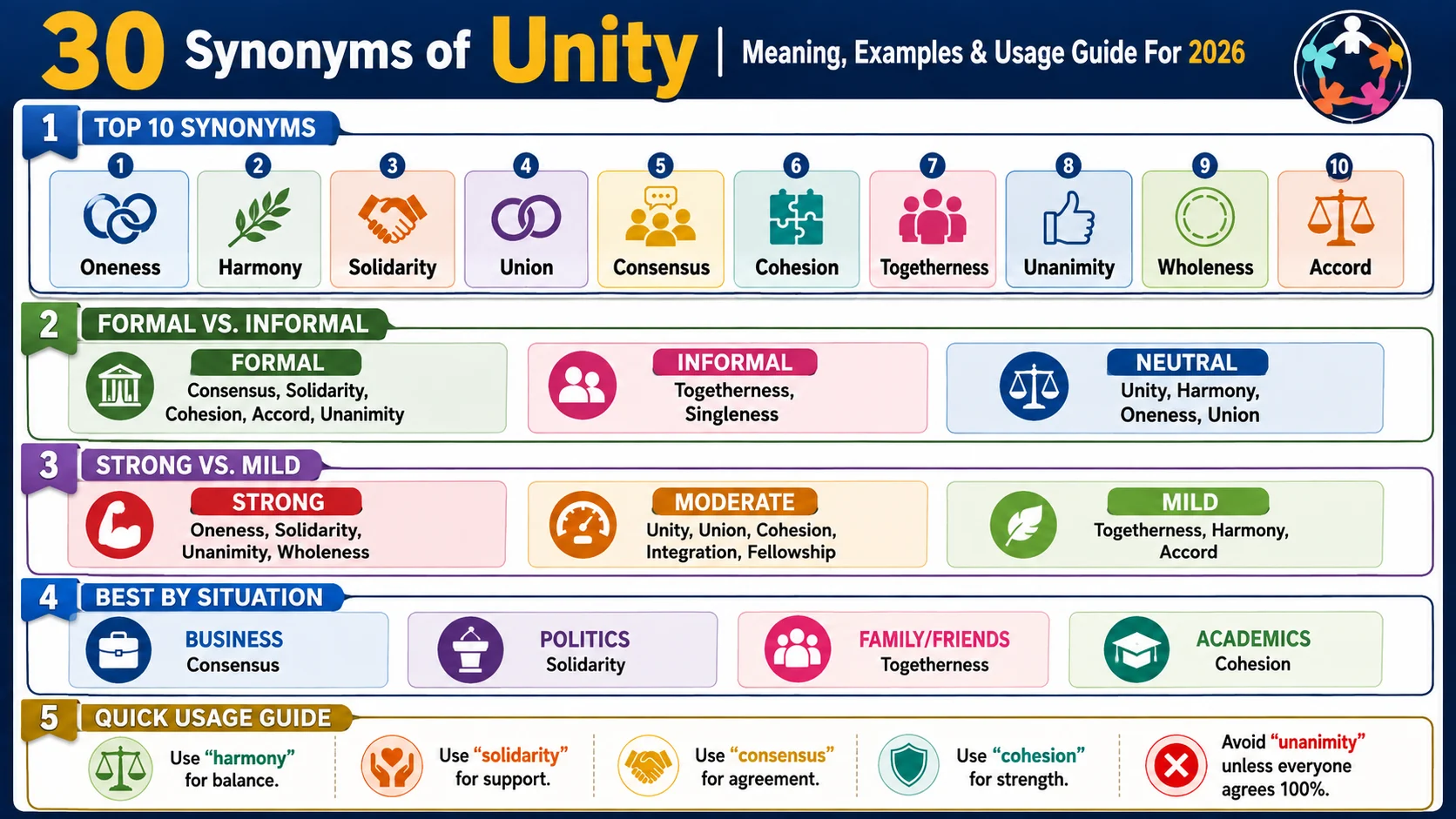
Unity means being joined together as one whole, or people feeling connected and in agreement. The most common synonyms are oneness, harmony, solidarity, union, and consensus. Use harmony for peaceful agreement, solidarity for group support, and union for things formally joined together. This guide explains 30 alternatives with examples and context notes to help you choose the right word every time.
Have you ever felt that a single word just doesn’t capture the idea you want to express? That’s where synonyms become your best friend! The word “unity” is powerful, but sometimes you need a slightly different shade of meaning. Maybe you’re writing a business report and need something more professional. Or perhaps you’re telling a story and want a more emotional word. By learning alternative words for unity, you’ll sound more fluent, natural, and precise. In this guide, you’ll discover 30 synonyms for “unity,” complete with meanings, example sentences, and practical tips for using each one confidently in the right situation.
What Does “Unity” Mean?
Definition
At its heart, unity describes the state of being joined together as a single whole. It can mean people or things that are physically combined into one unit, like parts of a country. More often, it describes a feeling of agreement and harmony between people, where everyone shares a common purpose, goal, or set of beliefs . Think of a team working perfectly together, or a family supporting each other through tough times that’s the spirit of unity. It’s the opposite of division, disagreement, or separation.
Pronunciation
| Feature | Information |
|---|---|
| US IPA | /ˈjuː.nə.t̬i/ |
| UK IPA | /ˈjuː.nə.ti/ |
| Syllables | 3 (u·ni·ty) |
| Tip | Stress the first syllable: YOU-nuh-tee. The “u” sounds like the word “you.” |
Grammar
| Grammar Feature | Information |
|---|---|
| Part of Speech | Noun (usually uncountable) |
| Common Position | Subject, object, or complement of a sentence. Often follows words like “sense of,” “spirit of,” or “need for.” |
| Typical Pattern | sense of unity, spirit of unity, call for unity, unity among [group] |
Example Sentences:
- The team’s unity was the key to their victory. (Subject)
- The new president called for national unity. (Object)
- There is a great sense of unity among the volunteers. (Complement)
Word Family
| Word | Part of Speech | Meaning |
|---|---|---|
| Unity | Noun | The state of being united or joined as a whole. |
| Unite | Verb | To join together or become one. |
| Unified | Adjective | Made into a single unit or whole; united. |
| Unifying | Adjective | Bringing people or things together to form one unit. |
| Unit | Noun | A single, complete thing; a component part of a larger whole. |
30 Synonyms of “Unity”
Oneness
Meaning: The state of being one single, whole thing; a feeling of being fully connected to others.
Best Used For: Spiritual or philosophical writing, describing deep personal connection, and emphasizing wholeness.
Formality: Neutral
Tone: Profound, Emotional, Philosophical
Frequency: ⭐⭐⭐⭐ (Common)
CEFR Level: B2
Example Sentence 1: Meditation can create a powerful sense of oneness with the universe.
Example Sentence 2: The community felt a deep oneness after overcoming the natural disaster together.
Usage Tip: Use “oneness” when you want to emphasize the feeling of being connected at a deep, almost spiritual level. It’s often preferred over “unity” in discussions about personal growth or philosophy.
Harmony
Meaning: A pleasing combination of different parts or people that creates a peaceful and balanced whole.
Best Used For: Describing relationships, music, art, and situations where different elements work well together.
Formality: Neutral
Tone: Positive, Peaceful, Balanced
Frequency: ⭐⭐⭐⭐⭐ (Very Common)
CEFR Level: B1
Example Sentence 1: The neighbors live in perfect harmony, even though they come from different cultures.
Example Sentence 2: The interior design of the room achieved a beautiful harmony of color and texture.
Usage Tip: This is a very common and natural word. Use “harmony” when you want to focus on the peaceful and pleasant cooperation of different parts, rather than just the fact that they are joined.
Solidarity
Meaning: A feeling of agreement and support among a group of people, especially during a conflict or for a common cause.
Best Used For: Political writing, social movements, union activities, and expressing support for a group.
Formality: Formal
Tone: Supportive, Strong, Political
Frequency: ⭐⭐⭐⭐ (Common)
CEFR Level: B2
Example Sentence 1: Workers across the country showed their solidarity by wearing matching t-shirts.
Example Sentence 2: We stand in solidarity with the families affected by the tragedy.
Common Confusion: Solidarity vs Unity “Solidarity” is more specific and implies support for a cause or group, often in a social or political context. “Unity” is a broader term for being one.
Usage Tip: Save “solidarity” for situations where people are actively showing support for each other, particularly when facing an external challenge or advocating for change.
Union
Meaning: The act of joining two or more things together into one, or the single entity created by this process.
Best Used For: Describing formal or political merges, such as countries, companies, or organizations.
Formality: Formal
Tone: Neutral, Official
Frequency: ⭐⭐⭐⭐⭐ (Very Common)
CEFR Level: B1
Example Sentence 1: The union of the two companies created a new global powerhouse.
Example Sentence 2: The treaty formalized the union between the two kingdoms.
Common Confusion: Union vs Unity “Union” often refers to the physical or formal act of joining, or the resulting structure (like a labor union or a political union). “Unity” more often describes the resulting sense of agreement and wholeness.
Usage Tip: Use “union” when you’re talking about the process of joining or the resulting structure itself. For the feeling of togetherness, “unity” is often a better choice.
Consensus
Meaning: A general agreement among a group of people, where everyone shares the same opinion on a matter.
Best Used For: Business meetings, political discussions, decision-making processes, and describing shared opinions.
Formality: Formal
Tone: Neutral, Professional
Frequency: ⭐⭐⭐⭐ (Common)
CEFR Level: B2
Example Sentence 1: The committee finally reached a consensus on the new budget.
Example Sentence 2: There is a growing consensus among scientists that climate change is real.
Common Confusion: Consensus vs Unity “Consensus” is about agreement in thought or opinion. “Unity” is about togetherness in action or spirit, even if people disagree.
Usage Tip: Choose “consensus” when the key idea is that everyone agrees on a decision or opinion, not just that they are working together.
Accord
Meaning: An official agreement or a state of harmony and mutual understanding.
Best Used For: Formal agreements between countries or parties, and describing a state of peaceful agreement.
Formality: Formal
Tone: Official, Peaceful
Frequency: ⭐⭐⭐ (Moderate)
CEFR Level: B2
Example Sentence 1: The two nations signed a peace accord.
Example Sentence 2: After hours of negotiation, they were in full accord on all points.
Usage Tip: “Accord” is a slightly more formal version of “agreement.” It’s a great word for international news or formal business contexts.
Cohesion
Meaning: The force that holds things together; the quality of being well organized, integrated, and sticking together.
Best Used For: Social science writing, business management, describing teams and societies.
Formality: Formal
Tone: Neutral, Professional
Frequency: ⭐⭐⭐ (Moderate)
CEFR Level: B2
Example Sentence 1: Social cohesion is essential for a stable and prosperous city.
Example Sentence 2: The team’s cohesion was evident in their seamless performance.
Common Confusion: Cohesion vs Unity “Cohesion” focuses on the strength of the bond that holds the group together. It often implies a functional or structural aspect. “Unity” can be a more general term.
Usage Tip: Use “cohesion” when you want to emphasize the forces that keep a group or system from falling apart, like the “glue” that holds it together.
Togetherness
Meaning: The warm, friendly feeling of being close to other people, especially when sharing activities or experiences.
Best Used For: Casual conversation, family contexts, team-building, and storytelling.
Formality: Informal
Tone: Warm, Emotional, Personal
Frequency: ⭐⭐⭐⭐ (Common)
CEFR Level: B1
Example Sentence 1: Our family reunion was full of love and togetherness.
Example Sentence 2: The team-building exercises really helped build a sense of togetherness.
Usage Tip: This is a warm, friendly word, perfect for casual situations. Avoid using it in formal business or academic writing.
Unanimity
Meaning: Complete agreement among all members of a group.
Best Used For: Formal decisions, voting, and situations requiring 100% agreement.
Formality: Formal
Tone: Neutral, Official
Frequency: ⭐⭐⭐ (Moderate)
CEFR Level: C1
Example Sentence 1: The decision was passed with complete unanimity.
Example Sentence 2: There is a surprising unanimity on the new policy from both sides.
Common Confusion: Unanimity vs Unity “Unanimity” is a stronger word for total agreement in opinion. “Unity” can exist without everyone holding the same view, as long as they are working for a common goal.
Usage Tip: Use “unanimity” only when you mean everyone was in 100% agreement. For simple agreement, “consensus” is often more appropriate.
Wholeness
Meaning: The state of being complete, entire, and undivided.
Best Used For: Personal development, health, philosophy, and psychology.
Formality: Neutral
Tone: Philosophical, Emotional, Profound
Frequency: ⭐⭐⭐ (Moderate)
CEFR Level: B2
Example Sentence 1: Yoga is about achieving a state of physical and mental wholeness.
Example Sentence 2: The artwork’s beauty comes from its sense of wholeness and completeness.
Usage Tip: “Wholeness” suggests completeness and being “all in one piece.” Use it when you want to emphasize that something is not broken or missing any parts.
Unity of Purpose
Meaning: A shared goal or objective that brings a group of people together.
Best Used For: Project management, mission statements, and describing successful teams.
Formality: Neutral
Tone: Professional, Inspiring
Frequency: ⭐⭐⭐ (Moderate)
CEFR Level: B2
Example Sentence 1: The project was a success thanks to the team’s unity of purpose.
Example Sentence 2: For a revolution to succeed, there must be unity of purpose.
Usage Tip: This is more specific than “unity.” It emphasizes that the togetherness is driven by a common goal, which is often the most important thing for a team.
Singleness
Meaning: The quality of being one, individual, or focused on a single thing.
Best Used For: Describing focus, unity of mind, and individuality.
Formality: Neutral
Tone: Neutral
Frequency: ⭐⭐ (Rare)
CEFR Level: B2
Example Sentence 1: She approached her work with a singleness of purpose that was admirable.
Example Sentence 2: The singleness of the nation was threatened by the separatist movement.
Usage Tip: “Singleness” is less common but can be a powerful word for describing laser-like focus (e.g., “singleness of mind”).
Solidness
Meaning: The quality of being firm, stable, and reliable.
Best Used For: Describing relationships, foundations, and structures.
Formality: Neutral
Tone: Positive, Dependable
Frequency: ⭐⭐⭐ (Moderate)
CEFR Level: B1
Example Sentence 1: The solidness of their friendship withstood many trials.
Example Sentence 2: We were impressed by the solidness of the building’s foundation.
Usage Tip: Use “solidness” when you want to emphasize the strength and reliability of a relationship or structure, suggesting it’s unlikely to fall apart.
Fellowship
Meaning: Friendly and supportive association with others who share similar interests or a common goal.
Best Used For: Academic communities (like a fellowship of scholars), religious groups, and organizations.
Formality: Neutral
Tone: Warm, Inclusive
Frequency: ⭐⭐⭐ (Moderate)
CEFR Level: B2
Example Sentence 1: He enjoyed the fellowship of his colleagues at the research institute.
Example Sentence 2: The church is known for its strong sense of fellowship.
Usage Tip: “Fellowship” often describes a community of people who share something in common. It’s a more personal term than “union” or “coalition.”
Integration
Meaning: The process of combining or bringing together different groups or things to form a whole.
Best Used For: Social policy, technology, and business.
Formality: Formal
Tone: Neutral, Professional
Frequency: ⭐⭐⭐⭐ (Common)
CEFR Level: B2
Example Sentence 1: The city is trying to promote racial integration in its schools.
Example Sentence 2: The integration of new software with the existing system took about a month.
Common Confusion: Integration vs Unity “Integration” is the process of bringing things together. “Unity” is the resulting state.
Usage Tip: Choose “integration” when you want to talk about the action or process of combining things, not just the final feeling of togetherness.
Synonyms Comparison Table
| Synonym | Best Context | Formality | Tone | Frequency |
|---|---|---|---|---|
| Harmony | Relationships, music, peaceful balance | Neutral | Positive | ⭐⭐⭐⭐⭐ |
| Union | Formal merging, countries, companies | Formal | Official | ⭐⭐⭐⭐⭐ |
| Solidarity | Social movements, political support | Formal | Strong | ⭐⭐⭐⭐ |
| Consensus | Meetings, decisions, opinions | Formal | Professional | ⭐⭐⭐⭐ |
| Togetherness | Family, friends, casual contexts | Informal | Warm | ⭐⭐⭐⭐ |
| Oneness | Spiritual, philosophical, deep connection | Neutral | Profound | ⭐⭐⭐⭐ |
| Cohesion | Teams, social bonds, structure | Formal | Professional | ⭐⭐⭐ |
| Accord | Formal agreements, mutual understanding | Formal | Official | ⭐⭐⭐ |
| Unanimity | Decisions, voting, 100% agreement | Formal | Official | ⭐⭐⭐ |
| Integration | Combining processes, social inclusion | Formal | Professional | ⭐⭐⭐⭐ |
| Fellowship | Communities, shared interests | Neutral | Inclusive | ⭐⭐⭐ |
| Wholeness | Health, personal development, psychology | Neutral | Philosophical | ⭐⭐⭐ |
| Singleness | Focus, purpose, undivided attention | Neutral | Neutral | ⭐⭐ |
| Solidness | Relationships, reliability, foundations | Neutral | Dependable | ⭐⭐⭐ |
| Esprit de corps | Military, teams, morale | Formal | Inspiring | ⭐⭐ |
Best Synonyms by Situation
Formal vs Informal Synonyms
Formal Alternatives
| Synonym | Best Used For |
|---|---|
| Union | Political mergers, official documents, international relations |
| Solidarity | Labor relations, social justice, political manifestos |
| Consensus | Official decisions, corporate strategy, research papers |
| Cohesion | Sociology, management theory, policy documents |
| Accord | International treaties, formal agreements, legal documents |
Neutral Alternatives
| Synonym | Best Used For |
|---|---|
| Unity | Most everyday situations, general writing, news articles |
| Harmony | Describing balance, music, art, and peaceful relationships |
| Oneness | Philosophy, personal development, and spiritual contexts |
| Integration | Describing processes of joining, technology, and social policy |
| Wholeness | Health, psychology, and descriptions of completeness |
Informal Alternatives
| Synonym | Best Used For |
|---|---|
| Togetherness | Describing the feeling of closeness with friends and family. |
| Singleness | Describing a single-minded focus (e.g., “singleness of purpose”). |
| Solidness | Describing the stable, reliable quality of a relationship or team. |
Choosing the Right Formality Level: The key to sounding natural in English is matching your vocabulary to the situation. In a formal essay or a business report, words like consensus or cohesion show a professional command of the language. When you’re chatting with colleagues or friends, togetherness is a more natural and warm choice. In most day-to-day writing, unity or harmony are safe, neutral options.
Strong vs Mild Synonyms
Mild
These synonyms are suitable for everyday situations and describe a simple, calm state of togetherness.
- Togetherness
- Harmony
- Accord
Moderate
These are more expressive than the simple word “unity” and are perfect for most writing and professional contexts.
- Unity
- Union
- Integration
- Cohesion
- Fellowship
Strong
These are high-intensity alternatives that carry a sense of profound, unbreakable connection or intense shared purpose. Use them carefully for maximum impact.
- Oneness
- Solidarity
- Unanimity
- Wholeness
How Intensity Changes Meaning: Choosing a stronger synonym like “solidarity” or “oneness” tells the reader that you’re describing a more powerful, deep, and often emotional state of connection. While you might say your office has a sense of “togetherness,” a political movement fighting for justice will call for “solidarity” to inspire action. The intensity of the word should match the intensity of the situation you’re describing.
Real-Life Examples
In a Business Email:
“I’m writing to follow up on our last meeting. I believe we’ve reached a solid consensus on the main objectives for the next quarter. The next step is to assign tasks to ensure our cohesion as we move forward.”
In a University Lecture:
“One of the key functions of religion in ancient societies was to provide a sense of oneness and unity of purpose. It created social cohesion among diverse groups of people, binding them together through shared rituals and beliefs.”
In a Casual Conversation:
“The best part of the camping trip wasn’t the hiking, but the togetherness. Sitting around the fire, just talking and laughing, made me feel so close to everyone.”
In a Political Speech:
“My fellow citizens, we face great challenges, but I know that if we stand in solidarity, we can overcome anything. We must put aside our differences and find unity. Our strength lies not in division, but in union.”
Common Collocations
| Common PhraseBetter Alternative (with synonym) | |
|---|---|
| A boring lecture | A lecture that lacked cohesion and was hard to follow. |
| A boring story | A story that had no unity of plot. |
| A boring meeting | A meeting where there was no consensus and we got nowhere. |
| A boring conversation | A conversation that had no real harmony or flow. |
| A boring routine | A routine with no wholeness or sense of purpose. |
Common Phrases
| Phrase | Meaning | Stronger Alternative |
|---|---|---|
| “Strength in unity” | A group is stronger together than alone. | “Our solidarity is our greatest asset.” |
| “Unity of purpose” | Everyone is working towards the same goal. | “Our cohesion is driven by a shared mission.” |
| “A sense of unity” | A feeling of belonging and togetherness. | “There is a profound oneness among the community.” |
| “United we stand” | We are stronger and more likely to succeed together. | “In our union, we find our greatest power.” |
| “Unity in diversity” | Despite being different, people can exist in harmony. | “Our diversity strengthens our harmony.” |
Context Guide
| Situation | Best Synonym | Reason |
|---|---|---|
| Essay | Cohesion | It sounds academic and accurately describes how arguments or societies are held together. |
| Speech | Solidarity | It’s an inspiring, powerful word that calls for support and action. |
| Business Email | Consensus | It’s the professional standard for describing a group agreement. |
| Novel | Oneness | It adds a literary, emotional, or spiritual depth to the narrative. |
| Presentation | Integration | It works well for describing how different parts or systems come together. |
| Conversation | Togetherness | It’s the most natural, friendly word for discussing relationships. |
| Academic Writing | Union / Cohesion | “Union” is correct for formal structures; “cohesion” is better for social bonds. |
| Marketing Copy | Unity / Harmony | These are positive, widely understood words that appeal to a broad audience. |
Related Words
Near Synonyms
- Agreement: A mutual understanding or alignment of opinions (e.g., “We are in full agreement.”)
- Fusion: The process of joining or blending together, often with the implication that the separate parts become something new (e.g., “A fusion of styles”).
- Marriage: A close or intimate union (e.g., “The marriage of science and art”).
Antonyms
- Division: The state of being separated or the act of separating.
- Discord: Disagreement and conflict between people.
- Disunity: A lack of agreement or harmony among a group.
- Anarchy: A state of disorder due to the absence of authority or rules.
Related Adjectives
- United: Joined together politically, by a common feeling, or for a common purpose (e.g., “We are a united front.”).
- Harmonious: Forming a pleasingly consistent whole; free from disagreement (e.g., “A harmonious family.”).
- Indivisible: Unable to be divided or separated (e.g., “The nation is indivisible.”).
Related Nouns
- Community: A group of people living in the same place or having a particular characteristic in common.
- Federation: A group of states or organizations with a central government/body but internal autonomy.
- Coalition: An alliance for combined action, especially a temporary one.
Related Verbs
- Unite: To come or bring together for a common purpose (e.g., “The group united to fight the new policy.”).
- Harmonize: To produce a pleasing combination or to make things compatible (e.g., “The colors harmonize perfectly.”).
- Integrate: To combine or bring together into a whole (e.g., “We need to integrate these systems.”).
- Coalesce: To come together to form one mass or whole.
Frequently Asked Questions
What is another word for unity?
There are many synonyms for unity, including oneness, harmony, solidarity, union, and consensus. The best choice depends on the context. For example, use “harmony” for peaceful relationships and “solidarity” for expressing support for a group.
Which synonym of unity sounds the most professional?
For professional situations, consensus and cohesion are excellent choices. “Consensus” is perfect for describing agreement in meetings, while “cohesion” works well in reports and strategy documents to describe how well a team or project is integrated.
What is the strongest synonym for unity?
Oneness and solidarity are among the strongest synonyms. “Oneness” suggests a profound, deep, almost spiritual connection. “Solidarity” expresses a powerful, active bond of support, especially in the face of challenges.
Which synonym is best for essays?
Cohesion is generally the best choice for academic essays as it sounds formal and accurately describes the “glue” holding ideas or society together. For historical topics, unification or union are also frequently used.
What’s the difference between unity and harmony?
While they are related, “unity” is the state of being one, while “harmony” is a pleasing state where different parts work well together. A team can be unified but lack harmony (e.g., they work together but argue), but a harmonious team almost always implies a positive and peaceful unity.
Which synonym is most common in everyday English?
Harmony and togetherness are very common in everyday speech. “Harmony” is often used for relationships and peaceful situations, while “togetherness” is a warm, informal word used for family and friends.
What is the opposite of unity?
The most common opposites are division, discord, and disunity. “Division” is a general term for being split up, “discord” focuses on conflict, and “disunity” specifically means a lack of agreement or harmony within a group.
Conclusion
Unity is a powerful word that describes togetherness, agreement, and wholeness. But as you’ve seen, the English language offers a rich variety of alternatives, from the formal “consensus” to the warm “togetherness” and the inspiring “solidarity.” The key to using these synonyms effectively is to consider your context. Are you writing a business email, a formal essay, or a text to a friend? The situation will always guide you to the most natural and effective word. By expanding your vocabulary, you can express yourself with greater precision and confidence. Use this guide as a reference, and don’t be afraid to practice using these new words. The best way to learn is to use them!
