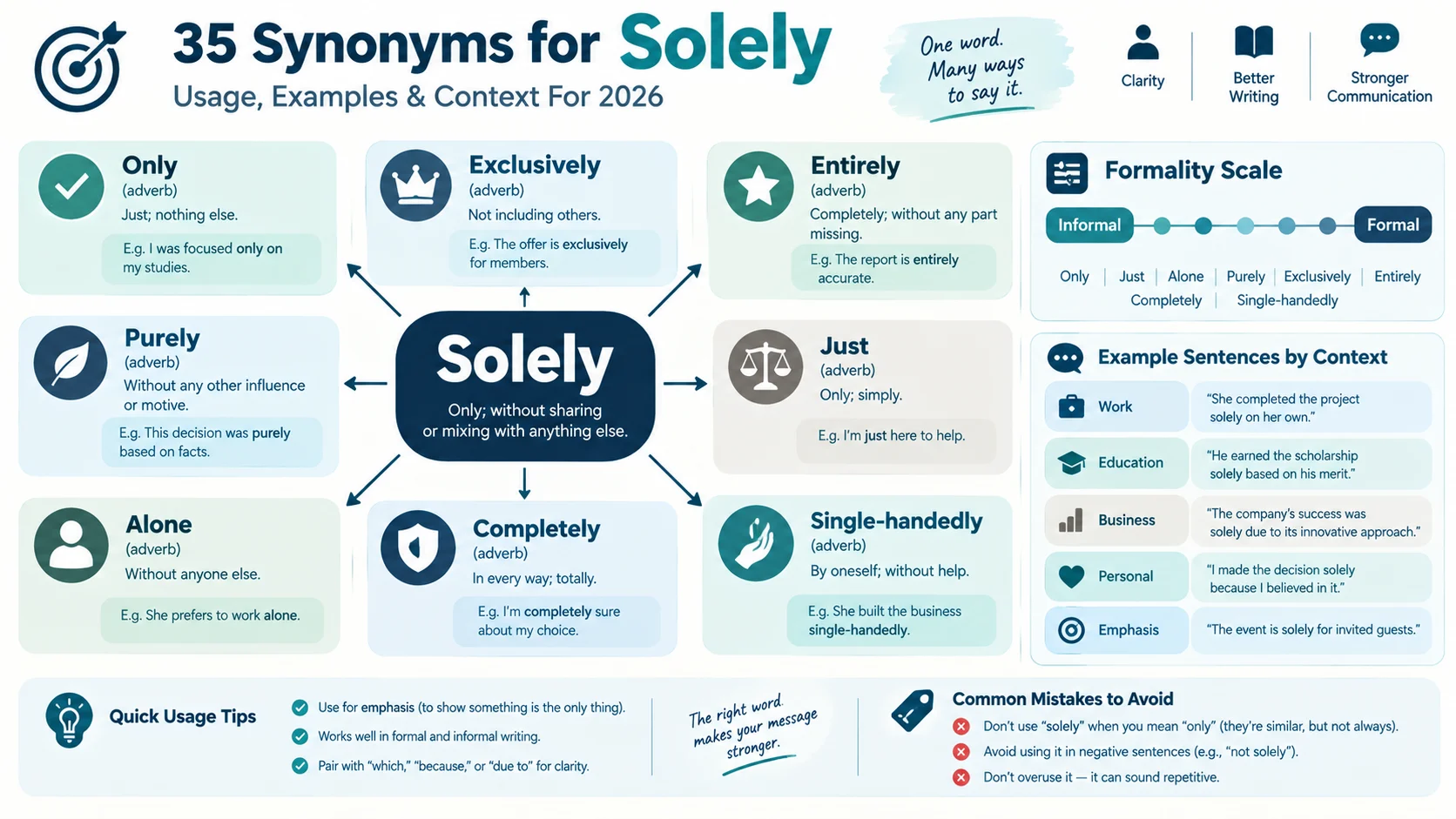
Solely means only, exclusively, or without any other person or thing involved. It emphasizes that something is done by one person or thing alone. The best synonyms are only, exclusively, entirely, purely, and just .Top 10 Synonyms:
- Only
- Exclusively
- Entirely
- Purely
- Just
- Alone
- Single-handedly
- Wholly
- Completely
- Uniquely
Each synonym carries a slightly different shade of meaning. Your choice depends on tone, formality, and context.
Have you ever written a sentence like “The decision was based solely on the data” and then wondered if there was a better word?
Perhaps you are writing a business report and want to sound more professional. Or maybe you are composing an email and “solely” feels too formal or repetitive.
Solely is a useful adverb, but it can make your writing feel stiff if you use it too often. The good news is that English offers many alternatives, each with its own subtle flavor.
This guide will walk you through 35 synonyms for solely. You will learn which ones work best in formal writing, which sound natural in conversation, and which ones you should avoid in certain situations.
What Does “Solely” Mean?
Definition
Solely means that something involves only one person, thing, or reason, with nothing else added or included . It comes from the adjective “sole,” which means single or only.
In everyday use, solely emphasizes exclusivity. When you say “I am solely responsible,” you mean no one else shares that responsibility. When you say “The delay was solely due to weather,” you mean weather was the only cause.
This word often appears in legal, academic, and professional writing because it adds precision and clarity.
Pronunciation
US IPA: /ˈsoʊl.li/
UK IPA: /ˈsəʊl.li/
Syllables: 2 (sole-ly)
Tip: The first syllable sounds like “soul.” The second syllable is light and quick, like “lee.”
Grammar
| Grammar Feature | Information |
|---|---|
| Part of Speech | Adverb |
| Common Position | Before an adjective, verb, or prepositional phrase |
| Typical Pattern | Solely + adjective, solely + verb, solely + because of |
Example sentences:
- “The project’s success was solely dependent on teamwork.”
- “She solely manages the entire department.”
- “The cancellation was solely because of the storm.”
Grammar note: Solely is an adverb of degree and exclusivity. It usually appears directly before the word or phrase it modifies.
Word Family
| Word | Part of Speech | Meaning |
|---|---|---|
| Solely | Adverb | Only, exclusively |
| Sole | Adjective | Single, only, belonging to one person |
| Soleness | Noun | The state of being alone or unique (rare) |
| Solo | Adjective/Adverb | Done alone, without a partner |
Note: Solely does not have a common verb form. The related adjective “sole” is the closest root word.
15 Synonyms of “Solely”
Only
Meaning: Without anyone or anything else; no more than .
Best Used For: All contexts, especially daily conversation.
Formality: Neutral
Tone: Neutral
Frequency: ⭐⭐⭐⭐⭐ Very Common
CEFR Level: A2
Example Sentence 1: “The meeting is only for senior staff members.”
Example Sentence 2: “I only wanted to help, not cause trouble.”
Usage Tip: Only is the simplest and most natural replacement for solely. It works in every context. Native speakers use it far more often than solely in everyday speech.
Exclusively
Meaning: Limited to one person, group, or purpose, with no others included .
Best Used For: Business writing, marketing, academic writing, formal announcements.
Formality: Formal
Tone: Professional, Neutral
Frequency: ⭐⭐⭐⭐ Common
CEFR Level: B2
Example Sentence 1: “This offer is available exclusively to members.”
Example Sentence 2: “The research focused exclusively on urban populations.”
Usage Tip: Exclusively is the closest formal synonym for solely. Use it in business and academic writing. It sounds professional and precise.
Entirely
Meaning: Completely, with nothing left out or excluded .
Best Used For: Formal writing, business reports, emotional statements.
Formality: Neutral to Formal
Tone: Strong, Neutral
Frequency: ⭐⭐⭐⭐⭐ Very Common
CEFR Level: B1
Example Sentence 1: “The failure was entirely my fault.”
Example Sentence 2: “Her success is entirely due to hard work.”
Usage Tip: Entirely emphasizes completeness rather than exclusivity. Use it when you want to stress that nothing else was involved or that something is total.
Purely
Meaning: Only, simply, with nothing else mixed in .
Best Used For: Academic writing, philosophical discussions, emotional statements.
Formality: Neutral
Tone: Neutral, Sometimes Emotional
Frequency: ⭐⭐⭐⭐ Common
CEFR Level: B2
Example Sentence 1: “The decision was purely business, not personal.”
Example Sentence 2: “It was purely by chance that we met.”
Usage Tip: Purely often suggests a lack of hidden motives. It works well when contrasting one reason against another. It is common in both formal and casual writing.
Just
Meaning: Only, simply, nothing more .
Best Used For: Daily conversation, informal writing, social media.
Formality: Informal
Tone: Casual, Neutral
Frequency: ⭐⭐⭐⭐⭐ Very Common
CEFR Level: A2
Example Sentence 1: “I just wanted to say hello.”
Example Sentence 2: “It was just a small mistake, nothing serious.”
Usage Tip: Just is one of the most common words in English. It works perfectly in casual conversation. Avoid it in formal writing where solely or exclusively would sound better.
Alone
Meaning: Without others; only this and nothing else .
Best Used For: All contexts, especially emotional or descriptive writing.
Formality: Neutral
Tone: Neutral, Sometimes Emotional
Frequency: ⭐⭐⭐⭐⭐ Very Common
CEFR Level: A2
Example Sentence 1: “Money alone cannot buy happiness.
Example Sentence 2: “She was alone responsible for the outcome.”
Usage Tip: Alone emphasizes singularity and isolation. It is common in both formal and casual writing. It often appears after the noun it modifies.
Single-handedly
Meaning: Done by one person without help from anyone else .
Best Used For: Storytelling, praise, biographies, casual descriptions.
Formality: Neutral to Informal
Tone: Admiring, Positive
Frequency: ⭐⭐⭐ Moderate
CEFR Level: B2
Example Sentence 1: “She single-handedly saved the company from bankruptcy.”
Example Sentence 2: “He single-handedly organized the entire event.”
Usage Tip: Single-handedly adds admiration and drama. It is perfect for describing impressive individual achievements. Avoid it in formal reports where a neutral tone is required.
Wholly
Meaning: Completely, entirely, to the fullest degree .
Best Used For: Formal writing, academic texts, legal documents.
Formality: Formal
Tone: Serious, Professional
Frequency: ⭐⭐⭐ Moderate
CEFR Level: C1
Example Sentence 1: “The committee was wholly in favor of the proposal.”
Example Sentence 2: “His explanation was wholly unsatisfactory.”
Usage Tip: Wholly is very formal and slightly old-fashioned. It works well in legal or academic writing. In casual conversation, completely or entirely sound more natural.
Completely
Meaning: In every way, totally, with nothing missing .
Best Used For: All contexts, especially everyday communication.
Formality: Neutral
Tone: Strong, Neutral
Frequency: ⭐⭐⭐⭐⭐ Very Common
CEFR Level: A2
Example Sentence 1: “I completely agree with your assessment.”
Example Sentence 2: “The building was completely destroyed in the fire.”
Usage Tip: Completely is versatile and natural in almost any context. It emphasizes totality rather than exclusivity. Native speakers use it constantly.
Uniquely
Meaning: In a way that is special or unlike anything else .
Best Used For: Marketing, creative writing, product descriptions.
Formality: Neutral to Formal
Tone: Positive, Promotional
Frequency: ⭐⭐⭐⭐ Common
CEFR Level: B2
Example Sentence 1: “This approach is uniquely suited to small businesses.”
Example Sentence 2: “She is uniquely qualified for this position.”
Usage Tip: Uniquely suggests special distinction. It works well in marketing and job applications. Do not confuse it with solely, which emphasizes exclusivity rather than uniqueness.
Pertaining only to
Meaning: Relating to just one specific thing or group .
Best Used For: Formal writing, legal documents, academic texts.
Formality: Formal
Tone: Professional, Neutral
Frequency: ⭐⭐⭐ Moderate
CEFR Level: B2
Example Sentence 1: “These rules are pertaining only to full-time employees.”
Example Sentence 2: “The discussion was pertaining only to budget matters.”
Usage Tip: This phrase is wordy but precise. Use it when you need to be very clear about scope. It works best in legal or technical writing.
Nothing but
Meaning: Only, just, with no exceptions .
Best Used For: Emotional writing, storytelling, casual conversation.
Formality: Informal to Neutral
Tone: Emotional, Emphatic
Frequency: ⭐⭐⭐⭐ Common
CEFR Level: B1
Example Sentence 1: “It was nothing but a misunderstanding.”
Example Sentence 2: “She showed nothing but kindness to everyone.”
Usage Tip: Nothing but adds emphasis and emotion. It sounds more dramatic than solely. Use it in narratives and personal writing, not formal reports.
No more than
Meaning: Only this amount or degree, not exceeding it .
Best Used For: Business writing, academic writing, data descriptions.
Formality: Neutral to Formal
Tone: Neutral, Factual
Frequency: ⭐⭐⭐⭐ Common
CEFR Level: B1
Example Sentence 1: “The delay was no more than a minor inconvenience.”
Example Sentence 2: “The cost was no more than we expected.”
Usage Tip: No more than emphasizes limits. It is useful in data-driven or factual writing. It is not a direct synonym for solely but can replace it in some sentences.
Barely
Meaning: Only just, almost not at all .
Best Used For: Daily conversation, emotional writing, storytelling.
Formality: Neutral
Tone: Emotional, Sometimes Negative
Frequency: ⭐⭐⭐⭐ Common
CEFR Level: B1
Example Sentence 1: “I barely had time to finish the report.”
Example Sentence 2: “She barely survived the accident.”
Usage Tip: Barely adds a sense of struggle or scarcity. It is not a direct synonym for solely. Use it when something almost did not happen.
Unaccompanied
Meaning: Alone, without anyone or anything else .
Best Used For: Formal writing, legal documents, travel descriptions.
Formality: Formal
Tone: Neutral, Serious
Frequency: ⭐⭐ Rare
CEFR Level: B2
Example Sentence 1: “Minors are not allowed to travel unaccompanied.”
Example Sentence 2: “The shipment arrived unaccompanied by documentation.”
Usage Tip: Unaccompanied is specific and formal. It is best for legal, travel, or official writing. It does not work well in casual conversation.
Synonyms Comparison Table
| Synonym | Best Context | Formality | Tone | Frequency |
|---|---|---|---|---|
| Only | All contexts | Neutral | Neutral | ⭐⭐⭐⭐⭐ |
| Exclusively | Business, academic | Formal | Professional | ⭐⭐⭐⭐ |
| Entirely | Formal, general | Neutral to Formal | Strong | ⭐⭐⭐⭐⭐ |
| Purely | Academic, emotional | Neutral | Neutral | ⭐⭐⭐⭐ |
| Just | Casual conversation | Informal | Casual | ⭐⭐⭐⭐⭐ |
| Alone | All contexts | Neutral | Neutral | ⭐⭐⭐⭐⭐ |
| Single-handedly | Storytelling, praise | Neutral to Informal | Admiring | ⭐⭐⭐ |
| Wholly | Legal, academic | Formal | Serious | ⭐⭐⭐ |
| Completely | All contexts | Neutral | Strong | ⭐⭐⭐⭐⭐ |
| Uniquely | Marketing, creative | Neutral to Formal | Positive | ⭐⭐⭐⭐ |
| Pertaining only to | Legal, technical | Formal | Professional | ⭐⭐⭐ |
| Nothing but | Emotional, casual | Informal to Neutral | Emphatic | ⭐⭐⭐⭐ |
| No more than | Business, data | Neutral to Formal | Factual | ⭐⭐⭐⭐ |
| Barely | Casual, emotional | Neutral | Emotional | ⭐⭐⭐⭐ |
| Unaccompanied | Legal, travel | Formal | Serious | ⭐⭐ |
Best Synonyms by Situation
| Situation | Best Synonym | Why It Works |
|---|---|---|
| Daily Conversation | Only or Just | These sound natural and are instantly understood. |
| Business Email | Exclusively or Only | These sound professional without being too formal. |
| Academic Writing | Exclusively or Purely | These demonstrate precision and scholarly tone. |
| School Assignment | Only or Entirely | These are clear and easy for teachers to follow. |
| Professional Meeting | Exclusively or Completely | These communicate confidence and clarity. |
| Presentation | Entirely or Completely | These are engaging and easy to hear. |
| Creative Writing | Nothing but or Alone | These add emotional depth and rhythm. |
| Social Media | Just or Only | These match the casual tone of online platforms. |
| Movie Review | Purely or Entirely | These sound thoughtful and critical. |
| Book Review | Wholly or Entirely | These sound analytical and literary. |
Formal vs Informal Synonyms
Formal Alternatives
| Synonym | Best Used For |
|---|---|
| Exclusively | Business proposals, contracts, official documents |
| Wholly | Legal texts, academic papers, formal speeches |
| Unaccompanied | Legal writing, travel documents, official reports |
| Pertaining only to | Technical writing, legal documents, policy statements |
Neutral Alternatives
| Synonym | Best Used For |
|---|---|
| Only | All contexts, from casual to professional |
| Entirely | Business writing, essays, everyday communication |
| Purely | Academic writing, emotional statements, explanations |
| Alone | General use, descriptive writing, emotional contexts |
| Completely | All contexts, especially persuasive writing |
Informal Alternatives
| Synonym | Best Used For |
|---|---|
| Just | Friends, social media, casual texts |
| Nothing but | Personal stories, emotional conversations, storytelling |
| Barely | Casual conversation, describing struggles |
Choosing the right level of formality: Match your synonym to your audience and purpose. Use exclusively and wholly in professional and academic writing. Use only and entirely for balanced, safe communication. Save just and nothing but for casual and emotional contexts. When in doubt, only is the safest choice in almost any situation.
Strong vs Mild Synonyms
Mild
These alternatives are simple and gentle.
- Only
- Just
- Barely
Moderate
These are balanced and expressive.
- Entirely
- Purely
- Completely
- Alone
Strong
These are intense and emphatic.
- Exclusively
- Wholly
- Single-handedly
- Nothing but
How intensity changes meaning: Strong synonyms like exclusively and single-handedly add weight and drama to your sentence. They emphasize exclusivity or individual effort. Mild alternatives like only or just keep your tone neutral and understated. Choose based on how much emphasis you want to create.
Real-Life Examples
School Context:
“The teacher explained that the exam would be based solely on the chapters we covered in class. Students who studied only the summaries struggled with the detailed questions.”
Office Context:
“Our team’s success was entirely dependent on clear communication. We could not afford to rely exclusively on email when quick decisions were needed.”
Business Email:
“This offer is available exclusively to our premium members. Please confirm your interest by Friday.”
Professional Meeting:
“The delay was caused purely by supply chain issues. We are working single-handedly to resolve this before the next quarter.”
Presentation:
“We are wholly committed to this project’s success. The decision to move forward was based entirely on market data.”
Creative Writing:
“She was alone responsible for the family’s survival. Nothing but courage kept her going through those dark months.”
Daily Conversation:
“I just wanted to check if you are still coming to dinner. It was only a small misunderstanding, nothing serious.”
Social Media:
“This win is entirely thanks to my incredible team. I could not have done this alone!”
Common Collocations
| Common Phrase | Better Alternative |
|---|---|
| solely responsible | entirely responsible, exclusively responsible |
| solely based on | based only on, founded purely on |
| solely dependent on | completely dependent on, entirely reliant on |
| solely for | exclusively for, only for |
| solely because of | purely because of, entirely due to |
| solely dedicated to | exclusively dedicated to, wholly committed to |
| solely owned | exclusively owned, wholly owned |
Common Phrases
Solely responsible
Meaning: Being the only person accountable.
Better alternative: “Entirely responsible” or “Exclusively accountable.”
Example: “She was solely responsible for the project’s success.”
Solely based on
Meaning: Founded on one thing alone.
Better alternative: “Purely based on” or “Founded entirely on.”
Example: “The decision was solely based on financial data.”
Solely for the purpose of
Meaning: Done for one specific reason.
Better alternative: “Exclusively for” or “Purely for.”
Example: “The meeting was held solely for the purpose of discussing the budget.”
Context Guide
| Situation | Best Synonym | Reason |
|---|---|---|
| Essay | Exclusively or Purely | Academic and precise |
| Speech | Entirely or Completely | Clear and powerful |
| Business Email | Only or Exclusively | Professional and direct |
| Novel | Alone or Nothing but | Literary and emotional |
| Presentation | Entirely or Completely | Audience-friendly and strong |
| Conversation | Just or Only | Natural and casual |
| Academic Writing | Exclusively or Wholly | Demonstrates rigor |
| Marketing Copy | Uniquely or Exclusively | Promotional and appealing |
Related Words
Near Synonyms
Only, exclusively, purely, entirely, wholly, completely
These words all emphasize singularity or totality .
Antonyms
- Partly
- Together
- Jointly
- Collectively
- Inclusively
Related Adjectives
- Sole
- Exclusive
- Pure
- Complete
- Total
Related Nouns
- Exclusivity
- Sole ownership
- Singularity
Related Verbs
- Exclude
- Restrict
- Limit
Frequently Asked Questions
What is another word for solely?
The most common alternatives are only, exclusively, purely, and entirely . Only is the simplest and most natural choice in everyday English. Exclusively works best in formal and professional contexts.
Which synonym sounds most professional?
Exclusively sounds most professional . It is widely used in business writing, legal documents, and academic papers. Wholly is also very professional but slightly more formal and less common.
What is the strongest synonym for solely?
Single-handedly is the strongest synonym when describing individual effort . Exclusively is the strongest when emphasizing exclusivity. Both add significant emphasis to your sentence.
What is the difference between solely and only?
Solely and only are very close in meaning. Solely sounds more formal and emphasizes exclusivity. Only is more versatile and natural in everyday speech . Both mean “without anything else.”
Which synonym is best for essays?
Exclusively and purely work best in academic essays . They sound precise and scholarly. Only also works well but may sound slightly too casual in very formal academic writing.
What is the opposite of solely?
The opposite of solely is partly, jointly, or collectively . These words indicate that something involves more than one person or thing.
Conclusion
Solely is a precise adverb that means only, exclusively, or entirely. It adds clarity and emphasis to your writing, especially in formal and professional contexts.
The best synonym depends on your situation. Choose only or just for casual conversation. Choose exclusively or wholly for formal writing. Choose entirely or completely for balanced, strong communication. Choose single-handedly when you want to praise individual effort.
Tone and formality matter just as much as meaning. Using a casual synonym in a formal report can sound unprofessional. Using a formal synonym in a text message can sound awkward and stiff.
The next time you are about to write “solely,” pause and consider whether a simpler or more precise word would serve you better. Your writing will become clearer, more natural, and more effective.
