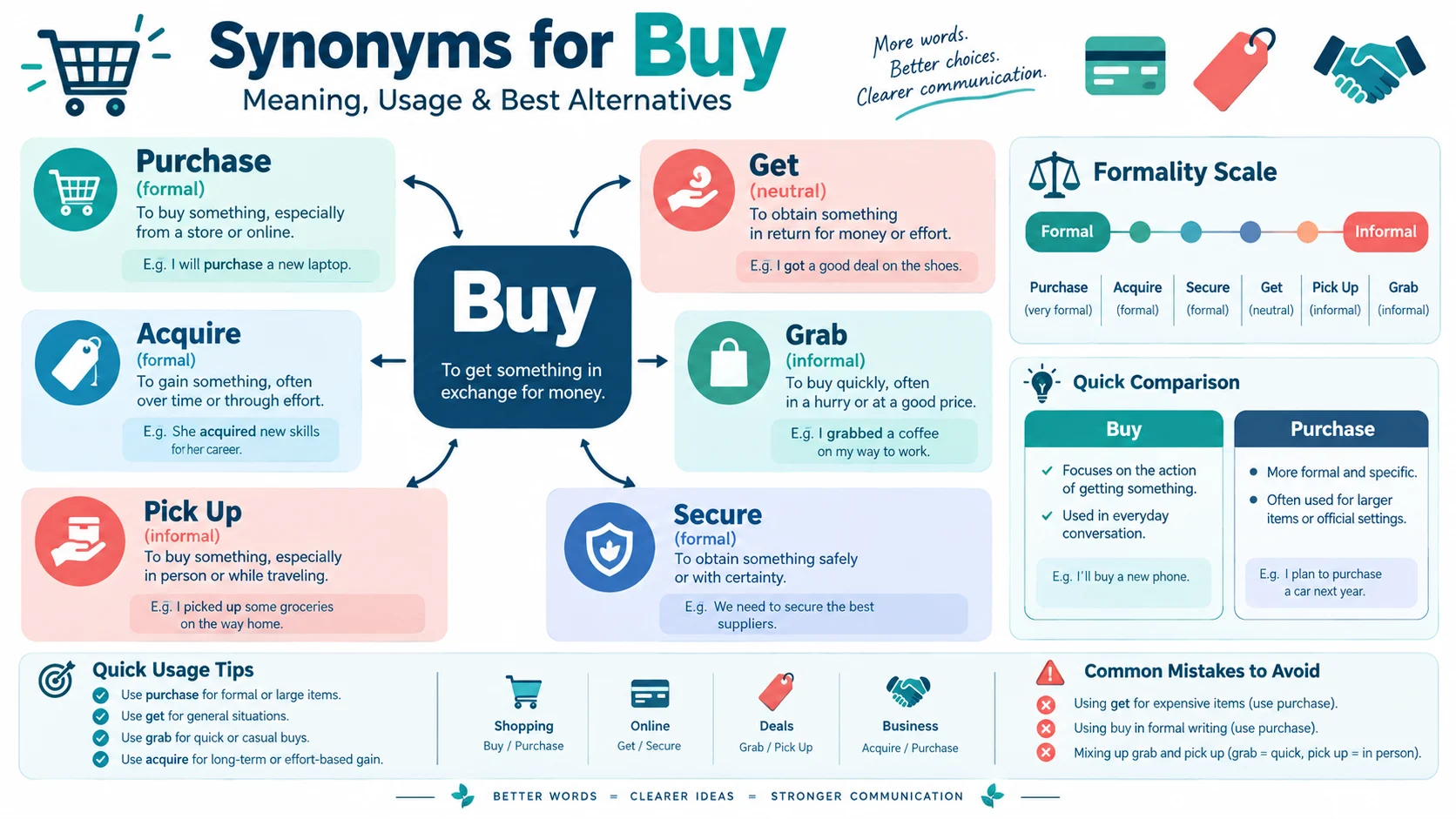
Buy means to get something by paying money for it. The best synonyms depend on context: use purchase for formal and business writing, get for casual conversation, and acquire for business or legal contexts. Grab and pick up work well in everyday speech.Top 10 Synonyms:
- Purchase
- Get
- Acquire
- Grab
- Pick up
- Procure
- Obtain
- Secure
- Snag
- Invest in
Every synonym carries a slightly different meaning, tone, or context. Choosing the right one makes your English sound more natural and precise.
Have you ever noticed how often you use the word “buy” in a single day?
You buy coffee in the morning. You buy groceries after work. You buy a gift for a friend’s birthday. You buy a subscription to a streaming service. The word appears everywhere in daily life.
But repeating “buy” over and over makes your writing and speaking sound flat. English offers dozens of richer alternatives, each with its own personality and purpose.
Imagine writing a business email about a major company acquisition. Saying “we bought another company” sounds too simple. Saying “we acquired another company” sounds professional and precise.
This guide will teach you exactly which synonym to use in every situation. You will learn the difference between purchase and procure, when to use grab and snag, and why invest in carries a completely different feeling from obtain. By the end, you will choose the perfect word every time.
What Does “Buy” Mean?
Definition
Buy means to get something by paying money for it. It is one of the most common verbs in everyday English.
In everyday life, buying covers everything from small daily purchases to major investments. You buy food, clothes, phone apps, and houses.
In business, buying refers to acquiring goods, services, or even entire companies. The meaning stays the same, but the context changes how formal the word should sound.
Buy can also mean to believe or accept something. For example, “I don’t buy that excuse” means “I don’t believe it.” This figurative use is common in casual conversation.
Pronunciation
US IPA: /baɪ/
UK IPA: /baɪ/
Syllables: 1
Tip: Rhymes with “cry,” “fly,” and “high.” The “u” is silent. Say it exactly like the word “by.”
Grammar
| Grammar Feature | Information |
|---|---|
| Part of Speech | Verb (transitive and intransitive) |
| Common Position | Main verb in a sentence, followed by an object |
| Typical Pattern | Buy + object (buy a car) OR Buy + object + for + person (buy a gift for mom) |
Example sentences:
- “She wants to buy a new laptop before school starts.”
- “He bought flowers for his mother’s birthday.”
- “They buy fresh vegetables at the farmers market every Saturday.”
Grammar note: The past tense is “bought,” not “buyed.” This is an irregular verb, and learners frequently make this mistake.
Word Family
| Word | Part of Speech | Meaning |
|---|---|---|
| Buy | Verb | To get something by paying money |
| Buyer | Noun | A person who purchases something |
| Buying | Noun / Verb form | The act of purchasing |
| Bought | Verb (past tense) | Purchased in the past |
| Buyable | Adjective | Able to be bought |
12 Synonyms of “Buy”
Purchase
Meaning: To buy something, especially in a formal or planned way.
Best Used For: Business writing, legal documents, formal emails, contracts.
Formality: Formal
Tone: Professional, Neutral
Frequency: ⭐⭐⭐⭐⭐ Very Common
CEFR Level: B1
Example Sentence 1: “The company plans to purchase new equipment for the factory next quarter.”
Example Sentence 2: “Customers who purchase tickets online receive a discount.”
Usage Tip: Purchase is the safest formal alternative to buy. It works in contracts, invoices, business emails, and academic writing. Avoid it in casual conversation, where it sounds stiff. Native speakers rarely say “I purchased coffee this morning.”
Get
Meaning: To obtain or receive something, often through payment.
Best Used For: Daily conversation, informal writing, text messages.
Formality: Informal
Tone: Casual, Neutral
Frequency: ⭐⭐⭐⭐⭐ Very Common
CEFR Level: A1
Example Sentence 1: “I need to get milk and eggs on my way home.”
Example Sentence 2: “Where did you get that jacket? It looks great.”
Usage Tip: Get is the most natural substitute in everyday speech. It is extremely common and flexible. However, avoid it in formal writing because it can sound too vague or casual for business documents.
Acquire
Meaning: To gain possession of something, often through effort or strategy.
Best Used For: Business writing, legal contexts, news reports, academic writing.
Formality: Formal
Tone: Professional, Serious
Frequency: ⭐⭐⭐⭐ Common
CEFR Level: B2
Example Sentence 1: “The tech giant acquired three smaller startups last year.”
Example Sentence 2: “She acquired the property through a private sale.”
Usage Tip: Acquire suggests a strategic or significant purchase. It is perfect for business mergers and legal transactions. Do not use it for small everyday purchases. Saying “I acquired a sandwich” sounds strange and overly dramatic.
Grab
Meaning: To quickly take or get something, often in a casual or rushed way.
Best Used For: Casual conversation, social media, informal writing.
Formality: Informal
Tone: Casual, Energetic
Frequency: ⭐⭐⭐⭐ Common
CEFR Level: A2
Example Sentence 1: “Let’s grab lunch before the meeting starts.”
Example Sentence 2: “I’ll grab a coffee on my way to work.”
Usage Tip: Grab adds energy and speed to the idea of buying. It works best for quick, casual purchases like food or drinks. It sounds odd for large or serious purchases. You would not say “I grabbed a house.”
Pick Up
Meaning: To buy something casually, often while already out doing something else.
Best Used For: Daily conversation, informal emails, casual writing.
Formality: Informal
Tone: Casual, Friendly
Frequency: ⭐⭐⭐⭐⭐ Very Common
CEFR Level: A2
Example Sentence 1: “Can you pick up some bread on your way home?”
Example Sentence 2: “I picked up a new phone case at the mall yesterday.”
Usage Tip: Pick up is one of the most natural casual alternatives to buy. It suggests a quick, unplanned purchase. It is very common in American English and works in both speech and informal writing.
Common Confusion: Pick up vs. Grab. Both mean to buy casually, but pick up feels calmer and more planned, while grab suggests urgency or speed.
Procure
Meaning: To obtain something, especially with care or effort.
Best Used For: Business writing, government documents, formal procurement processes.
Formality: Very Formal
Tone: Professional, Serious
Frequency: ⭐⭐⭐ Moderate
CEFR Level: C1
Example Sentence 1: “The department must procure all supplies through approved vendors.”
Example Sentence 2: “They worked hard to procure the necessary permits before construction.”
Usage Tip: Procure is a specialist word used in business, government, and law. It suggests a formal process, not a simple purchase. Avoid it in casual writing because it sounds overly technical.
Obtain
Meaning: To get something, often after effort or following a process.
Best Used For: Academic writing, formal reports, legal documents, news articles.
Formality: Formal
Tone: Professional, Neutral
Frequency: ⭐⭐⭐⭐ Common
CEFR Level: B2
Example Sentence 1: “You must obtain a license before opening a restaurant.”
Example Sentence 2: “She obtained the rare book from a private collector.”
Usage Tip: Obtain focuses on the result of getting something, not the payment itself. It works well for official documents, permissions, and rare items. For everyday shopping, it sounds too formal.
Secure
Meaning: To succeed in getting something valuable or difficult to obtain.
Best Used For: Business writing, professional communication, competitive contexts.
Formality: Formal
Tone: Professional, Confident
Frequency: ⭐⭐⭐⭐ Common
CEFR Level: B2
Example Sentence 1: “The startup secured funding from three major investors.”
Example Sentence 2: “We secured the last two tickets for the concert.”
Usage Tip: Secure suggests competition or difficulty. You secure something when getting it was not guaranteed. It is excellent for business deals, funding, and limited opportunities. It sounds wrong for routine shopping.
Snag
Meaning: To get something desirable, often quickly or luckily.
Best Used For: Casual conversation, social media, informal writing.
Formality: Informal
Tone: Casual, Positive, Excited
Frequency: ⭐⭐⭐ Moderate
CEFR Level: B2
Example Sentence 1: “I snagged the last pair of shoes on sale.”
Example Sentence 2: “She snagged front row seats to the show.”
Usage Tip: Snag is popular in American English and adds excitement. It works well for great deals or limited items. It is too casual for business writing, but perfect for social media captions and friendly conversation.
Invest In
Meaning: To buy something because it will bring future value or benefit.
Best Used For: Business writing, financial discussions, personal development contexts.
Formality: Neutral
Tone: Professional, Positive
Frequency: ⭐⭐⭐⭐ Common
CEFR Level: B2
Example Sentence 1: “We decided to invest in new software to improve efficiency.”
Example Sentence 2: “She invested in a good mattress because sleep matters.”
Usage Tip: Invest in changes the meaning slightly. It suggests the purchase will pay off later. Use it for tools, education, health, and business assets. It sounds odd for disposable items like snacks.
Score
Meaning: To get something good, often at a great price or by luck.
Best Used For: Casual conversation, social media, informal writing.
Formality: Informal
Tone: Casual, Excited, Positive
Frequency: ⭐⭐⭐ Moderate
CEFR Level: B2
Example Sentence 1: “I scored tickets to the championship game.”
Example Sentence 2: “He scored a vintage guitar for only fifty dollars.”
Usage Tip: Score adds a sense of victory and excitement. It works best when the purchase feels like a win. It is common in American English but too casual for professional writing.
Cop
Meaning: To buy something, often quickly or informally.
Best Used For: Very casual conversation, slang, social media.
Formality: Very Informal
Tone: Casual, Modern
Frequency: ⭐⭐ Rare in general use
CEFR Level: C1
Example Sentence 1: “I’m going to cop the new sneakers when they drop.”
Example Sentence 2: “He copped a new watch over the weekend.”
Usage Tip: Cop is modern slang, popular in streetwear and sneaker culture. It is acceptable with friends and on social media. Never use it in academic or professional writing. Learners should recognize it but use it carefully.
Synonyms Comparison Table
| Synonym | Best Context | Formality | Tone | Frequency |
|---|---|---|---|---|
| Purchase | Business, legal | Formal | Professional | ⭐⭐⭐⭐⭐ |
| Get | Daily conversation | Informal | Casual | ⭐⭐⭐⭐⭐ |
| Acquire | Business, news | Formal | Serious | ⭐⭐⭐⭐ |
| Grab | Casual, quick purchases | Informal | Energetic | ⭐⭐⭐⭐ |
| Pick up | Daily errands | Informal | Friendly | ⭐⭐⭐⭐⭐ |
| Procure | Government, business | Very Formal | Technical | ⭐⭐⭐ |
| Obtain | Official, academic | Formal | Neutral | ⭐⭐⭐⭐ |
| Secure | Competitive deals | Formal | Confident | ⭐⭐⭐⭐ |
| Snag | Great deals | Informal | Excited | ⭐⭐⭐ |
| Invest in | Long term value | Neutral | Positive | ⭐⭐⭐⭐ |
| Score | Lucky finds | Informal | Excited | ⭐⭐⭐ |
| Cop | Slang, streetwear | Very Informal | Modern | ⭐⭐ |
Best Synonyms by Situation
| Situation | Best Synonym | Why It Works |
|---|---|---|
| Daily Conversation | Get | Natural, simple, and universally understood. |
| Business Email | Purchase | Sounds professional and precise. |
| Academic Writing | Obtain | Formal and appropriate for scholarly contexts. |
| School Assignment | Get | Clear and simple for student writing. |
| Professional Meeting | Acquire | Sounds strategic and business focused. |
| Presentation | Invest in | Shows long term thinking and value. |
| Creative Writing | Secure | Adds tension and a sense of achievement. |
| Social Media | Snag | Fun, exciting, and relatable. |
| Movie Review | Pick up | Casual and natural for storytelling. |
| Book Review | Purchase | Neutral and appropriate for formal reviews. |
Formal vs Informal Synonyms
Formal Alternatives
| Synonym | Best Used For |
|---|---|
| Purchase | Contracts, invoices, business emails |
| Acquire | Mergers, business news, legal writing |
| Procure | Government, supply chain, official documents |
| Obtain | Academic papers, official permissions |
| Secure | Funding, deals, competitive situations |
Neutral Alternatives
| Synonym | Best Used For |
|---|---|
| Invest in | Financial planning, business strategy |
| Pick up | Everyday errands, informal emails |
Informal Alternatives
| Synonym | Best Used For |
|---|---|
| Get | Friends, family, casual conversation |
| Grab | Quick food or drink purchases |
| Snag | Great deals and limited items |
| Score | Lucky or exciting finds |
| Cop | Slang, social media, streetwear culture |
Choosing the right level of formality: Match your word choice to your audience and purpose. Formal writing demands purchase, acquire, or obtain. Casual conversations welcome get, grab, and snag. When unsure, get and purchase are the safest options at each end of the spectrum.
Strong vs Mild Synonyms
Mild
These are gentle and neutral.
- Get
- Pick up
- Obtain
Moderate
These add energy or strategy.
- Purchase
- Acquire
- Invest in
- Secure
Strong
These are intense and expressive.
- Snag
- Score
- Grab
How intensity changes meaning: Strong synonyms like snag and score add excitement and urgency. They make the purchase feel like a victory. Mild words like get and pick up stay calm and factual. Match intensity to the situation. You would not say “I scored milk at the grocery store” unless you wanted to sound playful.
Real-Life Examples
School Context:
“Students can purchase their textbooks from the campus bookstore or get them online for less.”
Office Context:
“Our department needs to procure new computers before the end of the quarter. We will acquire them through the approved vendor.”
Business Email:
“I wanted to confirm that we secured the contract with the supplier. We plan to purchase the materials next week.”
Professional Meeting:
“If we invest in better training, our team will perform at a higher level. Let’s discuss the budget.”
Presentation:
“Last year, we acquired two competitors and expanded into three new markets.”
Creative Writing:
“He snagged the last ticket, a small victory in a week full of losses.”
Daily Conversation:
“I’ll grab coffee on my way in. Do you want me to pick up anything else?”
Social Media:
“Just scored these vintage jeans for ten dollars. Best thrift find ever!”
Common Collocations
| Common Phrase | Better Alternative |
|---|---|
| Buy a house | Purchase a home, invest in property |
| Buy groceries | Pick up groceries, get groceries |
| Buy time | Stall, delay, play for time |
| Buy a car | Purchase a vehicle, finance a car |
| Buy in bulk | Purchase in large quantities |
| Buy into an idea | Accept, believe, support |
| Buy out a company | Acquire a company |
| Buy back shares | Repurchase stock |
Common Phrases
Buy time
Meaning: To delay something to gain more time.
Better alternative: “Stall” or “play for time.”
Example: “He asked another question to buy time while he thought.”
Buy into something
Meaning: To believe or accept an idea.
Better alternative: “Accept” or “support.”
Example: “The team didn’t buy into the new strategy at first.”
Buy out
Meaning: To purchase all of someone’s shares or ownership.
Better alternative: “Acquire fully.”
Example: “The investors decided to buy out the founder.”
Buy up
Meaning: To purchase large amounts of something.
Better alternative: “Stockpile” or “acquire in bulk.”
Example: “Developers bought up all the land in the area.”
Context Guide
| Situation | Best Synonym | Reason |
|---|---|---|
| Essay | Purchase | Formal and appropriate |
| Speech | Invest in | Inspires and shows vision |
| Business Email | Purchase | Clear and professional |
| Novel | Secure | Adds tension and drama |
| Presentation | Acquire | Sounds strategic |
| Conversation | Get | Natural and simple |
| Academic Writing | Obtain | Precise and formal |
| Marketing Copy | Grab | Creates urgency and excitement |
Related Words
Near Synonyms
Purchase, acquire, obtain, procure, secure
These all describe getting something, usually through payment or effort.
Antonyms
- Sell
- Trade
- Return
- Give away
- Donate
Related Adjectives
- Affordable
- Expensive
- Secondhand
- Brand new
Related Nouns
- Buyer
- Seller
- Purchase
- Transaction
- Receipt
Related Verbs
- Sell
- Pay
- Trade
- Return
- Bargain
Frequently Asked Questions
What is another word for buy?
Another word for buy is purchase, which is the most common formal alternative. In casual conversation, get and pick up sound more natural. For business deals, acquire and secure work best.
Which synonym sounds most professional?
Purchase sounds most professional for general use. Acquire sounds best for business mergers and major transactions. Procure works well in government and supply chain contexts.
What is the strongest synonym for buy?
Snag and score are the strongest in terms of excitement and energy. For business impact, secure is powerful because it implies competition and success.
Which synonym is best for essays?
Purchase and obtain are the best choices for academic essays. They sound formal and precise. Avoid casual words like grab or snag in academic writing.
What is the difference between buy and purchase?
Buy is the everyday word used in all contexts. Purchase is more formal and often used in business, legal, and written contexts. The meaning is the same, but the tone differs.
What is the opposite of buy?
The opposite of buy is sell. Other opposites include trade, return, donate, and give away. Each describes a different way of not purchasing something.
Is it correct to say “buyed”?
No. The past tense of buy is bought, not buyed. This is an irregular verb. Learners should memorize this form because it does not follow the standard past tense rule.
Conclusion
Buy is one of the most useful verbs in English, but it becomes repetitive quickly. Learning its synonyms gives you the flexibility to match any situation, from a quick coffee run to a major business acquisition.
The best synonym depends on your context and tone. Use purchase for formal writing, get for daily conversation, and acquire for business deals. Grab and snag add energy to casual speech, while procure and obtain fit official documents.
Paying attention to formality and intensity is the key to sounding natural. A word that works perfectly in a text message may sound wrong in a business report. Choose carefully, and your English will sound more confident and precise.
The next time you need to talk about buying something, pause and choose the word that fits best. Small vocabulary choices create big improvements in how you communicate.
