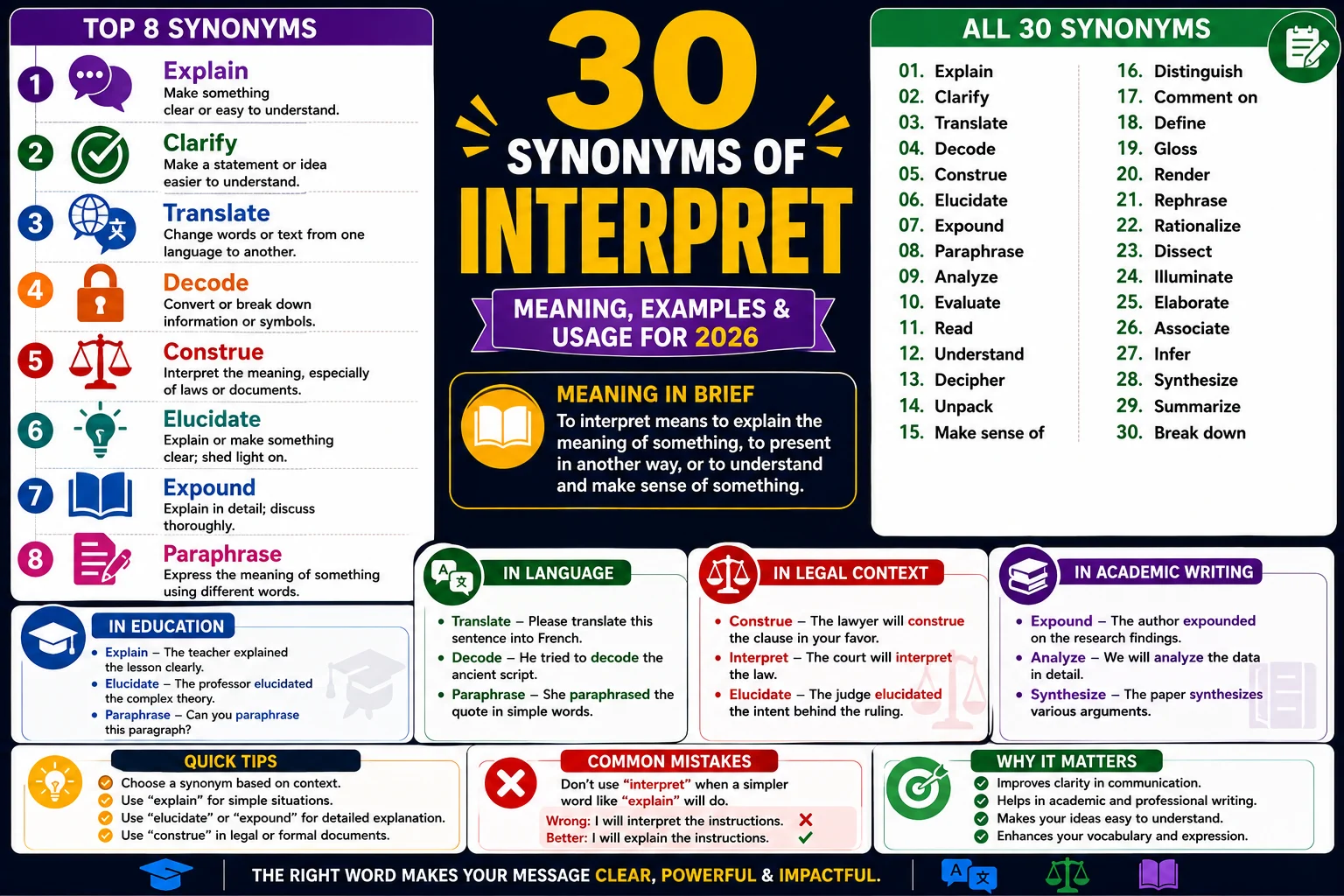
Interpret means to explain or understand the meaning of something. The best synonyms include explain, clarify, translate, decode, construe, elucidate, and expound. The most common everyday synonym is explain when clarifying something, and translate when working with languages. Each synonym has a slightly different meaning, tone, and context.
Have you ever read something and thought, “What does this really mean?” That’s exactly what interpreting is all about. Whether you’re translating between languages, explaining a complex idea, or figuring out what someone’s words truly mean, you’re interpreting.
But here’s the thing: “interpret” isn’t the only word you can use. There’s a whole toolbox of alternatives that can make your English sound more natural and precise. In this guide, we’ll explore 30 synonyms for “interpret” with clear explanations, real examples, and practical tips. By the end, you’ll know exactly which word to use in any situation.
What Does “Interpret” Mean?
Definition
Interpret has two main meanings. First, it means to explain the meaning of something like interpreting a poem or interpreting a dream. Second, it means to translate between languages like interpreting for someone who doesn’t speak the local language. In everyday use, it’s about understanding or explaining meaning.
Pronunciation
| Feature | Information |
|---|---|
| US IPA | /ɪnˈtɜr.prət/ |
| UK IPA | /ɪnˈtɜː.prɪt/ |
| Syllables | 3 (in-ter-pret) |
| Tip | Stress the second syllable: in-TER-pret |
Grammar
| Feature | Information |
|---|---|
| Part of Speech | Verb (regular) |
| Common Position | After the subject, before an object |
| Typical Pattern | “interpret [something]” or “interpret [something] as [something]” |
Example Sentences:
- The teacher interpreted the poem for her students.
- We interpreted his silence as agreement.
- She interprets French into English at the United Nations.
Grammar Note: “Interpret” is a regular verb. The past tense and past participle are both “interpreted.” It’s usually followed by a direct object (what you’re interpreting) and sometimes “as” (your interpretation).
Word Family
| Word | Part of Speech | Meaning |
|---|---|---|
| Interpret | Verb | To explain or understand meaning |
| Interpretation | Noun | The act of explaining or the explanation itself |
| Interpretive | Adjective | Related to explaining or understanding |
| Interpretable | Adjective | Capable of being understood |
| Interpreter | Noun | A person who translates or explains |
| Misinterpret | Verb | To understand incorrectly |
30 Synonyms of Interpret
1. Explain
Meaning: To make something clear or easy to understand.
Best Used For: Daily conversation, teaching, business communication.
Formality: Neutral
Tone: Neutral
Frequency: ⭐⭐⭐⭐⭐ Very Common
CEFR Level: A2
Example Sentence 1: Can you explain how this machine works?
Example Sentence 2: The professor explained the theory in simple terms.
Usage Tip: “Explain” is the most common and natural synonym. Use it whenever you need to clarify anything. It’s safe for almost every situation.
Common Confusion: Explain vs Interpret. “Explain” focuses on making something clear, while “interpret” focuses on finding or assigning meaning.
2. Clarify
Meaning: To make something easier to understand by providing more details.
Best Used For: Professional communication, writing, business emails.
Formality: Formal
Tone: Professional
Frequency: ⭐⭐⭐⭐ Common
CEFR Level: B2
Example Sentence 1: Could you clarify your last statement?
Example Sentence 2: The manual clarifies the installation process step by step.
Usage Tip: Use “clarify” when something is confusing or unclear and needs further explanation. It’s more formal than “explain.”
3. Translate
Meaning: To express the meaning of words from one language to another.
Best Used For: Language learning, professional translation, international business.
Formality: Neutral
Tone: Professional
Frequency: ⭐⭐⭐⭐⭐ Very Common
CEFR Level: A2
Example Sentence 1: She translates Spanish novels into English.
Example Sentence 2: Can you translate this phrase for me?
Usage Tip: “Translate” is specifically for language conversion. Only use it when dealing with actual languages.
4. Decode
Meaning: To discover the meaning of something that’s difficult to understand.
Best Used For: Technical contexts, solving mysteries, understanding complex information.
Formality: Informal
Tone: Neutral
Frequency: ⭐⭐⭐ Moderate
CEFR Level: B2
Example Sentence 1: It took us hours to decode the message.
Example Sentence 2: Children’s behavior can be hard to decode.
Usage Tip: “Decode” implies that the information is hidden or written in code. Use it for complex, difficult-to-understand information.
5. Construe
Meaning: To understand something in a particular way.
Best Used For: Formal writing, legal documents, academic contexts.
Formality: Formal
Tone: Neutral, Professional
Frequency: ⭐⭐ Rare
CEFR Level: C1
Example Sentence 1: The judge construed the evidence in the defendant’s favor.
Example Sentence 2: I construed her silence as disagreement.
Usage Tip: “Construe” is formal and often used in legal contexts. It means you’re making a judgment about meaning based on evidence.
6. Elucidate
Meaning: To make something clear that was previously difficult to understand.
Best Used For: Academic writing, lectures, formal presentations.
Formality: Formal
Tone: Academic
Frequency: ⭐⭐ Rare
CEFR Level: C1
Example Sentence 1: The professor elucidated the complex theory with simple diagrams.
Example Sentence 2: Can you elucidate this concept for the audience?
Usage Tip: “Elucidate” is a sophisticated word for clarifying complex ideas. It’s perfect for academic or formal contexts but too formal for daily conversation.
7. Expound
Meaning: To explain in detail.
Best Used For: Lectures, detailed presentations, formal writing.
Formality: Formal
Tone: Academic
Frequency: ⭐⭐ Rare
CEFR Level: C1
Example Sentence 1: The expert expounded his theory for two hours.
Example Sentence 2: She expounded on the importance of early childhood education.
Usage Tip: “Expound” suggests a long, detailed explanation. Use it when you want to emphasize thoroughness.
8. Paraphrase
Meaning: To express someone else’s words using different words.
Best Used For: Writing, academic work, avoiding plagiarism.
Formality: Formal
Tone: Professional
Frequency: ⭐⭐⭐ Moderate
CEFR Level: B2
Example Sentence 1: Please paraphrase this paragraph in your own words.
Example Sentence 2: The journalist paraphrased the president’s speech.
Usage Tip: “Paraphrase” is specifically about restating something in a different way while keeping the same meaning. It’s common in academic writing.
9. Understand
Meaning: To know the meaning of something.
Best Used For: Daily conversation, learning, personal communication.
Formality: Neutral
Tone: Neutral
Frequency: ⭐⭐⭐⭐⭐ Very Common
CEFR Level: A2
Example Sentence 1: I understand what you’re trying to say.
Example Sentence 2: She understood the instructions immediately.
Usage Tip: “Understand” focuses on your own comprehension, not explaining to others. Use it when you want to say “I get it.”
10. Perceive
Meaning: To understand or become aware of something through the senses.
Best Used For: Psychology, philosophical discussion, literature.
Formality: Formal
Tone: Neutral
Frequency: ⭐⭐⭐ Moderate
CEFR Level: B2
Example Sentence 1: Children perceive the world differently than adults.
Example Sentence 2: I perceived his comment as a criticism.
Usage Tip: “Perceive” emphasizes that your understanding comes from your senses or intuition. It’s more about interpretation through awareness.
11. Infer
Meaning: To reach a conclusion based on evidence.
Best Used For: Logical reasoning, research, detective work.
Formality: Formal
Tone: Neutral
Frequency: ⭐⭐⭐ Moderate
CEFR Level: B2
Example Sentence 1: We can infer from the evidence that she was lying.
Example Sentence 2: What did you infer from his silence?
Usage Tip: “Infer” means you’re using reasoning to figure something out. It’s about drawing conclusions from what you observe.
12. Deduce
Meaning: To reach a conclusion by logical reasoning.
Best Used For: Science, math, logical problems.
Formality: Formal
Tone: Neutral
Frequency: ⭐⭐ Rare
CEFR Level: C1
Example Sentence 1: Sherlock Holmes deduced the criminal’s identity.
Example Sentence 2: We can deduce the answer from the given facts.
Usage Tip: “Deduce” is similar to “infer” but suggests more formal logical thinking. It’s common in science and reasoning.
13. Discern
Meaning: To see, recognize, or understand with effort.
Best Used For: Formal contexts, careful observation, analysis.
Formality: Formal
Tone: Neutral
Frequency: ⭐⭐ Rare
CEFR Level: C1
Example Sentence 1: It was difficult to discern the truth from the rumors.
Example Sentence 2: I could discern a hint of disappointment in her voice.
Usage Tip: “Discern” suggests you’ve worked hard to recognize or understand something subtle.
14. Gloss
Meaning: To provide a brief explanation of a word or phrase.
Best Used For: Academic texts, dictionaries, notes.
Formality: Formal
Tone: Neutral
Frequency: ⭐⭐ Rare
CEFR Level: C1
Example Sentence 1: The teacher glossed the difficult vocabulary.
Example Sentence 2: The text was carefully glossed by the editor.
Usage Tip: “Gloss” is used for giving short, simple explanations of specific words or phrases. It’s common in academic settings.
15. Render
Meaning: To express or present something in a particular way.
Best Used For: Translation, art, performance.
Formality: Formal
Tone: Neutral
Frequency: ⭐⭐⭐ Moderate
CEFR Level: B2
Example Sentence 1: He rendered the ancient poem into modern English.
Example Sentence 2: The actor rendered the character perfectly.
Usage Tip: “Render” is often used for artistic interpretation or translation. It emphasizes the way you’ve expressed something.
16. Read
Meaning: To interpret or understand something in a certain way.
Best Used For: Analyzing texts, understanding social situations.
Formality: Neutral
Tone: Neutral
Frequency: ⭐⭐⭐⭐⭐ Very Common
CEFR Level: A2
Example Sentence 1: I read his comment as a criticism.
Example Sentence 2: She can read people’s emotions easily.
Usage Tip: “Read” is very natural in everyday language when you’re interpreting people or situations. It’s less about text and more about understanding.
17. Break down
Meaning: To explain something by separating it into parts.
Best Used For: Teaching, explaining complex topics.
Formality: Informal
Tone: Helpful
Frequency: ⭐⭐⭐⭐ Common
CEFR Level: B1
Example Sentence 1: Can you break this down for me step by step?
Example Sentence 2: He broke down the marketing strategy for the team.
Usage Tip: “Break down” is perfect when you need to simplify something complicated. It’s casual and easy to use.
18. Spell out
Meaning: To explain something very clearly.
Best Used For: Instructions, formal agreements, professional communication.
Formality: Neutral
Tone: Direct
Frequency: ⭐⭐⭐ Moderate
CEFR Level: B2
Example Sentence 1: Please spell out what you want me to do.
Example Sentence 2: The contract spells out all the details.
Usage Tip: “Spell out” means to make something completely clear. Use it when you want to avoid any misunderstanding.
19. Unpack
Meaning: To analyze something thoroughly.
Best Used For: Discussion, analysis, exploring ideas.
Formality: Informal
Tone: Thoughtful
Frequency: ⭐⭐ Rare
CEFR Level: B2
Example Sentence 1: Let’s unpack the meaning of that statement.
Example Sentence 2: The podcast unpacks complex issues in a simple way.
Usage Tip: “Unpack” is a metaphor that suggests you’re opening up a packed idea to see what’s inside. It’s informal and conversational.
20. Decipher
Meaning: To figure out the meaning of something difficult.
Best Used For: Reading bad handwriting, understanding complex situations.
Formality: Neutral
Tone: Neutral
Frequency: ⭐⭐⭐ Moderate
CEFR Level: B2
Example Sentence 1: Can you decipher what this note says?
Example Sentence 2: The detective deciphered the mysterious message.
Usage Tip: “Decipher” is perfect when something is hard to read or understand. It suggests you’re working to solve a puzzle.
21. Translate
Meaning: Already covered above. [Already included]
22. Resolve
Meaning: To find a solution or understand a problem.
Best Used For: Problems, disagreements, puzzles.
Formality: Neutral
Tone: Serious
Frequency: ⭐⭐⭐⭐ Common
CEFR Level: B1
Example Sentence 1: We need to resolve this misunderstanding.
Example Sentence 2: The engineer resolved the technical issue.
Usage Tip: “Resolve” is about solving or understanding a problem. It suggests finality.
23. Untangle
Meaning: To make something complicated clear and simple.
Best Used For: Complex problems, confusing situations.
Formality: Informal
Tone: Casual
Frequency: ⭐⭐ Rare
CEFR Level: B2
Example Sentence 1: The teacher untangled the difficult concept for the students.
Example Sentence 2: It took years to untangle the financial mess.
Usage Tip: “Untangle” is a metaphor that suggests untying knots. Use it for complicated or confusing situations.
24. Illustrate
Meaning: To explain or clarify with examples or pictures.
Best Used For: Presentations, teaching, explanations.
Formality: Formal
Tone: Professional
Frequency: ⭐⭐⭐⭐ Common
CEFR Level: B2
Example Sentence 1: The diagram illustrates the water cycle.
Example Sentence 2: Let me illustrate my point with an example.
Usage Tip: “Illustrate” means you’re using examples or visuals to make your explanation clearer.
25. Demystify
Meaning: To make something mysterious seem clear and understandable.
Best Used For: Explaining complex subjects, technology, science.
Formality: Neutral
Tone: Helpful
Frequency: ⭐⭐⭐ Moderate
CEFR Level: B2
Example Sentence 1: The book demystifies the world of finance.
Example Sentence 2: Can you demystify this confusing process for me?
Usage Tip: “Demystify” is perfect when you’re explaining something that seems complicated or mysterious.
26. Rationalize
Meaning: To find a logical explanation for something.
Best Used For: Psychology, explaining behavior.
Formality: Formal
Tone: Neutral
Frequency: ⭐⭐⭐ Moderate
CEFR Level: B2
Example Sentence 1: He tried to rationalize his decision.
Example Sentence 2: She rationalized her behavior as self-defense.
Usage Tip: “Rationalize” often means finding a logical reason for something, even if it wasn’t the true reason.
27. Comprehend
Meaning: To understand fully.
Best Used For: Formal contexts, academic writing.
Formality: Formal
Tone: Neutral
Frequency: ⭐⭐⭐ Moderate
CEFR Level: B2
Example Sentence 1: I cannot comprehend why he did that.
Example Sentence 2: The students struggled to comprehend the concept.
Usage Tip: “Comprehend” suggests deep, complete understanding. It’s stronger than “understand.”
28. Grasp
Meaning: To understand something.
Best Used For: Learning, quick understanding.
Formality: Neutral
Tone: Neutral
Frequency: ⭐⭐⭐⭐ Common
CEFR Level: B1
Example Sentence 1: I quickly grasped the meaning of the sign.
Example Sentence 2: She grasped the concept immediately.
Usage Tip: “Grasp” suggests sudden or quick understanding. It’s informal and natural.
29. Apprehend
Meaning: To understand or perceive.
Best Used For: Formal writing, legal contexts, philosophy.
Formality: Formal
Tone: Neutral
Frequency: ⭐⭐ Rare
CEFR Level: C1
Example Sentence 1: I couldn’t apprehend the meaning of his words.
Example Sentence 2: The physicist apprehended complex theories easily.
Usage Tip: “Apprehend” is formal and rarely used in conversation. Use it in very formal writing only.
30. Sensitize
Meaning: To make someone aware of or sensitive to something.
Best Used For: Training, raising awareness.
Formality: Formal
Tone: Professional
Frequency: ⭐⭐⭐ Moderate
CEFR Level: B2
Example Sentence 1: The training sensitized staff to cultural differences.
Example Sentence 2: The documentary sensitized viewers to environmental issues.
Usage Tip: “Sensitize” is about making people aware or understanding something new. It’s often used in professional training.
Synonyms Comparison Table
| Synonym | Best Context | Formality | Tone | Frequency |
|---|---|---|---|---|
| Explain | Daily life | Neutral | Neutral | ⭐⭐⭐⭐⭐ |
| Clarify | Professional | Formal | Professional | ⭐⭐⭐⭐ |
| Translate | Languages | Neutral | Professional | ⭐⭐⭐⭐⭐ |
| Decode | Complex info | Informal | Neutral | ⭐⭐⭐ |
| Construe | Legal | Formal | Professional | ⭐⭐ |
| Elucidate | Academic | Formal | Academic | ⭐⭐ |
| Expound | Lectures | Formal | Academic | ⭐⭐ |
| Paraphrase | Writing | Formal | Professional | ⭐⭐⭐ |
| Understand | Daily life | Neutral | Neutral | ⭐⭐⭐⭐⭐ |
| Perceive | Psychology | Formal | Neutral | ⭐⭐⭐ |
| Infer | Logic, research | Formal | Neutral | ⭐⭐⭐ |
| Deduce | Science, math | Formal | Neutral | ⭐⭐ |
| Discern | Careful observation | Formal | Neutral | ⭐⭐ |
| Illustrate | Presentations | Formal | Professional | ⭐⭐⭐⭐ |
| Demystify | Complex subjects | Neutral | Helpful | ⭐⭐⭐ |
Best Synonyms by Situation
| Situation | Best Synonym | Why It Works |
|---|---|---|
| Daily Conversation | Explain | Simple and widely understood |
| Business Email | Clarify | Professional and clear |
| Academic Writing | Elucidate | Precise and formal |
| School Assignment | Paraphrase | Academic appropriate |
| Professional Meeting | Clarify | Professional and direct |
| Presentation | Illustrate | Uses examples effectively |
| Creative Writing | Perceive | Artistic and thoughtful |
| Social Media | Break down | Casual and easy |
| Movie Review | Analyze | Critical and detailed |
| Book Review | Interpret | Expected in literary contexts |
Formal vs Informal Synonyms
Formal Alternatives
| Synonym | Best Used For |
|---|---|
| Construe | Legal contexts, formal analysis |
| Elucidate | Academic writing, lectures |
| Expound | Detailed presentations |
| Paraphrase | Academic writing, research |
| Discern | Careful analysis |
| Deduce | Logic, science |
| Apprehend | Very formal writing |
Neutral Alternatives
| Synonym | Best Used For |
|---|---|
| Explain | Most situations |
| Understand | Personal comprehension |
| Translate | Language conversion |
| Clarify | Clear communication |
| Infer | Reasoning |
| Interpret | General use |
Informal Alternatives
| Synonym | Best Used For |
|---|---|
| Break down | Simplifying complex things |
| Spell out | Making completely clear |
| Unpack | Analyzing deeply |
| Untangle | Making simple |
| Read | Understanding people |
Strong vs Mild Synonyms
Mild
- Explain – simply making clear
- Clarify – making easier to understand
- Translate – converting languages
- Paraphrase – rewording
Moderate
- Interpret – assigning meaning
- Construe – understanding in a specific way
- Infer – drawing conclusions
- Perceive – becoming aware
Strong
- Elucidate – making profoundly clear
- Expound – explaining in great detail
- Deduce – logical reasoning
- Discern – recognizing with effort
Intensity Matters: The strength of the word affects the message. Saying “Please explain” is different from saying “Please elucidate.” The first is simple; the second sounds academic. Always match the intensity to the situation.
Real-Life Examples
Classroom:
“The teacher interpreted the ancient text for us. She explained every symbol and helped us understand the author’s meaning.”
Workplace:
“In the meeting, our manager clarified the new policy. She broke down the rules to make sure everyone understood.”
Business Email:
“I’m writing to clarify the points we discussed yesterday. To be clear, we need your approval by Friday.”
Everyday Conversation:
“I just don’t know how to interpret his comments. Was he angry or joking? I can’t read him at all.”
Academic Paper:
“The study interprets the data differently than previous research. The authors infer that cultural factors influence the results.”
Common Collocations
| Common Phrase | Better Alternative |
|---|---|
| Interpret the data | Analyze the data |
| Interpret the meaning | Understand the meaning |
| Interpret a dream | Analyze a dream |
| Interpret the law | Apply the law |
| Interpret the results | Understand the results |
Common Phrases
| Phrase | Meaning | Better Alternative |
|---|---|---|
| Interpret as | Understand to mean | Take to mean |
| Interpret away | Explain to avoid something | Explain away |
| Interpret in a certain way | Understand from a specific perspective | Perceive in a certain way |
Context Guide
| Situation | Best Synonym | Reason |
|---|---|---|
| Essay | Elucidate | Academic precision |
| Speech | Explain | Easy to understand |
| Business Email | Clarify | Professional clarity |
| Novel | Interpret | Literary analysis |
| Presentation | Illustrate | Uses examples |
| Conversation | Explain | Natural and common |
| Academic Writing | Construe | Formal analysis |
| Marketing Copy | Demystify | Helpful and engaging |
Related Words
Near Synonyms
- Interpret is similar to explain, but “explain” focuses on making things clear while “interpret” focuses on finding meaning. You might explain a process but interpret a dream.
Antonyms
- Misinterpret – to understand wrongly
- Misunderstand – to fail to understand
- Confuse – to make unclear
Related Adjectives
- Interpretive – related to interpreting
- Misinterpreted – understood wrongly
- Ambiguous – unclear, open to interpretation
Related Nouns
- Interpretation – an explanation or understanding
- Interpreter – a person who translates or explains
- Interpretability – how easy something is to understand
Related Verbs
- Translate – to change from one language to another
- Paraphrase – to restate in different words
- Analyze – to examine in detail
- Comprehend – to understand
Frequently Asked Questions
What is another word for interpret?
The most common synonyms for interpret are explain, clarify, translate, decode, and construe. Each one has a different context, so choose based on your situation.
Which synonym sounds the most professional?
Clarify and elucidate sound the most professional. “Clarify” is perfect for emails and meetings, while “elucidate” is great for formal writing and academic contexts.
What’s the difference between interpret and translate?
Interpret means to explain or understand meaning, while translate specifically means converting from one language to another. You interpret a dream but translate a French document.
Which synonym is best for everyday conversation?
Explain is the most natural choice for everyday conversation. It’s simple, widely understood, and works in almost any situation.
What is the strongest synonym for interpret?
Elucidate and expound are among the strongest synonyms. They suggest detailed, thorough explanation and are used in academic or professional contexts.
What’s the difference between infer and deduce?
Infer means to reach a conclusion based on evidence, while deduce means to reach a conclusion through logical reasoning. They’re similar, but “deduce” suggests more formal logic.
Which synonym is most common in everyday English?
Explain, understand, and translate are the most common synonyms in everyday English. You’ll hear them in conversations, at work, and in school.
What is the opposite of interpret?
Misinterpret, misunderstand, and confuse are the main opposites. They all describe failing to understand or explain correctly.
What’s the difference between interpret and construe?
Interpret is a general word for understanding or explaining meaning. Construe is more formal and often used in legal contexts. They’re similar, but “construe” sounds more formal.
Is “decipher” a synonym of interpret?
Yes! Decipher is a great synonym when something is difficult to read or understand. It suggests solving a puzzle.
Conclusion
We’ve covered a lot of ground here. Interpret is a wonderful word with many useful synonyms, from the simple and everyday “explain” to the more sophisticated “elucidate” and “construe.” The key to using these synonyms well is understanding that each has a different context and tone.
For daily conversations, stick with explain and understand. For professional emails, use clarify. For academic writing, try elucidate or paraphrase. For language, there’s no better word than translate. Always think about your audience and situation before choosing a synonym.
The most important tip? Practice using these words in your own writing and conversations. Notice which ones native speakers use in different contexts. With time, choosing the perfect synonym will become second nature. So go ahead, start experimenting, and watch your vocabulary grow!
