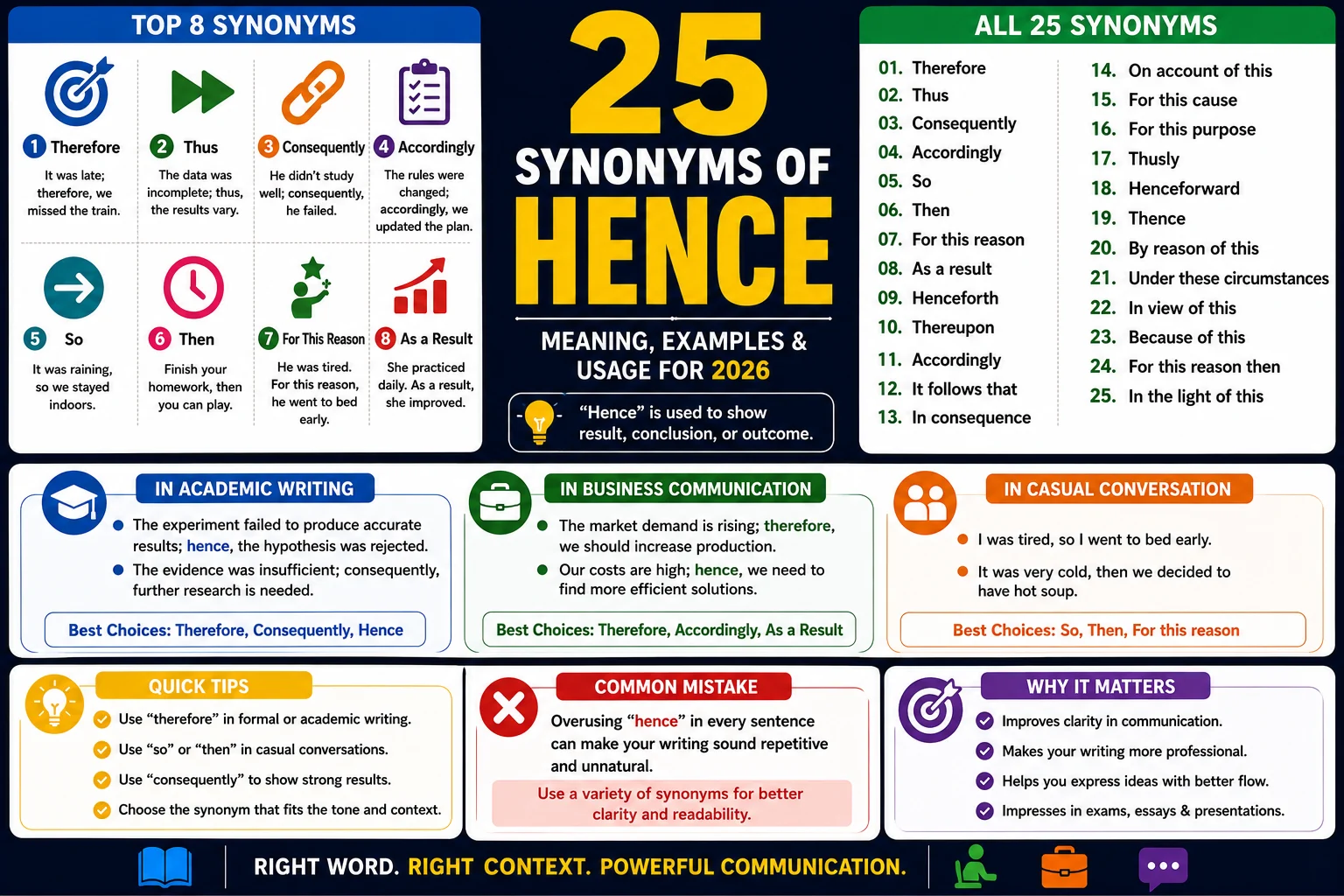
Hence means “as a result” or “from this time forward.” The best synonyms include therefore, thus, consequently, accordingly, so, then, for this reason, and from now on. The most common everyday synonym is so when showing results, and therefore for formal writing. Every synonym has a slightly different meaning, tone, or context.
Have you ever been writing and felt stuck because you kept using the same word over and over? Maybe you’ve been using “hence” but weren’t sure if there was a better option. You’re not alone.
“Hence” is one of those useful words that connects ideas and shows results. But it can sound overly formal in everyday conversation. The good news is that English has plenty of excellent alternatives.
In this guide, I’ll show you 25 synonyms for “hence” that will make your writing and speaking more natural and varied. We’ll cover formal options for academic writing, casual alternatives for everyday chats, and everything in between. Let’s get started.
What Does “Hence” Mean?
Definition
Simply put, hence has two main meanings. First, it shows a result or conclusion like saying “therefore” or “as a result.” For example, “It was raining heavily, hence the cancellation of the match.” Second, it means from this time forward like saying “from now on.” For example, “The company will be closed henceforth.” Think of it as connecting a reason to its outcome.
Pronunciation
| Feature | Information |
|---|---|
| US IPA | /hens/ |
| UK IPA | /hens/ |
| Syllables | 1 |
| Tip | Sounds exactly like “hens” (the bird). Rhymes with “sense.” |
Grammar
| Feature | Information |
|---|---|
| Part of Speech | Adverb |
| Common Position | Beginning of a clause, after a semicolon |
| Typical Pattern | [reason], hence [result] |
Example Sentences:
- The weather was terrible, hence the low attendance.
- He was the most experienced candidate, hence his selection for the role.
- The store will be closed for renovations. Hence, we need to find another supplier.
Grammar Note: “Hence” is typically followed by a noun phrase or a full clause. It’s often used after a semicolon to connect two related ideas.
Word Family
| Word | Part of Speech | Meaning |
|---|---|---|
| Hence | Adverb | As a result; from this time |
| Henceforth | Adverb | From this time forward |
| Henceforward | Adverb | From this time forward (formal) |
| Thence | Adverb | From that place or time (archaic) |
25 Synonyms of Hence
1. Therefore
Meaning: For that reason; as a direct result .
Best Used For: Academic writing, business reports, formal arguments.
Formality: Formal
Tone: Neutral, Professional
Frequency: ⭐⭐⭐⭐⭐ Very Common
CEFR Level: B2
Example Sentence 1: The project was over budget. Therefore, we had to reduce our expenses.
Example Sentence 2: She studied hard for months. Therefore, her exam results were excellent.
Usage Tip: “Therefore” is probably the most common formal alternative to “hence.” Use it when you want to sound professional and clear.
Common Confusion: Many learners confuse “therefore” with “therefor.” “Therefor” means “for that” and is very rare. “Therefore” means “as a result.”
2. Thus
Meaning: As a result of this; in this way .
Best Used For: Academic writing, formal explanations, logical arguments.
Formality: Formal
Tone: Neutral, Academic
Frequency: ⭐⭐⭐⭐⭐ Very Common
CEFR Level: B2
Example Sentence 1: The results were inconclusive. Thus, more research is needed.
Example Sentence 2: She followed the instructions carefully and thus completed the task successfully.
Usage Tip: “Thus” is slightly more formal than “therefore” but equally common in academic texts. It can also mean “in this way.”
3. Consequently
Meaning: As a result; therefore .
Best Used For: Business writing, academic essays, professional reports.
Formality: Formal
Tone: Neutral, Professional
Frequency: ⭐⭐⭐⭐ Common
CEFR Level: B2
Example Sentence 1: The company lost its main supplier. Consequently, production was delayed.
Example Sentence 2: He failed to submit his assignment on time. Consequently, he received a lower grade.
Usage Tip: “Consequently” emphasizes the cause-and-effect relationship more strongly than “therefore.” It’s excellent for showing clear results.
4. Accordingly
Meaning: In a way that is suitable for a situation; therefore .
Best Used For: Professional communication, business emails, official documents.
Formality: Formal
Tone: Professional, Neutral
Frequency: ⭐⭐⭐⭐ Common
CEFR Level: B2
Example Sentence 1: The situation has changed. Accordingly, we need to adjust our plans.
Example Sentence 2: The report highlighted several issues. Accordingly, management took immediate action.
Usage Tip: “Accordingly” suggests that you’re taking appropriate action based on what came before. It’s more action-oriented than “therefore.”
5. So
Meaning: As a result; therefore .
Best Used For: Daily conversation, informal writing, emails to friends.
Formality: Informal
Tone: Casual, Neutral
Frequency: ⭐⭐⭐⭐⭐ Very Common
CEFR Level: A2
Example Sentence 1: It was raining outside, so we stayed home.
Example Sentence 2: She was tired, so she went to bed early.
Usage Tip: “So” is the most natural and common choice in everyday speech. It’s simple, clear, and never sounds wrong in casual contexts.
6. Then
Meaning: As a result; in that case .
Best Used For: Daily conversation, storytelling, conditional statements.
Formality: Informal
Tone: Casual, Neutral
Frequency: ⭐⭐⭐⭐⭐ Very Common
CEFR Level: A2
Example Sentence 1: If you’re hungry, then we should stop for food.
Example Sentence 2: She forgot her keys. Then she couldn’t get into the house.
Usage Tip: “Then” is often used in conditional sentences and to show logical results. It’s very common in casual speech.
7. For This Reason
Meaning: Because of this; as a result .
Best Used For: Speeches, presentations, persuasive writing.
Formality: Neutral
Tone: Clear, Emphatic
Frequency: ⭐⭐⭐⭐ Common
CEFR Level: B1
Example Sentence 1: The bridge was unsafe. For this reason, it was closed to traffic.
Example Sentence 2: She has always loved animals. For this reason, she became a veterinarian.
Usage Tip: This phrase is clear and emphatic. It’s a great choice when you want to highlight the cause-and-effect relationship.
8. As a Result
Meaning: Because of something; therefore .
Best Used For: Academic writing, business reports, everyday conversation.
Formality: Neutral
Tone: Neutral
Frequency: ⭐⭐⭐⭐⭐ Very Common
CEFR Level: B1
Example Sentence 1: He practiced every day. As a result, his skills improved dramatically.
Example Sentence 2: The storm caused a power outage. As a result, the school closed early.
Usage Tip: This is one of the most useful and neutral alternatives. It works in almost any context.
9. Henceforth
Meaning: From this time forward .
Best Used For: Legal documents, official announcements, formal writing.
Formality: Formal
Tone: Official, Serious
Frequency: ⭐⭐⭐ Moderate
CEFR Level: B2
Example Sentence 1: The new rules will apply henceforth.
Example Sentence 2: Henceforth, all employees must wear identification badges.
Usage Tip: “Henceforth” specifically means “from now on,” not “as a result.” Don’t use it when showing results use it only for future time.
10. Thusly
Meaning: In this way; as a result (rare but used in informal speech).
Best Used For: Casual conversation (though it’s often considered incorrect).
Formality: Informal
Tone: Casual, Sometimes Playful
Frequency: ⭐ Rare
CEFR Level: C1
Example Sentence 1: He explained the process, and thusly, we understood it.
Example Sentence 2: She mixed the ingredients and thusly created the cake.
Usage Tip: Many English teachers consider “thusly” to be incorrect or unnecessary. Stick to “thus” instead it’s more correct and professional.
11. Ergo
Meaning: Therefore; as a result .
Best Used For: Formal writing, philosophical arguments, legal contexts.
Formality: Formal
Tone: Academic, Logical
Frequency: ⭐⭐⭐ Moderate
CEFR Level: C1
Example Sentence 1: All humans are mortal. Socrates is human. Ergo, Socrates is mortal.
Example Sentence 2: The evidence was clear. Ergo, the jury reached a guilty verdict.
Usage Tip: “Ergo” is Latin and sounds very formal and academic. Use it sparingly and in appropriate contexts.
12. Wherefore
Meaning: For which reason; therefore .
Best Used For: Legal writing, classic literature, formal speeches.
Formality: Formal
Tone: Literary, Old-fashioned
Frequency: ⭐ Rare
CEFR Level: C1
Example Sentence 1: The contract was breached. Wherefore, the plaintiff seeks damages.
Example Sentence 2: He failed to deliver. Wherefore, his services were terminated.
Usage Tip: “Wherefore” is very old-fashioned and rarely used today outside of legal documents. “Therefore” is almost always a better choice.
13. Thereupon
Meaning: Immediately after that; therefore .
Best Used For: Legal writing, formal reports, storytelling.
Formality: Formal
Tone: Professional, Slightly Dramatic
Frequency: ⭐⭐ Rare
CEFR Level: C1
Example Sentence 1: The witness identified the suspect. Thereupon, the police made an arrest.
Example Sentence 2: The board approved the proposal. Thereupon, construction began.
Usage Tip: “Thereupon” suggests immediate action following something. It’s quite formal and not used in everyday conversation.
14. Thence
Meaning: From that place or time; therefore .
Best Used For: Literary writing, historical texts, formal documents.
Formality: Formal
Tone: Literary, Archaic
Frequency: ⭐ Very Rare
CEFR Level: C1
Example Sentence 1: He left the city and thence traveled to the countryside.
Example Sentence 2: The decree was issued, and thence, the new policies took effect.
Usage Tip: “Thence” is very old-fashioned. Most modern readers would find it strange. Avoid it unless you’re writing historical fiction.
15. In Consequence
Meaning: As a result; therefore .
Best Used For: Formal writing, academic papers, official reports.
Formality: Formal
Tone: Professional, Serious
Frequency: ⭐⭐⭐ Moderate
CEFR Level: B2
Example Sentence 1: The equipment failed. In consequence, the experiment had to be stopped.
Example Sentence 2: He ignored the warnings. In consequence, he suffered the consequences.
Usage Tip: “In consequence” is a more formal way of saying “as a result.” It can sound slightly old-fashioned but is still acceptable in formal writing.
16. On That Account
Meaning: Because of that; for that reason .
Best Used For: Professional writing, formal conversations.
Formality: Formal
Tone: Professional, Neutral
Frequency: ⭐⭐ Rare
CEFR Level: B2
Example Sentence 1: The project was behind schedule. On that account, we decided to extend the deadline.
Example Sentence 2: He was the most qualified. On that account, he received the promotion.
Usage Tip: “On that account” sounds quite formal and a bit old-fashioned. Most people prefer “therefore” or “as a result.”
17. That Being The Case
Meaning: If that is true; therefore .
Best Used For: Professional discussions, formal arguments.
Formality: Neutral
Tone: Logical, Professional
Frequency: ⭐⭐⭐ Moderate
CEFR Level: B2
Example Sentence 1: You’ve already finished your part. That being the case, you can leave early.
Example Sentence 2: The evidence is inconclusive. That being the case, we cannot proceed.
Usage Tip: This phrase is useful in discussions when you want to acknowledge a situation before stating your conclusion.
18. Under Those Circumstances
Meaning: In that situation; therefore .
Best Used For: Professional discussions, formal writing.
Formality: Formal
Tone: Neutral, Professional
Frequency: ⭐⭐⭐ Moderate
CEFR Level: B2
Example Sentence 1: The weather was poor. Under those circumstances, the game was canceled.
Example Sentence 2: The budget was limited. Under those circumstances, we had to prioritize.
Usage Tip: This phrase is useful when discussing specific situations or conditions.
19. In That Case
Meaning: If that is true; therefore .
Best Used For: Daily conversation, professional discussions.
Formality: Neutral
Tone: Neutral, Casual
Frequency: ⭐⭐⭐⭐ Common
CEFR Level: B1
Example Sentence 1: You’re not feeling well? In that case, you should go home.
Example Sentence 2: The printer isn’t working? In that case, I’ll use the other one.
Usage Tip: “In that case” is very common in both spoken and written English. It’s a great neutral alternative.
20. Due To This
Meaning: Because of this; therefore .
Best Used For: Academic writing, business contexts.
Formality: Neutral
Tone: Neutral
Frequency: ⭐⭐⭐⭐ Common
CEFR Level: B1
Example Sentence 1: The funding was cut. Due to this, the program was discontinued.
Example Sentence 2: She was late to work. Due to this, she missed the morning meeting.
Usage Tip: “Due to this” is a clear and widely understood alternative. It works well in most formal and neutral contexts.
21. On That Account
Meaning: For that reason; because of that .
Best Used For: Formal writing, professional communication.
Formality: Formal
Tone: Professional
Frequency: ⭐⭐ Rare
CEFR Level: B2
Example Sentence 1: The contract was broken. On that account, the partnership was dissolved.
Example Sentence 2: He showed excellent leadership. On that account, he was promoted.
Usage Tip: “On that account” is a bit old-fashioned and not commonly used in everyday speech.
22. Therefore
Meaning: For that reason; as a result .
Best Used For: Academic writing, business reports, formal communication.
Formality: Formal
Tone: Professional, Neutral
Frequency: ⭐⭐⭐⭐⭐ Very Common
CEFR Level: B2
Example Sentence 1: The research was flawed. Therefore, the results are invalid.
Example Sentence 2: She missed the train. Therefore, she was late to the meeting.
Usage Tip: “Therefore” is the gold standard for formal writing. You can never go wrong with it in professional contexts.
23. Thus
Meaning: As a result; in this way .
Best Used For: Academic writing, formal explanations.
Formality: Formal
Tone: Academic, Neutral
Frequency: ⭐⭐⭐⭐⭐ Very Common
CEFR Level: B2
Example Sentence 1: The process was flawed. Thus, the results were unreliable.
Example Sentence 2: He worked diligently and thus achieved his goal.
Usage Tip: “Thus” has a slightly more formal and academic feel than “therefore.” It can also mean “in this way.”
24. Consequently
Meaning: As a result; therefore .
Best Used For: Academic essays, business reports, formal writing.
Formality: Formal
Tone: Neutral, Professional
Frequency: ⭐⭐⭐⭐ Common
CEFR Level: B2
Example Sentence 1: The evidence was undeniable. Consequently, the jury returned a guilty verdict.
Example Sentence 2: The economy slowed down. Consequently, many businesses struggled.
Usage Tip: “Consequently” strongly emphasizes the cause-and-effect relationship. It’s excellent for showing clear consequences.
25. Hence
Meaning: As a result; from this time forward.
Best Used For: Formal writing, professional contexts, academic texts.
Formality: Formal
Tone: Professional, Slightly Formal
Frequency: ⭐⭐⭐⭐ Common
CEFR Level: B2
Example Sentence 1: The evidence was clear; hence, the conclusion was inevitable.
Example Sentence 2: The company will close next month. Hence, employees must look for new jobs.
Usage Tip: “Hence” is formal but also very common in professional writing. It works well when you want to sound polished without being overly academic.
Synonyms Comparison Table
| Synonym | Best Context | Formality | Tone | Frequency |
|---|---|---|---|---|
| Therefore | Academic, business | Formal | Professional | ⭐⭐⭐⭐⭐ |
| Thus | Academic, formal | Formal | Academic | ⭐⭐⭐⭐⭐ |
| Consequently | Professional reports | Formal | Professional | ⭐⭐⭐⭐ |
| Accordingly | Business, official | Formal | Professional | ⭐⭐⭐⭐ |
| So | Conversation | Informal | Casual | ⭐⭐⭐⭐⭐ |
| Then | Conversation | Informal | Casual | ⭐⭐⭐⭐⭐ |
| For This Reason | Speeches, writing | Neutral | Emphatic | ⭐⭐⭐⭐ |
| As a Result | All contexts | Neutral | Neutral | ⭐⭐⭐⭐⭐ |
| Henceforth | Legal, official | Formal | Official | ⭐⭐⭐ |
| Ergo | Academic, philosophical | Formal | Academic | ⭐⭐⭐ |
Best Synonyms by Situation
| Situation | Best Synonym | Why It Works |
|---|---|---|
| Daily Conversation | So | Simple and natural |
| Business Email | Therefore | Professional and clear |
| Academic Writing | Thus | Academic and precise |
| School Assignment | As a result | Clear and widely accepted |
| Professional Meeting | Consequently | Strong and professional |
| Presentation | For this reason | Emphatic and clear |
| Creative Writing | Hence | Formal but literary |
| Social Media | So | Simple and casual |
| Legal Document | Henceforth | Precise and official |
| News Article | Therefore | Clear and professional |
Formal vs Informal Synonyms
Formal Alternatives
| Synonym | Best Used For |
|---|---|
| Therefore | Academic writing, business reports |
| Thus | Formal explanations, academic papers |
| Consequently | Professional documents, reports |
| Accordingly | Official correspondence, business |
| Ergo | Philosophical arguments, academic writing |
| Henceforth | Legal documents, official announcements |
Neutral Alternatives
| Synonym | Best Used For |
|---|---|
| As a result | Most everyday contexts |
| For this reason | Speeches, presentations |
| In that case | Discussions, casual writing |
| Due to this | Academic and business contexts |
Informal Alternatives
| Synonym | Best Used For |
|---|---|
| So | Conversation, informal writing |
| Then | Stories, casual speech |
| Thusly | Informal speech (use with caution!) |
Choosing the Right Level: Use formal synonyms for professional documents, academic papers, and official communication. Choose neutral alternatives for most everyday writing. Save informal synonyms for conversations with friends and casual messages.
Strong vs Mild Synonyms
Mild
- So – simple result (he was tired, so he slept)
- Then – basic logical result (if you’re hungry, then eat)
- In that case – conditional result (in that case, let’s wait)
Moderate
- Therefore – clear logical result
- As a result – neutral and common
- Consequently – emphasizes cause and effect
Strong
- Ergo – strong logical conclusion
- Henceforth – official, decisive future action
- Thereupon – immediate result or action
Intensity Matters: Strong synonyms like “ergo” and “henceforth” sound very formal and can seem aggressive or overly dramatic in casual contexts. Choose carefully based on your audience.
Real-Life Examples
Workplace:
“The team worked overtime to meet the deadline. Therefore, everyone received a bonus.”
Business Email:
“The shipment was delayed by weather conditions. Consequently, we will not receive the goods until Friday.”
Everyday Conversation:
“I forgot my phone at home, so I couldn’t check the directions.”
Academic Writing:
“The data were insufficient to draw conclusions. Thus, further research is necessary.”
News Report:
“Rainfall levels were below average for the third consecutive month. As a result, water restrictions have been implemented.”
Common Collocations
| Common Phrase | Better Alternative |
|---|---|
| And so | Therefore, consequently |
| And then | Consequently, as a result |
| So then | Therefore, accordingly |
| Hence why | Therefore, for this reason |
Note: “Hence why” is often considered incorrect in formal writing. Use “hence” alone or choose “therefore” instead.
Common Phrases
| Phrase | Meaning | Better Alternative |
|---|---|---|
| Hence the name | That explains the name | That’s why it’s called |
| Hence forth | From now on | From now on |
| Hence why | That’s why | That’s why, therefore |
Context Guide
| Situation | Best Synonym | Reason |
|---|---|---|
| Essay | Therefore | Formal and widely accepted |
| Speech | As a result | Clear and natural |
| Business Email | Consequently | Professional and precise |
| Novel | Thus | Literary and polished |
| Presentation | For this reason | Emphatic and clear |
| Conversation | So | Natural and casual |
| Academic Writing | Consequently | Precise and academic |
| Marketing Copy | Therefore | Professional and persuasive |
Related Words
Near Synonyms
- Hence and therefore are often interchangeable when showing results. However, “hence” can also mean “from now on” (henceforth), while “therefore” only shows results.
Antonyms
- Despite – in spite of something
- Nevertheless – in spite of that
- However – but, yet
- Although – even though
Related Adverbs
- Then – next or as a result
- Thus – in this way or as a result
- Consequently – as a result
Related Conjunctions
- Because – gives the reason
- Since – because
- As – because
Related Phrases
- As a consequence – as a result
- For this reason – therefore
- In consequence – as a result
Frequently Asked Questions
What is another word for hence?
The most common synonyms for hence are therefore, thus, consequently, accordingly, and so. Choose based on your context “so” for conversation and “therefore” for formal writing.
Which synonym sounds the most professional?
Therefore is the most professional and widely used synonym in business and academic contexts. Consequently and accordingly are also excellent choices for professional writing.
What’s the difference between hence and therefore?
Hence means “as a result” and can also mean “from this time forward.” Therefore only means “as a result.” In modern usage, “therefore” is more common in both formal and informal contexts.
Which synonym is best for academic essays?
Therefore, thus, and consequently are the best choices for academic essays. They are formal, precise, and widely accepted in academic writing.
What is the opposite of hence?
The opposite of hence (as a result) includes despite, nevertheless, and however words that show contrast rather than result. For “from now on,” the opposite would be previously or before.
Is “hence” considered formal?
Yes, hence is generally considered formal. In everyday conversation, native speakers usually prefer so or therefore because they sound more natural and less stiff.
Can I start a sentence with hence?
Yes, you can start a sentence with “hence” to show a result. For example: “The roads were icy. Hence, the schools closed early.” It’s perfectly correct and common in formal writing.
Conclusion
Let’s wrap things up. Hence is a useful word that shows results or future time. But English has many excellent alternatives that can make your writing and speaking more natural and varied.
For formal writing, therefore and consequently are your safest choices. For everyday conversations, so and then are the most natural options. For official documents, henceforth is precise and correct.
Remember to consider your audience and context. What works in an academic essay might sound odd in a text message. The key is choosing the synonym that fits your situation perfectly. Keep practicing with these alternatives, and soon you’ll be using them naturally without even thinking about it.
