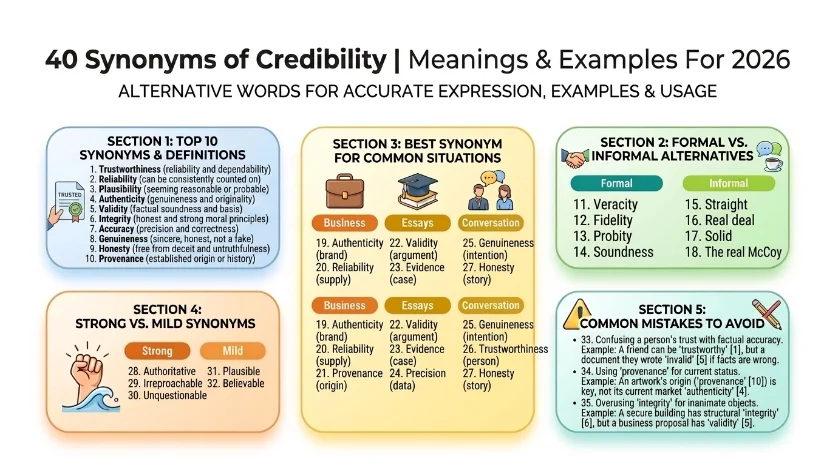
“Credibility” means the quality of being trusted and believed. The best synonyms are trustworthiness, reliability, believability, integrity, and authenticity. “Trustworthiness” is the most common and natural alternative. Each synonym has a slightly different meaning and context.
Top 10 Synonyms
- Trustworthiness
- Reliability
- Believability
- Integrity
- Authenticity
- Dependability
- Validity
- Plausibility
- Reputation
- Faithworthiness
“Credibility” is an important word, especially in professional and academic settings. It’s about being trusted and believed. But using it too often can make your writing feel repetitive and formal.
Think about it. You build credibility in your career, in relationships, and in your writing. Each situation might need a different word that captures a specific type of trustworthiness.
In this guide, you’ll learn 35 powerful synonyms for “credibility.” You’ll discover exactly when to use each one, how formal they are, and what common mistakes to avoid. Let’s dive in!
What Does “Credibility” Mean?
Definition
Credibility” means the quality of being believable, trustworthy, and reliable. When you have credibility, people trust what you say. It comes from being honest, consistent, and having good character. Credibility is earned over time through your actions and words.
Pronunciation
| Feature | Value |
|---|---|
| US IPA | /ˌkrɛdəˈbɪləti/ |
| UK IPA | /ˌkredəˈbɪləti/ |
| Syllables | 5 (cred-i-bil-i-ty) |
| Tip | Stress the third syllable: “kred-uh-BIL-uh-tee” |
Grammar
| Grammar Feature | Information |
|---|---|
| Part of Speech | Noun (uncountable) |
| Common Position | Subject or object |
| Typical Pattern | Credibility + of + person/thing |
Examples:
- “Her credibility as a journalist is unquestionable.”
- “The scandal damaged his credibility.”
- “We need to establish credibility with our clients.”
Grammar Note: “Credibility” is usually uncountable. We don’t say “credibilities” except in very specific contexts.
Word Family
| Word | Part of Speech | Meaning |
|---|---|---|
| Credible | Adjective | Believable and trustworthy |
| Credibility | Noun | The quality of being believable |
| Incredible | Adjective | Hard to believe (or amazing) |
| Incredulity | Noun | The state of being unwilling to believe |
15 Synonyms of “Credibility”
Trustworthiness
Meaning: The quality of being honest, reliable, and worthy of trust.
Best Used For: General contexts, personal relationships, professional settings.
Formality: Neutral
Tone: Honest, Dependable
Frequency: ⭐⭐⭐⭐⭐ (Very Common)
CEFR Level: B1
Example Sentence 1: “Her trustworthiness made her the perfect candidate for the job.”
Example Sentence 2: “Trustworthiness is the foundation of any good relationship.”
Usage Tip: “Trustworthiness” is the most direct and common synonym. It works in almost any context where credibility matters.
Common Confusion: Trustworthiness vs Credibility. “Trustworthiness” emphasizes honesty and reliability. “Credibility” is broader, including competence and believability.
Reliability
Meaning: The quality of being consistently good, trustworthy, and dependable.
Best Used For: Products, services, people, data.
Formality: Neutral
Tone: Dependable, Consistent
Frequency: ⭐⭐⭐⭐⭐ (Very Common)
CEFR Level: B1
Example Sentence 1: “The reliability of this car is unmatched.
Example Sentence 2: “Her reliability at work earned her a promotion.”
Usage Tip: “Reliability” emphasizes consistency and dependability. It’s great for describing people, products, and data.
Believability
Meaning: The quality of being able to be believed or accepted as true.
Best Used For: Stories, claims, explanations, characters.
Formality: Neutral
Tone: Logical, Convincing
Frequency: ⭐⭐⭐ (Moderate)
CEFR Level: B2
Example Sentence 1: “The believability of the movie’s plot was questionable.”
Example Sentence 2: “Facts add believability to your argument.”
Usage Tip: “Believability” focuses on whether something seems true. Use it for stories, claims, and explanations.
Integrity
Meaning: The quality of being honest and having strong moral principles.
Best Used For: Character, leadership, professional ethics.
Formality: Formal
Tone: Honorable, Principled
Frequency: ⭐⭐⭐⭐ (Common)
CEFR Level: B2
Example Sentence 1: “Her integrity is beyond question.
Example Sentence 2: “Integrity in business builds customer loyalty.
Usage Tip: “Integrity” is about having strong moral principles. It’s more about character than just being believable.
Authenticity
Meaning: The quality of being real, genuine, and not a copy.
Best Used For: Art, experiences, people, brands.
Formality: Formal
Tone: Genuine, Real
Frequency: ⭐⭐⭐⭐ (Common)
CEFR Level: B2
Example Sentence 1: “The authenticity of the painting was confirmed by experts.”
Example Sentence 2: “People value authenticity in a brand.”
Usage Tip: “Authenticity” is about being real and genuine. It’s often used for art, people, and brands.
Dependability
Meaning: The quality of being reliable and worthy of trust.
Best Used For: People, equipment, systems.
Formality: Neutral
Tone: Reliable, Steady
Frequency: ⭐⭐⭐ (Moderate)
CEFR Level: B2
Example Sentence 1: “Her dependability makes her an excellent team leader.
Example Sentence 2: “The dependability of the system is crucial.”
Usage Tip: “Dependability” is very similar to “reliability.” It emphasizes that you can depend on someone or something.
Validity
Meaning: The quality of being logically sound or legally acceptable.
Best Used For: Arguments, claims, research, legal documents.
Formality: Formal
Tone: Logical, Sound
Frequency: ⭐⭐⭐⭐ (Common)
CEFR Level: B2
Example Sentence 1: “The validity of his argument was questioned.
Example Sentence 2: “We need to verify the validity of these results.
Usage Tip: “Validity” focuses on logical soundness. Use it in academic and research contexts.
Plausibility
Meaning: The quality of seeming reasonable or believable.
Best Used For: Explanations, excuses, stories.
Formality: Formal
Tone: Reasonable, Acceptable
Frequency: ⭐⭐⭐ (Moderate)
CEFR Level: C1
Example Sentence 1: “The plausibility of the theory was widely debated.
Example Sentence 2: “His explanation lacked plausibility.”
Usage Tip: “Plausibility” is about seeming reasonable enough to be believed. It’s a formal word for arguments and theories.
Reputation
Meaning: The beliefs or opinions that people generally hold about someone or something.
Best Used For: People, companies, brands.
Formality: Neutral
Tone: Social, Reputational
Frequency: ⭐⭐⭐⭐⭐ (Very Common)
CEFR Level: B1
Example Sentence 1: “The company has a reputation for quality.”
Example Sentence 2: “His reputation as an honest man preceded him.”
Usage Tip: “Reputation” is what others think of you. It’s closely related to credibility but focuses more on public perception.
Faithworthiness
Meaning: The quality of being worthy of faith or trust.
Best Used For: Religious, spiritual, or deeply trusting contexts.
Formality: Formal
Tone: Spiritual, Trusting
Frequency: ⭐ (Very Rare)
CEFR Level: C1
Example Sentence 1: “His faithworthiness earned him a loyal following.”
Example Sentence 2: “Her faithworthiness in times of crisis is remarkable.”
Usage Tip: “Faithworthiness” is rare and quite formal. It’s used when trust is absolute, often in spiritual contexts.
Honesty
Meaning: The quality of being truthful and sincere.
Best Used For: Personal relationships, professional ethics.
Formality: Neutral
Tone: Truthful, Sincere
Frequency: ⭐⭐⭐⭐⭐ (Very Common)
CEFR Level: A2
Example Sentence 1: “Honesty is the best policy.”
Example Sentence 2: “Her honesty in the interview impressed everyone.
Usage Tip: “Honesty” emphasizes truthfulness. It’s a core component of credibility and works in almost any situation.
Sincerity
Meaning: The quality of being genuine and not hypocritical.
Best Used For: Apologies, emotions, relationships.
Formality: Neutral
Tone: Genuine, Warm
Frequency: ⭐⭐⭐ (Moderate)
CEFR Level: B2
Example Sentence 1: “His sincerity made him a trustworthy friend.”
Example Sentence 2: “She spoke with great sincerity.”
Usage Tip: “Sincerity” is about being genuine in your feelings and words. It’s a softer alternative to credibility.
Legitimacy
Meaning: The quality of being legal, valid, or justified.
Best Used For: Governments, businesses, claims, laws.
Formality: Formal
Tone: Legal, Authorized
Frequency: ⭐⭐⭐ (Moderate)
CEFR Level: C1
Example Sentence 1: “The legitimacy of the government was recognized internationally.”
Example Sentence 2: “We need to confirm the legitimacy of the contract.”
Usage Tip: “Legitimacy” is about being legal or officially recognized. Use it for legal and political contexts.
Believableness
Meaning: The quality of being believable.
Best Used For: Stories, claims, explanations.
Formality: Neutral
Tone: Convincing, Reasonable
Frequency: ⭐⭐ (Rare)
CEFR Level: B2
Example Sentence 1: “The believableness of the story kept readers engaged.”
Example Sentence 2: “Her believableness as a witness was crucial.”
Usage Tip: “Believableness” is simply another word for “believability.” It’s less common but perfectly acceptable.
Authority
Meaning: The power or right to give orders, make decisions, or be believed.
Best Used For: Experts, leaders, professionals.
Formality: Formal
Tone: Commanding, Respectable
Frequency: ⭐⭐⭐⭐ (Common)
CEFR Level: B2
Example Sentence 1: “He speaks with authority on the subject.
Example Sentence 2: “The article lacks authority without proper sources.”
Usage Tip: “Authority” is about being listened to and believed because of your knowledge or position.
Synonyms Comparison Table
| Synonym | Best Context | Formality | Tone | Frequency |
|---|---|---|---|---|
| Trustworthiness | General use | Neutral | Honest | ⭐⭐⭐⭐⭐ |
| Reliability | Consistency | Neutral | Dependable | ⭐⭐⭐⭐⭐ |
| Reputation | Public perception | Neutral | Social | ⭐⭐⭐⭐⭐ |
| Honesty | Truthfulness | Neutral | Sincere | ⭐⭐⭐⭐⭐ |
| Integrity | Character | Formal | Honorable | ⭐⭐⭐⭐ |
| Authenticity | Genuineness | Formal | Real | ⭐⭐⭐⭐ |
| Validity | Arguments, research | Formal | Logical | ⭐⭐⭐⭐ |
| Believability | Stories, claims | Neutral | Convincing | ⭐⭐⭐ |
| Dependability | People, systems | Neutral | Steady | ⭐⭐⭐ |
| Authority | Experts, leaders | Formal | Commanding | ⭐⭐⭐⭐ |
Best Synonyms by Situation
| Situation | Best Synonym | Why It Works |
|---|---|---|
| Daily Conversation | Trustworthiness | Natural and common |
| Business Email | Reliability | Professional and clear |
| Academic Writing | Validity | Formal and precise |
| School Assignment | Believability | Shows critical thinking |
| Professional Meeting | Integrity | Sounds principled |
| Presentation | Authority | Commands respect |
| Creative Writing | Authenticity | Adds literary depth |
| Social Media | Honesty | Engaging and relatable |
| Legal Context | Legitimacy | Formal and appropriate |
Formal vs Informal Synonyms
Formal Alternatives
| Synonym | Best Used For |
|---|---|
| Validity | Research, arguments, claims |
| Integrity | Leadership, ethics, character |
| Authenticity | Art, brands, experiences |
| Legitimacy | Legal, political, official contexts |
| Authority | Experts, professionals |
Neutral Alternatives
| Synonym | Best Used For |
|---|---|
| Trustworthiness | Most general situations |
| Reliability | Consistency and dependability |
| Believability | Stories, explanations |
| Reputation | Public perception |
Informal Alternatives
| Synonym | Best Used For |
|---|---|
| Honesty | Truthfulness in conversation |
| Sincerity | Genuine feelings |
| Cred (Slang) | Street credibility |
Choosing the Right Level: In academic writing, use “validity” or “authenticity.” In business, use “integrity” and “reliability.” In casual conversation, “honesty” and “trustworthiness” sound much more natural.
Strong vs Mild Synonyms
Mild
Suitable for everyday situations with less intensity.
- Believability
- Reputation
- Honesty
Moderate
More professional or specific alternatives.
- Trustworthiness
- Reliability
- Dependability
- Sincerity
Strong
High-intensity alternatives suggesting great trust or authority.
- Integrity (unquestionable principles)
- Authenticity (completely genuine)
- Validity (logically sound)
- Authority (commanding belief)
How Intensity Changes Meaning: “He has trustworthiness” is positive. “He has integrity” is much more powerful. Choose stronger words when you want to emphasize unshakable character or trust.
Real-Life Examples
School: “The student’s research lacked credibility without proper citations.”
Office: “Her reliability made her the team’s most valuable member.”
Business Email: “We need to establish trustworthiness with our clients.”
Meetings: “The integrity of our data is non-negotiable.”
Presentations: “His authority on the subject was unquestionable.”
Daily Conversations: “Honesty is what I value most in a friend.”
Social Media: “People appreciate authenticity in influencers.”
Academic Writing: “The validity of the study depends on the sample size.”
Common Collocations
| Common Phrase | Better Alternative |
|---|---|
| Build credibility | Build trustworthiness |
| Lose credibility | Damage reputation |
| Establish credibility | Establish trust |
| Gain credibility | Earn trust |
| Credibility gap | Trust gap |
| Credibility crisis | Trust crisis |
Common Phrases
Earn trust: To build credibility over time. (e.g., “She earned the trust of her colleagues.”)
Word of honor: A promise made with credibility. (e.g., “I give you my word of honor.”)
Track record: The history of reliability. (e.g., “He has a great track record.”)
In good faith: With honest intentions. (e.g., “They acted in good faith.”)
Above board: Honest and open. (e.g., “Everything about the deal was above board.”)
Put stock in: To trust or believe. (e.g., “I put a lot of stock in what she says.”)
Context Guide
| Situation | Best Synonym | Reason |
|---|---|---|
| Essay | Validity | Academic and precise |
| Speech | Authority | Commands respect |
| Business Email | Reliability | Professional and clear |
| Novel | Authenticity | Adds literary quality |
| Presentation | Integrity | Sounds principled |
| Conversation | Honesty | Natural and relatable |
| Academic Writing | Validity | Precise and analytical |
| Marketing Copy | Authenticity | Engaging and trustworthy |
Related Words
Near Synonyms
- Veracity: The quality of being truthful. (e.g., “I doubt the veracity of his claims.”)
- Verisimilitude: The appearance of being true. (e.g., “The novel has great verisimilitude.”)
- Sincerity: Genuine feeling. (e.g., “She spoke with sincerity.”)
- Honor: High respect and integrity.
Antonyms
- Dishonesty: Lack of truthfulness.
- Unreliability: Cannot be trusted.
- Duplicity: Deceitfulness.
- Deception: The act of misleading.
- Fraud: Intentional deception.
Related Adjectives
- Credible: Believable and trustworthy.
- Incredible: Hard to believe (or amazing).
- Trustworthy: Deserving of trust.
- Reliable: Consistently good.
- Authentic: Genuine and real.
Related Nouns
- Trust: Firm belief in reliability.
- Confidence: The feeling of trust.
- Faith: Complete trust.
- Honor: High respect.
- Reputation: What others think.
Related Verbs
- Validate: To confirm as credible.
- Verify: To confirm the truth of.
- Authenticate: To prove as genuine.
- Trust: To believe in reliability.
- Certify: To officially confirm.
Frequently Asked Questions
What is another word for credibility?
Common synonyms include trustworthiness, reliability, believability, integrity, and authenticity. “Trustworthiness” is the most common and direct alternative.
Which synonym sounds the most professional?
Integrity and validity sound very professional. “Authenticity” is also excellent for branding and personal contexts.
What is the strongest synonym for credibility?
Integrity is one of the strongest synonyms. It suggests unshakable moral principles. “Authority” is also strong, suggesting command of a subject.
Which synonym is best for essays?
Validity is the best choice for academic essays. It focuses on logical soundness. “Authenticity” is also excellent for humanities essays.
What’s the difference between credibility and trustworthiness?
“Credibility” is broader and includes competence and believability. “Trustworthiness” specifically emphasizes honesty and reliability.
Which synonym is most common in everyday English?
“Trustworthiness,” “honesty,” and “reliability” are very common in everyday conversation. “Reputation” is also frequently used.
What is the opposite of credibility?
Common opposites are dishonesty, unreliability, and deception. In formal contexts, “fraud” and “duplicity” are stronger opposites.
Conclusion
“Credibility” is a powerful word, but now you have 35 fantastic alternatives to choose from. Each synonym adds a different shade of meaning to your language.
Remember, the key is understanding the context and choosing the right word. Use “trustworthiness” for general situations. Use “integrity” for moral character. Use “validity” for logical arguments. Use “authenticity” for being genuine. Use “reliability” for consistency.
The best way to improve is practice. Try using one or two new synonyms each day. Listen for these words in conversations, books, and movies. Your vocabulary will become richer and more impressive with time.
