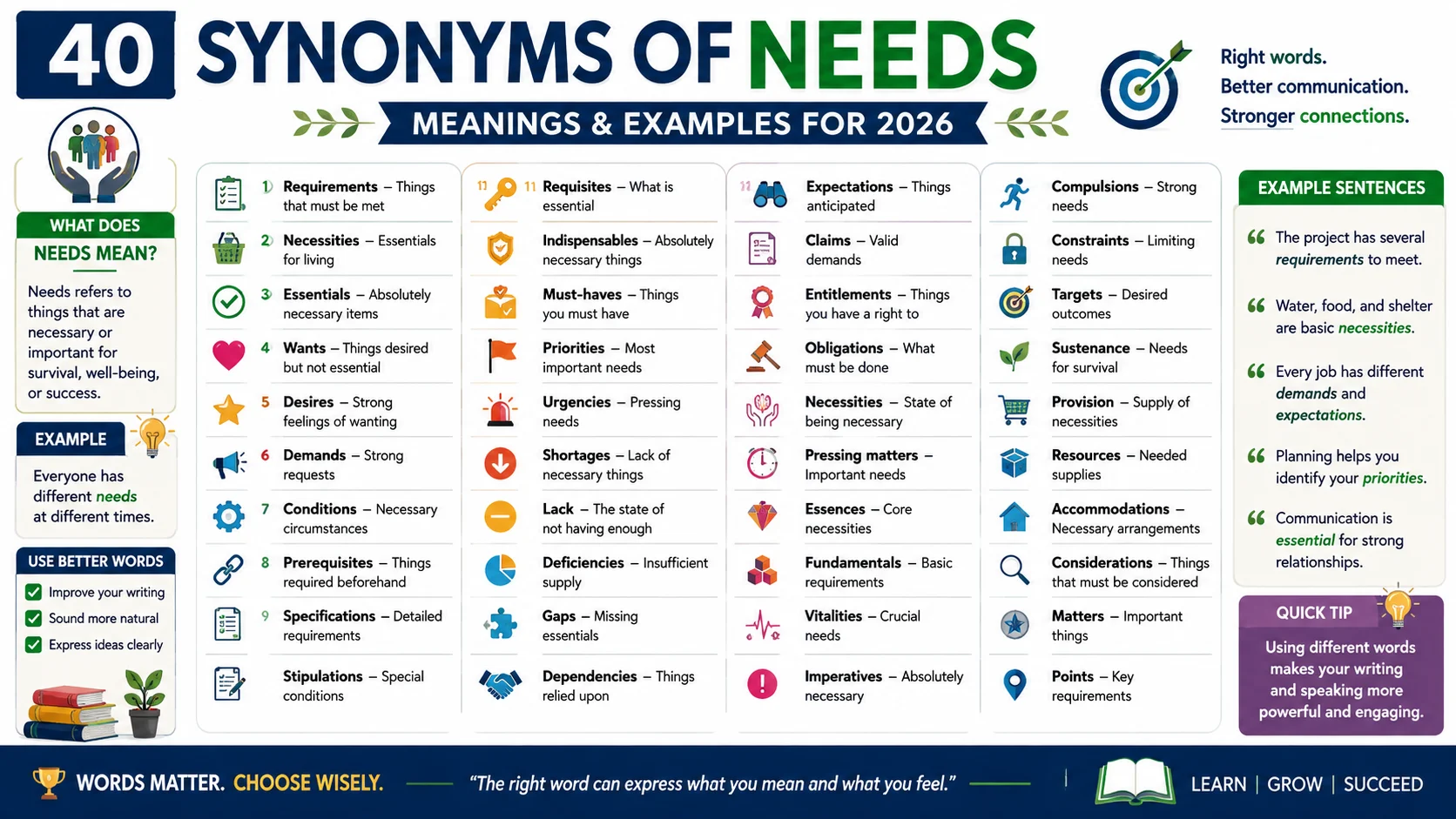
“Needs” means the things you must have or do. The best synonyms are requirements, necessities, essentials, obligations, and demands. “Requirements” is the most common professional alternative. Each synonym has a slightly different meaning and context where it works best.
Top 10 Synonyms
- Requirements
- Necessities
- Essentials
- Obligations
- Demands
- Wants
- Desires
- Prerequisites
- Must-haves
- Basic needs
“Needs” is a word we use every day. It’s simple and useful. But using it too often can make your English feel repetitive and basic.
Think about it. You need food, need to study, need to work, need money, and need to rest. Each situation might deserve a more specific word. Some needs are basic survival requirements. Others are personal desires or professional necessities.
In this guide, you’ll learn 35 powerful synonyms for “needs.” You’ll discover exactly when to use each one, how formal they are, and what common mistakes to avoid. Let’s begin!
What Does “Needs” Mean?
Definition
“Needs” refers to the things that are necessary or required. It can mean the basic things you must have to survive, like food and water. It can also mean things you must do or have to achieve a goal or meet an obligation.
Pronunciation
| Feature | Value |
|---|---|
| US IPA | /nidz/ |
| UK IPA | /niːdz/ |
| Syllables | 1 |
| Tip | Rhymes with “beads” and “seeds” |
Grammar
| Grammar Feature | Information |
|---|---|
| Part of Speech | Noun (plural) / Verb (third person singular) |
| Common Position | Subject or object |
| Typical Pattern | Needs + for + something / Noun + needs + noun |
Examples:
- “Her basic needs are food and shelter.” (noun)
- “He needs to study more.” (verb)
- “The project needs more time.” (verb)
Grammar Note: “Needs” can be both a noun and a verb. As a noun, it always takes a plural verb (“needs are”). As a verb, it agrees with the subject.
Word Family
| Word | Part of Speech | Meaning |
|---|---|---|
| Need | Verb | To require something |
| Need | Noun | A requirement or necessity |
| Needy | Adjective | Lacking basic necessities |
| Needfulness | Noun | The quality of being necessary |
| Needless | Adjective | Not necessary |
15 Synonyms of “Needs”
Requirements
Meaning: The things you must have or do to achieve something.
Best Used For: Business, education, formal contexts, job descriptions.
Formality: Formal
Tone: Professional, Structured
Frequency: ⭐⭐⭐⭐⭐ (Very Common)
CEFR Level: B1
Example Sentence 1: “The job has certain requirements you must meet.”
Example Sentence 2: “Basic requirements for the course include a computer.”
Usage Tip: “Requirements” is the most professional synonym. Use it for formal and work-related contexts.
Common Confusion: Requirements vs Needs. “Requirements” is more formal and specific. “Needs” is broader and more casual.
Necessities
Meaning: The things you cannot live or function without.
Best Used For: Basic needs, survival, essential items.
Formality: Neutral
Tone: Serious, Essential
Frequency: ⭐⭐⭐⭐ (Common)
CEFR Level: B2
Example Sentence 1: “Food and water are basic necessities.”
Example Sentence 2: “We packed only the necessities for the trip.”
Usage Tip: “Necessities” means you literally cannot do without something. Use it for essential, basic things.
Essentials
Meaning: The most important, necessary things.
Best Used For: Packing, lists, basic requirements.
Formality: Neutral
Tone: Practical, Basic
Frequency: ⭐⭐⭐⭐ (Common)
CEFR Level: B2
Example Sentence 1: “We bought only the essentials for the new apartment.”
Example Sentence 2: “Her essentials include her laptop and phone.”
Usage Tip: “Essentials” are the most important items you need. It’s a step above “necessities” in everyday use.
Obligations
Meaning: Things you must do because of duty, law, or promise.
Best Used For: Work duties, legal requirements, moral duties.
Formality: Formal
Tone: Responsible, Duty-focused
Frequency: ⭐⭐⭐⭐ (Common)
CEFR Level: B2
Example Sentence 1: “Her obligations at work include managing the team.
Example Sentence 2: “We have legal obligations to our clients.”
Usage Tip: “Obligations” are things you must do, not just things you want to have. Use it for duties and responsibilities.
Demands
Meaning: Things that people insist on having or doing.
Best Used For: Work, relationships, high-pressure situations.
Formality: Formal
Tone: Strong, Pressuring
Frequency: ⭐⭐⭐⭐ (Common)
CEFR Level: B2
Example Sentence 1: “The demands of the job are very high.”
Example Sentence 2: “She made unreasonable demands on her staff.”
Usage Tip: “Demands” suggests pressure and high expectations. It’s stronger than “needs.”
Wants
Meaning: Things you desire, but may not strictly need.
Best Used For: Desires, wishes, personal preferences.
Formality: Informal
Tone: Personal, Desire-focused
Frequency: ⭐⭐⭐⭐⭐ (Very Common)
CEFR Level: A2
Example Sentence 1: “Her wants are different from her needs.”
Example Sentence 2: “Children often confuse wants with needs.
Usage Tip: “Wants” are desires, not requirements. Use it when you want to contrast with actual needs.
Desires
Meaning: Strong feelings of wanting something.
Best Used For: Personal goals, dreams, ambitions.
Formality: Formal
Tone: Emotional, Aspirational
Frequency: ⭐⭐⭐⭐ (Common)
CEFR Level: B2
Example Sentence 1: “His desires include traveling the world.”
Example Sentence 2: “She has a strong desire for success.”
Usage Tip: “Desires” is more formal than “wants” and suggests stronger emotional wanting.
Prerequisites
Meaning: Things you must have or do before something else can happen.
Best Used For: Education, qualifications, requirements.
Formality: Formal
Tone: Conditional, Sequential
Frequency: ⭐⭐⭐ (Moderate)
CEFR Level: C1
Example Sentence 1: “This course has prerequisites you must complete.”
Example Sentence 2: “A degree is a prerequisite for this position.”
Usage Tip: “Prerequisites” are things that must happen first. Use it for education and qualifications.
Must-haves
Meaning: Things you absolutely must have.
Best Used For: Shopping, packing, informal lists.
Formality: Informal
Tone: Casual, Direct
Frequency: ⭐⭐⭐ (Moderate)
CEFR Level: B1
Example Sentence 1: “A good pair of shoes are must-haves for travel.”
Example Sentence 2: “Her must-haves include coffee and her phone.”
Usage Tip: “Must-haves” is a casual expression. Use it in informal contexts.
Basic needs
Meaning: The most fundamental things required for survival.
Best Used For: Survival, human rights, health.
Formality: Neutral
Tone: Serious, Essential
Frequency: ⭐⭐⭐⭐⭐ (Very Common)
CEFR Level: B1
Example Sentence 1: “Everybody deserves their basic needs met.”
Example Sentence 2: “Basic needs include food, water, and shelter.”
Usage Tip: “Basic needs” is a standard phrase for survival requirements. Use it in serious, important contexts.
Imperatives
Meaning: Things that are absolutely necessary.
Best Used For: Formal writing, urgent requirements.
Formality: Very Formal
Tone: Urgent, Serious
Frequency: ⭐⭐ (Rare)
CEFR Level: C1
Example Sentence 1: “Safety is an imperative in construction.”
Example Sentence 2: “The imperatives of the situation were clear.”
Usage Tip: “Imperatives” is a very formal word. Use it only in formal, serious writing.
Priorities
Meaning: The things you think are most important.
Best Used For: Time management, personal goals, life choices.
Formality: Neutral
Tone: Focused, Organized
Frequency: ⭐⭐⭐⭐⭐ (Very Common)
CEFR Level: B1
Example Sentence 1: “My priorities include my family and career.”
Example Sentence 2: “We need to set our priorities straight.”
Usage Tip: “Priorities” are what you choose to focus on. It’s about importance, not just necessity.
Prerogatives
Meaning: The special rights or privileges you have.
Best Used For: Special rights, privileges, personal choices.
Formality: Very Formal
Tone: Official, Legal
Frequency: ⭐ (Very Rare)
CEFR Level: C1
Example Sentence 1: “It’s his prerogative to make that decision.”
Example Sentence 2: “She exercised her prerogative as the owner.”
Usage Tip: “Prerogatives” are rights or privileges, not basic needs. Use it only in very formal contexts.
Necessaries
Meaning: Things that are needed.
Best Used For: Legal contexts, formal writing.
Formality: Very Formal
Tone: Official, Legal
Frequency: ⭐ (Very Rare)
CEFR Level: C1
Example Sentence 1: “The court ordered all necessaries for the child.”
Example Sentence 2: “Travel necessaries include documents and money.”
Usage Tip: “Necessaries” is an old-fashioned, formal word. Use it only in legal or very formal writing.
Requisites
Meaning: Things that are required.
Best Used For: Formal lists, qualifications.
Formality: Very Formal
Tone: Official, Required
Frequency: ⭐⭐ (Rare)
CEFR Level: C1
Example Sentence 1: “The requisites for admission are listed here.”
Example Sentence 2: “She has all the requisites for the position.”
Usage Tip: “Requisites” is very formal. Use it in official, administrative contexts.
Synonyms Comparison Table
| Synonym | Best Context | Formality | Tone | Frequency |
|---|---|---|---|---|
| Requirements | Work, education | Formal | Professional | ⭐⭐⭐⭐⭐ |
| Necessities | Survival, basics | Neutral | Serious | ⭐⭐⭐⭐ |
| Essentials | Packing, basics | Neutral | Practical | ⭐⭐⭐⭐ |
| Obligations | Duties, work | Formal | Responsible | ⭐⭐⭐⭐ |
| Demands | Work, pressure | Formal | Strong | ⭐⭐⭐⭐ |
| Wants | Desires, casual | Informal | Personal | ⭐⭐⭐⭐⭐ |
| Desires | Goals, dreams | Formal | Emotional | ⭐⭐⭐⭐ |
| Prerequisites | Education, steps | Formal | Conditional | ⭐⭐⭐ |
| Basic needs | Survival | Neutral | Serious | ⭐⭐⭐⭐⭐ |
| Priorities | Life choices | Neutral | Focused | ⭐⭐⭐⭐⭐ |
Best Synonyms by Situation
| Situation | Best Synonym | Why It Works |
|---|---|---|
| Daily Conversation | Needs / Wants | Natural and simple |
| Business Email | Requirements | Professional and clear |
| Academic Writing | Prerequisites | Formal and precise |
| School Assignment | Essentials | Simple and clear |
| Professional Meeting | Obligations | Sounds responsible |
| Presentation | Requirements | Clear and direct |
| Creative Writing | Desires | Adds emotional depth |
| Social Media | Must-haves | Casual and relatable |
| Health / Survival | Basic needs | Serious and appropriate |
Formal vs Informal Synonyms
Formal Alternatives
| Synonym | Best Used For |
|---|---|
| Requirements | Work, education, rules |
| Obligations | Duties, responsibilities |
| Prerequisites | Qualification, education |
| Imperatives | Absolute necessities |
| Requisites | Official requirements |
Neutral Alternatives
| Synonym | Best Used For |
|---|---|
| Necessities | Basic survival needs |
| Essentials | Important items |
| Basic needs | Fundamental requirements |
| Priorities | Important matters |
Informal Alternatives
| Synonym | Best Used For |
|---|---|
| Wants | Personal desires |
| Must-haves | Essential items casually |
| Needs | General use |
Choosing the Right Level: Use “requirements” and “obligations” in formal contexts. Use “necessities” and “essentials” in neutral situations. Use “wants” and “must-haves” with friends and family.
Strong vs Mild Synonyms
Mild
Suitable for everyday situations with less pressure.
- Wants
- Desires
- Essentials
Moderate
More serious or important alternatives.
- Needs
- Necessities
- Priorities
- Must-haves
Strong
High-intensity alternatives suggesting great urgency or importance.
- Requirements (formal obligation)
- Obligations (moral or legal duty)
- Demands (high pressure)
- Imperatives (absolute necessity)
How Intensity Changes Meaning: “I need help” is simple. “I have obligations” sounds more serious. “The requirements are strict” sounds formal and demanding. Choose based on urgency and formality.
Real-Life Examples
School: “The requirements for this class are clearly listed.”
Office: “Her obligations at work include meeting deadlines.”
Business Email: “Please review the requirements before applying.”
Meetings: “We need to prioritize our needs for this quarter.”
Presentations: “The basic needs of our customers must be met first.”
Daily Conversations: “I just want to take care of my basic needs.”
Social Media: “These are my must-haves for a perfect weekend!”
Academic Writing: “The prerequisites for this study are clearly defined.”
Common Collocations
| Common Phrase | Better Alternative |
|---|---|
| Need food | Need necessities |
| Need money | Have financial needs |
| Need time | Time requirements |
| Need help | Support needs |
| Need approval | Approval requirements |
Common Phrases
Essential needs: The most important requirements. (e.g., “She provides for her essential needs.”)
functional needs: Particular requirements, often for health. (e.g., “Children with functional needs require extra care.”)
Unmet needs: Requirements not fulfilled. (e.g., “The report highlighted unmet needs in the community.”)
Need of the hour: Something urgently required. (e.g., “Unity is the need of the hour.”)
Waste not, want not: Don’t waste and you won’t lack. (e.g., “Waste not, want not is a good principle.”)
Context Guide
| Situation | Best Synonym | Reason |
|---|---|---|
| Essay | Prerequisites / Requirements | Formal and academic |
| Speech | Basic needs / Priorities | Clear and inspiring |
| Business Email | Requirements / Obligations | Professional and direct |
| Novel | Desires / Necessities | Adds literary depth |
| Presentation | Requirements / Priorities | Clear and organized |
| Conversation | Needs / Wants | Natural and casual |
| Academic Writing | Requirements / Prerequisites | Precise and formal |
| Marketing Copy | Must-haves / Essentials | Engaging and relatable |
Related Words
Near Synonyms
- Supplies: The things you need. (e.g., “We stocked up on supplies.”)
- Provisions: Supplies of food and equipment. (e.g., “They had enough provisions.”)
- Resources: Available supplies or assets. (e.g., “We have limited resources.”)
- Commodities: Useful things. (e.g., “Water is a precious commodity.”)
Antonyms
- Luxuries: Things you want but don’t need.
- Extras: Additional, unnecessary things.
- Surplus: More than enough.
- Extravagances: Unnecessary spending.
Related Adjectives
- Necessary: Required.
- Essential: Absolutely needed.
- Required: Must be had.
- Obligatory: Must be done.
- Mandatory: Required by law.
Related Nouns
- Requirement: Something needed.
- Necessity: A basic need.
- Essential: A crucial item.
- Obligation: A duty.
- Prerequisite: A prior requirement.
Related Verbs
- Require: To need.
- Necessitate: To make necessary.
- Demand: To ask for strongly.
- Need: To have to have.
- Want: To desire.
Frequently Asked Questions
What is another word for needs?
Common synonyms include requirements, necessities, essentials, obligations, and demands. “Requirements” is the most professional alternative.
Which synonym sounds the most professional?
Requirements and obligations sound the most professional. “Prerequisites” is also excellent for academic contexts.
What is the strongest synonym for needs?
Imperatives is one of the strongest synonyms. It suggests absolute, urgent necessity. “Demands” is also strong, suggesting pressure.
Which synonym is best for essays?
Prerequisites and requirements are excellent for academic essays. “Necessities” is also strong for descriptive essays.
What’s the difference between needs and wants?
“Needs” are things you must have to survive or function. “Wants” are things you desire but can live without.
Which synonym is most common in everyday English?
“Needs” itself is the most common. “Wants” and “requirements” are also very common.
What is the opposite of needs?
Common opposites are luxuries, extras, and surplus. These are things beyond what is required.
Conclusion
Needs” is a simple word, but now you have 35 powerful alternatives to choose from. Each synonym adds a different shade of meaning to your language.
Remember, the key is understanding the context. Use “requirements” for professional situations. Use “necessities” for basic survival. Use “obligations” for duties and responsibilities. Use “wants” and “desires” for personal preferences.
The best way to improve is practice. Try using one or two new synonyms each day. Listen for these words in conversations, books, and movies. Your vocabulary will become richer and more impressive with time.
