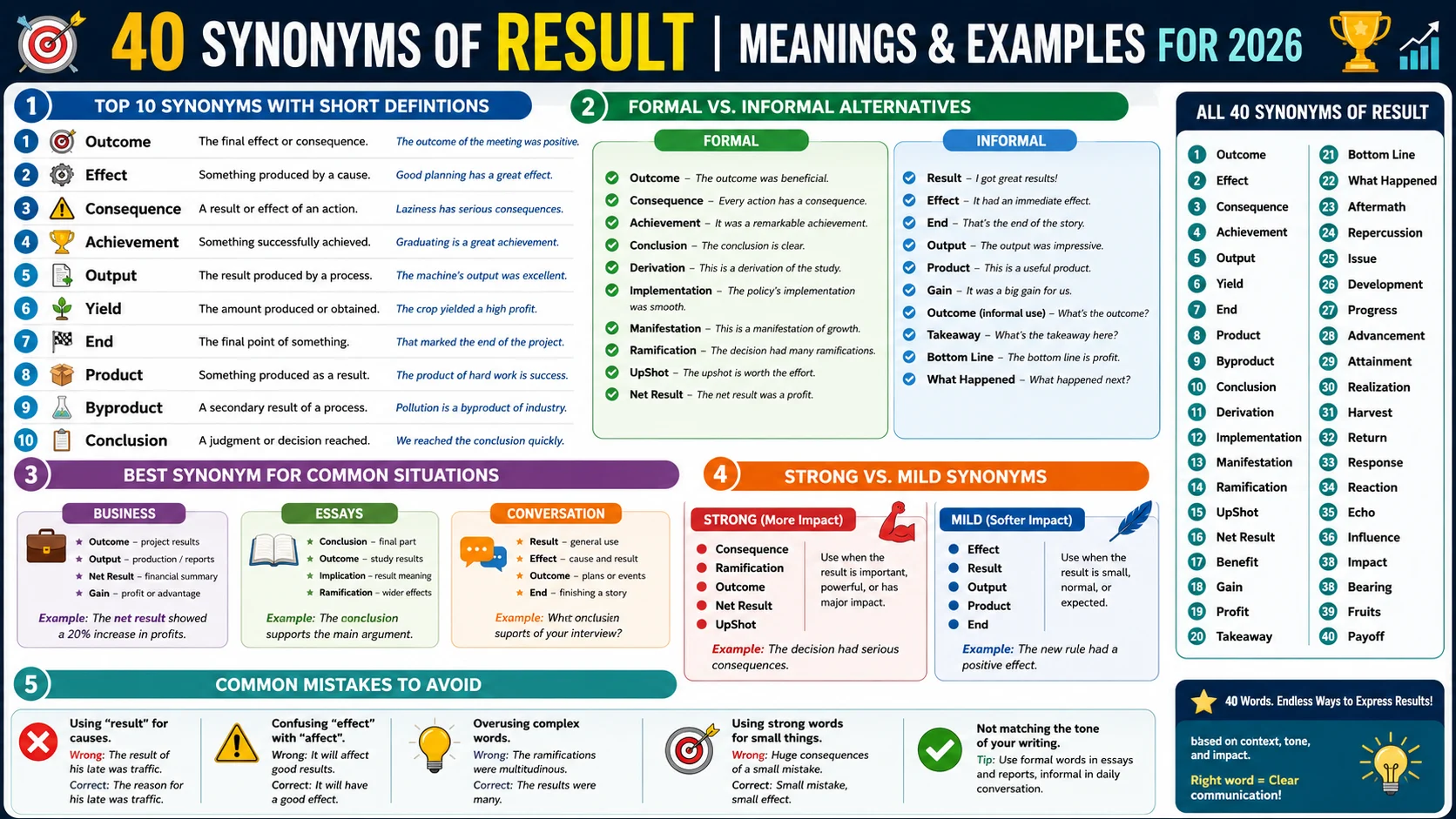
“Result” means something that happens because of an action or event. The best synonyms are outcome, consequence, effect, product, and conclusion. “Outcome” is the most common natural alternative. Each synonym has a slightly different meaning and context where it fits best.
Top 10 Synonyms
- Outcome
- Consequence
- Effect
- Product
- Conclusion
- End result
- Aftermath
- Byproduct
- Repercussion
- Upshot
“Result” is a word we use constantly. Every action has a result. Every decision has a result. But using it too often can make your English feel repetitive and boring.
Think about it. A result can be good or bad. It can be expected or surprising. It can be immediate or delayed. Each situation might need a different word that captures the exact meaning more clearly.
In this guide, you’ll learn 35 powerful synonyms for “result.” You’ll discover exactly when to use each one, how formal they are, and what common mistakes to avoid. Let’s begin!
What Does “Result” Mean?
Definition
Result” means something that happens or exists because of an action, event, or condition. It’s the outcome or consequence of what came before. When you do something, the result is what follows. It can be positive, negative, or neutral.
Pronunciation
| Feature | Value |
|---|---|
| US IPA | /rɪˈzʌlt/ |
| UK IPA | /rɪˈzʌlt/ |
| Syllables | 2 (re-sult) |
| Tip | Stress the second syllable: “rih-ZULT” |
Grammar
| Grammar Feature | Information |
|---|---|
| Part of Speech | Noun and Verb |
| Common Position | Subject or object |
| Typical Pattern | Result + of + something / Result + from + something |
Examples:
- “The result of the experiment was surprising.” (noun)
- “His success resulted from hard work.” (verb)
- “The results are in.” (plural)
Grammar Note: “Result” can be countable or uncountable. You can talk about “a result” or “results” from an experiment, but also “the result” of an action.
Word Family
| Word | Part of Speech | Meaning |
|---|---|---|
| Result | Verb/Noun | To happen as a consequence |
| Resulting | Adjective | Happening as a consequence |
| Resultant | Adjective | Occurring as a result |
| Results | Noun (plural) | The outcomes of an action |
15 Synonyms of “Result”
Outcome
Meaning: The final result of a process or situation.
Best Used For: Business, academic writing, general use.
Formality: Neutral
Tone: Neutral, Objective
Frequency: ⭐⭐⭐⭐⭐ (Very Common)
CEFR Level: B1
Example Sentence 1: “The outcome of the meeting was positive.”
Example Sentence 2: “We won’t know the outcome until next week.”
Usage Tip: “Outcome” is the most direct and common synonym. Use it for almost any situation where you need to talk about a result.
Common Confusion: Outcome vs Result. “Outcome” is slightly more formal and often used for processes. “Result” is more general.
Consequence
Meaning: A result that follows an action, often negative.
Best Used For: Serious situations, cause and effect.
Formality: Formal
Tone: Serious, Significant
Frequency: ⭐⭐⭐⭐ (Common)
CEFR Level: B1
Example Sentence 1: “He had to face the consequences of his actions.
Example Sentence 2: “One consequence of climate change is rising sea levels.
Usage Tip: “Consequence” often implies a negative or serious result. Use it for cause-and-effect situations.
Effect
Meaning: A change that happens because of an action.
Best Used For: Science, cause and effect, general use.
Formality: Neutral
Tone: Neutral, Factual
Frequency: ⭐⭐⭐⭐⭐ (Very Common)
CEFR Level: A2
Example Sentence 1: “The medicine had a positive effect on her health.
Example Sentence 2: “What effect will this have on the environment?”
Usage Tip: “Effect” focuses on the change or impact caused by something. It’s very common in everyday English.
Common Confusion: Effect vs Affect. “Effect” is a noun (the result). “Affect” is a verb (to influence).
Product
Meaning: Something created or produced by a process.
Best Used For: Manufacturing, creative work, processes.
Formality: Neutral
Tone: Practical, Concrete
Frequency: ⭐⭐⭐⭐ (Common)
CEFR Level: A2
Example Sentence 1: “The final product of their work was impressive.”
Example Sentence 2: “The product of years of research is this new method.”
Usage Tip: “Product” emphasizes something that is created or produced. Use it for tangible results.
Conclusion
Meaning: A final decision or judgment reached after thinking.
Best Used For: Research, arguments, essays, decisions.
Formality: Formal
Tone: Final, Decisive
Frequency: ⭐⭐⭐⭐ (Common)
CEFR Level: B1
Example Sentence 1: “The conclusion of the study was clear.”
Example Sentence 2: “What conclusion did you reach?”
Usage Tip: “Conclusion” is often about reasoning and decisions, not just any result.
End result
Meaning: The final outcome after a process.
Best Used For: Business, projects, processes.
Formality: Neutral
Tone: Final, Complete
Frequency: ⭐⭐⭐⭐ (Common)
CEFR Level: B1
Example Sentence 1: “The end result of all our hard work was success.”
Example Sentence 2: “The end result justified the effort.
Usage Tip: “End result” emphasizes the final stage of a longer process. It’s a very common phrase.
Aftermath
Meaning: The results of a disaster or significant event.
Best Used For: Disasters, wars, crises.
Formality: Formal
Tone: Serious, Negative
Frequency: ⭐⭐⭐ (Moderate)
CEFR Level: B2
Example Sentence 1: “The aftermath of the hurricane was devastating.”
Example Sentence 2: “In the aftermath of the crash, safety procedures were changed.”
Usage Tip: “Aftermath” is used for the results of something bad or disastrous. It has a negative tone.
Byproduct
Meaning: A secondary or unintended result of something.
Best Used For: Manufacturing, processes, unintended outcomes.
Formality: Formal
Tone: Secondary, Unexpected
Frequency: ⭐⭐⭐ (Moderate)
CEFR Level: B2
Example Sentence 1: “Confidence is a byproduct of success.”
Example Sentence 2: “The chemical process produces a harmful byproduct.”
Usage Tip: “Byproduct” emphasizes something that is produced in addition to the main result.
Repercussion
Meaning: An unintended, often negative consequence.
Best Used For: Serious actions, policy changes, consequences.
Formality: Formal
Tone: Negative, Serious
Frequency: ⭐⭐⭐ (Moderate)
CEFR Level: B2
Example Sentence 1: “The decision had serious repercussions for the company.”
Example Sentence 2: “Be careful—there could be repercussions.”
Usage Tip: “Repercussion” often implies negative, unexpected consequences that echo or ripple outward.
Upshot
Meaning: The most important result or point of a situation.
Best Used For: Summarizing, conclusions, final points.
Formality: Informal
Tone: Direct, Brief
Frequency: ⭐⭐ (Rare)
CEFR Level: B2
Example Sentence 1: “The upshot of the discussion was that we need more time.”
Example Sentence 2: “The upshot is, we can’t afford it.”
Usage Tip: “Upshot” is an informal word for the main point or conclusion. Use it to summarize.
Corollary
Meaning: A natural consequence that follows logically.
Best Used For: Academic writing, logic, formal contexts.
Formality: Very Formal
Tone: Logical, Intellectual
Frequency: ⭐ (Very Rare)
CEFR Level: C1
Example Sentence 1: “Increased costs are a corollary of inflation.
Example Sentence 2: “This is a natural corollary of the theory.”
Usage Tip: “Corollary” is a very formal, academic word. Use it in intellectual or logical contexts.
Payoff
Meaning: A positive result or reward for effort.
Best Used For: Effort, investment, work.
Formality: Informal
Tone: Positive, Rewarding
Frequency: ⭐⭐⭐ (Moderate)
CEFR Level: B2
Example Sentence 1: “The payoff for all that hard work was a promotion.”
Example Sentence 2: “What’s the payoff of this investment?”
Usage Tip: “Payoff” implies a positive result, often financial or personal.
Side effect
Meaning: A secondary or unintended result, often medical.
Best Used For: Medicine, technology, unintended outcomes.
Formality: Neutral
Tone: Secondary, Usually Negative
Frequency: ⭐⭐⭐⭐ (Common)
CEFR Level: B1
Example Sentence 1: “The medicine has some side effects.”
Example Sentence 2: “Increased productivity is a positive side effect of the new system.”
Usage Tip: “Side effect” emphasizes something that happens in addition to the main result. It’s often medical.
Fruit
Meaning: The results of effort or work.
Best Used For: Metaphorical, literary, success contexts.
Formality: Literary
Tone: Metaphorical, Positive
Frequency: ⭐⭐⭐ (Moderate)
CEFR Level: B2
Example Sentence 1: “She is finally enjoying the fruits of her labor.”
Example Sentence 2: “The fruit of years of research is this breakthrough.”
Usage Tip: “Fruit” is a metaphor for positive results from hard work. Use it in literary or inspirational contexts.
Ramification
Meaning: A complex or unexpected consequence.
Best Used For: Serious actions, policy changes, legal contexts.
Formality: Very Formal
Tone: Complex, Serious
Frequency: ⭐⭐ (Rare)
CEFR Level: C1
Example Sentence 1: “We need to consider the ramifications of this decision.”
Example Sentence 2: “The legal ramifications could be significant.”
Usage Tip: “Ramification” is a formal word for complex, often unexpected consequences.
Synonyms Comparison Table
| Synonym | Best Context | Formality | Tone | Frequency |
|---|---|---|---|---|
| Outcome | General use | Neutral | Objective | ⭐⭐⭐⭐⭐ |
| Effect | Cause and effect | Neutral | Factual | ⭐⭐⭐⭐⭐ |
| Consequence | Serious outcomes | Formal | Serious | ⭐⭐⭐⭐ |
| Product | Created results | Neutral | Practical | ⭐⭐⭐⭐ |
| Conclusion | Reasoning, decisions | Formal | Final | ⭐⭐⭐⭐ |
| End result | Final stage | Neutral | Complete | ⭐⭐⭐⭐ |
| Side effect | Secondary outcomes | Neutral | Unintended | ⭐⭐⭐⭐ |
| Aftermath | Disasters, crises | Formal | Negative | ⭐⭐⭐ |
| Byproduct | Unintended results | Formal | Secondary | ⭐⭐⭐ |
| Repercussion | Negative consequences | Formal | Serious | ⭐⭐⭐ |
Best Synonyms by Situation
| Situation | Best Synonym | Why It Works |
|---|---|---|
| Daily Conversation | Outcome | Natural and clear |
| Business Email | Outcome / End result | Professional and precise |
| Academic Writing | Conclusion / Corollary | Formal and analytical |
| School Assignment | Effect / Outcome | Clear and appropriate |
| Professional Meeting | Outcome | Professional and direct |
| Presentation | End result | Clear and final |
| Creative Writing | Fruit / Aftermath | Adds literary depth |
| Social Media | Upshot | Casual and engaging |
| Medical Context | Side effect | Specific and accurate |
Formal vs Informal Synonyms
Formal Alternatives
| Synonym | Best Used For |
|---|---|
| Consequence | Serious outcomes |
| Corollary | Logical consequences |
| Ramification | Complex consequences |
| Aftermath | Disaster results |
| Repercussion | Negative impacts |
Neutral Alternatives
| Synonym | Best Used For |
|---|---|
| Outcome | Most general situations |
| Effect | Cause and effect |
| Product | Created results |
| End result | Final outcomes |
| Side effect | Unintended outcomes |
Informal Alternatives
| Synonym | Best Used For |
|---|---|
| Upshot | Summarizing |
| Payoff | Positive results |
| Fruit | Metaphorical results |
Choosing the Right Level: Use “corollary” and “ramification” for academic writing. Use “consequence” for serious formal contexts. Use “upshot” and “payoff” for casual conversation.
Strong vs Mild Synonyms
Mild
Suitable for everyday situations with less intensity.
- Outcome
- Product
- End result
Moderate
More specific or formal alternatives.
- Effect
- Conclusion
- Byproduct
- Side effect
Strong
High-intensity alternatives suggesting significant impact.
- Consequence (serious impact)
- Aftermath (disaster results)
- Repercussion (negative echo)
- Ramification (complex outcome)
How Intensity Changes Meaning: “The outcome was bad” is clear. “The repercussions were serious” sounds much more dramatic. Choose stronger words when you want to emphasize the importance or negativity of a result.
Real-Life Examples
School: “The outcome of the experiment was successful.”
Office: “We need to consider the consequences of this decision.”
Business Email: “The end result of the project was impressive.”
Meetings: “Let’s discuss the outcome of the meeting.”
Presentations: “The findings are the product of years of research.”
Daily Conversations: “What was the outcome of the game?”
Social Media: “The upshot is that we need a new plan.”
Academic Writing: “The conclusion of the study is clear.”
Common Collocations
| Common Phrase | Better Alternative |
|---|---|
| Result of the study | Outcome of the study |
| Result of the action | Consequence of the action |
| Result of the process | Product of the process |
| Final result | End result |
| Unintended result | Byproduct / Side effect |
Common Phrases
End result: The final outcome. (e.g., “The end result was worth the effort.”)
In the end: Ultimately. (e.g., “In the end, everything worked out.”)
As a result: Because of something. (e.g., “As a result of the rain, we stayed inside.”)
With the result that: Leading to. (e.g., “He overslept, with the result that he missed the bus.”)
Fruit of your labor: The results of hard work. (e.g., “She enjoys the fruit of her labor.”)
Context Guide
| Situation | Best Synonym | Reason |
|---|---|---|
| Essay | Conclusion / Corollary | Academic and formal |
| Speech | Outcome / End result | Clear and inspiring |
| Business Email | Outcome | Professional and direct |
| Novel | Aftermath / Fruit | Adds literary depth |
| Presentation | End result | Clear and final |
| Conversation | Outcome | Natural and relatable |
| Academic Writing | Corollary / Ramification | Precise and formal |
| Legal Context | Ramification / Consequence | Serious and accurate |
Related Words
Near Synonyms
- Outgrowth: A natural development. (e.g., “The success was an outgrowth of hard work.”)
- Offshoot: A branch or result. (e.g., “The new company is an offshoot of the original.”)
- Derivative: Something obtained from another source. (e.g., “Her work is a derivative of earlier research.”)
- Residue: Something remaining. (e.g., “The residue of the conflict remained.”)
Antonyms
- Cause: What makes something happen.
- Source: The origin of something.
- Root: The basic cause.
- Origin: The beginning of something.
- Beginning: The start of a process.
Related Adjectives
- Resultant: Occurring as a result.
- Consequential: Important and resulting.
- Subsequent: Following something.
- Ensuing: Following afterward.
- Consequent: Happening as a result.
Related Nouns
- Cause: What creates an effect.
- Effect: The result of a cause.
- Consequence: A result of an action.
- Outcome: The final result.
- Conclusion: The final decision.
Related Verbs
- Result: To happen because of.
- Arise: To come from.
- Emerge: To come out as a result.
- Flow: To come from a source.
- Follow: To come after.
Frequently Asked Questions
What is another word for result?
Common synonyms include outcome, consequence, effect, product, and conclusion. “Outcome” is the most common and versatile alternative.
Which synonym sounds the most professional?
Outcome and consequence sound very professional. “Conclusion” is excellent for academic contexts.
What is the strongest synonym for result?
Consequence and repercussion are among the strongest synonyms. They suggest serious, often negative, impacts.
Which synonym is best for essays?
Conclusion and corollary are the best choices for academic essays. They are formal and precise.
What’s the difference between result and outcome?
“Result” is more general. “Outcome” is slightly more formal and often used for processes or decisions.
Which synonym is most common in everyday English?
“Outcome” and “effect” are very common in everyday speech. “Result” itself is still the most used.
What is the opposite of result?
Common opposites are cause, source, and origin. These words describe what creates something.
Conclusion
“Result” is a useful word, but now you have 35 fantastic alternatives. Each synonym adds a different shade of meaning to your language.
Remember, the key is understanding the context. Use “outcome” for general situations. Use “consequence” for serious outcomes. Use “effect” for cause and effect. Use “conclusion” for decisions and reasoning. Use “byproduct” for unintended results.
The best way to improve is practice. Try using one or two new synonyms each day. Listen for these words in conversations and books. Your vocabulary will become richer and more expressive with time.
