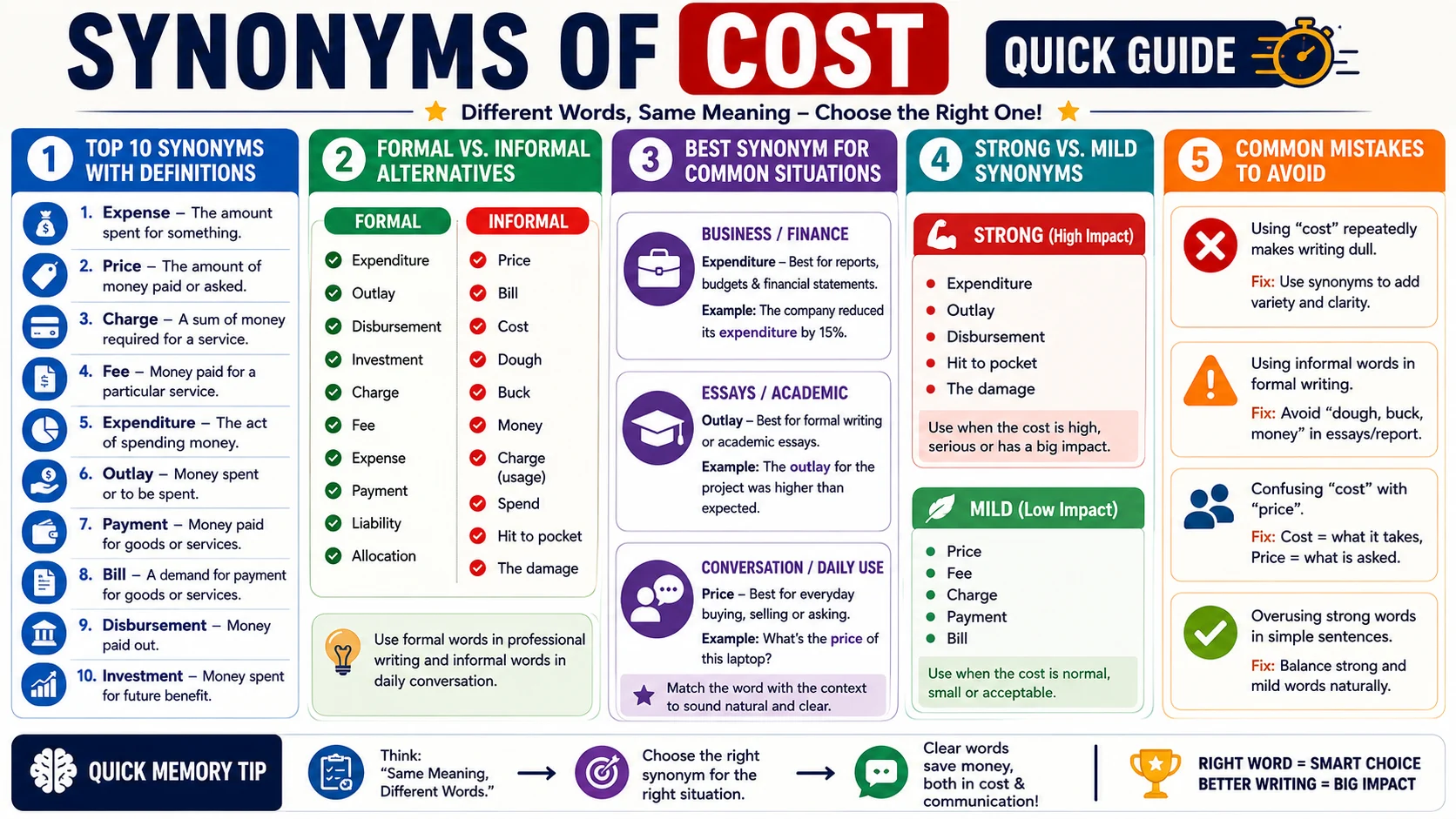
“Cost” means the amount of money, time, or effort needed to buy or do something. The best synonyms are price, expense, charge, fee, and value. “Price” is the most common natural alternative. Each synonym has a slightly different meaning and context where it fits best.
Top 10 Synonyms
- Price
- Expense
- Charge
- Fee
- Value
- Rate
- Payment
- Amount
- Worth
- Expenditure
“Cost” is a word we use every day. We talk about the cost of groceries, the cost of living, and the cost of a new car. But using it too often can make your English feel repetitive.
Think about it. You can talk about the cost of a product, the cost of a service, the cost of time, or the cost of a mistake. Each situation might need a different word that captures the specific type of cost.
In this guide, you’ll learn 35 powerful synonyms for “cost.” You’ll discover exactly when to use each one, how formal they are, and what common mistakes to avoid. Let’s begin!
What Does “Cost” Mean?
Definition
Cost” means the amount of money, time, or effort required to buy, do, or obtain something. It can be financial, like the price of a product. It can also be abstract, like the cost of a mistake in time or effort. Cost is what you give up to get something.
Pronunciation
| Feature | Value |
|---|---|
| US IPA | /kɔst/ |
| UK IPA | /kɒst/ |
| Syllables | 1 |
| Tip | Rhymes with “lost” and “frost” |
Grammar
| Grammar Feature | Information |
|---|---|
| Part of Speech | Noun and Verb |
| Common Position | Subject or object (noun); after subject (verb) |
| Typical Pattern | Cost + of + something / Cost + someone + something |
Examples:
- “The cost of living is high.” (noun)
- “This bag cost me fifty dollars.” (verb)
- “What is the cost of the service?” (noun)
Grammar Note: “Cost” as a verb has an irregular past tense: cost (same form). It also uses the pattern “cost + someone + money.”
Word Family
| Word | Part of Speech | Meaning |
|---|---|---|
| Cost | Noun/Verb | The amount needed to buy or do something |
| Costly | Adjective | Expensive |
| Costing | Gerund | The act of calculating cost |
| Costless | Adjective | Free of cost |
| Cost-effective | Adjective | Good value for money |
15 Synonyms of “Cost”
Price
Meaning: The amount of money you pay to buy something.
Best Used For: Products, services, general purchases.
Formality: Neutral
Tone: Commercial, Direct
Frequency: ⭐⭐⭐⭐⭐ (Very Common)
CEFR Level: A2
Example Sentence 1: “The price of that laptop is too high.”
Example Sentence 2: “We need to check the price before buying.”
Usage Tip: “Price” is the most direct synonym for the financial cost of goods or services.
Common Confusion: Price vs Cost. “Price” is what you pay. “Cost” can include time and effort too.
Expense
Meaning: The money spent on something.
Best Used For: Business, budgets, ongoing costs.
Formality: Formal
Tone: Financial, Budgetary
Frequency: ⭐⭐⭐⭐ (Common)
CEFR Level: B2
Example Sentence 1: “Travel expenses are covered by the company.”
Example Sentence 2: “We need to reduce our monthly expenses.”
Usage Tip: “Expense” is formal and often used in business contexts for regular spending.
Charge
Meaning: The amount of money asked for a service or product.
Best Used For: Services, fees, bills.
Formality: Neutral
Tone: Transactional, Direct
Frequency: ⭐⭐⭐⭐ (Common)
CEFR Level: B1
Example Sentence 1: “There’s a charge for late payments.”
Example Sentence 2: “What is the charge for delivery?”
Usage Tip: “Charge” emphasizes the amount asked for a specific service.
Fee
Meaning: A fixed payment for a service or privilege.
Best Used For: Professional services, memberships, licenses.
Formality: Formal
Tone: Official, Professional
Frequency: ⭐⭐⭐⭐ (Common)
CEFR Level: B2
Example Sentence 1: “There’s a membership fee to join the gym.”
Example Sentence 2: “The lawyer charged a consultation fee.”
Usage Tip: “Fee” is a fixed, often official charge for a specific service.
Value
Meaning: The worth of something in money or importance.
Best Used For: Worth, importance, cost-benefit.
Formality: Neutral
Tone: Worth-based, Important
Frequency: ⭐⭐⭐⭐⭐ (Very Common)
CEFR Level: B1
Example Sentence 1: “The value of this painting is enormous.”
Example Sentence 2: “You get good value for your money.”
Usage Tip: “Value” is about worth, not just price. Use it when discussing cost-effectiveness.
Rate
Meaning: A fixed price charged per unit.
Best Used For: Services, interest, hourly work.
Formality: Formal
Tone: Calculated, Standard
Frequency: ⭐⭐⭐⭐ (Common)
CEFR Level: B2
Example Sentence 1: “The hourly rate is fifty dollars.”
Example Sentence 2: “Interest rates are rising.”
Usage Tip: “Rate” is a fixed charge per unit, like per hour or per item.
Payment
Meaning: The amount of money paid.
Best Used For: Bills, invoices, salaries.
Formality: Neutral
Tone: Financial, Transactional
Frequency: ⭐⭐⭐⭐⭐ (Very Common)
CEFR Level: A2
Example Sentence 1: “The payment is due at the end of the month.”
Example Sentence 2: “We received the payment yesterday.”
Usage Tip: “Payment” focuses on the act of paying or the amount paid.
Amount
Meaning: The total quantity or sum.
Best Used For: General totals, bills.
Formality: Neutral
Tone: Neutral, Factual
Frequency: ⭐⭐⭐⭐⭐ (Very Common)
CEFR Level: A2
Example Sentence 1: “The total amount is fifty dollars.”
Example Sentence 2: “What is the amount due?”
Usage Tip: “Amount” is a general word for a sum. Use it when the exact total is the focus.
Worth
Meaning: The value or importance of something.
Best Used For: Value, importance, cost-benefit.
Formality: Neutral
Tone: Worth-based, Evaluative
Frequency: ⭐⭐⭐⭐ (Common)
CEFR Level: B1
Example Sentence 1: “The worth of the property has increased.”
Example Sentence 2: “What is the worth of this advice?”
Usage Tip: “Worth” is about how valuable something is, not just its price.
Expenditure
Meaning: The total amount of money spent.
Best Used For: Government, business, official contexts.
Formality: Formal
Tone: Official, Budgetary
Frequency: ⭐⭐⭐ (Moderate)
CEFR Level: C1
Example Sentence 1: “Government expenditure on health has increased.”
Example Sentence 2: “We need to track our expenditure.”
Usage Tip: “Expenditure” is a formal word for total spending, often used in official contexts.
Outlay
Meaning: The money spent to start or develop something.
Best Used For: Business, investments, projects.
Formality: Formal
Tone: Investment, Initial
Frequency: ⭐⭐ (Rare)
CEFR Level: C1
Example Sentence 1: “The initial outlay for the project was high.”
Example Sentence 2: “We need to calculate the outlay.”
Usage Tip: “Outlay” is a formal word for initial spending, often in business contexts.
Toll
Meaning: The damage, suffering, or loss caused by something.
Best Used For: Abstract costs, negative consequences.
Formality: Formal
Tone: Negative, Serious
Frequency: ⭐⭐⭐ (Moderate)
CEFR Level: B2
Example Sentence 1: “The accident took a heavy toll on her health.”
Example Sentence 2: “The stress had a toll on his family.”
Usage Tip: “Toll” is abstract. Use it for the cost of negative consequences.
Damage
Meaning: Physical harm or financial loss.
Best Used For: Injury, loss, negative impact.
Formality: Neutral
Tone: Negative, Serious
Frequency: ⭐⭐⭐⭐ (Common)
CEFR Level: B2
Example Sentence 1: “The storm caused millions in damage.”
Example Sentence 2: “The damage to his reputation was severe.”
Usage Tip: “Damage” can be financial or abstract. Use it for loss or harm.
Penalty
Meaning: A cost or punishment for breaking a rule.
Best Used For: Late payments, fines, violations.
Formality: Formal
Tone: Punitive, Serious
Frequency: ⭐⭐⭐ (Moderate)
CEFR Level: B2
Example Sentence 1: “There’s a penalty for late payment.”
Example Sentence 2: “He paid the penalty for his mistake.”
Usage Tip: “Penalty” is a cost as punishment. Use it for consequences of breaking rules.
Market price
Meaning: The current price of something in the market.
Best Used For: Financial markets, products.
Formality: Neutral
Tone: Financial, Current
Frequency: ⭐⭐⭐ (Moderate)
CEFR Level: B2
Example Sentence 1: “The market price of gold has fallen.”
Example Sentence 2: “We need to check the market price.”
Usage Tip: “Market price” is specific to current market conditions.
Synonyms Comparison Table
| Synonym | Best Context | Formality | Tone | Frequency |
|---|---|---|---|---|
| Price | Products, services | Neutral | Commercial | ⭐⭐⭐⭐⭐ |
| Expense | Spending | Formal | Financial | ⭐⭐⭐⭐ |
| Charge | Services | Neutral | Transactional | ⭐⭐⭐⭐ |
| Fee | Professional services | Formal | Official | ⭐⭐⭐⭐ |
| Value | Worth | Neutral | Worth-based | ⭐⭐⭐⭐⭐ |
| Rate | Per unit | Formal | Calculated | ⭐⭐⭐⭐ |
| Payment | Amount paid | Neutral | Financial | ⭐⭐⭐⭐⭐ |
| Amount | Total sum | Neutral | Factual | ⭐⭐⭐⭐⭐ |
| Expenditure | Total spending | Formal | Budgetary | ⭐⭐⭐ |
Best Synonyms by Situation
| Situation | Best Synonym | Why It Works |
|---|---|---|
| Daily Conversation | Price | Natural and common |
| Business Email | Expense | Professional and clear |
| Academic Writing | Expenditure | Formal and precise |
| School Assignment | Cost | Clear and simple |
| Professional Meeting | Expenditure | Sounds professional |
| Presentation | Value | Shows understanding |
| Creative Writing | Toll | Adds literary depth |
| Social Media | Price | Casual and relatable |
| Legal Context | Penalty | Formal and precise |
Formal vs Informal Synonyms
Formal Alternatives
| Synonym | Best Used For |
|---|---|
| Expenditure | Government, business, official contexts |
| Outlay | Initial investments |
| Charge | Professional services |
| Fee | Official payments |
| Penalty | Punitive costs |
Neutral Alternatives
| Synonym | Best Used For |
|---|---|
| Price | Most general situations |
| Expense | Regular spending |
| Payment | Amount paid |
| Amount | Totals |
Informal Alternatives
| Synonym | Best Used For |
|---|---|
| Price | Casual shopping |
| Worth | Value conversations |
Choosing the Right Level: Use “expenditure” and “outlay” for formal writing. Use “price” and “cost” for most situations. Use “price” and “worth” with friends.
Strong vs Mild Synonyms
Mild
Suitable for everyday situations with less intensity.
- Price
- Amount
- Payment
Moderate
More specific or formal alternatives.
- Expense
- Charge
- Fee
- Value
Strong
High-intensity alternatives suggesting serious consequences.
- Toll (negative impact)
- Penalty (punishment)
- Damage (loss)
- Expenditure (large-scale spending)
How Intensity Changes Meaning: “The cost is high” is simple. “The toll on his health was severe” is much more serious. Choose stronger words when you want to emphasize the seriousness of the cost.
Real-Life Examples
School: “The cost of textbooks has increased.”
Office: “We need to reduce our operating expenses.”
Business Email: “Please include the charges in the invoice.”
Meetings: “The expenditure on marketing is too high.”
Presentations: “The value of this investment is clear.”
Daily Conversations: “What’s the price of this coffee?”
Social Media: “The cost of living is getting out of control.”
Academic Writing: “Government expenditure rose significantly.”
Common Collocations
| Common Phrase | Better Alternative |
|---|---|
| Cost of living | Price of living |
| Cost of goods | Price of goods |
| Cost of services | Service charges |
| Cost of production | Production expenses |
| Cost of education | Education fees |
Common Phrases
At any cost: No matter what it takes. (e.g., “She wants to succeed at any cost.”)
Cost an arm and a leg: Very expensive. (e.g., “That car costs an arm and a leg.”)
Count the cost: To consider the risks. (e.g., “Count the cost before you decide.”)
The cost of doing business: The necessary expenses. (e.g., “Taxes are the cost of doing business.”)
Cost-benefit analysis: Weighing costs against benefits. (e.g., “We need a cost-benefit analysis.”)
Context Guide
| Situation | Best Synonym | Reason |
|---|---|---|
| Essay | Expenditure | Academic and formal |
| Speech | Value | Inspiring and clear |
| Business Email | Expense | Professional and clear |
| Novel | Toll | Adds literary depth |
| Presentation | Cost | Clear and effective |
| Conversation | Price | Natural and relatable |
| Academic Writing | Expenditure | Precise and formal |
| Marketing Copy | Value | Attractive and positive |
Related Words
Near Synonyms
- Charge: A fee for service.
- Price: The amount paid.
- Expense: Money spent.
- Fee: A fixed payment.
- Outlay: Initial spending.
Antonyms
- Benefit: A positive gain.
- Reward: Something given for effort.
- Profit: Financial gain.
- Gain: An advantage.
- Return: The benefit from spending.
Related Adjectives
- Costly: Expensive.
- Expensive: High cost.
- Cheap: Low cost.
- Affordable: Not too expensive.
- Valuable: Worth a lot.
Related Nouns
- Cost: The price or sacrifice.
- Expense: Money spent.
- Price: The amount charged.
- Value: The worth.
- Payment: Money paid.
Related Verbs
- Cost: To be worth.
- Spend: To pay money.
- Pay: To give money.
- Charge: To ask for payment.
- Value: To estimate worth.
Frequently Asked Questions
What is another word for cost?
Common synonyms include price, expense, charge, fee, and value. “Price” is the most common and direct alternative.
Which synonym sounds the most professional?
Expenditure and charge sound very professional. “Fee” is also excellent for professional services.
What is the strongest synonym for cost?
Toll is one of the strongest synonyms. It suggests serious negative consequences. “Penalty” is also strong for punitive costs.
Which synonym is best for essays?
Expenditure is the best choice for academic essays. It’s formal and precise.
What’s the difference between cost and price?
“Price” is the amount asked for a product. “Cost” is broader and includes time, effort, and the total sacrifice.
Which synonym is most common in everyday English?
“Price” and “cost” are the most common in everyday speech. “Payment” is also frequently used.
What is the opposite of cost?
Common opposites are benefit, reward, profit, and gain. These words describe positive returns.
Conclusion
“Cost” is a practical word, but now you have 35 fantastic alternatives. Each synonym adds a different shade of meaning to your language.
Remember, the key is understanding the context. Use “price” for product costs. Use “expense” for regular spending. Use “charge” for service fees. Use “toll” for negative consequences.
The best way to improve is practice. Try using one or two new synonyms each day. Listen for these words in conversations and books. Your vocabulary will become richer and more impressive with time.
