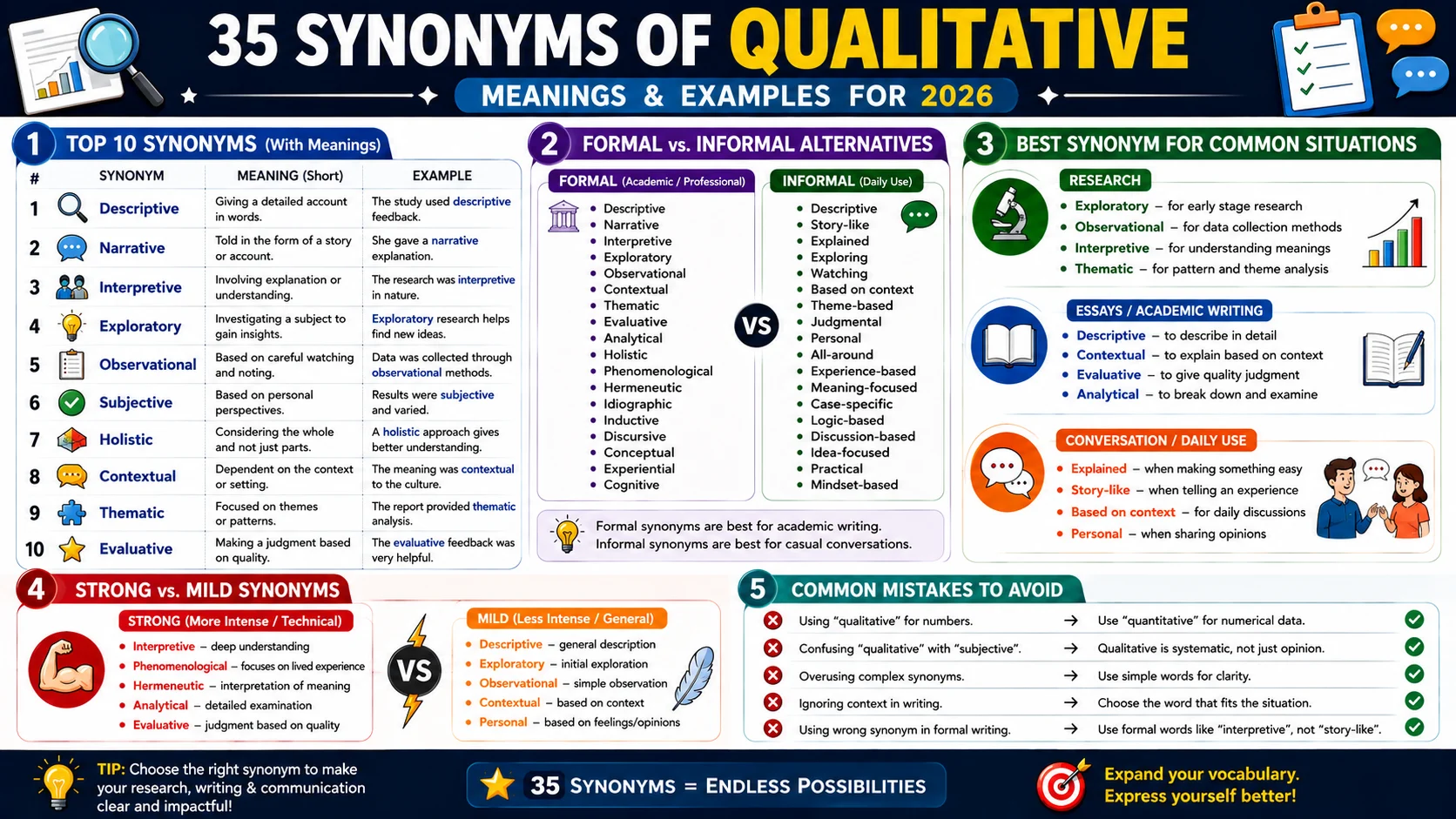
“Qualitative” means relating to the quality or character of something, not the quantity. The best synonyms are descriptive, interpretive, exploratory, subjective, and experiential. “Descriptive” is the most common natural alternative. Each synonym has a slightly different meaning and context where it fits best.
Top 10 Synonyms
- Descriptive
- Interpretive
- Exploratory
- Subjective
- Experiential
- Observational
- Naturalistic
- Ethnographic
- Phenomenological
- Contextual
“Qualitative” is a word we often hear in research, analysis, and everyday discussions. It’s about the quality, nature, and characteristics of things rather than numbers. But using it too often can make your English feel technical and repetitive.
Think about it. You can talk about qualitative research, qualitative data, qualitative analysis, or qualitative differences. Each situation might need a different word that captures the specific type of quality-based understanding.
In this guide, you’ll learn 35 powerful synonyms for “qualitative.” You’ll discover exactly when to use each one, how formal they are, and what common mistakes to avoid. Let’s begin!
What Does “Qualitative” Mean?
Definition
Qualitative” means relating to the quality, nature, or character of something. It focuses on the “what,” “how,” and “why” rather than “how many” or “how much.” When something is qualitative, it’s about understanding experiences, meanings, and qualities.
Pronunciation
| Feature | Value |
|---|---|
| US IPA | /ˈkwɑləˌteɪtɪv/ |
| UK IPA | /ˈkwɒlɪtətɪv/ |
| Syllables | 4 (qual-i-ta-tive) |
| Tip | Stress the first syllable: “KWAL-uh-tay-tiv” |
Grammar
| Grammar Feature | Information |
|---|---|
| Part of Speech | Adjective |
| Common Position | Before a noun or after a linking verb |
| Typical Pattern | Qualitative + noun / Subject + be + qualitative |
Examples:
- “She conducted qualitative research.” (before noun)
- “The analysis was qualitative.” (after verb)
- “We used qualitative methods.” (before noun)
Grammar Note: “Qualitative” is often contrasted with “quantitative,” which deals with numbers.
Word Family
| Word | Part of Speech | Meaning |
|---|---|---|
| Qualitative | Adjective | Relating to quality or character |
| Quality | Noun | A characteristic or feature |
| Qualitatively | Adverb | In a qualitative way |
| Qualitativeness | Noun | The state of being qualitative |
15 Synonyms of “Qualitative”
Descriptive
Meaning: Describing or explaining in detail rather than measuring.
Best Used For: Research, analysis, writing.
Formality: Neutral
Tone: Detailed, Explanatory
Frequency: ⭐⭐⭐⭐⭐ (Very Common)
CEFR Level: B2
Example Sentence 1: “She wrote a descriptive account of her experiences.”
Example Sentence 2: “The research used descriptive methods.”
Usage Tip: “Descriptive” is the most direct synonym. Use it for detailed explanations and observations.
Common Confusion: Descriptive vs Qualitative. “Descriptive” emphasizes describing. “Qualitative” emphasizes quality over quantity.
Interpretive
meaning: Understanding and explaining the meaning of something.
Best Used For: Literature, art, research analysis.
Formality: Formal
Tone: Analytical, Meaning-focused
Frequency: ⭐⭐⭐ (Moderate)
CEFR Level: C1
Example Sentence 1: “She took an interpretive approach to the data.
Example Sentence 2: “The interpretive analysis revealed new insights.”
Usage Tip: “Interpretive” emphasizes finding meaning. Use it for analysis of texts, art, and experiences.
Exploratory
Meaning: Done to discover or learn about something.
Best Used For: Research, investigations, early studies.
Formality: Formal
Tone: Curious, Investigative
Frequency: ⭐⭐⭐ (Moderate)
CEFR Level: B2
Example Sentence 1: “They conducted an exploratory study.”
Example Sentence 2: “The exploratory research asked open-ended questions.”
Usage Tip: “Exploratory” suggests open-ended investigation. Use it for early-stage research.
Subjective
Meaning: Based on personal feelings or opinions, not facts.
Best Used For: Opinions, experiences, interpretations.
Formality: Neutral
Tone: Personal, Opinion-based
Frequency: ⭐⭐⭐⭐ (Common)
CEFR Level: B2
Example Sentence 1: “The analysis was subjective and based on personal experience.”
Example Sentence 2: “Subjective opinions vary from person to person.”
Usage Tip: “Subjective” emphasizes personal perspective. It’s often contrasted with “objective.”
Experiential
Meaning: Based on personal experience and observation.
Best Used For: Learning, knowledge, understanding.
Formality: Formal
Tone: Practical, Experience-based
Frequency: ⭐⭐⭐ (Moderate)
CEFR Level: C1
Example Sentence 1: “The course offers experiential learning opportunities.”
Example Sentence 2: “His knowledge was experiential, not theoretical.”
Usage Tip: “Experiential” emphasizes learning through experience.
Observational
Meaning: Based on watching and noting what happens.
Best Used For: Research, studies, behavior analysis.
Formality: Formal
Tone: Careful, Noting
Frequency: ⭐⭐⭐ (Moderate)
CEFR Level: B2
Example Sentence 1: “The observational study recorded behavior patterns.”
Example Sentence 2: “She used observational methods in her research.”
Usage Tip: “Observational” emphasizes watching and recording without intervention.
Naturalistic
Meaning: Based on observation in natural settings.
Best Used For: Research, behavior studies.
Formality: Formal
Tone: Real-world, Authentic
Frequency: ⭐⭐ (Rare)
CEFR Level: C1
Example Sentence 1: “The naturalistic study observed behavior in the wild.”
Example Sentence 2: “Naturalistic observation provides authentic insights.”
Usage Tip: “Naturalistic” is a formal term for research in real-world settings.
Ethnographic
Meaning: Relating to the study of cultures and people.
Best Used For: Anthropology, sociology, cultural studies.
Formality: Formal
Tone: Cultural, Research-focused
Frequency: ⭐⭐ (Rare)
CEFR Level: C1
Example Sentence 1: “The ethnographic study explored community traditions.”
Example Sentence 2: “Ethnographic research involves long-term observation.”
Usage Tip: “Ethnographic” is a specific academic term for cultural research.
Phenomenological
Meaning: Relating to the study of conscious experience.
Best Used For: Psychology, philosophy, qualitative research.
Formality: Formal
Tone: Philosophical, Experience-focused
Frequency: ⭐ (Very Rare)
CEFR Level: C1
Example Sentence 1: “The phenomenological approach explored lived experiences.”
Example Sentence 2: “Phenomenological research focuses on human perception.”
Usage Tip: “Phenomenological” is a highly specific academic term.
Contextual
Meaning: Considering the context or surrounding circumstances.
Best Used For: Analysis, understanding, interpretation.
Formality: Formal
Tone: Holistic, Situational
Frequency: ⭐⭐⭐ (Moderate)
CEFR Level: B2
Example Sentence 1: “The contextual analysis considered social factors.”
Example Sentence 2: “Contextual understanding is essential for interpretation.”
Usage Tip: “Contextual” emphasizes the importance of context.
Holistic
Meaning: Considering the whole picture rather than parts.
Best Used For: Approaches, perspectives, understanding.
Formality: Formal
Tone: Comprehensive, Whole
Frequency: ⭐⭐⭐ (Moderate)
CEFR Level: C1
Example Sentence 1: “The holistic approach considered all factors.”
Example Sentence 2: “Holistic understanding requires seeing the bigger picture.”
Usage Tip: “Holistic” suggests a complete, whole-picture view.
Introspective
Meaning: Focusing on examining your own thoughts and feelings.
Best Used For: Personal reflection, psychology.
Formality: Formal
Tone: Reflective, Self-examining
Frequency: ⭐⭐⭐ (Moderate)
CEFR Level: C1
Example Sentence 1: “The introspective analysis revealed personal insights.”
Example Sentence 2: “Introspective research explores inner experiences.”
Usage Tip: “Introspective” emphasizes self-reflection and inner experience.
Dialogical
Meaning: Based on dialogue and conversation.
Best Used For: Research, therapy, communication studies.
Formality: Formal
Tone: Conversational, Interactive
Frequency: ⭐ (Very Rare)
CEFR Level: C1
Example Sentence 1: “The dialogical approach involved conversation analysis.”
Example Sentence 2: “Dialogical research explores how meaning is created.
Usage Tip: “Dialogical” is a specialized academic term for conversation-based research.
Anecdotal
Meaning: Based on personal stories rather than facts or research.
Best Used For: Evidence, examples, observations.
Formality: Neutral
Tone: Story-based, Informal
Frequency: ⭐⭐⭐ (Moderate)
CEFR Level: B2
Example Sentence 1: “The evidence was anecdotal, not scientific.”
Example Sentence 2: “Anecdotal accounts provided interesting insights.”
Usage Tip: “Anecdotal” suggests personal stories rather than systematic evidence.
Hermeneutic
Meaning: Relating to the interpretation of texts and meaning.
Best Used For: Philosophy, literature, theology.
Formality: Very Formal
Tone: Interpretive, Philosophical
Frequency: ⭐ (Very Rare)
CEFR Level: C1
Example Sentence 1: “The hermeneutic analysis explored multiple interpretations.”
Example Sentence 2: “Hermeneutic approaches are common in literary studies.”
Usage Tip: “Hermeneutic” is a very specific academic term for textual interpretation.
Synonyms Comparison Table
| Synonym | Best Context | Formality | Tone | Frequency |
|---|---|---|---|---|
| Descriptive | General description | Neutral | Detailed | ⭐⭐⭐⭐⭐ |
| Subjective | Personal views | Neutral | Personal | ⭐⭐⭐⭐ |
| Exploratory | Early research | Formal | Curious | ⭐⭐⭐ |
| Interpretive | Meaning analysis | Formal | Analytical | ⭐⭐⭐ |
| Experiential | Experience-based | Formal | Practical | ⭐⭐⭐ |
| Observational | Watching behavior | Formal | Careful | ⭐⭐⭐ |
| Contextual | Considering context | Formal | Holistic | ⭐⭐⭐ |
| Holistic | Whole picture | Formal | Comprehensive | ⭐⭐⭐ |
| Anecdotal | Personal stories | Neutral | Story-based | ⭐⭐⭐ |
| Naturalistic | Real-world research | Formal | Authentic | ⭐⭐ |
Best Synonyms by Situation
| Situation | Best Synonym | Why It Works |
|---|---|---|
| Daily Conversation | Descriptive | Natural and common |
| Business Email | Descriptive/Subjective | Professional and clear |
| Academic Writing | Interpretive/Exploratory | Formal and precise |
| School Assignment | Descriptive | Clear and simple |
| Professional Meeting | Exploratory | Sounds professional |
| Presentation | Descriptive | Clear and accessible |
| Creative Writing | Experiential | Adds depth |
| Social Media | Subjective | Casual and relatable |
| Research Paper | Qualitative | Formal and correct |
Formal vs Informal Synonyms
Formal Alternatives
| Synonym | Best Used For |
|---|---|
| Interpretive | Academic analysis |
| Exploratory | Early research |
| Naturalistic | Real-world studies |
| Phenomenological | Experience studies |
| Hermeneutic | Textual interpretation |
Neutral Alternatives
| Synonym | Best Used For |
|---|---|
| Descriptive | Most general situations |
| Subjective | Personal perspectives |
| Experiential | Experience-based |
| Observational | Watching behavior |
Informal Alternatives
| Synonym | Best Used For |
|---|---|
| Anecdotal | Personal stories |
| Subjective | Opinions, casual contexts |
| Descriptive | General descriptions |
Choosing the Right Level: Use “interpretive” and “exploratory” for formal writing. Use “descriptive” and “subjective” for most situations.
Strong vs Mild Synonyms
Mild
Suitable for everyday situations with less intensity.
- Descriptive
- Subjective
- Observational
Moderate
More specific or analytical alternatives.
- Interpretive
- Exploratory
- Experiential
- Contextual
Strong
High-intensity alternatives suggesting deep analysis.
- Phenomenological (experience-focused)
- Hermeneutic (interpretive)
- Naturalistic (real-world)
- Ethnographic (cultural)
How Intensity Changes Meaning: “The research was descriptive” is general. “The research was phenomenological” is very specific. Choose stronger words when you want to emphasize depth or specific methodology.
Real-Life Examples
School: “The teacher asked for a qualitative analysis of the poem.”
Office: “We need qualitative feedback from our customers.”
Business Email: “Please provide qualitative data about user experience.”
Meetings: “The exploratory research revealed interesting patterns.”
Presentations: “We used qualitative methods to understand behavior.”
Daily Conversations: “The description was subjective and based on opinions.”
Social Media: “My experience was positive it’s subjective, I know.”
Academic Writing: “The study used interpretive phenomenology as its methodology.”
Common Collocations
| Common Phrase | Better Alternative |
|---|---|
| Qualitative research | Exploratory research |
| Qualitative data | Descriptive data |
| Qualitative analysis | Interpretive analysis |
| Qualitative methods | Observational methods |
| Qualitative study | Naturalistic study |
Common Phrases
The bigger picture: The overall view. (e.g., “Let’s look at the bigger picture.”)
See things through: To understand from a personal perspective. (e.g., “She sees things through a different lens.”)
Way of thinking: A particular perspective. (e.g., “That’s his way of thinking.”)
Perspective shift: A change in viewpoint. (e.g., “The experience caused a perspective shift.”)
Lived experience: Personal experience. (e.g., “We need to consider lived experience.”)
Context Guide
| Situation | Best Synonym | Reason |
|---|---|---|
| Essay | Interpretive | Academic and formal |
| Speech | Descriptive | Clear and accessible |
| Business Email | Subjective | Professional and clear |
| Novel | Experiential | Adds literary depth |
| Presentation | Descriptive | Clear and professional |
| Conversation | Subjective | Natural and relatable |
| Academic Writing | Exploratory | Precise and formal |
| Research Paper | Qualitative | Specific and correct |
Related Words
Near Synonyms
- Qualitative: Quality-focused.
- Descriptive: Detailed explanation.
- Interpretive: Meaning-focused.
- Experiential: Experience-based.
- Subjective: Personal perspective.
Antonyms
- Quantitative: Number-based.
- Objective: Fact-based.
- Measurable: Can be measured.
- Statistical: Data-based.
- Empirical: Evidence-based.
Related Adjectives
- Qualitative: Quality-focused.
- Descriptive: Giving details.
- Analytical: Examining in detail.
- Interpretive: Finding meaning.
- Observational: Watching.
Related Nouns
- Quality: A characteristic.
- Description: A detailed account.
- Interpretation: Understanding meaning.
- Observation: Watching carefully.
- Experience: Personal involvement.
Related Verbs
- Describe: To give details.
- Interpret: To explain meaning.
- Observe: To watch carefully.
- Explore: To investigate.
- Understand: To grasp meaning.
Frequently Asked Questions
What is another word for qualitative?
Common synonyms include descriptive, interpretive, exploratory, subjective, and experiential. “Descriptive” is the most common and direct alternative.
Which synonym sounds the most professional?
Interpretive and exploratory sound very professional. “Naturalistic” is excellent for research contexts.
What is the strongest synonym for qualitative?
Phenomenological and hermeneutic are among the strongest. They suggest deep, philosophical analysis.
Which synonym is best for essays?
Interpretive is the best choice for academic essays. It’s formal and precise.
What’s the difference between qualitative and descriptive?
“Qualitative” is broader and includes interpretation. Descriptive” specifically means giving a detailed account.
Which synonym is most common in everyday English?
“Descriptive” and “subjective” are very common in everyday speech.
What is the opposite of qualitative?
The opposite is quantitative, which deals with numbers and measurement.
Conclusion
“Qualitative” is a valuable academic word, but now you have 35 fantastic alternatives. Each synonym adds a different shade of meaning to your language.
Remember, the key is understanding the context. Use “descriptive” for detailed accounts. Use “interpretive” for meaning-focused analysis. Use “exploratory” for early research. Use “subjective” for personal perspectives.
The best way to improve is practice. Try using one or two new synonyms each day. Listen for these words in conversations and academic contexts. Your vocabulary will become richer and more impressive with time.
