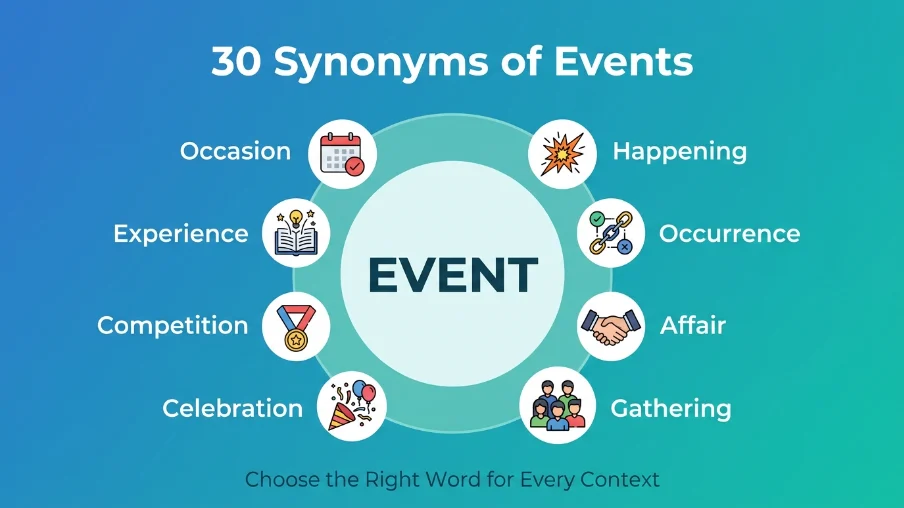
An event is something that happens, especially something important or organized. The best synonyms include occasion, happening, occurrence, affair, function, gathering, incident, episode, celebration, and competition. But each word has a slightly different meaning, tone, or context so choosing the right one depends on what you’re describing.
Looking for the right event synonym? You’re in the right place. The word event is one of the most useful nouns in English. We use it to describe parties, meetings, sports matches, historical moments, academic programs, and everyday happenings. But repeating the same word can make your writing feel flat.
Knowing events synonyms gives you more ways to express the same idea with greater accuracy and style. For example, occasion, gathering, ceremony, happening, and incident can all work as another word for event, but they are not always interchangeable.
So, what does events meaning depend on? Context matters. A formal meeting may be an occasion, while an unexpected situation may be an incident. This guide explains each synonym for event, including useful synonyms for events, common usage differences, and another word for events. You’ll also find the Spanish phrase sinónimo de evento académico for academic contexts. Let’s explore the best choices.
What Does “Event” Mean?
Definition
An event is anything that happens, especially something notable or organized. It can be a planned occasion like a wedding, an unexpected incident like a car crash, or a competition like a sports tournament. In simple terms, if something takes place, it’s an event.
Pronunciation
| Feature | Value |
|---|---|
| US IPA | /ɪˈvɛnt/ |
| UK IPA | /ɪˈvɛnt/ |
| Syllables | 2 (e-vent) |
| Tip | Stress the second syllable: “ee-VENT” |
H3: Grammar
| Grammar Feature | Information |
|---|---|
| Part of Speech | Noun (countable) |
| Common Position | Subject or object of a sentence |
| Typical Pattern | article + event + preposition (of, in, at) |
Example Sentences:
- The concert was the biggest event of the year.
- We’re planning a special event for our anniversary.
- Recent events have changed everything.
Grammar Note: “Event” is a countable noun, so you can say an event or events (plural). You cannot say “an event” for something that isn’t a specific happening.
Word Family
| Word | Part of Speech | Meaning |
|---|---|---|
| Event | Noun | Something that happens |
| Eventful | Adjective | Full of interesting or important events |
| Eventless | Adjective | Without any notable events |
| Eventually | Adverb | In the end; finally |
| Eventuality | Noun | A possible future event |
| Eventing | Noun | A sport involving horse riding competitions |
Note: “Event” can rarely be used as a verb in specialized contexts (e.g., to take part in equestrian eventing), but this is not common in everyday English.
30 Synonyms of “Event”
1. Occasion
Meaning: A special or important time when something happens.
Best Used For: Celebrations, ceremonies, and meaningful moments.
Formality: Neutral
Tone: Positive, respectful
Frequency: ⭐⭐⭐⭐⭐ Very Common
CEFR Level: B1
Example Sentence 1: Graduation is a special occasion for every student.
Example Sentence 2: We only dress up on formal occasions like weddings.
Usage Tip: Use “occasion” when the event has emotional or ceremonial significance. Don’t use it for routine daily events like “eating breakfast.”
2. Happening
Meaning: Something that takes place, often spontaneously or unusually.
Best Used For: Informal conversation, describing unusual or exciting events.
Formality: Informal
Tone: Casual, lively
Frequency: ⭐⭐⭐⭐ Common
CEFR Level: B1
Example Sentence 1: There’s a big happening at the town square this weekend.
Example Sentence 2: The art exhibit was the most exciting happening in the city.
Usage Tip: “Happening” sounds casual and can imply something a bit unexpected or trendy. It’s great for conversation but too informal for academic or business writing.
3. Occurrence
Meaning: Something that happens, especially a regular or everyday event.
Best Used For: Formal writing, reports, describing frequent or predictable events.
Formality: Formal
Tone: Neutral, factual
Frequency: ⭐⭐⭐ Moderate
CEFR Level: B2
Example Sentence 1: Traffic jams are a daily occurrence in this city.
Example Sentence 2: Such occurrences are rare in this region.
Usage Tip: “Occurrence” sounds professional and objective. Use it in formal reports or academic writing. It’s not the best choice for emotional or celebratory events.
4. Affair
Meaning: A matter, event, or situation, often one that is organized or involves multiple people.
Best Used For: Describing organized events, political or social situations.
Formality: Neutral
Tone: Neutral, sometimes formal
Frequency: ⭐⭐⭐⭐ Common
CEFR Level: B2
Example Sentence 1: The government has mishandled the whole affair.
Example Sentence 2: The charity affair raised thousands of dollars.
Usage Tip: “Affair” can mean both a planned event and a complicated situation. Be careful it can also mean a romantic relationship, so context is important.
5. Function
Meaning: A formal social event or gathering.
Best Used For: Professional or formal social events like galas, receptions, and dinners.
Formality: Formal
Tone: Professional, polite
Frequency: ⭐⭐⭐ Moderate
CEFR Level: B2
Example Sentence 1: The company is hosting a function for its top clients.
Example Sentence 2: She attended a formal function at the embassy.
Usage Tip: “Function” is a polished word for a formal event. Use it in professional settings when you want to sound sophisticated.
6. Gathering
Meaning: A meeting of people for a shared purpose.
Best Used For: Informal or semi-formal get-togethers, parties, meetings.
Formality: Neutral
Tone: Warm, social
Frequency: ⭐⭐⭐⭐ Common
CEFR Level: B1
Example Sentence 1: We’re having a small gathering at our house on Saturday.
Example Sentence 2: The gathering brought together people from all over the world.
Usage Tip: “Gathering” emphasizes the people coming together. It works for both casual and formal contexts, but it’s most natural for social occasions.
7. Incident
Meaning: An event, especially one that is unusual, unpleasant, or violent.
Best Used For: News reports, police reports, describing problems or accidents.
Formality: Formal
Tone: Serious, neutral
Frequency: ⭐⭐⭐⭐⭐ Very Common
CEFR Level: B1
Example Sentence 1: The police are investigating the incident.
Example Sentence 2: There was a minor incident at the school today.
Usage Tip: “Incident” usually suggests something negative or problematic. Don’t use it for happy events like weddings or parties.
8. Episode
Meaning: One event in a series of related events.
Best Used For: Stories, narratives, describing a part of a larger sequence.
Formality: Neutral
Tone: Narrative, storytelling
Frequency: ⭐⭐⭐ Moderate
CEFR Level: B2
Example Sentence 1: That was an embarrassing episode in my life.
Example Sentence 2: The book describes an important episode in the country’s history.
Usage Tip: “Episode” implies that the event is part of a bigger story or series. It’s perfect for narratives but less common in everyday conversation about social events.
9. Celebration
Meaning: A joyful event held to mark a special occasion.
Best Used For: Parties, festivals, weddings, birthdays, holidays.
Formality: Neutral
Tone: Positive, festive
Frequency: ⭐⭐⭐⭐⭐ Very Common
CEFR Level: A2
Example Sentence 1: The celebration lasted well into the night.
Example Sentence 2: We’re planning a big celebration for their 25th anniversary.
Usage Tip: “Celebration” is specifically for happy, festive events. Use it when the main purpose is to enjoy and commemorate something positive.
10. Competition
Meaning: An event where people compete against each other.
Best Used For: Sports, contests, tournaments, academic competitions.
Formality: Neutral
Tone: Competitive, exciting
Frequency: ⭐⭐⭐⭐⭐ Very Common
CEFR Level: A2
Example Sentence 1: She won first place in the international competition.
Example Sentence 2: The competition attracted teams from twelve countries.
Usage Tip: Use “competition” when the event involves a contest or rivalry. For non-competitive gatherings, choose a different synonym.
11. Ceremony
Meaning: A formal event with special rituals or traditions.
Best Used For: Weddings, graduations, religious services, award presentations.
Formality: Formal
Tone: Respectful, solemn
Frequency: ⭐⭐⭐⭐ Common
CEFR Level: B1
Example Sentence 1: The graduation ceremony was held in the main hall.
Example Sentence 2: They attended a traditional wedding ceremony.
Usage Tip: “Ceremony” implies formality and ritual. It’s not suitable for casual or spontaneous events.
12. Festival
Meaning: A large public event celebrating culture, music, food, or a specific theme.
Best Used For: Cultural events, music festivals, food fairs, holiday celebrations.
Formality: Neutral
Tone: Festive, lively
Frequency: ⭐⭐⭐⭐ Common
CEFR Level: A2
Example Sentence 1: The city hosts a famous music festival every summer.
Example Sentence 2: We went to a food festival and tried dishes from around the world.
Usage Tip: “Festival” usually means a large, public, multi-day event with entertainment and activities. It’s more specific than “event.”
13. Conference
Meaning: A formal meeting for discussion, often with presentations and multiple speakers.
Best Used For: Professional gatherings, academic meetings, industry events.
Formality: Formal
Tone: Professional, academic
Frequency: ⭐⭐⭐⭐ Common
CEFR Level: B1
Example Sentence 1: She’s speaking at a technology conference next week.
Example Sentence 2: The conference brought together experts from around the world.
Usage Tip: “Conference” is specifically for professional or academic events focused on information sharing. Don’t use it for social parties.
14. Seminar
Meaning: A small, focused educational event with discussion and training.
Best Used For: Workshops, training sessions, academic classes.
Formality: Formal
Tone: Educational, professional
Frequency: ⭐⭐⭐ Moderate
CEFR Level: B1
Example Sentence 1: I attended a seminar on digital marketing.
Example Sentence 2: The professor led a seminar on ancient history.
Usage Tip: “Seminar” emphasizes learning and discussion. It’s smaller and more interactive than a conference.
15. Symposium
Meaning: A formal academic event where experts present papers on a specific topic.
Best Used For: Academic conferences, scholarly gatherings.
Formality: Very Formal
Tone: Academic, intellectual
Frequency: ⭐⭐ Rare
CEFR Level: C1
Example Sentence 1: The symposium featured leading researchers in the field.
Example Sentence 2: She presented her findings at an international symposium.
Usage Tip: “Symposium” is highly formal and academic. Only use it in scholarly contexts.
16. Gala
Meaning: A grand, festive event, often with entertainment and fundraising.
Best Used For: Charity events, formal dinners, award ceremonies.
Formality: Formal
Tone: Elegant, celebratory
Frequency: ⭐⭐ Rare
CEFR Level: B2
Example Sentence 1: The charity gala raised over a million dollars.
Example Sentence 2: She wore a stunning dress to the annual gala.
Usage Tip: “Gala” suggests glamour and formality. It’s a great choice for high-profile, elegant events.
17. Banquet
Meaning: A large formal meal with speeches, often for a special occasion.
Best Used For: Formal dinners, award ceremonies, celebrations.
Formality: Formal
Tone: Elegant, celebratory
Frequency: ⭐⭐ Rare
CEFR Level: B2
Example Sentence 1: The banquet was held in the grand ballroom.
Example Sentence 2: They served a seven-course meal at the wedding banquet.
Usage Tip: “Banquet” focuses on the meal aspect. Use it when the event centers around a formal dinner.
18. Reception
Meaning: A formal social event, often after a wedding or ceremony, with food and drinks.
Best Used For: Weddings, official events, after-parties.
Formality: Formal
Tone: Polite, social
Frequency: ⭐⭐⭐ Moderate
CEFR Level: B1
Example Sentence 1: The wedding reception was held at a beautiful hotel.
Example Sentence 2: We attended a reception at the ambassador’s residence.
Usage Tip: “Reception” often follows a ceremony. It implies a gathering with refreshments and socializing.
19. Exhibition
Meaning: A public display of art, products, or information.
Best Used For: Art shows, trade fairs, museums.
Formality: Neutral
Tone: Cultural, professional
Frequency: ⭐⭐⭐ Moderate
CEFR Level: B1
Example Sentence 1: The exhibition featured works by local artists.
Example Sentence 2: We visited a photography exhibition at the museum.
Usage Tip: “Exhibition” is specifically for displays or showcases. Don’t use it for events without a visual or informational display component.
20. Tournament
Meaning: A competition with multiple matches or rounds.
Best Used For: Sports, games, chess, esports.
Formality: Neutral
Tone: Competitive, exciting
Frequency: ⭐⭐⭐ Moderate
CEFR Level: B1
Example Sentence 1: The tennis tournament attracted players from twenty countries.
Example Sentence 2: They won the championship after a long tournament.
Usage Tip: “Tournament” implies a structured competition with a series of matches leading to a winner.
21. Contest
Meaning: A competition where people try to win.
Best Used For: Talent shows, writing competitions, beauty pageants.
Formality: Neutral
Tone: Competitive, fun
Frequency: ⭐⭐⭐⭐ Common
CEFR Level: B1
Example Sentence 1: She entered a singing contest and won first prize.
Example Sentence 2: The contest was open to all students.
Usage Tip: “Contest” can be used for both serious and fun competitions. It’s slightly more general than “tournament.”
22. Match
Meaning: A sports competition between two individuals or teams.
Best Used For: Sports games, boxing, tennis.
Formality: Neutral
Tone: Competitive
Frequency: ⭐⭐⭐⭐ Common
CEFR Level: A2
Example Sentence 1: The football match ended in a draw.
Example Sentence 2: We watched the tennis match on TV.
Usage Tip: “Match” is specifically for head-to-head sports competitions. Don’t use it for non-sporting events.
23. Performance
Meaning: An event where someone entertains an audience through acting, singing, or dancing.
Best Used For: Concerts, plays, dance shows.
Formality: Neutral
Tone: Artistic, entertaining
Frequency: ⭐⭐⭐⭐ Common
CEFR Level: A2
Example Sentence 1: The performance received a standing ovation.
Example Sentence 2: We’re going to see a performance of Hamlet tonight.
Usage Tip: “Performance” is specifically for artistic or entertainment events. Use it when someone is performing on stage.
24. Concert
Meaning: A musical performance event.
Best Used For: Music events, live bands, orchestras.
Formality: Neutral
Tone: Entertaining, artistic
Frequency: ⭐⭐⭐⭐⭐ Very Common
CEFR Level: A2
Example Sentence 1: We went to a rock concert last night.
Example Sentence 2: The orchestra gave a beautiful concert in the park.
Usage Tip: “Concert” is specifically for music. Don’t use it for non-musical events.
25. Show
Meaning: An entertainment event, often with performances or displays.
Best Used For: Theatrical productions, exhibitions, talent events.
Formality: Informal
Tone: Casual, entertaining
Frequency: ⭐⭐⭐⭐⭐ Very Common
CEFR Level: A2
Example Sentence 1: We saw a fantastic show on Broadway.
Example Sentence 2: The art show attracted hundreds of visitors.
Usage Tip: “Show” is a casual, versatile word. It can refer to performances, exhibitions, or even TV programs. It’s less formal than “performance” or “exhibition.”
26. Experience
Meaning: An event that you personally take part in and remember.
Best Used For: Describing personal, memorable events.
Formality: Neutral
Tone: Personal, reflective
Frequency: ⭐⭐⭐⭐⭐ Very Common
CEFR Level: A2
Example Sentence 1: Traveling to Japan was an unforgettable experience.
Example Sentence 2: The workshop was a valuable learning experience.
Usage Tip: “Experience” emphasizes what the event felt like to you personally. It’s a great choice when you want to focus on the emotional or personal impact.
27. Adventure
Meaning: An exciting or daring event.
Best Used For: Travel, outdoor activities, exciting experiences.
Formality: Informal
Tone: Exciting, positive
Frequency: ⭐⭐⭐⭐ Common
CEFR Level: B1
Example Sentence 1: She set off for a new adventure in South America.
Example Sentence 2: Our hiking trip turned into a real adventure.
Usage Tip: “Adventure” implies excitement, risk, or novelty. Use it for events that are thrilling or out of the ordinary.
28. Spectacle
Meaning: A grand, impressive event that attracts attention.
Best Used For: Parades, fireworks, large performances.
Formality: Neutral
Tone: Impressive, grand
Frequency: ⭐⭐ Rare
CEFR Level: B2
Example Sentence 1: The New Year’s fireworks were a spectacular spectacle.
Example Sentence 2: The opening ceremony was a magnificent spectacle.
Usage Tip: “Spectacle” emphasizes visual impressiveness. Use it for events that are grand and visually stunning.
29. Extravaganza
Meaning: A lavish, elaborate, and spectacular event.
Best Used For: Large productions, festivals, grand shows.
Formality: Informal
Tone: Grand, exciting
Frequency: ⭐ Rare
CEFR Level: C1
Example Sentence 1: The music festival was a three-day extravaganza.
Example Sentence 2: They put on an extravaganza with dancers, singers, and fireworks.
Usage Tip: “Extravaganza” suggests excess and grandeur. Use it sparingly for truly over-the-top events.
30. Milestone
Meaning: An important event marking a significant stage in development.
Best Used For: Personal achievements, career progress, historical moments.
Formality: Neutral
Tone: Significant, positive
Frequency: ⭐⭐⭐ Moderate
CEFR Level: B2
Example Sentence 1: Graduating from university was a major milestone in my life.
Example Sentence 2: The company celebrated its 50th anniversary as a milestone.
Usage Tip: “Milestone” is for events that mark important progress or achievement. It’s not for everyday or routine events.
Synonyms Comparison Table
| Synonym | Best Context | Formality | Tone | Frequency |
|---|---|---|---|---|
| Occasion | Celebrations, ceremonies | Neutral | Positive | ⭐⭐⭐⭐⭐ |
| Happening | Casual, unusual events | Informal | Lively | ⭐⭐⭐⭐ |
| Occurrence | Formal writing, reports | Formal | Neutral | ⭐⭐⭐ |
| Affair | Organized events, situations | Neutral | Neutral | ⭐⭐⭐⭐ |
| Function | Formal social events | Formal | Professional | ⭐⭐⭐ |
| Gathering | Social get-togethers | Neutral | Warm | ⭐⭐⭐⭐ |
| Incident | Negative or unusual events | Formal | Serious | ⭐⭐⭐⭐⭐ |
| Episode | Part of a series | Neutral | Narrative | ⭐⭐⭐ |
| Celebration | Happy, festive events | Neutral | Positive | ⭐⭐⭐⭐⭐ |
| Competition | Sports, contests | Neutral | Competitive | ⭐⭐⭐⭐⭐ |
| Ceremony | Rituals, formal occasions | Formal | Respectful | ⭐⭐⭐⭐ |
| Festival | Cultural, public events | Neutral | Festive | ⭐⭐⭐⭐ |
| Conference | Professional meetings | Formal | Professional | ⭐⭐⭐⭐ |
| Seminar | Educational events | Formal | Educational | ⭐⭐⭐ |
| Symposium | Academic events | Very Formal | Academic | ⭐⭐ |
| Gala | Charity, elegant events | Formal | Elegant | ⭐⭐ |
| Banquet | Formal dinners | Formal | Elegant | ⭐⭐ |
| Reception | Post-ceremony events | Formal | Social | ⭐⭐⭐ |
| Exhibition | Art, trade displays | Neutral | Cultural | ⭐⭐⭐ |
| Tournament | Sports competitions | Neutral | Competitive | ⭐⭐⭐ |
| Match | Sports games | Neutral | Competitive | ⭐⭐⭐⭐ |
| Performance | Artistic events | Neutral | Artistic | ⭐⭐⭐⭐ |
| Concert | Music events | Neutral | Entertaining | ⭐⭐⭐⭐⭐ |
| Show | Entertainment events | Informal | Casual | ⭐⭐⭐⭐⭐ |
| Experience | Personal, memorable events | Neutral | Personal | ⭐⭐⭐⭐⭐ |
| Adventure | Exciting, unusual events | Informal | Exciting | ⭐⭐⭐⭐ |
| Spectacle | Grand, impressive events | Neutral | Grand | ⭐⭐ |
| Extravaganza | Lavish, spectacular events | Informal | Grand | ⭐ |
| Milestone | Important achievements | Neutral | Positive | ⭐⭐⭐ |
Best Synonyms by Situation
| Situation | Best Synonym | Why It Works |
|---|---|---|
| Daily Conversation | Happening, Show | Casual and natural |
| Business Email | Function, Conference | Professional and clear |
| Academic Writing | Occurrence, Symposium | Formal and precise |
| School Assignment | Occasion, Episode | Clear and appropriate |
| Professional Meeting | Conference, Seminar | Formal and focused |
| Presentation | Event, Occurrence | Neutral and clear |
| Creative Writing | Adventure, Spectacle | Evocative and engaging |
| Social Media | Happening, Show | Casual and attention-grabbing |
| Movie Review | Performance, Spectacle | Descriptive and artistic |
| Book Review | Episode, Experience | Narrative and personal |
Formal vs Informal Synonyms
Formal Alternatives
| Synonym | Best Used For |
|---|---|
| Occurrence | Academic papers, reports |
| Symposium | Scholarly gatherings |
| Function | Professional social events |
| Ceremony | Ritual occasions |
| Conference | Professional meetings |
| Incident | Official reports |
| Seminar | Educational sessions |
Neutral Alternatives
| Synonym | Best Used For |
|---|---|
| Event | Almost any context |
| Occasion | Special moments |
| Affair | Organized events |
| Gathering | Social meetings |
| Celebration | Festive events |
| Competition | Contests |
| Exhibition | Displays |
Informal Alternatives
| Synonym | Best Used For |
|---|---|
| Happening | Casual conversation |
| Show | Entertainment events |
| Adventure | Exciting experiences |
| Extravaganza | Grand, over-the-top events |
| Bash | Parties (very informal) |
| Get-together | Small social gatherings |
When to choose each level of formality: Use formal synonyms for academic writing, business reports, and official documents. Choose neutral synonyms for most everyday writing and conversation. Save informal synonyms for casual chats with friends, social media, and creative writing where you want a relaxed tone.
Strong vs Mild Synonyms
Mild
These synonyms are suitable for everyday situations and don’t carry strong emotional weight.
- Occurrence
- Affair
- Gathering
- Function
Moderate
These synonyms are more expressive than the original word and add some emotional or descriptive weight.
- Occasion
- Happening
- Episode
- Celebration
- Competition
- Ceremony
- Festival
- Conference
- Seminar
- Exhibition
- Performance
- Experience
Strong
These are high-intensity alternatives that should be used carefully, as they carry strong emotional or descriptive power.
- Spectacle
- Extravaganza
- Adventure
- Milestone
How intensity changes meaning: Choosing a stronger synonym makes your description more vivid and emotional. For example, calling something a “spectacle” suggests it was impressive and attention-grabbing, while calling it an “occurrence” is neutral and factual. Use strong synonyms when you want to emphasize the impact or significance of the event.
Real-Life Examples
Here’s how native speakers naturally use synonyms for “event” in different contexts:
At School:
“The school’s annual science fair is a major event that everyone looks forward to.”
In the Office:
“We’re organizing a team-building function next Friday. Please RSVP by Wednesday.”
In Business Emails:
“I’d like to invite you to a networking reception following the conference.”
In Meetings:
“Let’s review the schedule of events for the upcoming product launch.”
In Presentations:
“The economic summit was a pivotal event that shaped policy for years to come.”
In Books:
“The protagonist’s journey was marked by a series of extraordinary adventures.”
In Movies:
“The film’s climactic battle scene was a visual spectacle.”
In Daily Conversation:
“There’s a cool happening at the park this weekend food trucks and live music!”
On Social Media:
“Had an amazing time at the music festival yesterday! 🎵”
In Academic Writing:
“The historical occurrence had significant social and economic consequences.”
Common Collocations
| Common Phrase | Better Alternative |
|---|---|
| Big event | Major event, significant occasion |
| Special event | Special occasion, memorable experience |
| Social event | Social gathering, function |
| Sporting event | Sports competition, tournament, match |
| Cultural event | Cultural festival, exhibition |
| Historical event | Historical occurrence, milestone |
| Current events | Current affairs, news |
| Main event | Highlight, centerpiece |
| Whole event | Entire affair, whole experience |
Common Phrases
| PhraseMeaningStronger Synonym | ||
|---|---|---|
| Current events | Recent news and happenings | Current affairs |
| In the event of | If something happens | In case of |
| Event of the year | The most important event | Highlight of the year |
| A turn of events | A change in circumstances | A shift in circumstances |
| Happy event | A joyful occasion (often a birth) | Joyous occasion |
| Blessed event | A baby’s birth (old-fashioned) | New arrival |
Context Guide
| Situation | Best Synonym | Reason |
|---|---|---|
| Essay | Occurrence, Episode | Formal, precise language expected |
| Speech | Occasion, Celebration | Warm, engaging tone |
| Business Email | Function, Conference | Professional and clear |
| Novel | Adventure, Episode | Narrative and descriptive |
| Presentation | Event, Milestone | Clear and impactful |
| Conversation | Happening, Show | Natural and casual |
| Academic Writing | Occurrence, Symposium | Formal and scholarly |
| Marketing Copy | Experience, Spectacle | Emotional and compelling |
Related Words
Near Synonyms
- Phenomenon – A remarkable or unusual event
- Circumstance – A fact or condition connected to an event
- Situation – A set of circumstances at a particular time
- Case – An instance of something happening
Antonyms
- Non-event – An event that is boring or disappointing
- Inaction – Lack of activity or events
- Stagnation – No change or progress
- Routine – Boring, repetitive activities
Related Adjectives
- Eventful – Full of interesting events (We had an eventful day.)
- Eventless – Without any notable events (It was an eventless weekend.)
- Memorable – Worth remembering (A memorable occasion.)
- Unforgettable – Impossible to forget (An unforgettable experience.)
Related Nouns
- Schedule – A plan of events
- Program – A list of events
- Agenda – A list of items to be discussed at an event
- Calendar – A system for organizing events
Related Verbs
- Happen – To take place (What happened?)
- Occur – To happen (The incident occurred at noon.)
- Take place – To happen (The meeting will take place tomorrow.)
- Organize – To plan and arrange an event
Frequently Asked Questions
What is another word for event?
Another word for event is occasion, happening, or occurrence. The best choice depends on the context. For formal writing, use occurrence or affair. For casual conversation, use happening or show. For celebrations, use celebration or festival.
Which synonym sounds the most professional?
Occurrence, function, and conference sound the most professional. Occurrence is great for formal reports and academic writing. Function works well for professional social events. Conference is perfect for business and academic meetings.
What is the strongest synonym for event?
Spectacle and extravaganza are the strongest synonyms. They suggest something grand, impressive, and attention-grabbing. Milestone is also strong when referring to important achievements. Use these sparingly for truly remarkable events.
Which synonym is best for essays?
Occurrence and episode are excellent choices for essays. Occurrence sounds formal and objective, while episode works well when describing events in a narrative or historical sequence. Avoid informal options like happening or show in academic writing.
What’s the difference between event and occasion?
An event is any happening, planned or unplanned. An occasion is a special or significant event, often with emotional or ceremonial importance. For example, a daily commute is an event (it happens), but a wedding is an occasion (it’s special).
What’s the difference between event and incident?
An event is neutral it can be good, bad, or neither. An incident usually suggests something negative, unpleasant, or problematic. For example, a concert is an event, but a car crash is an incident.
Which synonym is most common in everyday English?
Event itself is the most common. After that, occasion, happening, and show are very frequent in everyday conversation. For specific types of events, celebration, competition, concert, and performance are also very common.
What is the opposite of event?
The opposite of an event is a non-event something that is boring, unimportant, or fails to meet expectations. Other opposites include inactivity, stagnation, and routine. These describe a lack of notable happenings.
Conclusion
The word event is incredibly useful, but using the same word repeatedly can make your English sound dull and repetitive. By learning these 30 synonyms, you now have a rich vocabulary to describe any happening from a casual get-together to a grand international conference.
Remember, the best synonym depends on three things: context (where are you writing or speaking?), tone (formal or casual?), and meaning (what kind of event is it?). Use occurrence for formal reports, celebration for happy occasions, incident for problems, and happening for casual conversation.
The key to natural English is variety. Practice using different synonyms in your daily writing and speaking. Over time, you’ll develop an instinct for which word sounds most natural in each situation. Keep learning, keep practicing, and your vocabulary will continue to grow!
