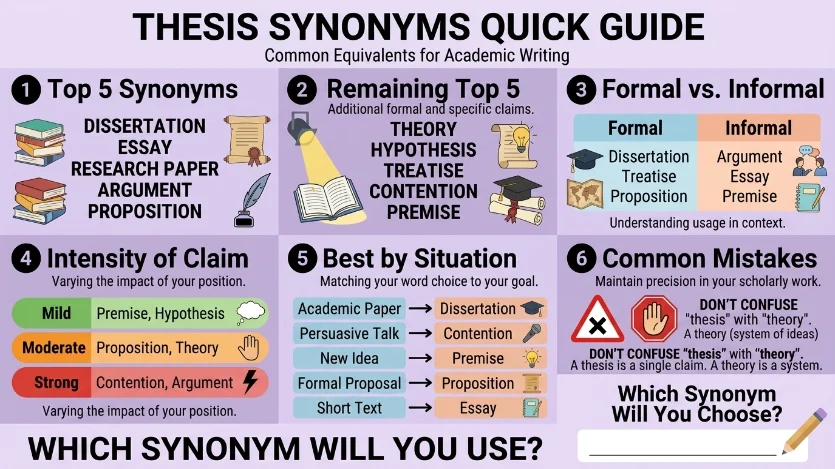
A thesis is a long academic paper or a main idea supported by evidence. The best synonyms are dissertation, argument, proposition, theory, hypothesis, and research paper. Choose based on context: use dissertation for a PhD paper, argument for your main point, and theory for an unproven idea. Each synonym has a slightly different tone and use case.
Have you ever struggled to find the right word instead of “thesis”? Maybe you are writing a paper, preparing a presentation, or simply trying to improve your vocabulary. The word “thesis” can mean different things depending on how you use it. It might be a long university paper, a main argument in an essay, or a central idea you are trying to prove.
Learning synonyms helps you sound more natural and professional in your writing. In this article, you will learn 21 useful alternatives, when to use each one, and common mistakes to avoid. Let’s get started.
What Does “Thesis” Mean?
Definition
A thesis has two main meanings. First, it can mean a long piece of academic writing based on original research, usually written for a university degree. Second, it can mean a main idea or argument that you support with evidence in your writing or speech . In simple terms, a thesis is either your central point or the big paper you write to graduate.
Pronunciation
| Feature | Value |
|---|---|
| US IPA | /ˈθiːsɪs/ |
| UK IPA | /ˈθiːsɪs/ |
| Syllables | 2 |
| Tip | Stress the first syllable: THEE-sis. Say it like “thee” + “sis.” |
Grammar
| Grammar Feature | Information |
|---|---|
| Part of Speech | Noun |
| Singular | thesis |
| Plural | theses |
| Common Position | Subject or object of a sentence |
Example sentences:
- My thesis focuses on climate change policy.
- The professor approved her thesis topic.
- His central thesis is that education reduces poverty.
Grammar note: The plural of thesis is “theses” (pronounced THEE-seez). This is an irregular plural, like “analysis/analyses.”
Word Family
| Word | Part of Speech | Meaning |
|---|---|---|
| Thesis | Noun | A main idea or academic paper |
| Theses | Noun (plural) | More than one thesis |
| Thetic | Adjective | Relating to a proposition |
| Thetical | Adjective | Relating to a thesis or proposition |
21 Synonyms of “Thesis”
1. Dissertation
Meaning: A long academic work written for a PhD or similar advanced degree .
Best Used For: Doctoral research, PhD programs, formal academic writing.
Formality: Formal
Tone: Academic, Professional
Frequency: ⭐⭐⭐⭐⭐ Very Common
CEFR Level: B2
Example Sentence 1: Her dissertation examined the economic impact of immigration policies.
Example Sentence 2: He spent five years completing his dissertation on medieval history.
Usage Tip: Use “dissertation” for a PhD-level work. In the UK and US, “dissertation” is also used for master’s degrees, while “thesis” often refers to PhD work. Always check your university’s preferred term.
2. Argument
Meaning: A reason or set of reasons given to support an idea or action.
Best Used For: Essays, debates, persuasive writing, everyday discussions.
Formality: Neutral
Tone: Logical, Persuasive
Frequency: ⭐⭐⭐⭐⭐ Very Common
CEFR Level: B1
Example Sentence 1: The author’s main argument is that technology harms social connections.
Example Sentence 2: She presented a strong argument for changing the policy.
Usage Tip: Use “argument” when you want to emphasize the logical reasoning behind your main point. Native speakers use this word frequently in academic and daily conversation.
3. Proposition
Meaning: A statement or idea that someone suggests for consideration.
Best Used For: Logical reasoning, formal proposals, philosophical writing.
Formality: Formal
Tone: Neutral, Logical
Frequency: ⭐⭐⭐ Common
CEFR Level: B2
Example Sentence 1: The proposition that all humans are equal is central to democracy.
Example Sentence 2: He put forward a bold proposition about the future of work.
Usage Tip: “Proposition” often suggests something that needs to be proven or tested . It is common in logic, philosophy, and formal writing.
4. Theory
Meaning: A system of ideas intended to explain something, often based on general principles .
Best Used For: Scientific writing, academic papers, explanations of how things work.
Formality: Formal
Tone: Academic, Scientific
Frequency: ⭐⭐⭐⭐⭐ Very Common
CEFR Level: B1
Example Sentence 1: Darwin’s theory of evolution changed biology forever.
Example Sentence 2: Her theory about learning styles has been widely discussed.
Usage Tip: In academic writing, “theory” is used for established explanations supported by evidence . Don’t use it for simple guesses or personal opinions.
5. Hypothesis
Meaning: An idea that is suggested as a possible explanation but has not yet been proven .
Best Used For: Scientific research, experiments, starting points for investigation.
Formality: Formal
Tone: Scientific, Neutral
Frequency: ⭐⭐⭐⭐ Common
CEFR Level: B2
Example Sentence 1: The scientists tested their hypothesis with a series of experiments.
Example Sentence 2: We need to form a clear hypothesis before collecting any data.
Usage Tip: Use “hypothesis” in research settings to describe a testable idea . Unlike “theory,” a hypothesis has not yet been strongly supported by evidence.
6. Research Paper
Meaning: A piece of academic writing based on research and analysis.
Best Used For: Academic assignments, journal articles, university coursework.
Formality: Formal
Tone: Academic, Neutral
Frequency: ⭐⭐⭐⭐⭐ Very Common
CEFR Level: B1
Example Sentence 1: He published a research paper on renewable energy sources.
Example Sentence 2: Students must submit a research paper at the end of the semester.
Usage Tip: “Research paper” is a broader term than “thesis.” It can refer to any academic paper, not just one submitted for a degree.
7. Essay
Meaning: A short piece of writing on a particular subject .
Best Used For: School assignments, college applications, opinion pieces.
Formality: Neutral
Tone: Academic, Personal
Frequency: ⭐⭐⭐⭐⭐ Very Common
CEFR Level: A2
Example Sentence 1: She wrote an essay about her summer vacation.
Example Sentence 2: The final exam requires you to write a 500-word essay.
Usage Tip: “Essay” is usually shorter than a thesis. It is commonly used in schools, universities, and for personal writing.
8. Treatise
Meaning: A formal and detailed written work on a specific subject .
Best Used For: Formal academic writing, historical works, comprehensive explanations.
Formality: Very Formal
Tone: Academic, Scholarly
Frequency: ⭐⭐ Rare
CEFR Level: C1
Example Sentence 1: He wrote a lengthy treatise on political philosophy.
Example Sentence 2: This treatise remains one of the most important works in linguistics.
Usage Tip: “Treatise” sounds quite old-fashioned and formal . Use it in very serious academic contexts only.
9. Contention
Meaning: A point or statement that someone argues strongly .
Best Used For: Debates, persuasive writing, strong arguments.
Formality: Formal
Tone: Strong, Persuasive
Frequency: ⭐⭐⭐ Common
CEFR Level: C1
Example Sentence 1: Her main contention is that the government failed to act quickly.
Example Sentence 2: The author’s contention has been supported by recent studies.
Usage Tip: “Contention” suggests a strong, often debated position. It emphasizes that the idea might be controversial.
10. Monograph
Meaning: A detailed written study of a single specialized subject .
Best Used For: Academic publishing, scholarly research, specialized topics.
Formality: Very Formal
Tone: Academic, Specialized
Frequency: ⭐⭐ Rare
CEFR Level: C1
Example Sentence 1: The professor published a monograph on 19th-century French art.
Example Sentence 2: This monograph is the most comprehensive study on the topic.
Usage Tip: Use “monograph” when referring to a book-length study of one specific subject. It is common in academic publishing.
11. Premise
Meaning: A statement or idea that forms the basis for a theory or argument .
Best Used For: Logical reasoning, philosophy, formal arguments.
Formality: Formal
Tone: Neutral, Logical
Frequency: ⭐⭐⭐⭐ Common
CEFR Level: B2
Example Sentence 1: The basic premise of the book is that people are naturally good.
Example Sentence 2: We disagree on the premise that all problems can be solved by technology.
Usage Tip: “Premise” is the starting point of an argument. If the premise is wrong, the whole argument falls apart .
12. Theory vs. Thesis (Important Distinction)
Many learners confuse these two words.
- Thesis: Your main argument or position in your writing.
- Theory: A broader system of ideas used to explain something.
Think of it this way: your thesis is what YOU argue. A theory is what EXPERTS use to understand the world.
13. Paper
Meaning: A piece of written work or academic article.
Best Used For: School assignments, journal articles, conferences.
Formality: Neutral
Tone: Academic, Neutral
Frequency: ⭐⭐⭐⭐⭐ Very Common
CEFR Level: A2
Example Sentence 1: I need to finish my paper by Friday.
Example Sentence 2: She presented a paper at the international conference.
Usage Tip: “Paper” is a general term that covers many types of written academic work. It is less formal than “dissertation” but widely used.
14. Theme
Meaning: The main subject or idea in a piece of writing, art, or speech .
Best Used For: Literature analysis, art criticism, discussions of ideas.
Formality: Neutral
Tone: Literary, Academic
Frequency: ⭐⭐⭐⭐⭐ Very Common
CEFR Level: B1
Example Sentence 1: Love is the central theme of many Shakespeare plays.
Example Sentence 2: The conference theme is “Sustainable Development.”
Usage Tip: “Theme” is often used in literary analysis and refers to the underlying message or topic, not necessarily an argument that is proven.
15. Topic
Meaning: The subject you are writing or speaking about .
Best Used For: General writing, conversations, choosing subjects to study.
Formality: Neutral
Tone: Neutral
Frequency: ⭐⭐⭐⭐⭐ Very Common
CEFR Level: A2
Example Sentence 1: Her thesis topic was renewable energy.
Example Sentence 2: We need to choose a topic for our presentation.
Usage Tip: “Topic” is the general subject area, while “thesis” is the specific argument or position within that topic.
16. Proposal
Meaning: A suggestion or plan for something to be done .
Best Used For: Business, research grants, planning.
Formality: Formal
Tone: Professional, Neutral
Frequency: ⭐⭐⭐⭐ Common
CEFR Level: B1
Example Sentence 1: She submitted a research proposal to the university.
Example Sentence 2: The government’s proposal was rejected by parliament.
Usage Tip: A proposal suggests what you PLAN to do. A thesis is what you have ALREADY argued or written.
17. View
Meaning: A person’s opinion or way of thinking about something .
Best Used For: Discussions, expressing opinions, informal writing.
Formality: Neutral
Tone: Personal, Neutral
Frequency: ⭐⭐⭐⭐⭐ Very Common
CEFR Level: A2
Example Sentence 1: In my view, education is the most important investment.
Example Sentence 2: The author presents a very different view of history.
Usage Tip: “View” is personal. It is about what one person believes or thinks, not a formal academic argument.
18. Opinion
Meaning: A belief or judgment about something .
Best Used For: Everyday conversations, opinion pieces, expressing personal beliefs.
Formality: Neutral
Tone: Personal, Neutral
Frequency: ⭐⭐⭐⭐⭐ Very Common
CEFR Level: A2
Example Sentence 1: In my opinion, the movie was excellent.
Example Sentence 2: She expressed her opinion about the new policy.
Usage Tip: An opinion doesn’t necessarily need evidence. A thesis should be supported by evidence and reasoning.
19. Idea
Meaning: A thought or suggestion about something .
Best Used For: Brainstorming, creative writing, everyday conversation.
Formality: Neutral
Tone: Casual, Creative
Frequency: ⭐⭐⭐⭐⭐ Very Common
CEFR Level: A1
Example Sentence 1: He had a great idea for the project.
Example Sentence 2: The central idea of the book is freedom.
Usage Tip: “Idea” is the most general word. It is often the starting point before you develop it into a strong thesis.
20. Subject
Meaning: The person or thing that is being discussed or studied .
Best Used For: General writing, choosing what to study.
Formality: Neutral
Tone: Neutral
Frequency: ⭐⭐⭐⭐⭐ Very Common
CEFR Level: A2
Example Sentence 1: The subject of her thesis is modern architecture.
Example Sentence 2: Please write about a subject that interests you.
Usage Tip: Like “topic,” “subject” is broader than “thesis.” It points to the general area of focus.
21. Thesis Statement
Meaning: A sentence that clearly states the main argument of your paper.
Best Used For: Essay writing, academic writing, structuring arguments.
Formality: Formal
Tone: Academic, Clear
Frequency: ⭐⭐⭐⭐⭐ Very Common
CEFR Level: B2
Example Sentence 1: Your thesis statement should be clear and concise.
Example Sentence 2: The professor asked us to highlight our thesis statement in the introduction.
Usage Tip: “Thesis statement” specifically refers to the sentence or two that presents your main argument. Don’t confuse it with the whole paper.
Synonyms Comparison Table
| Synonym | Best Context | Formality | Tone | Frequency |
|---|---|---|---|---|
| Dissertation | PhD research | Formal | Academic | ⭐⭐⭐⭐⭐ |
| Argument | Essays, debates | Neutral | Logical | ⭐⭐⭐⭐⭐ |
| Proposition | Logic, philosophy | Formal | Neutral | ⭐⭐⭐ |
| Theory | Scientific writing | Formal | Academic | ⭐⭐⭐⭐⭐ |
| Hypothesis | Scientific research | Formal | Scientific | ⭐⭐⭐⭐ |
| Research Paper | Academic assignments | Formal | Academic | ⭐⭐⭐⭐⭐ |
| Essay | School assignments | Neutral | Academic | ⭐⭐⭐⭐⭐ |
| Treatise | Formal academic works | Very Formal | Scholarly | ⭐⭐ |
| Contention | Debates, strong arguments | Formal | Persuasive | ⭐⭐⭐ |
| Monograph | Specialized academic studies | Very Formal | Specialized | ⭐⭐ |
| Premise | Logical reasoning | Formal | Logical | ⭐⭐⭐⭐ |
| Paper | General academic writing | Neutral | Academic | ⭐⭐⭐⭐⭐ |
| Theme | Literary analysis | Neutral | Literary | ⭐⭐⭐⭐⭐ |
| Topic | General subjects | Neutral | Neutral | ⭐⭐⭐⭐⭐ |
| Proposal | Business, grants | Formal | Professional | ⭐⭐⭐⭐ |
| View | Personal opinions | Neutral | Personal | ⭐⭐⭐⭐⭐ |
| Opinion | Personal beliefs | Neutral | Personal | ⭐⭐⭐⭐⭐ |
| Idea | Brainstorming, creativity | Neutral | Creative | ⭐⭐⭐⭐⭐ |
| Subject | General studies | Neutral | Neutral | ⭐⭐⭐⭐⭐ |
| Thesis Statement | Essay introductions | Formal | Academic | ⭐⭐⭐⭐⭐ |
Best Synonyms by Situation
| Situation | Best Synonym | Why It Works |
|---|---|---|
| PhD Research | Dissertation | Specifically refers to doctoral work. |
| Essay Writing | Thesis Statement | Defines your main argument clearly. |
| Debates | Contention | Emphasizes strong, supported positions. |
| Scientific Research | Hypothesis | Shows you are testing an idea. |
| Business Proposals | Proposition | Sounds professional and logical. |
| Literary Analysis | Theme | Focuses on underlying messages in art. |
| Everyday Discussion | View or Opinion | Natural, clear, and appropriate for conversation. |
| Presenting Your Main Argument | Argument | Directly conveys your reasoning. |
| General Academic Work | Research Paper | Widely understood and appropriate for most assignments. |
Formal vs Informal Synonyms
Formal Alternatives
| Synonym | Best Used For |
|---|---|
| Dissertation | PhD research |
| Monograph | Specialized academic publishing |
| Treatise | Formal, in-depth scholarly works |
| Contention | Formal debates |
| Proposition | Logical, philosophical writing |
Neutral Alternatives
| Synonym | Best Used For |
|---|---|
| Argument | Essays and everyday reasoning |
| Research Paper | General academic writing |
| Essay | School assignments |
| Paper | Journal articles and conferences |
Informal Alternatives
| Synonym | Best Used For |
|---|---|
| Idea | Brainstorming and conversation |
| View | Sharing opinions casually |
| Opinion | Expressing personal beliefs |
When to Choose Each: Use formal synonyms for academic and professional writing. Use neutral synonyms for most written work. Use informal synonyms for conversations and casual writing.
Strong vs Mild Synonyms
Mild
These are suitable for everyday use:
- View
- Opinion
- Idea
- Topic
Moderate
These are more expressive:
- Argument
- Theme
- Theory
- Proposition
Strong
Use these sparingly in academic contexts:
- Contention
- Dissertation
- Treatise
- Monograph
How Intensity Changes Meaning: Stronger words suggest greater effort, deeper research, and more established ideas. Choose milder words for general conversations and stronger words for serious academic or professional writing.
Real-Life Examples
Here’s how native speakers use synonyms of “thesis” in different contexts:
Context: School Assignment
- “My history essay needs a clear thesis statement.”
Context: Office Meeting
- “The main proposition from the marketing team is to expand our social media presence.”
Context: Academic Writing
- “Her dissertation on climate change won the university’s top award.”
Context: Scientific Journal
- “The researchers tested their hypothesis with a large-scale study.”
Context: Podcast Discussion
- “The author’s central argument is that happiness comes from relationships.”
Context: Social Media
- “What’s your opinion on the new policy?”
Common Collocations
| Common Phrase | Better Alternative |
|---|---|
| Main thesis | Central argument |
| Thesis paper | Dissertation or research paper |
| Write a thesis | Defend a dissertation |
| Thesis idea | Thesis concept or research proposal |
| Thesis subject | Thesis topic |
Common Phrases
| Phrase | Meaning | Better Alternative |
|---|---|---|
| “Just an opinion” | Personal view only | “My view is…” |
| “The main idea” | Central thought | “The central argument” |
| “In theory” | Conceptually | “The hypothesis is…” |
| “Prove a point” | Support an argument | “Support the proposition” |
Context Guide
| Situation | Best Synonym | Reason |
|---|---|---|
| PhD Work | Dissertation | Standard term for doctoral research. |
| Academic Essays | Thesis Statement | Clearly shows your argument. |
| Business Presentations | Proposition | Formal and professional. |
| Scientific Publications | Research Paper | Widely used in journals. |
| Literature Reviews | Theme | Focuses on interpretation. |
| University Assignments | Essay | Standard for undergraduate work. |
| Conference Papers | Paper | Neutral and widely accepted. |
| Grant Applications | Proposal | Focuses on future plans. |
Related Words
Near Synonyms
These words are close to “thesis” but not exact matches:
- Argument – a logical reason or set of reasons
- Theory – a broader explanation
- Hypothesis – an idea to be tested
Antonyms
- Fact
- Proof
- Certainty
- Conclusion
Related Adjectives
- Academic – related to universities and study
- Scholarly – showing serious study
- Argumentative – involving arguments
Related Nouns
- Research
- Study
- Analysis
- Investigation
Related Verbs
- Argue (to present reasons for an idea)
- Propose (to suggest an idea)
- Hypothesize (to suggest a possible explanation)
- Demonstrate (to show evidence for something)
Frequently Asked Questions
1. What is another word for “thesis” in academic writing?
Answer: In academic writing, common synonyms are dissertation, research paper, argument, and proposition. If you are referring to a PhD paper, use dissertation . If you mean your main argument, use argument or contention. Choose based on the specific context of your writing.
2. Which synonym of “thesis” sounds the most professional?
Answer: Dissertation, monograph, and treatise sound the most professional . Dissertation is widely used in academic settings. Monograph and treatise are very formal and best used for serious scholarly works. For business or general professional writing, proposition is an excellent choice.
3. What is the strongest synonym for “thesis”?
Answer: Contention is one of the strongest synonyms . It implies that the idea is strongly argued and potentially controversial. Dissertation is also strong because it represents a significant academic achievement. Choose contention when you want to emphasize the strength of your argument.
4. Which synonym is best for essays?
Answer: For essays, thesis statement, argument, or simply thesis work best . The thesis statement is the single sentence that presents your main point. Argument emphasizes the reasoning behind your essay. Both are appropriate for most essay assignments.
5. What is the difference between “thesis” and “dissertation”?
Answer: In the US, a thesis is often for a master’s degree, while a dissertation is for a PhD . In the UK, the terms are sometimes reversed. However, both describe a long academic paper based on original research. Always check your university’s preferred usage.
6. What is the difference between “thesis” and “hypothesis”?
Answer: A thesis is a statement or argument that you support with evidence. A hypothesis is an idea that is tested through research . A hypothesis often comes before a thesis in the research process. You test the hypothesis, and then you develop a thesis based on your findings.
7. What is the opposite of “thesis”?
Answer: There is no perfect antonym for “thesis” in the sense of a written work. However, in terms of ideas, the opposite of a thesis (main argument) could be fact, proof, or certainty. A thesis is something that needs to be proven, while a fact is already accepted as true.
8. Which synonym is most common in everyday English?
Answer: In everyday English, idea, view, and opinion are most common . People rarely say “thesis” in casual conversation. Instead, they say things like “What’s your opinion?” or “I have an idea.” Save academic synonyms for academic writing.
Conclusion
The word “thesis” has many useful synonyms. The right choice depends on what you mean and who you are talking to. Use dissertation for PhD-level research, argument for your main point, and hypothesis for ideas being tested. For everyday conversation, stick with opinion, view, or idea.
Remember that thesis can refer to either a complete academic paper or your central argument. Understanding this difference will help you choose the best synonym every time. Practice using these synonyms in your own writing. Start by replacing “thesis” with more specific words like dissertation or proposition. Your vocabulary will improve naturally, and your writing will become clearer and more professional.
