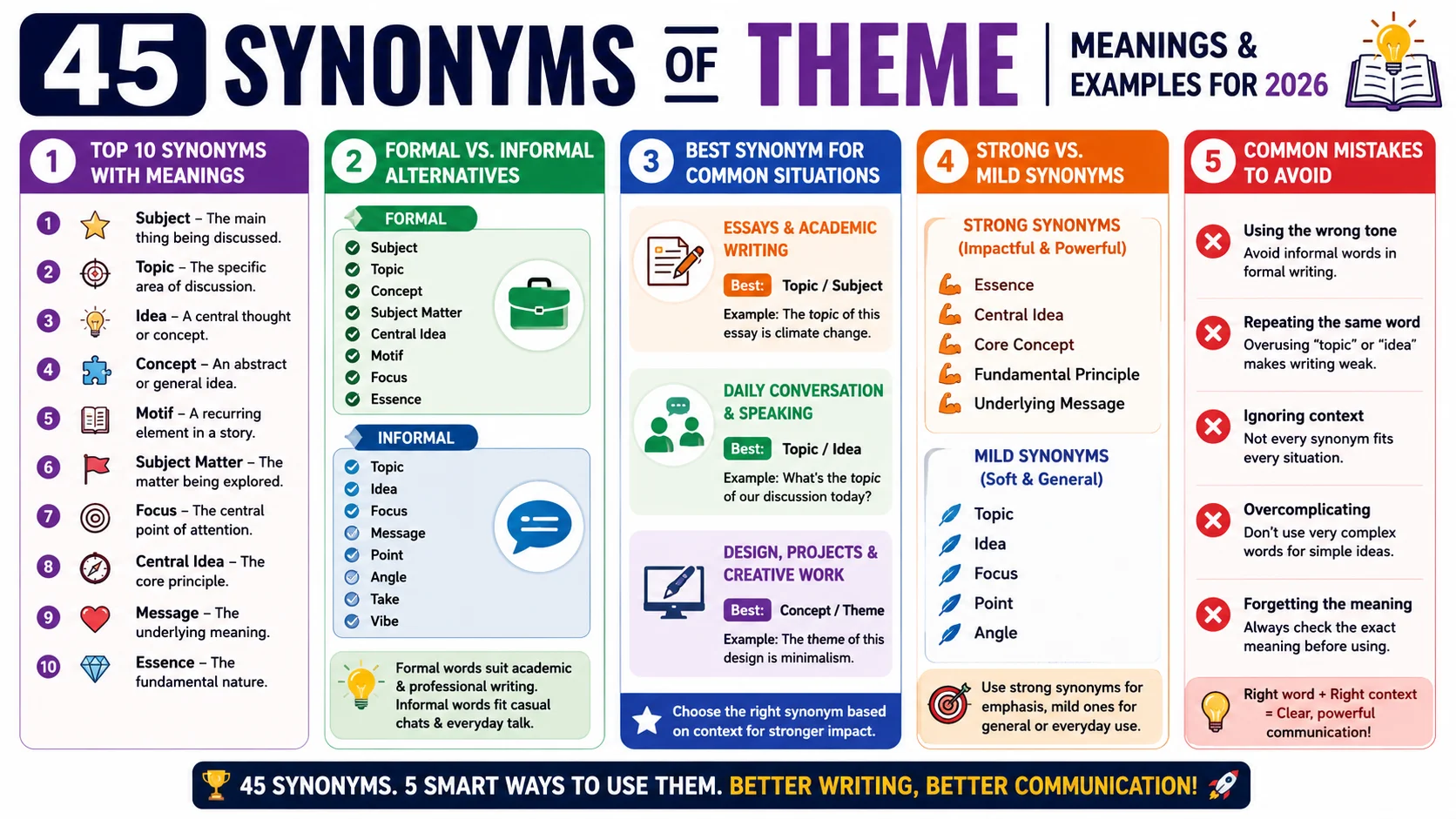
A “theme” is the main idea, subject, or underlying message of something, like a book, movie, or event. The best synonyms are topic, subject, motif, idea, and concept. “Topic” is the most common alternative. Each synonym has a slightly different meaning and context.
Top 10 Synonyms
- Topic
- Subject
- Motif
- Idea
- Concept
- Message
- Thesis
- Argument
- Subject matter
- Point
Ever feel like you keep using the word “theme” again and again? You’re not alone. Finding the right theme synonym can make your writing clearer, sharper, and more natural.
Theme is a common word in English. We use it for books, movies, parties, presentations, websites, and even academic discussions. But the best synonym for theme depends on what you mean. Are you talking about a main idea, a message, a subject, a style, or a design?
In this guide, you’ll discover 35 useful theme synonyms with simple meanings, examples, and usage tips. You’ll also learn another word for theme, the difference between theme synonyms and themes synonyms, and what part of speech is theme.
Whether you’re searching for synonyms of theme, synonyms for themes, or simply another word for themes, this guide will help you choose the right word with confidence.
What Does “Theme” Mean?
Definition
Theme” has two main meanings. First, it means the main subject, idea, or message of a work like a book, movie, or speech. Second, it means a specific style, design, or pattern that repeats in something, like a color scheme or musical melody.
Pronunciation
| Feature | Value |
|---|---|
| US IPA | /θim/ |
| UK IPA | /θiːm/ |
| Syllables | 1 |
| Tip | Say it with the “th” sound like in “thin” |
Grammar
| Grammar Feature | Information |
|---|---|
| Part of Speech | Noun |
| Common Position | Subject or object |
| Typical Pattern | Theme + of + something / about + something |
Examples:
- “The theme of the book is love.”
- “We chose a tropical theme for the party.”
- “The movie explores themes like friendship and courage.”
Grammar Note: “Theme” is countable. You can have one theme or multiple themes in a single work.
Word Family
| Word | Part of Speech | Meaning |
|---|---|---|
| Theme | Noun | The main idea or subject |
| Thematic | Adjective | Relating to a theme |
| Thematically | Adverb | In a way relating to a theme |
15 Synonyms of “Theme”
Topic
Meaning: The subject that you are talking, writing, or learning about.
Best Used For: Conversation, speeches, writing, everyday contexts.
Formality: Neutral
Tone: Direct, Practical
Frequency: ⭐⭐⭐⭐⭐ (Very Common)
CEFR Level: A2
Example Sentence 1: “The topic of our discussion today is climate change.”
Example Sentence 2: “She writes about various topics in her blog.
Usage Tip: “Topic” is the most common and natural alternative. Use it for almost any situation where you’re talking about what something is about.
Common Confusion: Theme vs Topic. A “topic” is the general subject. A “theme” is the deeper message or recurring idea.
Subject
Meaning: The thing that is being discussed, studied, or written about.
Best Used For: Academic writing, formal contexts, classes.
Formality: Neutral
Tone: Academic, Formal
Frequency: ⭐⭐⭐⭐⭐ (Very Common)
CEFR Level: A2
Example Sentence 1: “The subject of her research is endangered species.”
Example Sentence 2: “Physics is his favorite subject at school.”
Usage Tip: “Subject” is very common and neutral. Use it for fields of study or what something is about.
Motif
Meaning: A recurring pattern, idea, or image in a work of art or literature.
Best Used For: Literature, art, design, music.
Formality: Formal
Tone: Artistic, Analytical
Frequency: ⭐⭐⭐ (Moderate)
CEFR Level: B2
Example Sentence 1: “The flower motif appears throughout the painting.”
Example Sentence 2: “The composer used a recurring motif in the symphony.”
Usage Tip: “Motif” is more specific than “theme.” It refers to a repeated pattern or idea in art, design, or music.
Message
Meaning: The main idea or meaning that someone wants to communicate.
Best Used For: Speeches, stories, communications.
Formality: Neutral
Tone: Meaningful, Purposeful
Frequency: ⭐⭐⭐⭐ (Common)
CEFR Level: B1
Example Sentence 1: “The message of the film is about forgiveness.”
Example Sentence 2: “The speech had a powerful message of hope.
Usage Tip: “Message” works well when the theme is something the author or speaker wants to communicate to the audience.
Concept
Meaning: An abstract idea or general notion.
Best Used For: Academic writing, theoretical discussions, business.
Formality: Formal
Tone: Abstract, Intellectual
Frequency: ⭐⭐⭐⭐ (Common)
CEFR Level: B2
Example Sentence 1: “The concept of freedom is central to the story.”
Example Sentence 2: “She explained the concept of renewable energy.”
Usage Tip: “Concept” is an abstract idea. It’s more formal and theoretical than “topic” or “theme.”
Thesis
Meaning: The main argument or idea that someone develops in writing.
Best Used For: Academic writing, essays, arguments.
Formality: Formal
Tone: Academic, Analytical
Frequency: ⭐⭐⭐ (Moderate)
CEFR Level: C1
Example Sentence 1: “The thesis of the book is that education is essential.”
Example Sentence 2: “The author’s thesis challenges common assumptions.”
Usage Tip: “Thesis” is very formal. It’s used in academic writing to describe the main argument or claim.
Subject matter
Meaning: The content or material that is being dealt with.
Best Used For: Formal writing, discussing content.
Formality: Formal
Tone: Direct, Clear
Frequency: ⭐⭐⭐ (Moderate)
CEFR Level: B2
Example Sentence 1: “The subject matter of the book is complex.”
Example Sentence 2: “The course covers a wide range of subject matter.”
Usage Tip: “Subject matter” is a formal way to say “content.” It’s useful when you want to emphasize the material being discussed.
Argument
Meaning: The main idea or line of reasoning in a piece of writing.
Best Used For: Essays, debates, persuasive writing.
Formality: Formal
Tone: Persuasive, Analytical
Frequency: ⭐⭐⭐⭐ (Common)
CEFR Level: B2
Example Sentence 1: “The main argument of the essay is convincing.”
Example Sentence 2: “His argument is that we need to change our approach.”
Usage Tip: “Argument” is used in academic contexts to describe the main point someone is trying to prove.
Idea
Meaning: A thought, plan, or suggestion.
Best Used For: Everyday conversation, brainstorming.
Formality: Neutral
Tone: Creative, Casual
Frequency: ⭐⭐⭐⭐⭐ (Very Common)
CEFR Level: A2
Example Sentence 1: “The central idea of the film is about family.”
Example Sentence 2: “That’s a great idea for the project.”
Usage Tip: “Idea” is a very common alternative. It’s useful when you’re talking about the core thought behind something.
Point
Meaning: The main idea or purpose behind something.
Best Used For: Conversations, speeches, simple explanations.
Formality: Neutral
Tone: Direct, Clear
Frequency: ⭐⭐⭐⭐⭐ (Very Common)
CEFR Level: A2
Example Sentence 1: “What’s the main point of the article?”
Example Sentence 2: “She made some interesting points during the discussion.”
Usage Tip: “Point” is a simple, direct word for the main idea. It’s common in conversation and informal contexts.
Underlying meaning
Meaning: The hidden or deeper meaning beneath the surface.
Best Used For: Literature, analysis, deep conversations.
Formality: Formal
Tone: Analytical, Deep
Frequency: ⭐⭐⭐ (Moderate)
CEFR Level: B2
Example Sentence 1: “The underlying meaning of the poem is about loss.
Example Sentence 2: “His words had an underlying meaning I didn’t understand.
Usage Tip: “Underlying meaning” refers to the hidden, deeper significance of something. It’s great for literary analysis.
Leitmotif
Meaning: A recurring theme in music or literature.
Best Used For: Music, literature, artistic works.
Formality: Formal
Tone: Artistic, Analytical
Frequency: ⭐ (Very Rare)
CEFR Level: C1
Example Sentence 1: “The composer used a leitmotif for the main character.”
Example Sentence 2: “Love is a leitmotif throughout his novels.”
Usage Tip: “Leitmotif” is a very specific formal term from German. It’s used in music and literature to describe recurring themes.
Thread
Meaning: A recurring theme or idea that runs through something.
Best Used For: Stories, conversations, writing.
Formality: Neutral
Tone: Connected, Flowing
Frequency: ⭐⭐⭐ (Moderate)
CEFR Level: B2
Example Sentence 1: “A thread of hope runs through the entire story.
Example Sentence 2: “Several themes are woven together in the narrative.”
Usage Tip: “Thread” is metaphorical. It suggests the theme is like a thread running through a story.
Trend
Meaning: A general direction in which something is developing.
Best Used For: Fashion, design, social changes.
Formality: Neutral
Tone: Modern, Current
Frequency: ⭐⭐⭐⭐ (Common)
CEFR Level: B1
Example Sentence 1: “The theme of sustainability is a growing trend.”
Example Sentence 2: “The design uses current trends in color.”
Usage Tip: “Trend” is more about what’s popular or developing, not the core meaning of a piece of work.
Style
Meaning: A particular way of doing something, often related to design or appearance.
Best Used For: Design, events, fashion.
Formality: Neutral
Tone: Creative, Visual
Frequency: ⭐⭐⭐⭐⭐ (Very Common)
CEFR Level: A2
Example Sentence 1: “The party had a vintage style theme.”
Example Sentence 2: “The restaurant’s style is modern and minimalist.”
Usage Tip: “Style” is used for design and appearance themes, like party decorations or interior design.
Synonyms Comparison Table
| Synonym | Best Context | Formality | Tone | Frequency |
|---|---|---|---|---|
| Topic | General use | Neutral | Direct | ⭐⭐⭐⭐⭐ |
| Subject | Study, discussion | Neutral | Academic | ⭐⭐⭐⭐⭐ |
| Idea | Everyday, creative | Neutral | Casual | ⭐⭐⭐⭐⭐ |
| Point | Conversations | Neutral | Clear | ⭐⭐⭐⭐⭐ |
| Concept | Theoretical | Formal | Abstract | ⭐⭐⭐⭐ |
| Message | Stories, speeches | Neutral | Meaningful | ⭐⭐⭐⭐ |
| Motif | Art, literature | Formal | Artistic | ⭐⭐⭐ |
| Thesis | Academic writing | Formal | Analytical | ⭐⭐⭐ |
| Subject matter | Content discussion | Formal | Direct | ⭐⭐⭐ |
Best Synonyms by Situation
| Situation | Best Synonym | Why It Works |
|---|---|---|
| Daily Conversation | Topic / Point | Natural and simple |
| Business Email | Concept / Idea | Professional and clear |
| Academic Writing | Thesis / Subject | Formal and precise |
| School Assignment | Subject / Topic | Shows understanding |
| Professional Meeting | Topic / Idea | Clear and focused |
| Presentation | Message / Idea | Engaging and purposeful |
| Creative Writing | Motif / Thread | Literary and artistic |
| Social Media | Topic / Idea | Casual and engaging |
| Literature Review | Motif / Underlying meaning | Analytical and deep |
Formal vs Informal Synonyms
Formal Alternatives
| Synonym | Best Used For |
|---|---|
| Thesis | Academic essays, dissertations |
| Concept | Theoretical discussions, business |
| Motif | Literary and artistic analysis |
| Subject matter | Formal content description |
| Underlying meaning | Deep analysis |
Neutral Alternatives
| Synonym | Best Used For |
|---|---|
| Topic | Most general situations |
| Subject | Study, discussion |
| Idea | Creative thinking, planning |
| Point | Conversation, speaking |
| Message | Communication, stories |
Informal Alternatives
| Synonym | Best Used For |
|---|---|
| Point | Casual conversation |
| Idea | Brainstorming, everyday chat |
| Style | Design, fashion, events |
Choosing the Right Level: In academic writing, use “thesis” or “concept.” In professional contexts, use “topic” or “message.” In casual conversation, “point” and “idea” are most natural.
Strong vs Mild Synonyms
Mild
Suitable for everyday situations.
- Topic
- Subject
- Point
- Style
Moderate
More specific or analytical alternatives.
- Idea
- Message
- Concept
- Thread
Strong
High-intensity, formal, or deep alternatives.
- Thesis (strong academic argument)
- Motif (strong literary analysis)
- Underlying meaning (deep analysis)
- Leitmotif (very formal, artistic)
How Intensity Changes Meaning: “The topic of the story” is simple. “The underlying meaning of the story” suggests deeper analysis. Choose stronger words when you want to show deeper understanding.
Real-Life Examples
School: “The topic of the essay is climate change.”
Office: “We need to discuss the main points of the presentation.”
Business Email: “The concept behind the strategy is simple.”
Meetings: “The theme of this quarter is growth.”
Presentations: “The main message I want to convey is about innovation.”
Daily Conversations: “What’s the point of the movie?”
Social Media: “The theme of this post is self-care.”
Academic Writing: “The thesis of the study is that education matters.”
Common Collocations
| Common Phrase | Better Alternative |
|---|---|
| Main theme | Central idea / Core message |
| Common theme | Recurring motif / Frequent topic |
| Underlying theme | Underlying meaning |
| Party theme | Party theme / Event style |
| Theme song | Theme song / Signature melody |
Common Phrases
Theme park: A park designed around a theme. (e.g., “We visited a theme park in Florida.”)
Theme and variations: A musical form. (e.g., “The composer used theme and variations.”)
Central theme: The most important theme. (e.g., “Love is the central theme.”)
Common theme: A theme that appears often. (e.g., “A common theme in literature is good vs. evil.”)
Thematic elements: Parts related to the theme. (e.g., “The film uses thematic elements to tell its story.”)
Context Guide
| Situation | Best Synonym | Reason |
|---|---|---|
| Essay | Thesis / Subject | Formal and academic |
| Speech | Message / Point | Clear and engaging |
| Business Email | Concept / Idea | Professional and direct |
| Novel | Motif / Thread | Literary and artistic |
| Presentation | Message / Idea | Engaging and purposeful |
| Conversation | Topic / Point | Natural and casual |
| Academic Writing | Thesis / Concept | Formal and precise |
| Marketing Copy | Message / Theme | Connected and clear |
Related Words
Near Synonyms
- Topic: The general subject.
- Subject: What is being discussed.
- Motif: A recurring element.
- Leitmotif: A recurring theme in music.
- Subject matter: The content.
Antonyms
- Irrelevance: Not related to the theme.
- Tangential: Only slightly related.
- Digression: Moving away from the theme.
- Nonissue: Something not important.
Related Adjectives
- Thematic: Relating to a theme.
- Topical: Related to a topic.
- Relevant: Closely connected.
- Central: Most important.
- Recurring: Happening repeatedly.
Related Nouns
- Subject: The topic being discussed.
- Topic: The general theme.
- Motif: Recurring element.
- Message: The intended meaning.
Related Verbs
- Theme: To create or arrange around a theme.
- Focus on: To center on.
- Center on: To have as the main subject.
- Revolve around: To have as the central theme.
Frequently Asked Questions
What is another word for theme?
Common synonyms include topic, subject, motif, idea, concept, and message. “Topic” is the most common and versatile alternative.
Which synonym sounds the most professional?
“Concept” and “thesis” sound the most professional. “Subject matter” is also excellent for formal writing.
What is the strongest synonym for theme?
“Thesis” is one of the strongest, especially in academic contexts. “Motif” is strong for literary and artistic analysis.
Which synonym is best for essays?
“Thesis” and “subject” are excellent for essays. “Concept” is also good for analytical writing.
What’s the difference between theme and topic?
A “topic” is the general subject being discussed. A “theme” is the deeper message, recurring idea, or underlying meaning.
Which synonym is most common in everyday English?
“Topic” and “point” are the most common alternatives in everyday conversation.
What is the opposite of theme?
Common opposites include irrelevance and digression. These words describe things that are not related to the main theme.
Conclusion
“Theme” is a valuable word, but now you have 35 powerful alternatives to choose from. Each synonym adds its own special meaning and nuance to your language.
The key is understanding the context. Use “topic” and “point” for everyday conversations. Use “motif” and “message” for literary analysis. Use “thesis” and “concept” for academic writing. Use “style” for design and events.
The best way to improve is to practice. Try using one or two new synonyms each day. Pay attention to how native speakers use these words in books, conversations, and online content. Your vocabulary will become richer and more impressive with time.
