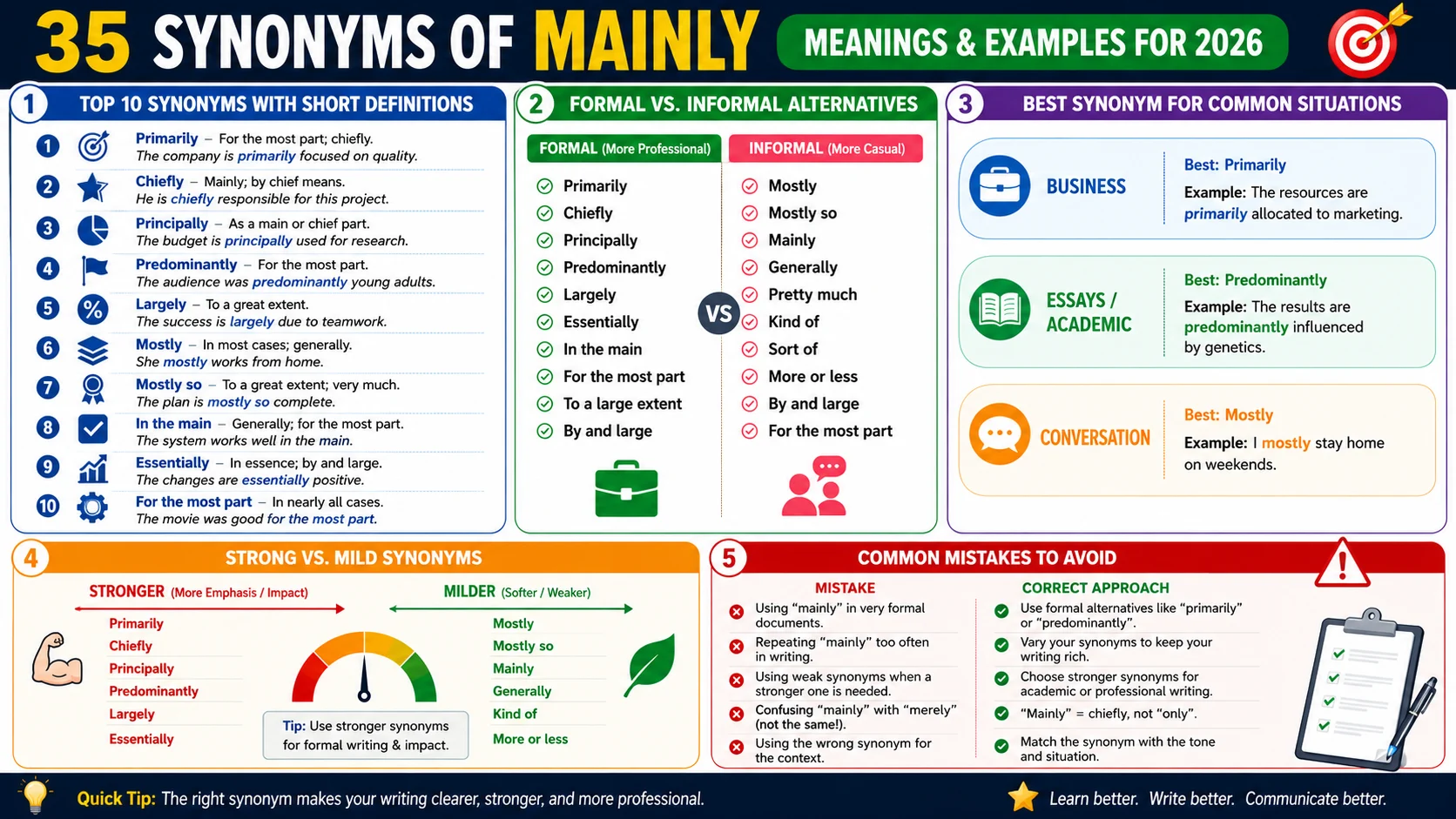
“Mainly” means mostly, primarily, or for the most part. The best synonyms are primarily, mostly, chiefly, predominantly, and principally. “Primarily” is the most common professional alternative. Each synonym has a slightly different meaning and context where it fits best.
Top 10 Synonyms
- Primarily
- Mostly
- Chiefly
- Predominantly
- Principally
- Largely
- Generally
- Essentially
- Above all
- For the most part
“Mainly” is a word we use all the time. It’s a great way to say something is the most important part or happens most often. But using it too much can make your English feel repetitive.
Think about it. You can say something is mainly about education, mainly about money, or mainly about relationships. Each situation might need a different word that captures the specific emphasis.
In this guide, you’ll learn 35 powerful synonyms for “mainly.” You’ll discover exactly when to use each one, how formal they are, and what common mistakes to avoid. Let’s begin!
What Does “Mainly” Mean?
Definition
Mainly” means for the most part, mostly, or primarily. It tells you what the main focus or biggest part of something is. When you say something is mainly about a topic, you mean that’s the most important or largest part.
Pronunciation
| Feature | Value |
|---|---|
| US IPA | /ˈmeɪnli/ |
| UK IPA | /ˈmeɪnli/ |
| Syllables | 2 (main-ly) |
| Tip | Stress the first syllable: “MAIN-lee” |
Grammar
| Grammar Feature | Information |
|---|---|
| Part of Speech | Adverb |
| Common Position | Before the main verb or at the start of a sentence |
| Typical Pattern | Mainly + verb / Mainly + adjective |
Examples:
- “The course is mainly about grammar.” (before adjective)
- “She mainly works from home.” (before verb)
- “Mainly, I want to help people.” (start of sentence)
Grammar Note: “Mainly” is an adverb that modifies verbs, adjectives, or entire sentences. It’s used to express the primary focus or biggest part of something.
Word Family
| Word | Part of Speech | Meaning |
|---|---|---|
| Main | Adjective/Noun | The most important part |
| Mainly | Adverb | For the most part |
| Mainstay | Noun | A chief support |
| Mainstream | Noun/Adjective | The dominant trend |
15 Synonyms of “Mainly”
Primarily
Meaning: For the most part; mainly or first.
Best Used For: Formal writing, business, academic contexts.
Formality: Formal
Tone: Professional, Precise
Frequency: ⭐⭐⭐⭐⭐ (Very Common)
CEFR Level: B2
Example Sentence 1: “The course is primarily designed for beginners.”
Example Sentence 2: “She is primarily responsible for the project.”
Usage Tip: “Primarily” is the most professional synonym. Use it in business and academic writing for a formal tone.
Common Confusion: Primarily vs Mainly. “Primarily” often suggests first importance or first in order. “Mainly” is slightly more casual.
Mostly
Meaning: For the greatest part; mainly.
Best Used For: Everyday conversation, casual writing.
Formality: Informal
Tone: Casual, Natural
Frequency: ⭐⭐⭐⭐⭐ (Very Common)
CEFR Level: A2
Example Sentence 1: “The audience was mostly students.”
Example Sentence 2: “I mostly work from home now.”
Usage Tip: “Mostly” is the most common and natural synonym in everyday speech. Use it for casual situations.
Chiefly
Meaning: Mainly; above all.
Best Used For: Formal writing, academic contexts.
Formality: Formal
Tone: Intellectual, Precise
Frequency: ⭐⭐⭐ (Moderate)
CEFR Level: C1
Example Sentence 1: “The book is chiefly concerned with politics.”
Example Sentence 2: “His success was chiefly due to hard work.
Usage Tip: “Chiefly” is a formal word that sounds intellectual. Use it in academic or formal writing.
Predominantly
Meaning: Mainly; for the most part; most noticeably.
Best Used For: Data, statistics, formal writing.
Formality: Formal
Tone: Analytical, Precise
Frequency: ⭐⭐⭐ (Moderate)
CEFR Level: C1
Example Sentence 1: “The city is predominantly Muslim.”
Example Sentence 2: “The students are predominantly female.”
Usage Tip: “Predominantly” is great for statistical or demographic descriptions. Use it in formal contexts.
Principally
Meaning: For the most part; especially.
Best Used For: Formal writing, academic contexts, legal writing.
Formality: Formal
Tone: Professional, Precise
Frequency: ⭐⭐⭐ (Moderate)
CEFR Level: C1
Example Sentence 1: “The fund is principally for education.”
Example Sentence 2: “The report is principally concerned with finances.
Usage Tip: “Principally” is a formal synonym. Use it in legal, academic, or professional writing.
Largely
Meaning: To a great extent; mainly.
Best Used For: General writing, describing proportions.
Formality: Neutral
Tone: Factual, Descriptive
Frequency: ⭐⭐⭐⭐ (Common)
CEFR Level: B2
Example Sentence 1: “The success of the project was largely due to her work.”
Example Sentence 2: “The city is largely dependent on tourism.”
Usage Tip: “Largely” is a great neutral alternative. It works in both formal and informal contexts.
Generally
Meaning: In most cases; usually.
Best Used For: General statements, describing trends.
Formality: Neutral
Tone: Broad, Descriptive
Frequency: ⭐⭐⭐⭐⭐ (Very Common)
CEFR Level: B1
Example Sentence 1: “Generally speaking, the weather is warm here.”
Example Sentence 2: “She is generally very calm.”
Usage Tip: “Generally” is about what happens most of the time. Use it for broad statements.
Essentially
Meaning: Basically; fundamentally.
Best Used For: Explaining the core of something.
Formality: Formal
Tone: Core, Fundamental
Frequency: ⭐⭐⭐⭐ (Common)
CEFR Level: B2
Example Sentence 1: “The course is essentially about writing skills.”
Example Sentence 2: “The issue is essentially a lack of communication.”
Usage Tip: “Essentially” is used to get to the heart of something. Use it for core meanings.
Above all
Meaning: Most importantly; chiefly.
Best Used For: Emphasizing the most important point.
Formality: Neutral
Tone: Emphatic, Clear
Frequency: ⭐⭐⭐ (Moderate)
CEFR Level: B2
Example Sentence 1: “We need, above all, to stay calm.
Example Sentence 2: “Above all, she wants to help others.”
Usage Tip: “Above all” emphasizes the most important thing. It’s great for adding emphasis.
For the most part
Meaning: Mostly; usually.
Best Used For: General statements, casual contexts.
Formality: Informal
Tone: Casual, General
Frequency: ⭐⭐⭐ (Moderate)
CEFR Level: B2
Example Sentence 1: “For the most part, the students were happy.”
Example Sentence 2: “The movie was, for the most part, entertaining.”
Usage Tip: “For the most part” is a conversational phrase. Use it in everyday English.
In the main
Meaning: For the most part; mainly.
Best Used For: Formal writing, literary contexts.
Formality: Formal
Tone: Literary, Traditional
Frequency: ⭐⭐ (Rare)
CEFR Level: C1
Example Sentence 1: “In the main, the reviews were positive.”
Example Sentence 2: “In the main, the policy was successful.”
Usage Tip: “In the main” is a formal, somewhat old-fashioned phrase. Use it in literary or formal writing.
On the whole
Meaning: Considering everything; generally.
Best Used For: Summarizing, general conclusions.
Formality: Neutral
Tone: General, Balanced
Frequency: ⭐⭐⭐ (Moderate)
CEFR Level: B2
Example Sentence 1: “On the whole, the conference was successful.”
Example Sentence 2: “On the whole, I think we did well.”
Usage Tip: “On the whole” suggests you’re looking at the big picture. Use it for overall assessments.
As a rule
Meaning: Usually; generally.
Best Used For: General rules, typical situations.
Formality: Neutral
Tone: General, Typical
Frequency: ⭐⭐⭐ (Moderate)
CEFR Level: B2
Example Sentence 1: “As a rule, we don’t work on weekends.”
Example Sentence 2: “As a rule, she arrives early.”
Usage Tip: “As a rule” is used for what usually happens. It’s a great formal-sounding phrase.
At heart
Meaning: Basically; fundamentally.
Best Used For: Describing someone’s true nature.
Formality: Informal
Tone: Personal, Emotional
Frequency: ⭐⭐⭐ (Moderate)
CEFR Level: B2
Example Sentence 1: “At heart, she is a kind person.”
Example Sentence 2: “He is, at heart, a teacher.”
Usage Tip: “At heart” is used to describe someone’s true character. Use it for personal descriptions.
To a large extent
Meaning: Mostly; largely.
Best Used For: Formal writing, describing degree.
Formality: Formal
Tone: Precise, Measured
Frequency: ⭐⭐⭐ (Moderate)
CEFR Level: C1
Example Sentence 1: “The project’s success is due to a large extent to her work.”
Example Sentence 2: “To a large extent, the problem has been solved.”
Usage Tip: “To a large extent” is a formal way to say “mostly.” Use it in academic or professional writing.
Synonyms Comparison Table
| Synonym | Best Context | Formality | Tone | Frequency |
|---|---|---|---|---|
| Mostly | Everyday speech | Informal | Casual | ⭐⭐⭐⭐⭐ |
| Primarily | Professional | Formal | Professional | ⭐⭐⭐⭐⭐ |
| Generally | General statements | Neutral | Broad | ⭐⭐⭐⭐⭐ |
| Largely | Proportions | Neutral | Factual | ⭐⭐⭐⭐ |
| Essentially | Core meaning | Formal | Fundamental | ⭐⭐⭐⭐ |
| Chiefly | Academic | Formal | Intellectual | ⭐⭐⭐ |
| Predominantly | Statistics | Formal | Analytical | ⭐⭐⭐ |
| Principally | Legal, academic | Formal | Precise | ⭐⭐⭐ |
| On the whole | Summarizing | Neutral | Balanced | ⭐⭐⭐ |
| For the most part | Casual conversation | Informal | Casual | ⭐⭐⭐ |
Best Synonyms by Situation
| Situation | Best Synonym | Why It Works |
|---|---|---|
| Daily Conversation | Mostly | Natural and common |
| Business Email | Primarily | Professional and clear |
| Academic Writing | Chiefly | Formal and precise |
| School Assignment | Largely | Clear and appropriate |
| Professional Meeting | Primarily | Sounds professional |
| Presentation | Primarily | Clear and professional |
| Creative Writing | Chiefly | Adds literary depth |
| Social Media | Mostly | Casual and relatable |
| Data Analysis | Predominantly | Precise and analytical |
Formal vs Informal Synonyms
Formal Alternatives
| Synonym | Best Used For |
|---|---|
| Primarily | Professional contexts |
| Chiefly | Academic writing |
| Principally | Legal, official contexts |
| Predominantly | Data, statistics |
| Essentially | Core explanations |
Neutral Alternatives
| Synonym | Best Used For |
|---|---|
| Generally | Most situations |
| Largely | Proportions |
| On the whole | Summarizing |
| To a large extent | Degree |
Informal Alternatives
| Synonym | Best Used For |
|---|---|
| Mostly | Everyday conversation |
| For the most part | Casual contexts |
| At heart | Personal descriptions |
Choosing the Right Level: Use “primarily” and “chiefly” for formal writing. Use “generally” and “largely” for most situations. Use “mostly” for everyday conversation.
Strong vs Mild Synonyms
Mild
Suitable for everyday situations with less intensity.
- Mostly
- Generally
- For the most part
Moderate
More specific or precise alternatives.
- Primarily
- Largely
- Principally
- On the whole
Strong
High-intensity alternatives suggesting strong emphasis.
- Chiefly (above all)
- Predominantly (most noticeably)
- Essentially (fundamentally)
- Above all (most importantly)
How Intensity Changes Meaning: “It’s mostly about money” is mild. “It’s essentially about money” is stronger. Choose stronger words when you want to emphasize the core importance.
Real-Life Examples
School: “The exam is mainly about grammar and vocabulary.”
Office: “She is primarily responsible for marketing.”
Business Email: “The proposal is chiefly concerned with cost savings.”
Meetings: “The discussion will largely focus on the budget.”
Presentations: “The market is predominantly young adults.”
Daily Conversations: “I mostly eat healthy food.”
Social Media: “My diet is mostly plant-based.”
Academic Writing: “The study is principally concerned with language acquisition.”
Common Collocations
| Common Phrase | Better Alternative |
|---|---|
| Mainly about | Primarily about |
| Mainly due to | Largely due to |
| Mainly focused | Chiefly focused |
| Mainly concerned | Principally concerned |
| Mainly composed | Predominantly composed |
Common Phrases
Above all else: More than anything. (e.g., “Above all else, stay safe.”)
In the main: For the most part. (e.g., “In the main, the plan worked.”)
By and large: Generally speaking. (e.g., “By and large, people are good.”)
For the most part: Mostly. (e.g., “For the most part, I agree.”)
On balance: Considering everything. (e.g., “On balance, it was a good year.”)
Context Guide
| Situation | Best Synonym | Reason |
|---|---|---|
| Essay | Chiefly | Academic and formal |
| Speech | Primarily | Professional and clear |
| Business Email | Primarily | Professional and precise |
| Novel | Chiefly | Literary and sophisticated |
| Presentation | Primarily | Clear and professional |
| Conversation | Mostly | Natural and relatable |
| Academic Writing | Principally | Precise and formal |
| Marketing Copy | Primarily | Clear and professional |
Related Words
Near Synonyms
- Chiefly: Mainly.
- Predominantly: Mostly.
- Principally: Mainly.
- Essentially: Basically.
- Broadly: Generally.
Antonyms
- Minorly: In a minor way.
- Secondarily: In a secondary way.
- Incidentally: By the way.
- Marginally: To a small extent.
- Slightly: A little bit.
Related Adjectives
- Primary: Main or first.
- Chief: Most important.
- Principal: Main.
- Dominant: Most important.
Related Nouns
- Main: The most important part.
- Focus: The main point.
- Core: The central part.
- Essence: The basic nature.
Related Verbs
- Focus: To concentrate on.
- Emphasize: To stress.
- Center: To have as the main point.
- Revolve around: To have as the main focus.
Frequently Asked Questions
What is another word for mainly?
Common synonyms include primarily, mostly, chiefly, predominantly, and principally. “Primarily” is the most professional alternative.
Which synonym sounds the most professional?
Primarily and chiefly sound the most professional. “Principally” is also excellent for formal contexts.
What is the strongest synonym for mainly?
Chiefly is one of the strongest synonyms. It suggests above all else. “Essentially” is also strong, suggesting fundamental importance.
Which synonym is best for essays?
Chiefly is the best choice for academic essays. It’s formal and precise. “Principally” is also excellent.
What’s the difference between mainly and primarily?
“Primarily” often suggests first importance or first in order. “Mainly” is more casual and general. Both mean mostly, but “primarily” is more formal.
Which synonym is most common in everyday English?
“Mostly” is the most common in everyday speech. “Generally” is also very common.
What is the opposite of mainly?
Common opposites are minorly, secondarily, and incidentally. These words describe things that are less important.
Conclusion
“Mainly” is a useful word, but now you have 35 fantastic alternatives. Each synonym adds a different shade of meaning to your language.
Remember, the key is understanding the context. Use “mostly” for casual conversation. Use “primarily” for professional contexts. Use “chiefly” for formal writing. Use “predominantly” for statistics and data.
The best way to improve is practice. Try using one or two new synonyms each day. Listen for these words in conversations and books. Your vocabulary will become richer and more impressive with time.
