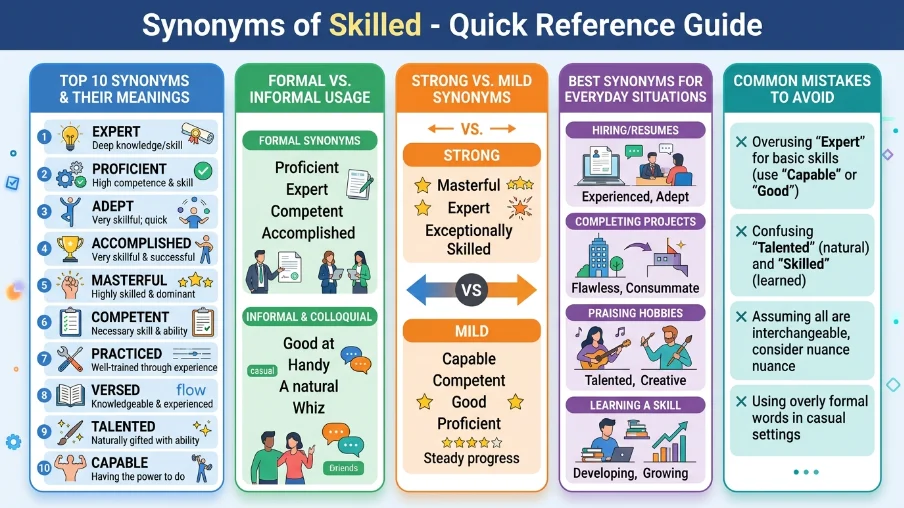
Skilled means having the ability, knowledge, and experience to do something well. The best synonyms are expert, proficient, competent, talented, and adept. “Expert” is the most common and natural in everyday English. Each synonym has a slightly different meaning, tone, and context where it fits best.
Top 10 Synonyms
- Expert
- Proficient
- Competent
- Talented
- Adept
- Accomplished
- Capable
- Masterful
- Qualified
- Skilful
Do you ever feel like you keep using the same word to describe someone’s abilities? Many English learners struggle with this. The word “skilled” is useful, but using it too often can make your speaking and writing feel boring and repetitive.
Learning different ways to say “skilled” helps you express yourself more clearly. It also makes your English sound more natural and impressive. Whether you are writing a job application, describing a colleague, or talking about your own abilities, having the right word can make all the difference.
In this guide, you will learn 30 powerful synonyms. You will also discover when to use each one, how formal they are, and common mistakes to avoid. Let’s get started!
What Does “Skilled” Mean?
Definition
Skilled means having the training, knowledge, and experience to do a particular job or activity well. It is about being good at something because you have learned how to do it. A skilled worker, for example, has practiced and developed their abilities over time.
Pronunciation
| Feature | Value |
|---|---|
| US IPA | /skɪld/ |
| UK IPA | /skɪld/ |
| Syllables | 1 |
| Tip | Say it like “skild” with a short ‘i’ sound, similar to “built.” |
Grammar
| Grammar Feature | Information |
|---|---|
| Part of Speech | Adjective |
| Common Position | Before a noun or after a linking verb |
| Typical Pattern | Skilled + at/in + noun/gerund |
Examples:
- “She is a skilled surgeon.” (before a noun)
- “He is very skilled at playing the piano.” (after a verb, with ‘at’)
- “They are skilled in negotiation.” (after a verb, with ‘in’)
Note: Use “skilled at” for specific actions and “skilled in” for broader areas. Both are common and acceptable.
Word Family
| Word | Part of Speech | Meaning |
|---|---|---|
| Skill | Noun | The ability to do something well |
| Skilled | Adjective | Having skill or ability |
| Skilful | Adjective | Done with skill (UK spelling) |
| Skillful | Adjective | Done with skill (US spelling) |
| Skillfully | Adverb | In a skilled way |
10–15 Synonyms of “Skilled”
Expert
Meaning: Someone who has a very high level of knowledge or skill in a specific area, often from years of experience.
Best Used For: Professional settings, resumes, describing someone with deep knowledge.
Formality: Neutral
Tone: Professional, Respectful
Frequency: ⭐⭐⭐⭐⭐ (Very Common)
CEFR Level: B1
Example Sentence 1: “She is an expert in digital marketing.”
Example Sentence 2: “His expert advice helped us avoid a major problem.”
Usage Tip: “Expert” is a strong word. Use it for people who truly have deep knowledge, not just basic ability. It suggests years of experience or study.
Proficient
Meaning: Being very good at something because you have practiced and trained. It is a step above just being “good.”
Best Used For: Business writing, job applications, describing professional skills.
Formality: Formal
Tone: Professional, Objective
Frequency: ⭐⭐⭐⭐ (Common)
CEFR Level: B2
Example Sentence 1: “She is proficient in three languages.
Example Sentence 2: “The team is proficient at using the new software.”
Usage Tip: “Proficient” is a safe and professional choice for work and academic contexts. It implies a high level of ability that comes from practice. It’s often used with “in” or “at.”
Competent
Meaning: Having enough skill or knowledge to do something well, but not necessarily exceptional.
Best Used For: Job applications, formal evaluations, describing someone who can do the job.
Formality: Formal
Tone: Professional, Neutral
Frequency: ⭐⭐⭐⭐ (Common)
CEFR Level: B1
Example Sentence 1: “He is a competent manager who gets results.
Example Sentence 2: “She is competent in all areas of accounting.
Usage Tip: “Competent” means someone can do a job well, but it doesn’t mean they are the best. It’s a reliable, neutral word for professional settings.
Talented
Meaning: Having a natural ability to do something well, often without much training.
Best Used For: Describing artists, musicians, athletes, and creative people.
Formality: Neutral
Tone: Positive, Appreciative
Frequency: ⭐⭐⭐⭐⭐ (Very Common)
CEFR Level: B1
Example Sentence 1: “She is a talented singer with a beautiful voice.”
Example Sentence 2: “He is naturally talented at drawing.”
Usage Tip: “Talented” suggests a gift or natural ability. It’s often used for creative and artistic skills. It doesn’t always mean someone has been formally trained.
Adept
Meaning: Very skilled or proficient at something. It suggests natural ability combined with learning.
Best Used For: Formal writing, professional contexts, describing specific expertise.
Formality: Formal
Tone: Professional, Impressive
Frequency: ⭐⭐⭐ (Moderate)
CEFR Level: B2
Example Sentence 1: “She is adept at navigating complex negotiations.
Example Sentence 2: “He is adept in the use of social media for marketing.”
Usage Tip: “Adept” is a formal synonym that means “very good at.” It is often used with “at” and suggests both natural talent and learned skill. It sounds impressive and professional.
Accomplished
Meaning: Highly skilled and successful, usually because of years of hard work and achievement.
Best Used For: Formal writing, bios, resumes, describing someone with a proven record.
Formality: Formal
Tone: Respectful, Impressive
Frequency: ⭐⭐⭐ (Moderate)
CEFR Level: B2
Example Sentence 1: “She is an accomplished pianist with international awards.”
Example Sentence 2: “The author is an accomplished writer with many published books.
Usage Tip: “Accomplished” implies both skill and success. Use it for people who have achieved significant things in their field. It is always a compliment.
Capable
Meaning: Having the ability, skill, or strength to do something.
Best Used For: General use, describing reliability, job applications.
Formality: Neutral
Tone: Practical, Reliable
Frequency: ⭐⭐⭐⭐⭐ (Very Common)
CEFR Level: B1
Example Sentence 1: “She is a capable leader who handles pressure well.”
Example Sentence 2: “He is capable of managing the project on his own.”
Usage Tip: “Capable” is a safe and useful word. It means someone can do the job, but it doesn’t necessarily mean they are exceptional. It is often used with “of.”
Masterful
Meaning: Done with great skill and authority, like a master. It implies being in complete control.
Best Used For: Describing a performance, artistic work, or someone with total control.
Formality: Formal
Tone: Impressive, Strong
Frequency: ⭐⭐⭐ (Moderate)
CEFR Level: B2
Example Sentence 1: “Her masterful performance captivated the audience.”
Example Sentence 2: “He gave a masterful presentation that convinced everyone.”
Usage Tip: “Masterful” is a strong word that suggests someone is in complete command of their skill. It is often used for performances and presentations. It can also mean being controlling in a negative way, so use with care.
Qualified
Meaning: Having the necessary training, education, or experience to do a job.
Best Used For: Job applications, professional contexts, formal writing.
Formality: Formal
Tone: Professional, Objective
Frequency: ⭐⭐⭐⭐ (Common)
CEFR Level: B1
Example Sentence 1: “She is highly qualified for the position.”
Example Sentence 2: “He is a qualified engineer with ten years of experience.”
Usage Tip: “Qualified” focuses on meeting the formal requirements for a job or task. It’s about having the right certificates, education, or experience.
Skilful
Meaning: Done with skill or expertise. It’s the British spelling of “skillful.”
Best Used For: British English writing, describing actions done with skill.
Formality: Neutral
Tone: Professional, Objective
Frequency: ⭐⭐⭐⭐ (Common in UK)
CEFR Level: B1
Example Sentence 1: “He made a skilful pass that set up the goal.”
Example Sentence 2: “Her skilful handling of the situation impressed everyone.
Usage Tip: “Skilful” (with one ‘l’) is the British spelling. “Skillful” (with two ‘l’s) is the American spelling. Both are correct. It emphasizes the quality of the action or skill.
Versatile
Meaning: Skilled at many different things and able to adapt to various tasks.
Best Used For: Describing people who can do many things, job applications.
Formality: Neutral
Tone: Positive, Modern
Frequency: ⭐⭐⭐⭐ (Common)
CEFR Level: B2
Example Sentence 1: “She is a versatile employee who can work in any department.”
Example Sentence 2: “He is a versatile actor who can play any role.”
Usage Tip: “Versatile” is a very positive word that means someone can do a wide range of things well. It is especially useful in today’s job market.
Synonyms Comparison Table
| Synonym | Best Context | Formality | Tone | Frequency |
|---|---|---|---|---|
| Expert | Professional | Neutral | Respectful | ⭐⭐⭐⭐⭐ |
| Proficient | Business | Formal | Professional | ⭐⭐⭐⭐ |
| Competent | Job Applications | Formal | Professional | ⭐⭐⭐⭐ |
| Talented | Creative Fields | Neutral | Positive | ⭐⭐⭐⭐⭐ |
| Adept | Formal Writing | Formal | Impressive | ⭐⭐⭐ |
| Accomplished | Formal Bios | Formal | Respectful | ⭐⭐⭐ |
| Capable | General Use | Neutral | Practical | ⭐⭐⭐⭐⭐ |
| Masterful | Performances | Formal | Impressive | ⭐⭐⭐ |
| Qualified | Job Contexts | Formal | Professional | ⭐⭐⭐⭐ |
| Skilful | UK English | Neutral | Professional | ⭐⭐⭐⭐ |
Best Synonyms by Situation
| Situation | Best Synonym | Why It Works |
|---|---|---|
| Daily Conversation | Talented | It is natural and positive. |
| Business Email | Proficient | It sounds professional and clear. |
| Academic Writing | Expert | It shows a high level of knowledge. |
| School Assignment | Capable | It is clear and appropriate for any context. |
| Professional Meeting | Competent | It is safe and professional. |
| Presentation | Masterful | It suggests a powerful and impressive delivery. |
| Creative Writing | Talented | It fits arts and creative contexts perfectly. |
| Social Media | Talented | It is engaging and positive. |
| Movie Review | Accomplished | It suggests a skilled director or actor. |
| Book Review | Accomplished | It works well for describing a skilled author. |
Formal vs Informal Synonyms
Formal Alternatives
| Synonym | Best Used For |
|---|---|
| Proficient | Business and professional writing |
| Competent | Formal evaluations and job applications |
| Adept | Very formal contexts and impressive descriptions |
| Accomplished | Resumes and professional bios |
Neutral Alternatives
| Synonym | Best Used For |
|---|---|
| Expert | Most situations, formal or informal |
| Capable | General everyday use |
| Talented | Describing people’s natural abilities |
| Versatile | Modern workplace and everyday contexts |
Informal Alternatives
| Synonym | Best Used For |
|---|---|
| Skilful (UK) | Natural everyday language |
| Good at | Casual conversation, very common and simple |
Choosing the Right Level: Use “proficient” and “competent” in formal writing like job applications. Use “talented” and “capable” in conversation. “Expert” works in almost any situation.
Strong vs Mild Synonyms
Mild
Suitable for everyday situations where you don’t need to overstate someone’s ability.
- Capable
- Competent
- Qualified
Moderate
More expressive than the original word and good for most contexts.
- Proficient
- Talented
- Skilful
- Versatile
Strong
High-intensity alternatives that should be used carefully.
- Expert
- Masterful
- Accomplished
- Adept
How Intensity Changes Meaning: Using a strong word like “expert” or “masterful” says someone is among the best. Using a mild word like “capable” simply says they can do the job. Choose the word that matches the level of ability you want to express.
Real-Life Examples
School: “The students became competent in basic math skills.”
Office: “We need a proficient programmer for this project.”
Business Email: “She is highly qualified for the marketing manager position.”
Meetings: “His adept handling of the client’s concerns was impressive.”
Presentations: “The CEO gave a masterful presentation to the investors.”
Books: “The author is an accomplished writer with a dedicated fan base.”
Movies: “The director is known for his expert storytelling.”
Daily Conversations: “My sister is so talented at painting.”
Social Media: “Follow this incredibly talented artist!”
Academic Writing: “The expert analysis provided a new perspective.”
Common Collocations
| Common Phrase | Better Alternative |
|---|---|
| Skilled worker | Proficient employee |
| Very skilled | Expert / Accomplished |
| Skilled at | Proficient in / Adept at |
| Good at | Skilful at |
Common Phrases
Skilled in the art of: Means someone is very good at a specific skill. (e.g., “He is skilled in the art of negotiation.”)
A skilled pair of hands: Means someone is very good at practical or craft work. (e.g., “We need a skilled pair of hands to fix this.”)
Skilled at multitasking: Means someone can do many things at once.
Context Guide
| Situation | Best Synonym | Reason |
|---|---|---|
| Essay | Expert | It conveys a high level of authority. |
| Speech | Masterful | It suggests a powerful, confident performance. |
| Business Email | Proficient | It sounds professional and clear. |
| Novel | Accomplished | It shows the author’s skill and success. |
| Presentation | Masterful | It describes a confident and skilled delivery. |
| Conversation | Talented | It is natural and positive for everyday talk. |
| Academic Writing | Expert | It shows deep knowledge and authority. |
| Marketing Copy | Versatile | It highlights a broad range of abilities. |
Related Words
Near Synonyms
- Able: Having the power or skill to do something.
- Gifted: Having a natural talent or ability.
- Virtuoso: Exceptionally skilled in a particular art or field.
Antonyms
- Incompetent: Lacking the necessary skill to do something.
- Unskilled: Not having any special skill or training.
- Inexperienced: Lacking the practice or knowledge.
Related Adjectives
- Trained: Having learned skills through practice or study.
- Qualified: Having the formal requirements for a job.
- Experienced: Having knowledge from doing something many times.
Related Nouns
- Skill: The ability to do something well.
- Expertise: A high level of skill or knowledge.
- Proficiency: A good level of skill.
Related Verbs
- Master: To become highly skilled at something.
- Learn: To gain knowledge or skill.
- Practice: To do something regularly to improve.
Frequently Asked Questions
What is another word for skilled?
Common synonyms are expert, proficient, competent, talented, adept, capable, and accomplished. The best choice depends on the context and the level of skill you want to describe.
Which synonym sounds the most professional?
Proficient and competent are the most professional choices. They are safe, formal, and clearly show that someone can do a job well. They are perfect for resumes and business writing.
What is the strongest synonym for skilled?
Expert and masterful are among the strongest. “Expert” suggests a very high level of knowledge, while “masterful” suggests complete control and authority over a skill or performance.
Which synonym is best for a job application?
Proficient and qualified are the best for job applications. “Proficient” shows you have the skill, and “qualified” shows you have the formal requirements. Both are professional and clear.
What’s the difference between skilled and talented?
Skilled means you have learned to do something well. Talented means you have a natural ability to do something well. You can be talented without being skilled, and vice versa.
Which synonym is most common in everyday English?
Expert, talented, and capable are the most common in everyday speech. They are simple, positive, and everyone understands them. “Talented” is especially popular for describing creative ability.
What is the opposite of skilled?
Incompetent is the most direct opposite. Other opposites include unskilled, inexperienced, and incapable. These words mean someone lacks the ability or training to do something well.
Conclusion
Understanding the different ways to say “skilled” can transform your English. It helps you be more precise and makes your language more interesting. The key is to remember that no two words are exactly the same.
As we’ve seen, “expert” is for deep knowledge, “proficient” is for professional ability, “talented” is for natural gifts, and “competent” is for reliable performance. The best word depends on the person, the skill, and the situation.
Here is your takeaway: stop using “skilled” for everything. Start with one new word today. Try saying “expert” or “proficient” in your next email. Use “talented” to compliment a friend. With a little practice, these synonyms will become a natural part of your vocabulary.
