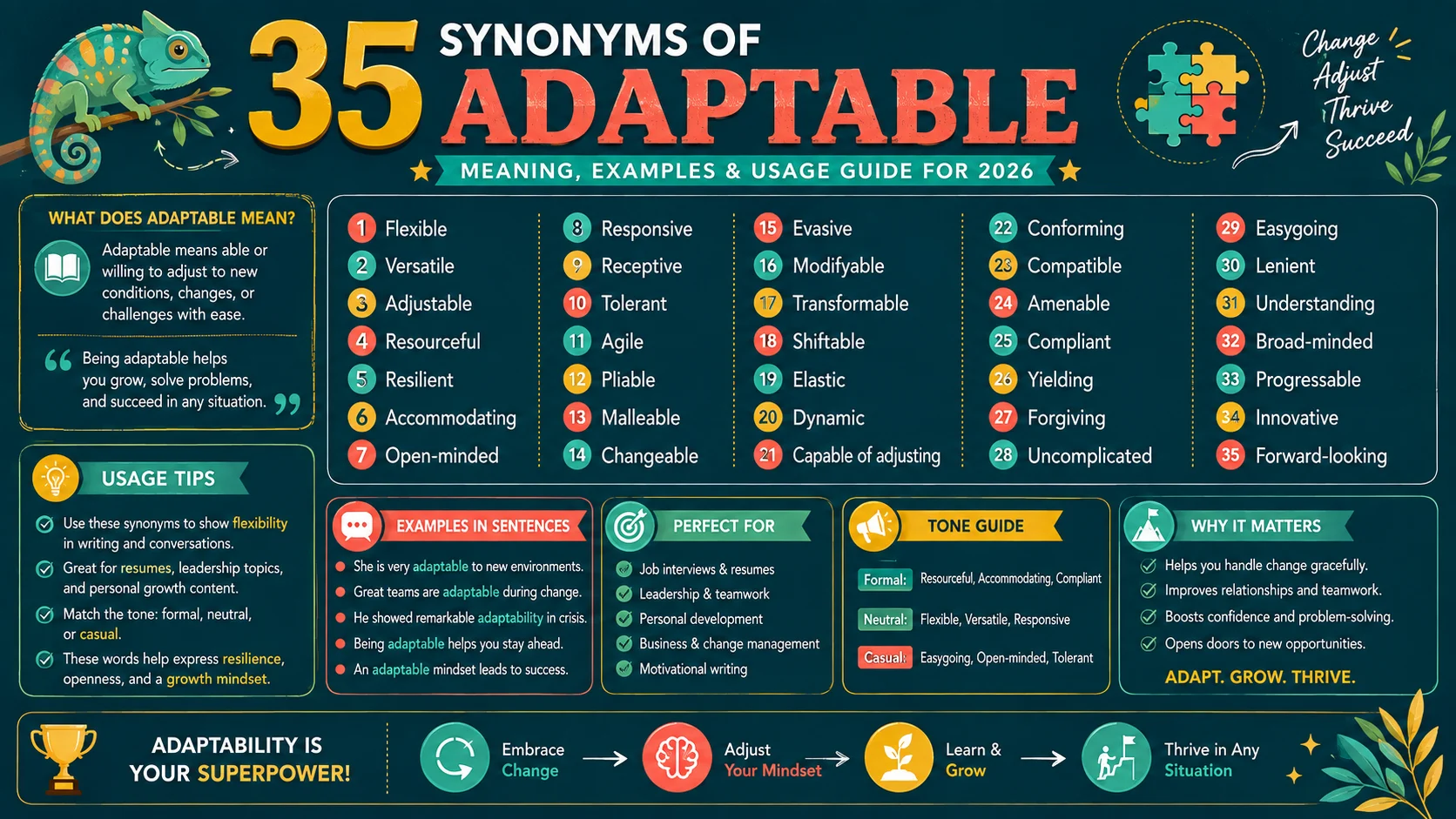
- Adaptable means being able to change easily to suit different conditions or situations. The best synonyms include flexible, versatile, adjustable, malleable, pliable, resilient, accommodating, and open-minded. The most common everyday synonym is flexible, while versatile works best for describing skills and abilities. Each synonym carries a slightly different tone and fits different situations perfectly.
Top 10 Synonyms
- Flexible
- Versatile
- Adjustable
- Malleable
- Pliable
- Resilient
- Accommodating
- Open-minded
- Changeable
- Multifaceted
Every synonym has a slightly different meaning, tone, or context, so choose carefully based on your situation.
Do you keep using “adaptable” when describing yourself, others, or situations? It’s a useful word, but using it too often makes your writing sound repetitive and boring.
Learning synonyms for “adaptable” helps you express yourself more precisely. Whether you’re writing a resume, describing a colleague, or talking about your own skills, having the right word makes a huge difference.
In this guide, you’ll discover 35 powerful alternatives to “adaptable.” You’ll learn their meanings, when to use them, and which ones native speakers prefer in different situations. Let’s explore!
What Does “Adaptable” Mean?
Definition
Adaptable means having the ability to change or be changed easily to fit new conditions or situations. It describes someone or something that can adjust when circumstances change.
Think of it like water. Water takes the shape of whatever container holds it. That’s what being adaptable means—you can adjust to different environments, requirements, or challenges without breaking.
Adaptable can describe:
- People who handle change well (“She’s an adaptable employee”)
- Things that can be modified (“This adaptable furniture fits any room”)
- Skills that work in different situations (“Adaptable problem-solving skills”)
Pronunciation
| Feature | Value |
|---|---|
| US IPA | /əˈdæp.tə.bəl/ |
| UK IPA | /əˈdæp.tə.bəl/ |
| Syllables | 4 (a-dap-ta-ble) |
| Tip | Stress the second syllable: a-DAP-ta-ble |
Grammar
| Grammar Feature | Information |
|---|---|
| Part of Speech | Adjective |
| Common Position | Before a noun or after a linking verb |
| Typical Pattern | adaptable + to + noun/gerund |
Example Sentences:
- “Children are naturally adaptable to new environments.”
- “The adaptable design works in both small and large spaces.”
- “She proved adaptable when the project requirements changed suddenly.”
Grammar Note: “Adaptable” is an adjective. The verb form is “adapt,” and the noun form is “adaptation.”
Word Family
| Word | Part of Speech | Meaning |
|---|---|---|
| Adapt | Verb | To change to fit new conditions |
| Adaptation | Noun | The process of changing to fit new conditions |
| Adaptable | Adjective | Able to change easily |
| Adaptability | Noun | The quality of being able to change |
| Adaptably | Adverb | In an adaptable way |
| Maladaptive | Adjective | Not helping adaptation (often negative) |
| Readapt | Verb | To adapt again |
35 Synonyms of “Adaptable”
1. Flexible
Meaning: Able to change easily according to different situations.
Best Used For: Daily conversation, resumes, describing people and schedules.
Formality: Neutral
Tone: Positive, Practical
Frequency: ⭐⭐⭐⭐⭐ Very Common
CEFR Level: B1
Example Sentence 1: “She has a flexible approach to problem-solving.”
Example Sentence 2: “My work schedule is flexible, so I can adjust my hours.”
Usage Tip: “Flexible” is the most common and natural synonym. Use it for almost any situation. It suggests easy adjustment without difficulty.
2. Versatile
Meaning: Having many different skills or uses; able to do many things well.
Best Used For: Resumes, professional profiles, describing people and tools.
Formality: Neutral to Formal
Tone: Impressive, Capable
Frequency: ⭐⭐⭐⭐⭐ Very Common
CEFR Level: B2
Example Sentence 1: “She’s a versatile musician who plays several instruments.
Example Sentence 2: “This versatile phone case works as a stand and wallet.”
Usage Tip: “Versatile” is excellent for resumes. It suggests you have many useful skills. Use it when describing someone who succeeds in various roles.
3. Adjustable
Meaning: Able to be changed to fit different needs or conditions.
Best Used For: Describing objects, equipment, and physical things.
Formality: Neutral
Tone: Practical, Functional
Frequency: ⭐⭐⭐⭐ Common
CEFR Level: B1
Example Sentence 1: “The adjustable chair fits people of all heights.”
Example Sentence 2: “This adjustable lamp has three brightness settings.”
Usage Tip: “Adjustable” is perfect for physical items that can be modified. Use it for furniture, tools, and equipment. Don’t use it for people or skills.
4. Malleable
Meaning: Able to be shaped, changed, or influenced easily.
Best Used For: Describing materials, personalities, or situations.
Formality: Neutral to Formal
Tone: Neutral, Descriptive
Frequency: ⭐⭐⭐ Moderate
CEFR Level: B2
Example Sentence 1: “Gold is a malleable metal that can be shaped into jewelry.”
Example Sentence 2: “Young children have malleable minds that absorb new information quickly.”
Usage Tip: “Malleable” originally describes metal that can be hammered into shapes. It works well for describing influenceable people or adaptable materials.
5. Pliable
Meaning: Easily bent, shaped, or influenced.
Best Used For: Describing materials, personalities, and physical flexibility.
Formality: Neutral
Tone: Descriptive, Neutral
Frequency: ⭐⭐⭐ Moderate
CEFR Level: B2
Example Sentence 1: “The clay was pliable and easy to sculpt.”
Example Sentence 2: “She has a pliable personality and adapts to any team.
Usage Tip: “Pliable” is similar to “malleable” but suggests flexibility. Use it for soft materials or people who are easily influenced. It can sometimes suggest weakness.
6. Resilient
Meaning: Able to recover quickly from difficulties or changes.
Best Used For: Describing emotional strength, businesses, and communities.
Formality: Neutral to Formal
Tone: Strong, Positive
Frequency: ⭐⭐⭐⭐⭐ Very Common
CEFR Level: B2
Example Sentence 1: “The community proved resilient after the natural disaster.”
Example Sentence 2: “Resilient people bounce back from setbacks quickly.”
Usage Tip: “Resilient” emphasizes recovery from challenges. It’s stronger than “adaptable” and suggests strength. Use it when describing how people handle hardships.
7. Accommodating
Meaning: Willing to help and make changes for others.
Best Used For: Describing helpful people, customer service, and teamwork.
Formality: Neutral
Tone: Helpful, Kind
Frequency: ⭐⭐⭐⭐ Common
CEFR Level: B2
Example Sentence 1: “The hotel staff were very accommodating to our requests.”
Example Sentence 2: “She’s an accommodating colleague who helps everyone.”
Usage Tip: “Accommodating” suggests being helpful and making adjustments for others. It’s a positive word that shows kindness. Use it in customer service and teamwork contexts.
8. Open-minded
Meaning: Willing to consider new ideas and different opinions.
Best Used For: Describing people, leaders, and teams.
Formality: Neutral
Tone: Positive, Progressive
Frequency: ⭐⭐⭐⭐⭐ Very Common
CEFR Level: B1
Example Sentence 1: “An open-minded manager listens to all suggestions.”
Example Sentence 2: “She’s open-minded about trying new approaches.”
Usage Tip: “Open-minded” is about being willing to consider new ideas, not necessarily changing. Use it for people who don’t judge too quickly.
9. Changeable
Meaning: Likely to change; not staying the same.
Best Used For: Describing weather, opinions, situations.
Formality: Neutral
Tone: Neutral, Descriptive
Frequency: ⭐⭐⭐ Moderate
CEFR Level: B2
Example Sentence 1: “The weather in spring is very changeable.”
Example Sentence 2: “His changeable moods make him difficult to work with.”
Usage Tip: “Changeable” describes things that change frequently. It can be neutral or negative. It’s not always positive like “adaptable.”
10. Multifaceted
Meaning: Having many different sides, features, or aspects.
Best Used For: Describing people with many skills, complex situations.
Formality: Formal
Tone: Sophisticated, Impressive
Frequency: ⭐⭐⭐ Moderate
CEFR Level: C1
Example Sentence 1: “She has a multifaceted career in art, teaching, and writing.
Example Sentence 2: “This multifaceted problem requires creative solutions.”
Usage Tip: “Multifaceted” is a sophisticated word. Use it in professional writing to describe people with diverse talents or complex issues.
11. Resourceful
Meaning: Able to find clever solutions to problems using available resources.
Best Used For: Resumes, describing problem-solvers, creative people.
Formality: Neutral to Formal
Tone: Clever, Capable
Frequency: ⭐⭐⭐⭐ Common
CEFR Level: B2
Example Sentence 1: “The resourceful student built a robot from recycled parts.”
Example Sentence 2: “Resourceful managers solve problems without extra money.”
Usage Tip: “Resourceful” is slightly different from “adaptable.” It emphasizes finding solutions creatively. Use it for problem-solvers and innovators.
12. Pliancy
Meaning: The quality of being flexible and easily influenced.
Best Used For: Formal writing, describing personality traits.
Formality: Formal
Tone: Neutral, Analytical
Frequency: ⭐⭐ Rare
CEFR Level: C1
Example Sentence 1: “Her pliancy made her an excellent team player.
Example Sentence 2: “The pliancy of the material made it easy to work with.”
Usage Tip: “Pliancy” is a noun, not an adjective. It’s quite formal. Use it sparingly in sophisticated writing.
13. Supple
Meaning: Bending easily without breaking; flexible.
Best Used For: Describing materials, bodies, and physical things.
Formality: Neutral to Formal
Tone: Elegant, Descriptive
Frequency: ⭐⭐⭐ Moderate
CEFR Level: B2
Example Sentence 1: “Regular yoga makes your body supple and strong.”
Example Sentence 2: “The supple leather formed a comfortable shoe.”
Usage Tip: “Supple” is usually physical. Use it for materials, bodies, or objects that bend gracefully. It suggests elegance and smoothness.
14. Lithe
Meaning: Moving gracefully and flexibly.
Best Used For: Describing dancers, athletes, or elegant movement.
Formality: Literary/Formal
Tone: Graceful, Elegant
Frequency: ⭐⭐ Rare
CEFR Level: C1
Example Sentence 1: “The ballerina’s lithe movements amazed the audience.”
Example Sentence 2: “The cat moved with lithe grace across the roof.”
Usage Tip: “Lithe” is poetic and literary. Use it in creative writing, not everyday conversation. It suggests beauty and grace in movement.
15. Elastic
Meaning: Able to stretch and return to original shape; flexible.
Best Used For: Describing materials, rules, and situations.
Formality: Neutral
Tone: Practical, Descriptive
Frequency: ⭐⭐⭐ Moderate
CEFR Level: B2
Example Sentence 1: “The elastic band stretched to fit around the box.”
Example Sentence 2: “The schedule has elastic boundaries that allow changes.”
Usage Tip: “Elastic” describes physical stretching or flexible limits. Use it for materials or situations that can expand and return.
16. Plastic
Meaning: Able to be shaped or molded.
Best Used For: Scientific contexts, describing materials or minds.
Formality: Formal
Tone: Scientific, Technical
Frequency: ⭐⭐⭐ Moderate
CEFR Level: B2
Example Sentence 1: “The plastic clay was ready for sculpting.”
Example Sentence 2: “The adolescent brain is highly plastic and adaptable.”
Usage Tip: “Plastic” in this context means shapable. It’s common in science and psychology. Don’t confuse it with the material. Use it carefully in non-technical writing.
17. Fluid
Meaning: Smooth, flowing, and able to change easily.
Best Used For: Describing situations, plans, and movement.
Formality: Neutral to Formal
Tone: Smooth, Modern
Frequency: ⭐⭐⭐⭐ Common
CEFR Level: B2
Example Sentence 1: “The conversation was fluid and natural.”
Example Sentence 2: “Our plans are still fluid and can change.”
Usage Tip: “Fluid” suggests smooth, natural change. It’s often used for plans or situations that aren’t fixed. It sounds modern and professional.
18. Adaptive
Meaning: Showing the ability to change for a new situation.
Best Used For: Scientific contexts, evolution, technology.
Formality: Formal
Tone: Scientific, Technical
Frequency: ⭐⭐⭐⭐ Common
CEFR Level: B2
Example Sentence 1: “Animals have adaptive behaviors that help them survive.”
Example Sentence 2: “The software uses adaptive learning for each student.”
Usage Tip: “Adaptive” is very similar to “adaptable” but often used in technical contexts. Use it in science, technology, and professional discussions.
19. Accommodating
Meaning: Making changes to help others.
Best Used For: Customer service, describing helpful people.
Formality: Neutral
Tone: Helpful, Kind
Frequency: ⭐⭐⭐⭐ Common
CEFR Level: B2
Example Sentence 1: “The accommodating staff moved us to a better room.”
Example Sentence 2: “She was accommodating and rescheduled the meeting.”
Usage Tip: This word emphasizes helpfulness. Use it when describing people who go out of their way to help others.
20. Receptive
Meaning: Willing to consider new ideas or suggestions.
Best Used For: Describing listeners, leaders, and teams.
Formality: Neutral to Formal
Tone: Open, Positive
Frequency: ⭐⭐⭐⭐ Common
CEFR Level: B2
Example Sentence 1: “The manager was receptive to employee feedback.”
Example Sentence 2: “She’s receptive to learning new skills.”
Usage Tip: “Receptive” is about being open to ideas, not necessarily changing. It’s slightly more passive than “adaptable.”
21. Modifiable
Meaning: Able to be changed or modified.
Best Used For: Technology, systems, and processes.
Formality: Formal
Tone: Technical, Practical
Frequency: ⭐⭐⭐ Moderate
CEFR Level: B2
Example Sentence 1: “The software is modifiable to meet client needs.”
Example Sentence 2: “This modifiable curriculum works in any classroom.”
Usage Tip: “Modifiable” suggests planned flexibility. Use it in technical and professional contexts. It’s less personal than “adaptable.”
22. Tranformable
Meaning: Able to change completely into something else.
Best Used For: Materials, products, and concepts.
Formality: Formal
Tone: Impressive, Dynamic
Frequency: ⭐⭐ Rare
CEFR Level: C1
Example Sentence 1: “This transformable furniture changes from bed to desk.”
Example Sentence 2: “The transformable company adapted to the digital age.”
Usage Tip: “Transformable” suggests big changes. Use it when something can change completely, not just adjust slightly.
23. Protean
Meaning: Able to change shape or form easily.
Best Used For: Literary contexts, describing creative people.
Formality: Formal/Literary
Tone: Artistic, Sophisticated
Frequency: ⭐ Very Rare
CEFR Level: C1
Example Sentence 1: “She has a protean talent that works in many art forms.”
Example Sentence 2: “His protean personality adapts to any social situation.”
Usage Tip: “Protean” is a very sophisticated word. Use it in artistic or literary writing. It’s based on Proteus, a mythical god who could change shape.
24. Agile
Meaning: Quick and graceful in movement; able to think and react quickly.
Best Used For: Business, technology, describing quick thinkers.
Formality: Neutral to Formal
Tone: Smart, Dynamic
Frequency: ⭐⭐⭐⭐⭐ Very Common
CEFR Level: B2
Example Sentence 1: “Agile companies respond quickly to market changes.”
Example Sentence 2: “She’s an agile thinker who solves problems fast.”
Usage Tip: “Agile” suggests quick, responsive adaptability. It’s very common in business and technology. It’s more active than “adaptable.”
25. Nimble
Meaning: Quick and light in movement or thinking.
Best Used For: Describing quick thinkers, athletes, and responses.
Formality: Neutral
Tone: Quick, Clever
Frequency: ⭐⭐⭐⭐ Common
CEFR Level: B2
Example Sentence 1: “The nimble entrepreneur spotted opportunities quickly.”
Example Sentence 2: “His nimble fingers played the piano beautifully.”
Usage Tip: “Nimble” suggests speed and lightness. Use it for quick thinking or movement. It’s more specific than “adaptable.”
26. Ductile
Meaning: Able to be drawn out into thin wire (metals); easily led or influenced.
Best Used For: Scientific contexts, describing materials.
Formality: Formal
Tone: Technical, Scientific
Frequency: ⭐⭐ Rare
CEFR Level: C1
Example Sentence 1: “Copper is a ductile metal used in electrical wiring.”
Example Sentence 2: “His ductile personality makes him easy to work with.”
Usage Tip: “Ductile” is technical. Use it for materials in scientific contexts. It can describe people but sounds formal.
27. Responsive
Meaning: Reacting quickly and positively to change or communication.
Best Used For: Customer service, technology, describing reactions.
Formality: Neutral
Tone: Positive, Attentive
Frequency: ⭐⭐⭐⭐ Common
CEFR Level: B2
Example Sentence 1: “The responsive team addressed all customer concerns.
Example Sentence 2: “This responsive website works on every device.”
Usage Tip: “Responsive” emphasizes quick positive reactions. Use it for services, technology, and communication.
28. Supple-minded
Meaning: Having a flexible way of thinking.
Best Used For: Formal writing, describing open-minded people.
Formality: Formal
Tone: Intellectual, Positive
Frequency: ⭐⭐ Rare
CEFR Level: C1
Example Sentence 1: “Supple-minded leaders adapt to new information.”
Example Sentence 2: “Her supple-minded approach solved complex problems.
Usage Tip: “Supple-minded” is a sophisticated phrase. Use it in formal contexts to describe flexible thinking.
29. Easygoing
Meaning: Relaxed and not easily upset or annoyed.
Best Used For: Daily conversation, describing friendly people.
Formality: Informal
Tone: Casual, Friendly
Frequency: ⭐⭐⭐⭐ Common
CEFR Level: B1
Example Sentence 1: “She’s easygoing and doesn’t get stressed about small changes.”
Example Sentence 2: “My easygoing colleague works well with everyone.”
Usage Tip: “Easygoing” suggests a relaxed personality that accepts change. Use it in friendly, casual contexts.
30. Go-with-the-flow
Meaning: Accepting of change and doesn’t resist new situations.
Best Used For: Informal conversation, describing easygoing people.
Formality: Informal
Tone: Casual, Relaxed
Frequency: ⭐⭐⭐⭐ Common
CEFR Level: B1
Example Sentence 1: “He’s go-with-the-flow and never argues about plans.”
Example Sentence 2: “She has a go-with-the-flow attitude that reduces stress.”
Usage Tip: This is an idiom. It’s informal and friendly. Use it in casual conversation, not professional writing.
31. Expandable
Meaning: Able to be enlarged or extended.
Best Used For: Describing products, systems, and storage.
Formality: Neutral
Tone: Practical, Functional
Frequency: ⭐⭐⭐ Moderate
CEFR Level: B2
Example Sentence 1: “The expandable table seats eight people.”
Example Sentence 2: “The expandable storage fits all your files.”
Usage Tip: “Expandable” is about growing in size or capacity. Use it for physical objects and systems.
32. Forgiving
Meaning: Allowing for mistakes or changes without severe consequences.
Best Used For: Describing systems, materials, and people.
Formality: Neutral
Tone: Lenient, Understanding
Frequency: ⭐⭐⭐ Moderate
CEFR Level: B2
Example Sentence 1: “This forgiving fabric doesn’t show wrinkles.”
Example Sentence 2: “A forgiving manager accepts occasional mistakes.”
Usage Tip: “Forgiving” suggests tolerance for errors. Use it when something is not too demanding or strict.
33. Tolerant
Meaning: Allowing things to happen without objection.
Best Used For: Describing people, societies, and environments.
Formality: Neutral to Formal
Tone: Accepting, Positive
Frequency: ⭐⭐⭐⭐ Common
CEFR Level: B2
Example Sentence 1: “Tolerant communities accept different cultures.”
Example Sentence 2: “The tolerant plant survives in various conditions.
Usage Tip: “Tolerant” is about accepting differences. It’s broader than “adaptable” and suggests patience.
34. Compliant
Meaning: Willing to obey or follow rules.
Best Used For: Legal, safety, and regulatory contexts.
Formality: Formal
Tone: Neutral, Professional
Frequency: ⭐⭐⭐⭐ Common
CEFR Level: B2
Example Sentence 1: “The company is compliant with all safety regulations.”
Example Sentence 2: “The compliant student followed all instructions.”
Usage Tip: “Compliant” is about following rules, not adapting creatively. Use it in legal or professional contexts.
35. All-round
Meaning: Good at many different things.
Best Used For: British English, describing versatile people.
Formality: Informal
Tone: Positive, Capable
Frequency: ⭐⭐⭐ Moderate
CEFR Level: B2
Example Sentence 1: “He’s an all-round player who excels in every position.”
Example Sentence 2: “The all-round assistant handles every task.”
Usage Tip: “All-round” is more common in British English. Use it to describe someone who’s good at many things.
Synonyms Comparison Table
| Synonym | Best Context | Formality | Tone | Frequency |
|---|---|---|---|---|
| Flexible | Any situation | Neutral | Practical | ⭐⭐⭐⭐⭐ |
| Versatile | Skills, abilities | Neutral | Impressive | ⭐⭐⭐⭐⭐ |
| Adjustable | Physical items | Neutral | Functional | ⭐⭐⭐⭐ |
| Resilient | Strength, recovery | Neutral | Strong | ⭐⭐⭐⭐⭐ |
| Accommodating | Helping others | Neutral | Kind | ⭐⭐⭐⭐ |
| Open-minded | Ideas, opinions | Neutral | Progressive | ⭐⭐⭐⭐⭐ |
| Resourceful | Problem-solving | Neutral | Clever | ⭐⭐⭐⭐ |
| Agile | Business, thinking | Neutral | Dynamic | ⭐⭐⭐⭐⭐ |
| Responsive | Communication | Neutral | Attentive | ⭐⭐⭐⭐ |
| Easygoing | Casual contexts | Informal | Friendly | ⭐⭐⭐⭐ |
Best Synonyms by Situation
| Situation | Best Synonym | Why It Works |
|---|---|---|
| Resume | Versatile, Resourceful | Shows many skills and creativity |
| Job Interview | Flexible, Agile | Suggests quick adjustment |
| Teamwork | Accommodating, Open-minded | Shows willingness to cooperate |
| Description of a person | Versatile, Multifaceted | Highlights diverse abilities |
| Business Context | Agile, Responsive | Sounds professional and modern |
| Academic Writing | Adaptive, Malleable | Precise and scholarly |
| Daily Conversation | Flexible, Easygoing | Natural and friendly |
| Technology | Modifiable, Expandable | Technical and precise |
| Creative Writing | Protean, Lithe | Artistic and descriptive |
| Customer Service | Accommodating, Responsive | Emphasizes helpfulness |
Formal vs Informal Synonyms
Formal Alternatives
| Synonym | Best Used For |
|---|---|
| Protean | Literary, sophisticated writing |
| Multifaceted | Professional, complex descriptions |
| Malleable | Scientific, psychological contexts |
| Adaptive | Technical, academic contexts |
| Modifiable | Technology, systems |
| Ductile | Materials science |
Neutral Alternatives
| Synonym | Best Used For |
|---|---|
| Flexible | Most professional contexts |
| Versatile | Resumes, skills descriptions |
| Resilient | Strength, recovery |
| Accommodating | Helpfulness |
| Resourceful | Problem-solving |
| Open-minded | Ideas and opinions |
Informal Alternatives
| Synonym | Best Used For |
|---|---|
| Easygoing | Friendly conversation |
| Go-with-the-flow | Casual situations |
| All-round | British English, sports |
When to choose each level: Use formal synonyms for academic papers and technical writing. Use neutral synonyms for resumes, business communication, and everyday professional contexts. Use informal synonyms with friends and in casual conversation.
Strong vs Mild Synonyms
Mild (Everyday Situations)
- Flexible
- Adjustable
- Easygoing
- Open-minded
- Accommodating
Moderate (More Expressive)
- Versatile
- Resilient
- Resourceful
- Responsive
- Agile
Strong (High-Intensity)
- Protean
- Multifaceted
- Malleable
- Adaptive
- Transformable
Remember: Choose intensity that matches your message. “Flexible” works for simple situations. “Protean” is dramatic and artistic. Use strong synonyms sparingly for maximum impact.
Real-Life Examples
In the Office
“The versatile project manager handled marketing, design, and client relations.”
On a Resume
“Adaptable professional with experience in six different industries.”
In Customer Service
“Please be accommodating with our client’s special requests.”
Academic Context
“The malleable nature of the curriculum allows for teacher creativity.”
During a Presentation
“Our company is agile and responds quickly to market changes.”
Daily Conversation
“Living abroad made me more open-minded about different cultures.”
Creative Writing
“She moved with lithe grace across the dance floor.”
Common Collocations
| Common Phrase | Better Alternative |
|---|---|
| Very adaptable | Highly adaptable, Extremely flexible |
| Easy to change | Pliable, Malleable |
| Handles change well | Resilient, Agile |
| Many skills | Versatile, Multifaceted |
| Accepting of differences | Tolerant, Open-minded |
| Willing to help | Accommodating, Responsive |
| Quick to adjust | Nimble, Quick-witted |
Common Phrases
- “Roll with the punches” – Meaning: Adapt to difficult situations. Instead of “adaptable,” say “resilient” or “flexible.”
- “Go with the flow” – Meaning: Accept and adapt to changes. Instead of “adaptable,” say “easygoing.”
- “Think on your feet” – Meaning: Adapt quickly to new situations. Instead of “adaptable,” say “agile” or “nimble.”
- “Wear many hats” – Meaning: Have many different roles. Instead of “adaptable,” say “versatile.”
Context Guide
| Situation | Best Synonym | Reason |
|---|---|---|
| Essay | Adaptive, Malleable | Formal and scholarly |
| Speech | Flexible, Resilient | Inspiring and clear |
| Business Email | Adaptable, Versatile | Professional and positive |
| Novel | Protean, Lithe | Creative and descriptive |
| Presentation | Agile, Responsive | Modern and energetic |
| Conversation | Flexible, Easygoing | Natural and friendly |
| Academic Writing | Adaptive, Modifiable | Precise and technical |
| Marketing Copy | Versatile, Transformable | Exciting and persuasive |
Related Words
Near Synonyms
- Flexible: Able to change easily.
- Versatile: Having many abilities.
- Resilient: Recovering from hardship.
- Agile: Quick and responsive.
Antonyms
- Inflexible: Unable to change.
- Rigid: Stiff and unbending.
- Stubborn: Refusing to change.
- Inadaptable: Not able to adjust.
- Set in one’s ways: Fixed habits.
- Related Adjectives
- Resourceful: Creative problem-solving.
- Open-minded: Accepting of new ideas.
- Responsive: Quick positive reactions.
- Tolerant: Accepting differences.
- Related Nouns
- Adaptability: The quality of being adaptable.
- Flexibility: The ability to bend or change.
- Versatility: Having many skills.
- Resilience: The ability to recover.
- Agility: Quick and easy movement.
- Related Verbs
- Adapt: To change for new conditions.
- Adjust: To make small changes.
- Modify: To make partial changes.
- Accommodate: To help or make changes for others.
Frequently Asked Questions
What is another word for adaptable?
The best alternatives are flexible, versatile, adjustable, malleable, pliable, resilient, accommodating, and open-minded. The most common and natural choice is flexible, which works in almost any context. For professional contexts, versatile and agile are excellent options.
Which synonym sounds the most professional?
Versatile, agile, resourceful, and multifaceted sound most professional in workplace settings. Adaptable itself is also professional. Use versatile for resumes and agile for business contexts. These words suggest capability and competence.
What is the strongest synonym for adaptable?
Protean, transformable, and multifaceted are among the strongest alternatives. Protean suggests almost magical shape-shifting ability, while multifaceted suggests many dimensions of capability. Use them carefully as they can sound dramatic.
Which synonym is best for resumes?
Versatile and resourceful are best for resumes. Versatile shows you have many skills. Resourceful shows you solve problems creatively. Both impress employers and are common in successful resumes. Adaptable itself also works well.
What’s the difference between adaptable and flexible?
They are very similar and often interchangeable. Flexible suggests easy bending or change. Adaptable suggests permanent adjustment to new conditions. In everyday use, they mean essentially the same thing. Flexible is slightly more common.
Which synonym is most common in everyday English?
Flexible is the most common everyday synonym. Native speakers use it frequently for schedules, people, and situations. Easygoing is also very common in casual conversation. Both are natural and easy for English learners to understand.
What is the opposite of adaptable?
The most common opposites are inflexible, rigid, stubborn, inadaptable, and unyielding. These words describe people or things that cannot or will not change. Rigid is the most common opposite in professional contexts.
Is “adaptable” a positive word?
Yes, “adaptable” is generally a positive word. It suggests someone or something can handle change well. However, it can be neutral in scientific contexts. In most situations, calling someone adaptable is a compliment.
Conclusion
Learning alternatives to “adaptable” helps you express yourself more precisely. The right word depends on your context, audience, and what you want to emphasize.
For everyday situations, flexible is your safest choice. It’s natural and works in almost any context. For professional writing and resumes, versatile, resourceful, and agile will help you stand out. For describing people who help others, accommodating is perfect.
Remember these key principles:
- Formal situations need formal words like adaptive, malleable, or modifiable
- Neutral situations work well with flexible, versatile, or resilient
- Informal situations let you use easygoing or go-with-the-flow
Choose the word that fits your situation, and your English will sound more natural and professional. Keep practicing these alternatives, and they’ll become part of your vocabulary naturally.
.
