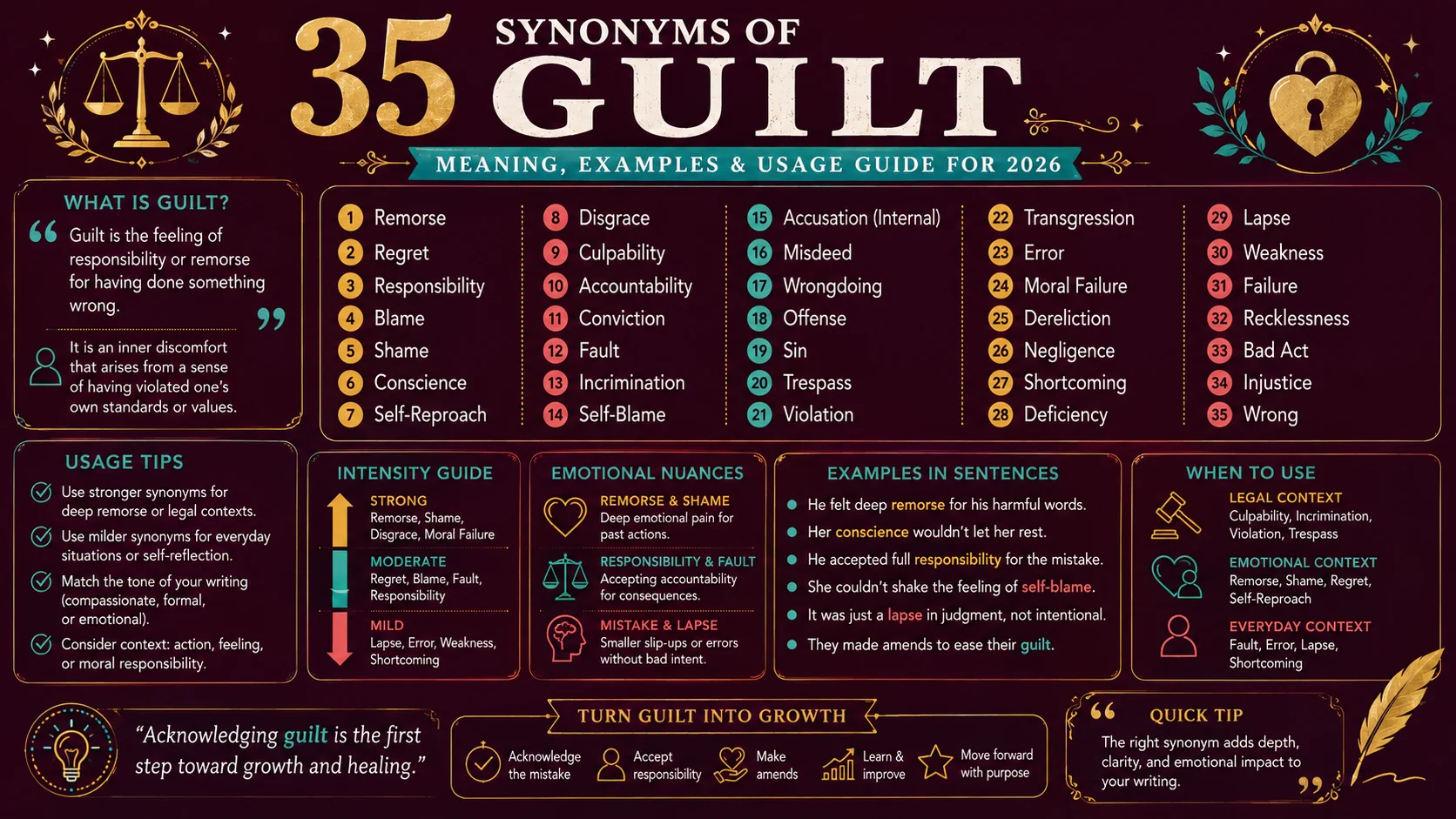
Guilt means the painful feeling you get when you know you’ve done something wrong. The best synonyms include remorse, regret, shame, contrition, self-reproach, penitence, compunction, and culpability. The most common everyday synonym is regret, while remorse works best for deep emotional guilt. Each synonym carries a slightly different meaning, tone, or context, so choose carefully based on your situation.
Top 10 Synonyms
- Remorse
- Regret
- Shame
- Contrition
- Self-reproach
- Penitence
- Compunction
- Culpability
- Sorrow
- Conscience
Every synonym has a slightly different meaning, tone, or context, so choose carefully based on your situation.
Do you ever struggle to find the right word to describe that uncomfortable feeling after making a mistake? “Guilt” is a common word, but overusing it makes your writing repetitive and less precise.
Learning synonyms for “guilt” helps you express emotions more accurately. Whether you’re writing a personal journal, describing a character in a story, or explaining a situation in conversation, having the right word makes your message clearer and more powerful.
In this guide, you’ll discover 35 powerful alternatives to “guilt.” You’ll learn their meanings, when to use them, and which ones native speakers prefer in different situations. Let’s dive in!
What Does “Guilt” Mean?
Definition
Guilt is the unhappy feeling you experience when you believe you’ve done something wrong. It’s that heavy, uncomfortable sensation in your chest when you know you’ve hurt someone, broken a rule, or failed to meet your own standards.
In everyday terms, think of guilt as your inner voice telling you, “You shouldn’t have done that.” It’s a moral emotion that helps us learn from mistakes and make better choices in the future.
Guilt can describe:
- The feeling of wrongdoing (“She felt terrible guilt after lying”)
- Legal responsibility (“The court proved his guilt”)
- The cause of the feeling (“The guilt was eating him alive”)
Pronunciation
| Feature | Value |
|---|---|
| US IPA | /ɡɪlt/ |
| UK IPA | /ɡɪlt/ |
| Syllables | 1 (guilt) |
| Tip | The “u” is silent. Say it like “gilt” (rhymes with “built”) |
Grammar
| Grammar Feature | Information |
|---|---|
| Part of Speech | Noun (also used as a verb: “to guilt someone”) |
| Common Position | Subject, object, or after a preposition |
| Typical Pattern | guilt + about/over + something |
Example Sentences:
- “She felt a deep sense of guilt about lying to her friend.”
- “The guilt of what he had done kept him awake at night.”
- “He guilted me into helping him move.”
Grammar Note: “Guilt” is an uncountable noun, so you can’t say “a guilt.” You can say “a sense of guilt” or “a feeling of guilt.”
Word Family
| Word | Part of Speech | Meaning |
|---|---|---|
| Guilt | Noun | The feeling of having done wrong |
| Guilty | Adjective | Feeling or showing guilt |
| Guiltily | Adverb | In a guilty manner |
| Guiltless | Adjective | Innocent; without guilt |
| Guiltiness | Noun | The state of being guilty |
| Guilt-trip | Noun/Verb | Making someone feel guilty |
35 Synonyms of “Guilt”
1. Remorse
Meaning: Deep and painful regret for something wrong you’ve done.
Best Used For: Emotional writing, personal reflection, describing deep regret.
Formality: Neutral to Formal
Tone: Emotional, Serious
Frequency: ⭐⭐⭐⭐ Common
CEFR Level: B2
Example Sentence 1: “He felt deep remorse for the hurtful words he had spoken.”
Example Sentence 2: “Her remorse was evident in the tears streaming down her face.”
Usage Tip: “Remorse” is stronger than “regret.” It suggests genuine sadness and a desire to make things right. Use it when guilt is accompanied by emotional pain.
2. Regret
Meaning: A sad feeling about something you did or failed to do.
Best Used For: Daily conversation, writing, personal reflection.
Formality: Neutral
Tone: Sad, Reflective
Frequency: ⭐⭐⭐⭐⭐ Very Common
CEFR Level: B1
Example Sentence 1: “She expressed regret for not attending her grandmother’s funeral.”
Example Sentence 2: “He has no regrets about following his dream.”
Usage Tip: “Regret” is the most common and versatile synonym. It can describe mild disappointment or deep sorrow. Use it when guilt is less intense or when you wish you’d made a different choice.
3. Shame
Meaning: A painful feeling of embarrassment or dishonor.
Best Used For: Describing public embarrassment or personal failure.
Formality: Neutral
Tone: Negative, Embarrassing
Frequency: ⭐⭐⭐⭐⭐ Very Common
CEFR Level: B1
Example Sentence 1: “She felt shame when her lie was exposed.”
Example Sentence 2: “He brought shame to his family with his actions.”
Usage Tip: “Shame” differs from guilt. Guilt is about your actions (“I did something bad”), while shame is about yourself (“I am bad”). Use “shame” when someone feels exposed or humiliated.
4. Contrition
Meaning: Deep regret for doing something wrong, often with a desire to repent.
Best Used For: Religious or spiritual contexts, formal apologies.
Formality: Formal
Tone: Sincere, Repentant
Frequency: ⭐⭐ Rare
CEFR Level: C1
Example Sentence 1: “He showed genuine contrition by apologizing publicly.”
Example Sentence 2: “The priest asked for contrition and penance.”
Usage Tip: “Contrition” is formal and often religious. It suggests heartfelt regret and a desire to make amends. Use it in serious, formal contexts.
5. Self-reproach
Meaning: The act of blaming yourself for something you’ve done wrong.
Best Used For: Personal reflection, psychology, describing inner criticism.
Formality: Neutral to Formal
Tone: Blaming, Critical
Frequency: ⭐⭐⭐ Moderate
CEFR Level: B2
Example Sentence 1: “His self-reproach was unbearable after the accident.”
Example Sentence 2: “She couldn’t stop the self-reproach for failing the exam.”
Usage Tip: This word emphasizes blaming yourself, not just feeling bad. It’s useful when someone is being especially hard on themselves.
6. Penitence
Meaning: The state of being sorry for sins or wrongdoings.
Best Used For: Religious contexts, formal apologies.
Formality: Formal
Tone: Repentant, Humble
Frequency: ⭐⭐ Rare
CEFR Level: C1
Example Sentence 1: “She knelt in penitence for the mistakes she had made.”
Example Sentence 2: “His penitence led him to change his ways.”
Usage Tip: “Penitence” is very formal and religious in tone. It suggests humility and a desire for forgiveness, especially from a higher power.
7. Compunction
Meaning: A slight feeling of guilt or regret about doing something wrong.
Best Used For: Describing hesitation, moral unease.
Formality: Formal
Tone: Uneasy, Hesitant
Frequency: ⭐⭐ Rare
CEFR Level: C1
Example Sentence 1: “She had no compunction about leaving her job after they treated her poorly.”
Example Sentence 2: “He felt a twinge of compunction when he saw how upset she was.”
Usage Tip: “Compunction” often appears in negative phrases like “without compunction” (meaning “without guilt”). It suggests a small, nagging feeling rather than overwhelming guilt.
8. Culpability
Meaning: Responsibility for something wrong or harmful.
Best Used For: Legal contexts, official investigations, formal writing.
Formality: Formal
Tone: Serious, Legal
Frequency: ⭐⭐⭐ Moderate
CEFR Level: B2
Example Sentence 1: “The investigation determined her culpability in the fraud.”
Example Sentence 2: “He acknowledged his culpability and accepted the punishment.”
Usage Tip: “Culpability” is about responsibility, not just feeling guilty. Use it in legal or formal contexts to describe who is to blame.
9. Sorrow
Meaning: Deep sadness or grief about something.
Best Used For: Emotional writing, literature, expressing sympathy.
Formality: Neutral to Formal
Tone: Sad, Grieving
Frequency: ⭐⭐⭐⭐ Common
CEFR Level: B1
Example Sentence 1: “He expressed his sorrow for the pain he had caused.”
Example Sentence 2: “Her sorrow was evident in her eyes.”
Usage Tip: “Sorrow” is broader than guilt. It’s about sadness from any source, not just wrongdoing. Use it when guilt is combined with grief or sadness.
10. Conscience
Meaning: The inner voice that tells you right from wrong.
Best Used For: Moral discussions, personal reflection.
Formality: Neutral
Tone: Reflective, Moral
Frequency: ⭐⭐⭐⭐⭐ Very Common
CEFR Level: B1
Example Sentence 1: “His conscience wouldn’t let him keep the money.”
Example Sentence 2: “She had a guilty conscience about lying to her mother.”
Usage Tip: “Conscience” refers to the inner moral voice itself, not the feeling of guilt. A guilty conscience” means you feel guilty because your inner voice is bothering you.
11. Misgiving
Meaning: A feeling of doubt or worry about something.
Best Used For: Describing doubt, hesitation, uncertainty.
Formality: Neutral to Formal
Tone: Doubtful, Worried
Frequency: ⭐⭐⭐ Moderate
CEFR Level: B2
Example Sentence 1: “She had serious misgivings about accepting the job offer.”
Example Sentence 2: “He felt misgivings about the plan but went along anyway.”
Usage Tip: “Misgiving” is about doubt or unease before doing something. It’s different from guilt (feeling bad after). Use it when someone isn’t sure about a decision.
12. Stain
Meaning: Something that damages someone’s reputation or honor.
Best Used For: Literary writing, describing dishonor.
Formality: Literary
Tone: Shameful, Dark
Frequency: ⭐⭐ Moderate
CEFR Level: B2
Example Sentence 1: “The scandal left a stain on his reputation.”
Example Sentence 2: “She felt the stain of her actions on her soul.”
Usage Tip: “Stain” is metaphorical. It suggests that guilt or wrongdoing permanently damages someone’s reputation or self-respect. Use it for vivid, literary writing.
13. Blame
Meaning: Responsibility for something bad that happened.
Best Used For: Daily conversation, assigning responsibility.
Formality: Neutral
Tone: Accusatory, Serious
Frequency: ⭐⭐⭐⭐⭐ Very Common
CEFR Level: A2
Example Sentence 1: “He accepted the blame for the project’s failure.”
Example Sentence 2: “She placed the blame entirely on her team.”
Usage Tip: “Blame” is about responsibility, not the feeling of guilt. “Guilt” is the feeling; “blame” is the responsibility. They often go together but aren’t the same.
14. Fault
Meaning: Responsibility for a mistake or wrongdoing.
Best Used For: Everyday situations, assigning responsibility.
Formality: Neutral
Tone: Accusatory, Direct
Frequency: ⭐⭐⭐⭐⭐ Very Common
CEFR Level: A2
Example Sentence 1: “The accident was entirely his fault.”
Example Sentence 2: “She admitted it was her fault.”
Usage Tip: “Fault” is similar to “blame” but slightly more neutral. “It’s my fault” is a common, natural way to accept responsibility.
15. Responsibility
Meaning: The state of being accountable for something.
Best Used For: Professional contexts, serious discussions.
Formality: Neutral to Formal
Tone: Serious, Accountable
Frequency: ⭐⭐⭐⭐⭐ Very Common
CEFR Level: B1
Example Sentence 1: “He took full responsibility for the mistake.”
Example Sentence 2: “The company accepted responsibility for the defective product.”
Usage Tip: “Responsibility” is about being accountable. It’s more neutral and professional than “blame.” Use it when you want to focus on accountability, not punishment.
16. Self-blame
Meaning: Blaming yourself for something that went wrong.
Best Used For: Psychology, personal reflection, therapy contexts.
Formality: Neutral to Formal
Tone: Critical, Reflective
Frequency: ⭐⭐⭐ Moderate
CEFR Level: B2
Example Sentence 1: “Her constant self-blame prevented her from moving forward.”
Example Sentence 2: “Self-blame is common among survivors of abuse.”
Usage Tip: This term is common in psychology and personal development. It describes the habit of blaming yourself excessively, often for things beyond your control.
17. Guiltiness
Meaning: The state of being guilty; responsibility for wrongdoing.
Best Used For: Formal contexts, legal discussions.
Formality: Formal
Tone: Legal, Serious
Frequency: ⭐⭐ Moderate
CEFR Level: B2
Example Sentence 1: “The evidence confirmed his guiltiness in the crime.”
Example Sentence 2: “Her guiltiness was never proven in court.”
Usage Tip: “Guiltiness” is a less common form of “guilt.” Use it in formal or legal writing. In everyday conversation, “guilt” is more natural.
18. Mea culpa
meaning: A Latin phrase meaning “my fault” or “I am to blame.
Best Used For: Formal apologies, public statements, literary writing.
Formality: Formal
Tone: Sincere, Humble
Frequency: ⭐⭐ Rare
CEFR Level: C1
Example Sentence 1: “The politician issued a mea culpa for his earlier comments.”
Example Sentence 2: “Her mea culpa was brief but sincere.”
Usage Tip: This is a borrowed Latin phrase used in formal English. It’s powerful but might sound old-fashioned. Use it for formal apologies or literary effect.
19. Penance
Meaning: Self-punishment or suffering to show regret for wrongdoing.
Best Used For: Religious contexts, literary writing.
Formality: Formal
Tone: Self-punishing, Repentant
Frequency: ⭐⭐⭐ Moderate
CEFR Level: B2
Example Sentence 1: “He did penance for his sins by fasting for a week.”
Example Sentence 2: “She felt she had to do penance for the pain she caused.”
Usage Tip: “Penance” is the action taken to show regret, not the feeling itself. It’s common in religious contexts. Use it when someone takes action to prove they’re sorry.
20. Atonement
Meaning: Making amends for wrongdoing; making things right.
Best Used For: Religious, spiritual, and serious contexts.
Formality: Formal
Tone: Repentant, Healing
Frequency: ⭐⭐⭐ Moderate
CEFR Level: B2
Example Sentence 1: “He sought atonement for his past mistakes.”
Example Sentence 2: “The company’s donation was an act of atonement.”
Usage Tip: “Atonement” is about making things right. It’s similar to “penance” but focuses on repairing the damage rather than self-punishment.
21. Redemption
Meaning: The act of making up for past wrongdoing.
Best Used For: Inspirational writing, stories of personal growth.
Formality: Neutral
Tone: Hopeful, Transformative
Frequency: ⭐⭐⭐⭐ Common
CEFR Level: B2
Example Sentence 1: “He worked hard to find redemption after his mistakes.”
Example Sentence 2: “Her story is one of redemption and forgiveness.”
Usage Tip: “Redemption” is about recovery and second chances. It’s more hopeful than “guilt.” Use it when someone is trying to overcome their past.
22. Mortification
Meaning: Extreme shame or embarrassment.
Best Used For: Describing public humiliation, strong emotions.
Formality: Neutral to Formal
Tone: Embarrassing, Intense
Frequency: ⭐⭐⭐ Moderate
CEFR Level: B2
Example Sentence 1: “He felt absolute mortification when his secret was revealed.”
Example Sentence 2: “To her mortification, she realized her zipper was down.”
Usage Tip: “Mortification” is stronger than “shame.” It suggests profound embarrassment that feels almost unbearable. Use it for extreme situations.
23. Disgrace
Meaning: Loss of respect or honor; shame.
Best Used For: Formal contexts, describing reputation damage.
Formality: Formal
Tone: Shameful, Serious
Frequency: ⭐⭐⭐⭐ Common
CEFR Level: B2
Example Sentence 1: “He brought disgrace to his family’s name.”
Example Sentence 2: “The scandal caused her disgrace.”
Usage Tip: “Disgrace” is about losing respect in the eyes of others. It’s more about public reputation than private feelings. Use it when someone has lost standing or honor.
24. Self-condemnation
Meaning: Strongly and harshly criticizing yourself.
Best Used For: Psychology, personal reflection, describing intense self-criticism.
Formality: Formal
Tone: Harsh, Self-critical
Frequency: ⭐⭐ Rare
CEFR Level: C1
Example Sentence 1: “His self-condemnation prevented him from forgiving himself.”
Example Sentence 2: “Self-condemnation is a symptom of depression.”
Usage Tip: This term describes severe self-criticism. It’s more intense than “self-reproach.” Use it in psychological or personal development contexts.
25. Self-accusation
Meaning: Accusing or blaming yourself for something.
Best Used For: Personal reflection, describing internal conflict.
Formality: Formal
Tone: Self-critical, Blaming
Frequency: ⭐⭐ Rare
CEFR Level: C1
Example Sentence 1: “She could hear the self-accusation in his voice.”
Example Sentence 2: “His self-accusation was overwhelming.”
Usage Tip: “Self-accusation” is similar to “self-blame.” It suggests an internal voice that accuses you, like a prosecutor in your mind.
26. Chagrin
Meaning: Annoyance or embarrassment caused by failure or disappointment.
Best Used For: Describing mild embarrassment, literary writing.
Formality: Neutral to Formal
Tone: Embarrassing, Disappointed
Frequency: ⭐⭐⭐ Moderate
CEFR Level: B2
Example Sentence 1: “To his chagrin, he forgot his wife’s birthday.”
Example Sentence 2: “She felt a wave of chagrin when she realized her mistake.”
Usage Tip: “Chagrin” is milder than “guilt.” It describes the embarrassment of making a mistake, especially a silly one. It’s more about “Oops!” than deep moral guilt.
27. Conscience-stricken
Meaning: Feeling very guilty and upset about something.
Best Used For: Describing guilt that affects someone deeply.
Formality: Neutral
Tone: Guilty, Disturbed
Frequency: ⭐⭐⭐ Moderate
CEFR Level: B2
Example Sentence 1: “He was conscience-stricken when he realized he’d lied.”
Example Sentence 2: “The conscience-stricken woman confessed to the crime.”
Usage Tip: This is a vivid way to describe someone bothered by their conscience. It suggests the person can’t stop thinking about what they did wrong.
28. Guilty conscience
Meaning: A feeling of guilt caused by something you did wrong.
Best Used For: Everyday conversation, describing moral unease.
Formality: Neutral
Tone: Guilty, Uneasy
Frequency: ⭐⭐⭐⭐⭐ Very Common
CEFR Level: B1
Example Sentence 1: “She couldn’t sleep because of a guilty conscience.”
Example Sentence 2: “His guilty conscience led him to confess.”
Usage Tip: “A guilty conscience” is a common phrase describing the feeling of guilt. It’s natural and works in almost any context.
29. Guilt trip
Meaning: Making someone feel guilty on purpose.
Best Used For: Informal conversation, describing manipulation.
Formality: Informal
Tone: Manipulative, Negative
Frequency: ⭐⭐⭐⭐ Common
CEFR Level: B2
Example Sentence 1: “She always tries to guilt trip me into doing things.
Example Sentence 2: “I’m not falling for your guilt trip again.”
Usage Tip: “Guilt trip” is when someone makes you feel guilty to get what they want. It’s negative, describing manipulation. Use it in informal contexts.
30. Repentance
Meaning: The act of feeling sorry and changing your behavior.
Best Used For: Religious, spiritual, and moral contexts.
Formality: Formal
Tone: Repentant, Transformative
Frequency: ⭐⭐⭐ Moderate
CEFR Level: B2
Example Sentence 1: “He showed true repentance by apologizing and changing.”
Example Sentence 2: “Without repentance, forgiveness is hard.”
Usage Tip: “Repentance” is about changing your ways after feeling guilty. It’s more about transformation than just feeling bad. Common in religious and moral contexts.
Synonyms Comparison Table
| Synonym | Best Context | Formality | Tone | Frequency |
|---|---|---|---|---|
| Regret | Everyday, mild guilt | Neutral | Sad | ⭐⭐⭐⭐⭐ |
| Remorse | Deep emotional guilt | Neutral | Serious | ⭐⭐⭐⭐ |
| Shame | Embarrassment, public | Neutral | Negative | ⭐⭐⭐⭐⭐ |
| Culpability | Legal responsibility | Formal | Serious | ⭐⭐⭐ |
| Contrition | Formal apologies | Formal | Sincere | ⭐⭐ |
| Compunction | Hesitation, doubt | Formal | Uneasy | ⭐⭐ |
| Self-reproach | Inner criticism | Neutral | Blaming | ⭐⭐⭐ |
| Penitence | Religious context | Formal | Humble | ⭐⭐ |
| Conscience | Moral voice | Neutral | Reflective | ⭐⭐⭐⭐⭐ |
| Blame | Responsibility | Neutral | Accusatory | ⭐⭐⭐⭐⭐ |
| Sorrow | Sadness, grief | Neutral | Sad | ⭐⭐⭐⭐ |
Best Synonyms by Situation
| Situation | Best Synonym | Why It Works |
|---|---|---|
| Daily Conversation | Regret | Natural and easy to understand |
| Formal Apology | Contrition, Penitence | Sincere and professional |
| Legal Context | Culpability, Guiltiness | Accurate and legal |
| Personal Journal | Remorse, Self-reproach | Emotional and reflective |
| Psychology | Self-blame, Self-condemnation | Precise and therapeutic |
| Religious Context | Penance, Repentance, Atonement | Appropriate and respectful |
| Literature | Mortification, Sorrow | Vivid and descriptive |
| Business | Responsibility, Fault | Professional and clear |
| Social Media | Guilt trip, Regret | Natural and relatable |
| Parenting | Guilty conscience | Empathetic and clear |
Formal vs Informal Synonyms
Formal Alternatives
| Synonym | Best Used For |
|---|---|
| Culpability | Legal, official contexts |
| Contrition | Formal apologies |
| Penitence | Religious, formal |
| Compunction | Moral unease, hesitation |
| Self-condemnation | Psychology, formal writing |
| Atonement | Religious, making amends |
Neutral Alternatives
| Synonym | Best Used For |
|---|---|
| Regret | Most situations |
| Remorse | Emotional situations |
| Shame | Embarrassment |
| Responsibility | Accountability |
| Sorrow | Grief, sadness |
| Conscience | Moral discussions |
Informal Alternatives
| Synonym | Best Used For |
|---|---|
| Guilt trip | Manipulation |
| Fault | Everyday mistakes |
| Blame | Daily conversation |
| Bad feeling | Casual description |
When to choose each level: Use formal synonyms for legal documents, academic papers, and formal apologies. Use neutral synonyms for everyday writing and most professional contexts. Use informal synonyms with friends and family.
Strong vs Mild Synonyms
Mild (Everyday Situations)
These are gentle and appropriate for everyday use.
- Regret
- Fault
- Blame
- Misgiving
- Chagrin
Moderate (More Expressive)
These have more emotional weight and are perfect for describing deeper feelings.
- Remorse
- Shame
- Self-reproach
- Sorrow
- Conscience
Strong (High-Intensity)
Use these for intense situations. They can sound dramatic if overused.
- Self-condemnation
- Mortification
- Contrition
- Penitence
- Self-loathing (related, but different)
Remember: Choose the intensity that matches your situation. In a formal legal document, “culpability” is appropriate. In a personal conversation, “regret” is more natural.
Real-Life Examples
- In the Office
- “He expressed regret for the delay and promised to do better next time.”
- In a Formal Apology
- “The CEO issued a statement of contrition after the company’s mistake.”
- In Court
- “The jury determined the defendant’s culpability in the crime.”
- In Personal Reflection
- “Her remorse kept her awake at night, replaying the conversation over and over.”
- In Daily Conversation
- “I have no regrets about moving to this city.”
- In Literature
- “He carried the burden of guilt like a heavy stone in his chest.”
On Social Media
“Stop trying to guilt trip me into coming to your party.”
Common Collocations
| Common Phrase | Better Alternative |
|---|---|
| Feel guilty | Experience remorse |
| Terrible guilt | Deep remorse |
| Guilty conscience | Troubled conscience |
| Feeling bad | Feeling regret |
| Guilty party | Responsible party |
| Burden of guilt | Weight of guilt |
Common Phrases
- “Guilty conscience” – Meaning: Feeling guilty. Instead of “guilty conscience,” try “remorseful” or “troubled.”
- “Guilty pleasure” – Meaning: Something you enjoy but feel a little guilty about.
- “Guilty as charged” – Meaning: Accepting blame. Instead of “guilty,” say “at fault” or “responsible.”
- “Carry the weight of guilt” – Meaning: Feel guilty for a long time. Instead of “guilt,” say “remorse” or “burden.”
- “Stricken with guilt” – Meaning: Overwhelmed by guilt. Instead of “guilt,” say “remorse” or “conscience-stricken.”
Context Guide
| Situation | Best Synonym | Reason |
|---|---|---|
| Essay | Culpability, Regret | Formal and precise |
| Speech | Remorse, Atonement | Powerful and emotional |
| Business Email | Responsibility, Regret | Professional and clear |
| Novel | Shame, Mortification | Vivid and descriptive |
| Presentation | Accountability, Responsibility | Professional and clear |
| Conversation | Regret, Fault | Natural and easy to understand |
| Academic Writing | Culpability, Self-reproach | Scholarly and precise |
| Marketing Copy | Redemption | Inspiring and hopeful |
Related Words
Near Synonyms
- Remorse: Deep regret for wrongdoing.
- Regret: Sadness about a past action.
- Shame: Embarrassment and dishonor.
- Self-reproach: Blaming yourself.
Antonyms
- Innocence: Freedom from guilt or blame.
- Pride: Feeling good about yourself.
- Honor: High respect and esteem.
- Absolution: Forgiveness from guilt.
- Related Adjectives
- Guilty: Feeling or showing guilt.
- Repentant: Feeling or showing remorse.
- Ashamed: Feeling embarrassed or guilty.
- Remorseful: Full of deep regret.
- Related Nouns
- Conscience: The inner sense of right and wrong.
- Responsibility: The state of being accountable.
- Accountability: The obligation to explain actions.
- Forgiveness: Letting go of blame.
- Related Verbs
- Regret: To feel sorry about something.
- Repent: To feel sorry and change.
- Confess: To admit wrongdoing.
- Apologize: To express regret.
Frequently Asked Questions
What is another word for guilt?
The best alternatives are remorse, regret, shame, contrition, self-reproach, penitence, compunction, and culpability. The most common everyday synonym is regret, while remorse suggests deeper emotional pain. Your choice depends on the intensity and context of the feeling.
Which synonym sounds the most professional?
Culpability, responsibility, and contrition sound the most professional. Culpability is used in legal contexts. Responsibility works in business. Contrition is appropriate for formal apologies. Avoid informal words like “guilt trip” in professional settings.
What is the strongest synonym for guilt?
Remorse, self-condemnation, and contrition are among the strongest. Remorse suggests deep emotional pain. Self-condemnation suggests harsh self-criticism. Contrition suggests sincere repentance. Use these when you want to emphasize intense guilt.
Which synonym is best for essays?
- Culpability, self-reproach, and remorse work best in academic essays. They’re formal and precise. Use culpability for legal or political topics. Use remorse for psychological or emotional topics. Use self-reproach for personal reflection.
What’s the difference between guilt and shame?
Guilt is about your actions (“I did something bad”). Shame is about who you are (“I am bad”). Guilt focuses on behavior. Shame focuses on identity. Understanding this difference helps you use the right word. Guilt is usually more helpful because it can lead to change.
Which synonym is most common in everyday English?
Regret is the most common everyday synonym. Native speakers use it frequently in conversation. Fault and blame are also very common when discussing responsibility. Regret works in almost any context.
What is the opposite of guilt?
The most common opposites are innocence, pride, honor, and absolution. Innocence means freedom from guilt. Pride means feeling good about yourself. Absolution means forgiveness. Choose based on your context.
Is “guilt trip” a real word?
Yes, “guilt trip” is a real phrase. It describes making someone feel guilty on purpose. It’s informal and often negative. Use it with friends or in casual writing. Avoid it in formal or professional contexts.
Conclusion
Learning alternatives to “guilt” helps you express emotions more accurately and naturally. The right word depends on the intensity of the feeling and the situation you’re describing.
- For everyday situations, regret is your safest choice. It’s natural, clear, and works in almost any context. For deeper emotional pain, remorse is more powerful. For legal or formal contexts, culpability or responsibility are appropriate. For religious or spiritual contexts, penitence or repentance are the right choices.
Remember these key principles:
- Guilt is about your actions (“I did wrong”)
- Shame is about yourself (“I am wrong”)
- Remorse is deep emotional pain
- Regret is sadness about a choice
- Culpability is legal responsibility
The more you practice using these alternatives, the more natural they’ll become. Choose the word that fits your situation, and your writing and speaking will become more precise and power
