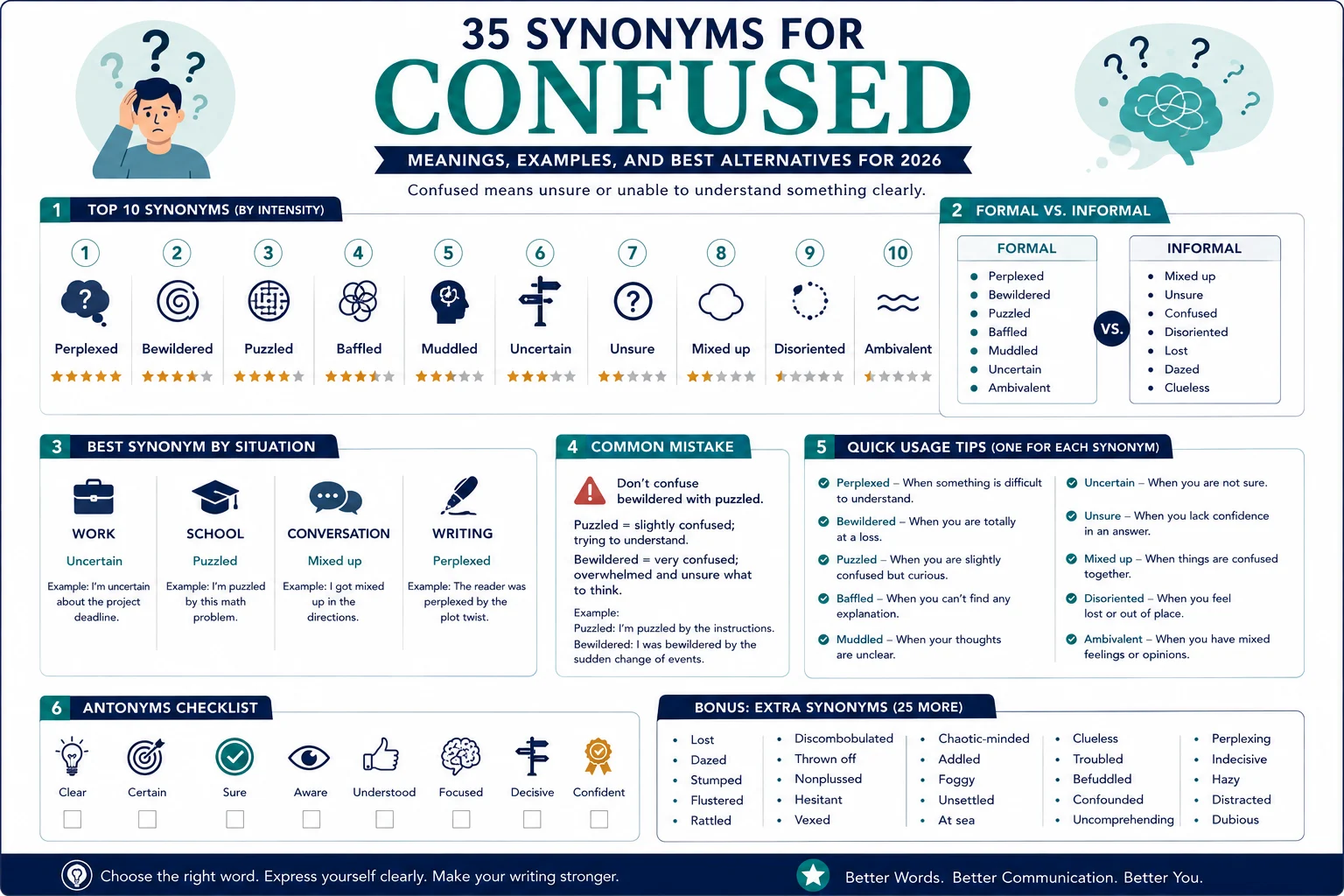
Confused means being unable to think clearly or understand something properly. The best synonyms include bewildered for strong confusion, puzzled for mild confusion, perplexed for intellectual confusion, baffled when you cannot find an explanation, and muddled for a state of mental disarray. The most common choice in everyday conversation is confused itself, but puzzled and bewildered appear frequently in both speech and writing. Each synonym carries a slightly different intensity and tone, so choosing the right one depends on how confused you actually feel.
Have you ever struggled to find the right word to describe that foggy, head-spinning feeling when nothing makes sense?
You are not alone. English learners and native speakers alike often reach for “confused” again and again. But English offers a rich variety of alternatives that can express exactly how you feel, whether you are slightly puzzled by a riddle or completely bewildered by a complex situation.
This guide will help you understand the subtle differences between 35 synonyms for confused. You will learn which words sound natural in conversation, which ones belong in academic writing, and which ones native speakers actually prefer. By the end, you will never feel at a loss for words when describing confusion again.
What Does “Confused” Mean?
Definition
Confused describes a mental state where you cannot think clearly, understand something, or distinguish between different things. It can refer to temporary mental fogginess, emotional disorientation, or a jumbled state of disorder. When you are confused, your thoughts feel scattered, and you struggle to make sense of what is happening around you. The word can describe both people and situations. A confused person cannot follow an explanation, while a confused situation lacks order or clarity.
Pronunciation
| Feature | Value |
|---|---|
| US IPA | /kənˈfjuːzd/ |
| UK IPA | /kənˈfjuːzd/ |
| Syllables | 2 |
| Tip | Stress the second syllable: con-FUZED |
Grammar
| Grammar Feature | Information |
|---|---|
| Part of Speech | Adjective |
| Common Position | Before a noun (a confused student) or after a linking verb (She looks confused) |
| Typical Pattern | confused + about + noun (confused about the instructions) |
Example sentences:
- The students looked confused during the difficult lecture.
- I am confused about the new policy changes.
- Her explanation left me more confused than before.
Word Family
| Word | Part of Speech | Meaning |
|---|---|---|
| Confuse | Verb | To make someone unable to think clearly |
| Confused | Adjective | Unable to think clearly or understand |
| Confusing | Adjective | Causing confusion |
| Confusion | Noun | The state of being confused |
| Confusedly | Adverb | In a confused manner |
15 Synonyms for “Confused”
1. Puzzled
Meaning: Slightly confused because something is difficult to understand. This is a mild and common synonym.
Best Used For: Daily conversation, casual writing, and describing minor confusion.
Formality: Neutral
Tone: Neutral, slightly curious
Frequency: ⭐⭐⭐⭐⭐ Very Common
CEFR Level: B1
Example Sentence 1: I was puzzled by the cryptic message on the whiteboard.
Example Sentence 2: Scientists remain puzzled by this strange phenomenon.
Usage Tip: Use “puzzled” when you are curious and intrigued rather than frustrated. It suggests you want to solve the mystery. Native speakers often use this word to describe mild confusion about puzzles, riddles, or unexpected events. Avoid using it for serious disorientation.
2. Perplexed
Meaning: Completely confused and unable to understand something, often due to complexity or contradiction.
Best Used For: Academic writing, professional communication, and describing intellectual confusion.
Formality: Formal
Tone: Neutral, intellectual
Frequency: ⭐⭐⭐⭐ Common
CEFR Level: B2
Example Sentence 1: The professor was perplexed by the student’s unusual question.
Example Sentence 2: She is perplexed about what to do for her daughter’s education.
Usage Tip: “Perplexed” sounds more formal and intellectual than “puzzled.” Use it in academic essays or professional emails. It works well when you are confused by complex information, not everyday situations.
3. Bewildered
Meaning: Extremely confused and surprised, often because something unexpected or overwhelming has happened.
Best Used For: Creative writing, storytelling, and describing strong emotional confusion.
Formality: Neutral to slightly formal
Tone: Emotional, surprised
Frequency: ⭐⭐⭐⭐ Common
CEFR Level: B2
Example Sentence 1: Some shoppers look bewildered by the variety of goods on offer.
Example Sentence 2: The flood of questions left her bewildered and confused.
Usage Tip: Use “bewildered” when confusion comes with surprise or shock. It is stronger than “puzzled” and often suggests being overwhelmed. This word appears frequently in literature and storytelling.
4. Baffled
Meaning: So confused that you cannot understand or explain something at all. It suggests total puzzlement.
Best Used For: Describing situations where you have no explanation, informal conversation, and problem-solving contexts.
Formality: Neutral to informal
Tone: Frustrated, surprised
Frequency: ⭐⭐⭐⭐ Common
CEFR Level: B2
Example Sentence 1: The detective was baffled by the mysterious disappearance.
Example Sentence 2: She was baffled by the sudden change in his behavior.
Usage Tip: “Baffled” is more intense than “puzzled.” Use it when you have tried to understand something but failed completely. It often carries a hint of frustration. This is a very common word in everyday English.
5. Muddled
Meaning: Confused and disorganized in thinking, often because you are tired, overwhelmed, or dealing with too much information.
Best Used For: Describing mental fog, tiredness, and informal situations.
Formality: Informal
Tone: Neutral, slightly negative
Frequency: ⭐⭐⭐⭐ Common
CEFR Level: B2
Example Sentence 1: I’m afraid I’m a little muddled. I don’t know where to begin.
Example Sentence 2: After the long flight, my thoughts felt muddled and unclear.
Usage Tip: “Muddled” suggests a state of mental disarray rather than confusion about a specific thing. Use it when your thinking feels messy or disorganized. It is a great word for describing how you feel when you are exhausted or overwhelmed.
6. Disoriented
Meaning: Confused about where you are, what time it is, or what is happening around you. It often involves loss of bearings.
Best Used For: Describing physical or situational confusion, travel, and medical contexts.
Formality: Neutral to slightly formal
Tone: Neutral, concerned
Frequency: ⭐⭐⭐⭐ Common
CEFR Level: B2
Example Sentence 1: I feel dizzy and disoriented after the roller coaster ride.
Example Sentence 2: The patient was disoriented and could not remember his name.
Usage Tip: “Disoriented” is more specific than other synonyms. It describes confusion about time, place, or identity. Use it when someone cannot find their bearings physically or mentally. It is common in medical and travel contexts.
7. Befuddled
Meaning: Confused and unable to think clearly, often suggesting mild intoxication or extreme tiredness.
Best Used For: Informal conversation, humorous descriptions, and creative writing.
Formality: Informal
Tone: Playful, slightly negative
Frequency: ⭐⭐⭐ Moderate
CEFR Level: C1
Example Sentence 1: The complicated tax forms left him completely befuddled.
Example Sentence 2: I felt befuddled after the long night of studying.
Usage Tip: “Befuddled” has a slightly humorous quality. It often suggests confusion from tiredness, drink, or being overwhelmed by silly things. Use it in casual contexts, not formal writing. It is less common than “puzzled” or “bewildered.”
8. Flummoxed
Meaning: Utterly confused and unable to understand or solve something. This is a playful, slightly old-fashioned word.
Best Used For: Informal conversation, humorous writing, and describing frustrating situations.
Formality: Informal
Tone: Playful, frustrated
Frequency: ⭐⭐ Rare
CEFR Level: C1
Example Sentence 1: The leaders were flummoxed by the suggestion.
Example Sentence 2: I was completely flummoxed by the crossword puzzle.
Usage Tip: “Flummoxed” is a fun, informal word that sounds old-fashioned but charming. Use it when you want to describe confusion in a lighthearted way. It is not common in everyday speech but appears in writing for effect.
9. Nonplussed
Meaning: So confused and surprised that you do not know how to react or what to say.
Best Used For: Formal writing, describing social situations, and literary contexts.
Formality: Formal
Tone: Surprised, uncertain
Frequency: ⭐⭐ Rare
CEFR Level: C1
Example Sentence 1: Patricia was totally nonplussed by Coyne’s behavior.
Example Sentence 2: The unexpected question left the speaker nonplussed.
Usage Tip: “Nonplussed” is formal and relatively uncommon. It suggests confusion accompanied by surprise or embarrassment. Many native speakers misuse this word as meaning “unbothered,” so be careful. Use it in formal writing, not conversation.
10. Confounded
Meaning: Extremely confused and annoyed, often because something is frustrating or difficult to understand.
Best Used For: Expressing frustration, formal writing, and strong emotions.
Formality: Formal
Tone: Frustrated, annoyed
Frequency: ⭐⭐ Rare
CEFR Level: C1
Example Sentence 1: The complicated instructions confounded everyone in the room.
Example Sentence 2: I was confounded by his refusal to explain his actions.
Usage Tip: “Confounded” is stronger than “confused” and carries frustration. It is quite formal and less common than “baffled” or “bewildered.” Use it when you are not just confused but also annoyed by the confusion.
11. Addled
Meaning: Confused and unable to think clearly, often suggesting mental decay or being overwhelmed.
Best Used For: Describing mental fatigue, literary writing, and older texts.
Formality: Formal
Tone: Negative, concerned
Frequency: ⭐⭐ Rare
CEFR Level: C1
Example Sentence 1: The stressful situation left her mind completely addled.
Example Sentence 2: His addled brain could not process the complex information.
Usage Tip: “Addled” suggests confusion from exhaustion, stress, or aging. It is relatively uncommon in modern conversation. Use it in literary writing or to describe someone who cannot think straight due to external pressures.
12. Discombobulated
Meaning: Confused and thrown into disarray, often in a humorous or exaggerated way.
Best Used For: Humorous descriptions, informal conversation, and creative writing.
Formality: Informal
Tone: Playful, exaggerated
Frequency: ⭐⭐ Rare
CEFR Level: C1
Example Sentence 1: The sudden change in plans left everyone discombobulated.
Example Sentence 2: I felt completely discombobulated after the surprise party.
Usage Tip: “Discombobulated” is a fun, exaggerated word that is never used in formal writing. It suggests confusion mixed with mild chaos. Use it for humorous effect, but do not overuse it.
13. Muzzy
Meaning: Dull and confused, often due to tiredness, illness, or alcohol. It describes a fuzzy mental state.
Best Used For: Describing how you feel physically, informal contexts, and British English.
Formality: Informal
Tone: Neutral, slightly negative
Frequency: ⭐ Rare
CEFR Level: C1
Example Sentence 1: My head feels muzzy after the long journey.
Example Sentence 2: I was still muzzy from the medication.
Usage Tip: “Muzzy” is more common in British English than American English. It describes a foggy, unclear mental state, often from physical causes. It is not commonly used in American conversation.
14. Stupefied
Meaning: So confused and shocked that you cannot think or react normally.
Best Used For: Strong emotional shock, literary writing, and medical contexts.
Formality: Formal
Tone: Shocked, stunned
Frequency: ⭐⭐ Rare
CEFR Level: C1
Example Sentence 1: The audience sat stupefied by the shocking performance.
Example Sentence 2: She was stupefied with grief after the terrible news.
Usage Tip: “Stupefied” is an intense word. It suggests confusion from shock or extreme emotion. Use it only when describing someone who has been completely overwhelmed by events.
15. At a loss
Meaning: Unsure what to do or say because you are confused or surprised. This is a common expression.
Best Used For: Daily conversation, professional communication, and describing inability to respond.
Formality: Neutral
Tone: Uncertain, surprised
Frequency: ⭐⭐⭐⭐ Common
CEFR Level: B2
Example Sentence 1: I was at a loss for what to do next.
Example Sentence 2: The teacher was at a loss to explain the student’s strange behavior.
Usage Tip: “At a loss” is a common expression that means confused about what action to take. It is different from other synonyms because it focuses on not knowing how to respond rather than not understanding something. Use it in both conversation and professional contexts.
Synonyms Comparison Table
| Synonym | Best Context | Formality | Tone | Frequency |
|---|---|---|---|---|
| Puzzled | Daily conversation | Neutral | Curious | Very Common |
| Perplexed | Academic writing | Formal | Intellectual | Common |
| Bewildered | Creative writing | Neutral | Surprised | Common |
| Baffled | Problem-solving | Neutral | Frustrated | Common |
| Muddled | Mental fog | Informal | Exhausted | Common |
| Disoriented | Physical confusion | Neutral | Concerned | Common |
| Befuddled | Humorous description | Informal | Playful | Moderate |
| Flummoxed | Playful frustration | Informal | Playful | Rare |
| Nonplussed | Formal situations | Formal | Surprised | Rare |
| Confounded | Frustrated expression | Formal | Frustrated | Rare |
| Addled | Literary writing | Formal | Concerned | Rare |
| Discombobulated | Humorous effect | Informal | Playful | Rare |
| Muzzy | Physical state | Informal | Fuzzy | Rare |
| Stupefied | Strong shock | Formal | Stunned | Rare |
| At a loss | Decision confusion | Neutral | Uncertain | Very Common |
Best Synonyms by Situation
| Situation | Best Synonym | Why It Works |
|---|---|---|
| Daily Conversation | Puzzled | Sounds natural, not too strong |
| Business Email | Perplexed | Professional and clear |
| Academic Writing | Perplexed / Confounded | Formal and precise |
| School Assignment | Puzzled / Baffled | Appropriate for student work |
| Professional Meeting | At a loss | Humble and professional |
| Presentation | Perplexed | Shows intellectual engagement |
| Creative Writing | Bewildered / Disoriented | Adds emotional depth |
| Social Media | Baffled / Muddled | Relatable and modern |
| Describing a Person | Bewildered | Emphasizes the person’s state |
| Describing a Situation | Confused / Muddled | Fits chaotic contexts |
Formal vs Informal Synonyms
Formal Alternatives
| Synonym | Best Used For |
|---|---|
| Perplexed | Academic essays, research papers |
| Nonplussed | Formal speeches, literary analysis |
| Confounded | Professional correspondence, formal reports |
| Stupefied | Medical or psychological descriptions |
Neutral Alternatives
| Synonym | Best Used For |
|---|---|
| Puzzled | Most everyday situations |
| Bewildered | Writing and conversation |
| Disoriented | Physical and situational contexts |
| At a loss | Professional and personal decisions |
Informal Alternatives
| Synonym | Best Used For |
|---|---|
| Muddled | Conversations with friends |
| Befuddled | Humorous or casual contexts |
| Flummoxed | Playful writing |
| Discombobulated | Exaggerated or funny descriptions |
Which should you choose? Use formal synonyms for academic essays and professional emails. Choose neutral synonyms for most everyday situations. Save informal synonyms for conversations with friends and creative writing.
Strong vs Mild Synonyms
Mild
These synonyms describe mild or temporary confusion:
- Puzzled
- Muddled
- At a loss
Moderate
These describe stronger confusion:
- Perplexed
- Baffled
- Disoriented
Strong
These describe intense or overwhelming confusion:
- Bewildered
- Confounded
- Stupefied
- Flummoxed
Choosing the right intensity matters. If you use a strong synonym for mild confusion, you may sound dramatic. If you use a mild synonym for strong confusion, you may downplay the situation. Match the intensity to how confused you actually feel.
Real-Life Examples
School: The students were completely perplexed by the complicated math problem, even after the teacher explained it twice.
Office: During the meeting, everyone was at a loss when the CEO announced the sudden restructuring.
Business Email: I am a little puzzled by the discrepancy in the quarterly report figures.
Conversation: After trying to assemble the furniture for three hours, I was thoroughly befuddled by the remaining pieces.
Creative Writing: She stumbled through the dark forest, bewildered and disoriented, with no idea which direction led home.
Social Media: Day 3 of trying to learn this coding language, and I am thoroughly baffled.
Professional: The research team was confounded by the unexpected results of their experiment.
Common Collocations
| Common Phrase | Better Alternative |
|---|---|
| Very confused | Completely bewildered |
| A bit confused | Slightly puzzled |
| Totally confused | Utterly baffled |
| Confused look | Bewildered expression |
| Confused thinking | Muddled reasoning |
| Confused situation | Chaotic situation |
Common Phrases
1. At a loss for words
Meaning: Unable to speak because you are so confused or surprised.
Better alternative: Speechless, dumbfounded
2. Confused by something
Meaning: Made unable to understand something.
Better alternative: Baffled by, perplexed by
3. Left feeling confused
Meaning: Made to feel a lack of understanding.
Better alternative: Left bewildered, left puzzled
Context Guide
| Situation | Best Synonym | Reason |
|---|---|---|
| Essay | Perplexed | Formal and academic |
| Speech | Bewildered | Strong and emotional |
| Business Email | Puzzled | Professional but friendly |
| Novel | Disoriented | Descriptive and literary |
| Presentation | At a loss | Relatable and honest |
| Conversation | Muddled | Casual and natural |
| Academic Writing | Confounded | Precise and formal |
| Marketing Copy | Baffled | Relatable and engaging |
Related Words
Near Synonyms
- Unsure
- Uncertain
- Doubtful
- Lost
Antonyms
| Antonym | Meaning | Example Sentence |
|---|---|---|
| Clear | Easy to understand | The instructions were perfectly clear. |
| Oriented | Having awareness of surroundings | She felt fully oriented in the new city. |
| Comprehending | Understanding something | He was comprehending the lesson easily. |
| Organized | Having order and structure | The notes were neat and organized. |
| Methodical | Done in a systematic way | His methodical approach prevented any confusion. |
Related Adjectives
- Confusing (causes confusion)
- Clear (not confused)
- Uncertain (not sure)
Related Nouns
- Confusion (the state of being confused)
- Perplexity (the state of being perplexed)
- Bewilderment (the state of being bewildered)
Related Verbs
- Confuse (to make someone confused)
- Perplex (to make someone perplexed)
- Baffle (to make someone baffled)
Frequently Asked Questions
1. What is the most common synonym for confused?
Puzzled is the most common synonym in everyday conversation. It describes mild confusion in a natural way. Bewildered and baffled are also common but suggest stronger confusion.
2. Which synonym sounds the most professional?
Perplexed sounds the most professional. It is formal enough for academic writing and business communication while remaining clear and precise. Use it in emails, reports, and professional correspondence.
3. What is the strongest synonym for confused?
Bewildered is one of the strongest synonyms. It suggests complete mental disorientation, often with surprise. Stupefied is even stronger but is less common in everyday language.
4. Which synonym is best for essays?
Perplexed or confounded are best for essays. Both are formal and academic, making them appropriate for scholarly writing. They show intellectual engagement with complex topics.
5. What is the difference between puzzled and bewildered?
Puzzled describes mild confusion with curiosity, while bewildered describes strong confusion with surprise and shock. Puzzled is like trying to solve a riddle. Bewildered is like being completely lost.
6. What is a casual way to say confused?
Muddled or befuddled are casual ways to say confused. Befuddled even has a playful quality. You can also say “I am at a loss” or “I am baffled” in informal contexts.
7. What is a British synonym for confused?
Muzzy is a more British synonym for confused. It suggests a foggy mental state from tiredness or illness. Flummoxed is also more common in British English than American English.
8. What is the opposite of confused?
The opposite of confused is clear, oriented, or organized. A clear person understands everything. An organized system has no chaos or disorder. Other antonyms include methodical and comprehending.
Conclusion
Confused describes a state of mental fog when you cannot think clearly or understand something. But English offers many ways to express this feeling with precision.
For everyday situations, choose puzzled for mild confusion, perplexed for formal contexts, or bewildered for stronger emotions. Use baffled when you have no explanation and muddled when your thoughts are disorganized. Save playful words like flummoxed and discombobulated for lighthearted moments.
The key to using these synonyms well is matching intensity to the situation. A mild synonym for mild confusion sounds natural. A strong synonym for mild confusion sounds exaggerated. Choose carefully, and your English will sound more precise and native-like.
Start practicing today. The next time you feel confused, reach for the perfect word instead of settling for the same old one.
