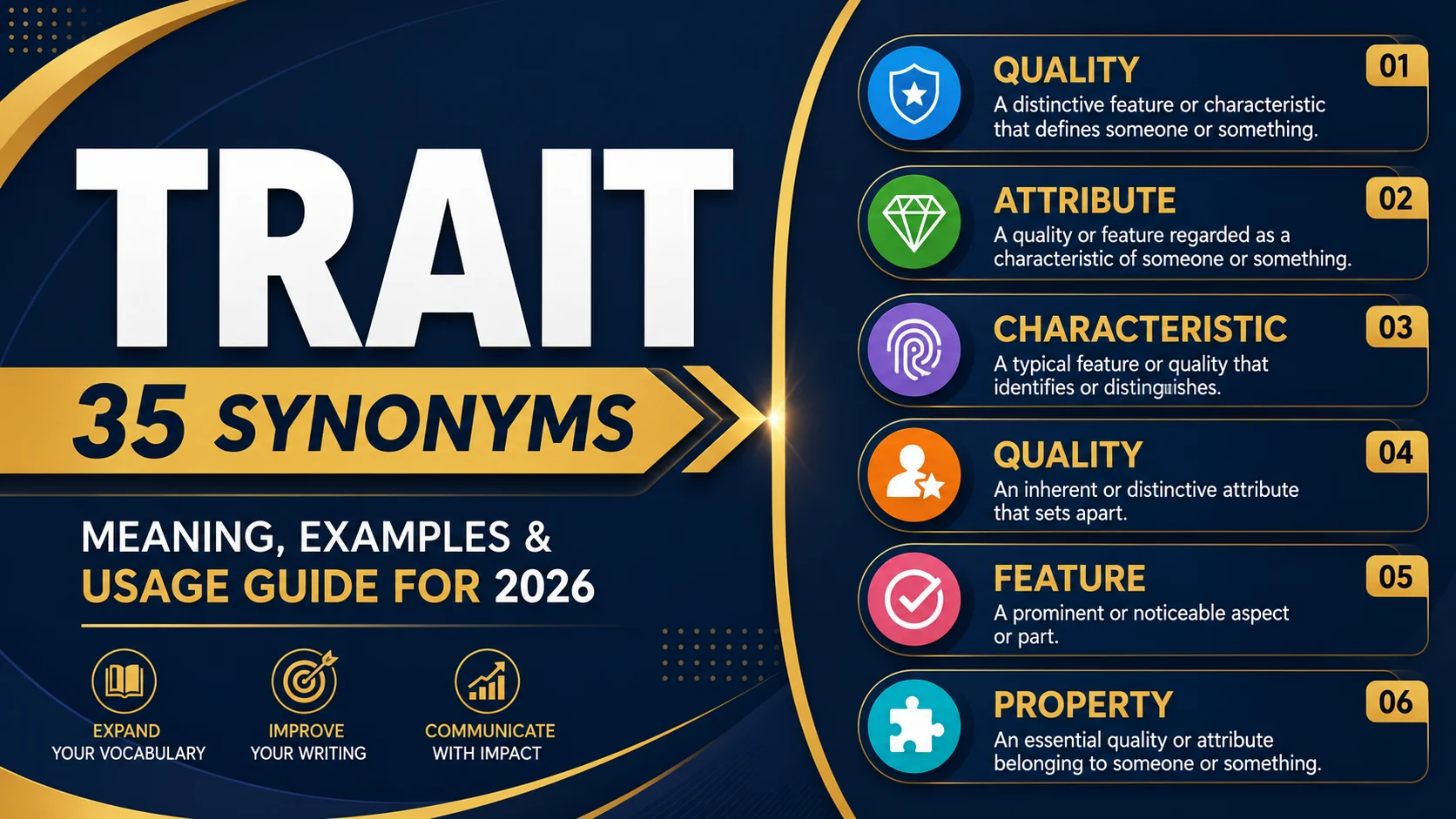
A trait is a distinguishing quality or characteristic of a person, animal, or thing. The best synonyms include characteristic, feature, attribute, quality, and property. In everyday conversation, native speakers often say “that’s just his nature” or “it runs in the family” instead of using the word trait. Each synonym carries a slightly different nuance, so choosing the right one depends on whether you’re describing personality, physical appearance, biology, or objects.
Top 10 Synonyms of Trait:
- Characteristic
- Feature
- Attribute
- Quality
- Property
- Aspect
- Mark
- Hallmark
- Peculiarity
- Quirk
Have you ever struggled to describe someone’s personality or the unique features of an object? The word “trait” is incredibly useful, but using it repeatedly can make your writing feel stiff and repetitive. Whether you’re writing a character description, a biology paper, or simply talking about what makes your friend special, having a rich vocabulary of synonyms makes all the difference.
In this guide, I’ll teach you the best synonyms for trait, explain exactly when and how to use them, and help you avoid common mistakes that even advanced English learners make. We’ll explore the subtle differences between words like characteristic and feature, attribute and quality, so you can choose the perfect word every time.
What Does “Trait” Mean?
Definition
In simple terms, a trait is a specific quality or feature that makes someone or something different or recognizable. Think of it as a “marker” that helps you identify or describe a person, animal, or object. Traits can be physical, like eye color or height, or they can be about personality, like kindness or honesty.
For example, “Her most noticeable trait is her infectious laugh,” or “The plant’s genetic traits make it resistant to drought.” A trait is essentially any distinguishing characteristic that stands out.
Pronunciation
- US IPA: /treɪt/
- UK IPA: /treɪt/
- Syllables: 1
- Tip: Pronounce it to rhyme with “great” or “late.” The “ai” makes a long “a” sound.
Grammar
| Grammar Feature | Information |
|---|---|
| Part of Speech | Noun (countable) |
| Common Position | Usually follows adjectives or possessive pronouns |
| Typical Pattern | trait + of / trait + in |
Example Sentences:
- Patience is a trait I really admire in teachers.
- One physical trait that runs in my family is curly hair.
- The most important trait for a leader is empathy.
Grammar Note: “Trait” is a countable noun, so you can have “a trait,” “several traits,” or “many traits.”
Word Family
| Word | Part of Speech | Meaning |
|---|---|---|
| Trait | Noun | A distinguishing quality or characteristic. |
| Traited | Adjective | Having specific traits (rarely used). |
| Traitless | Adjective | Lacking any distinguishing traits. |
15 Synonyms of “Trait”
Characteristic
Meaning: A quality or feature that is typical of someone or something and helps to identify them.
Best Used For: Academic writing, scientific descriptions, formal essays, and general descriptions.
Formality: Neutral to Formal
Tone: Objective, Descriptive
Frequency: ⭐⭐⭐⭐⭐ Very Common
CEFR Level: B1
Example Sentence 1: One defining characteristic of successful entrepreneurs is their willingness to take risks.
Example Sentence 2: The main characteristic of this breed of dog is its loyalty and intelligence.
Usage Tip: “Characteristic” is perhaps the closest and most direct synonym for trait. It’s versatile and works well in almost any context. Use it when you want to sound slightly more formal or academic than just saying “trait.”
Feature
Meaning: A distinctive or noticeable part or quality of something.
Best Used For: Everyday conversation, product descriptions, technology, and creative writing.
Formality: Neutral
Tone: Descriptive, Informative
Frequency: ⭐⭐⭐⭐⭐ Very Common
CEFR Level: A2
Example Sentence 1: The best feature of this new phone is its incredible camera.
Example Sentence 2: Her most striking feature is her beautiful green eyes.
Usage Tip: “Feature” is often used for physical or visible qualities, especially in products or technology. Use this synonym when you’re talking about what something has rather than what someone is.
Attribute
Meaning: A quality or characteristic that is considered to be part of someone’s nature or personality.
Best Used For: Professional settings, personality descriptions, performance reviews.
Formality: Formal
Tone: Professional, Analytical
Frequency: ⭐⭐⭐⭐ Common
CEFR Level: B2
Example Sentence 1: Her most valuable attribute as an employee is her reliability.
Example Sentence 2: Physical strength is not the most important attribute for success in this sport.
Usage Tip: “Attribute” sounds professional and is perfect for job interviews or performance reviews. It often implies a quality that is positive or valuable. Native speakers prefer this word when discussing skills or personal strengths.
Quality
Meaning: A distinctive characteristic or feature of a person or thing.
Best Used For: Everyday conversation, personal descriptions, general writing.
Formality: Neutral
Tone: Evaluative, Descriptive
Frequency: ⭐⭐⭐⭐⭐ Very Common
CEFR Level: A2
Example Sentence 1: Kindness is a quality I look for in all my friends.
Example Sentence 2: The most important quality of a good teacher is patience.
Usage Tip: “Quality” is probably the most flexible synonym. It can describe both good and bad characteristics, but it’s most often used for positive ones. It works beautifully in everyday speech.
Property
Meaning: A characteristic or quality inherent in the nature of a substance or object.
Best Used For: Scientific writing, technical descriptions, chemistry, physics.
Formality: Formal
Tone: Scientific, Technical
Frequency: ⭐⭐⭐ Moderate
CEFR Level: B2
Example Sentence 1: One chemical property of water is its ability to dissolve many substances.
Example Sentence 2: The healing properties of this plant have been known for centuries.
Usage Tip: “Property” is the go-to word in scientific and technical contexts. It describes inherent, measurable qualities of materials, substances, or objects. Avoid this synonym in casual conversation about people.
Aspect
Meaning: A particular part or feature of a situation, idea, or person.
Best Used For: Analysis, discussions, academic writing, problem-solving.
Formality: Neutral to Formal
Tone: Analytical, Objective
Frequency: ⭐⭐⭐⭐⭐ Very Common
CEFR Level: B1
Example Sentence 1: The most challenging aspect of this job is the long hours.
Example Sentence 2: We need to consider every aspect of the problem before making a decision.
Usage Tip: “Aspect” is perfect when you’re analyzing a complex topic or breaking something down into parts. It focuses on the part rather than the whole.
Mark
Meaning: A distinctive characteristic or quality that is typical of someone or something.
Best Used For: Descriptive writing, literary contexts, poetic language.
Formality: Neutral to Literary
Tone: Expressive, Imaginative
Frequency: ⭐⭐⭐ Moderate
CEFR Level: B1
Example Sentence 1: Generosity is the mark of a truly good person.
Example Sentence 2: The marks of a great leader include integrity and vision.
Usage Tip: “Mark” has a slightly literary or poetic feel. It’s excellent for making a strong, memorable statement. Native speakers often use it in phrases like “the mark of greatness.”
Hallmark
Meaning: A distinctive characteristic or feature that is a reliable indicator of quality or authenticity.
Best Used For: Formal writing, product reviews, quality assessments.
Formality: Formal
Tone: Authoritative, Evaluative
Frequency: ⭐⭐⭐ Moderate
CEFR Level: B2
Example Sentence 1: Attention to detail is the hallmark of a skilled craftsman.
Example Sentence 2: Clear communication is a hallmark of effective leadership.
Usage Tip: “Hallmark” implies a defining or quality feature. It’s often used to identify something as genuine or superior. Use it when you want to emphasize that something is the best example of a quality.
Peculiarity
Meaning: A strange or unusual characteristic or habit.
Best Used For: Creative writing, character descriptions, psychology.
Formality: Neutral
Tone: Curious, Observant
Frequency: ⭐⭐ Rare
CEFR Level: C1
Example Sentence 1: One of his many peculiarities is his habit of talking to his plants.
Example Sentence 2: The peculiarity of this building is that it has no windows.
Usage Tip: “Peculiarity” focuses on the unusual or odd. It’s perfect for describing quirks or things that make someone or something stand out in a unique way.
Quirk
Meaning: A peculiar habit or characteristic; an idiosyncrasy.
Best Used For: Informal conversation, character descriptions, storytelling.
Formality: Informal
Tone: Playful, Affectionate
Frequency: ⭐⭐⭐⭐ Common
CEFR Level: B2
Example Sentence 1: One of my favorite quirks about her is that she always sings in the shower.
Example Sentence 2: The car has a few quirks, but I love it anyway.
Usage Tip: “Quirk” has a positive or neutral tone, often used affectionately. It’s almost always about personality or habits, not physical features. Use this when you want a friendly, conversational word.
Idiosyncrasy
Meaning: A distinctive, unusual, or eccentric way of behaving or thinking.
Best Used For: Psychology, character analysis, formal writing.
Formality: Formal
Tone: Analytical, Psychological
Frequency: ⭐⭐ Rare
CEFR Level: C1
Example Sentence 1: His idiosyncrasy of always wearing mismatched socks made him memorable.
Example Sentence 2: The psychologist studied the patient’s idiosyncrasies to understand her personality better.
Usage Tip: “Idiosyncrasy” is the formal, academic cousin of “quirk.” Use it in psychological or analytical contexts when you want to sound scholarly.
Disposition
Meaning: A person’s inherent qualities of mind and character; a tendency or inclination.
Best Used For: Psychology, personality descriptions, formal writing.
Formality: Formal
Tone: Psychological, Descriptive
Frequency: ⭐⭐⭐ Moderate
CEFR Level: B2
Example Sentence 1: She has a naturally cheerful disposition that brightens the room.
Example Sentence 2: His aggressive disposition made him difficult to work with.
Usage Tip: “Disposition” describes a person’s natural or habitual mood or way of thinking. It’s more about a person’s general nature than a single trait.
Temperament
Meaning: A person’s nature, especially as it affects their behavior and reactions.
Best Used For: Psychology, parenting, animal behavior.
Formality: Formal
Tone: Psychological, Analytical
Frequency: ⭐⭐⭐ Moderate
CEFR Level: B2
Example Sentence 1: A calm temperament is essential for someone working in emergency services.
Example Sentence 2: The dog’s friendly temperament makes him great with children.
Usage Tip: “Temperament” is similar to “disposition” but often focuses more on emotional reactivity. It’s about how someone (or an animal) responds to the world.
Predisposition
Meaning: A tendency to behave in a particular way or to develop a certain condition.
Best Used For: Medicine, psychology, genetics.
Formality: Formal
Tone: Scientific, Objective
Frequency: ⭐⭐ Rare
CEFR Level: C1
Example Sentence 1: She has a genetic predisposition to diabetes.
Example Sentence 2: There’s a natural predisposition in humans to seek social connection.
Usage Tip: “Predisposition” is used in medical or psychological contexts to describe an inclination or tendency, especially one that is innate or genetic.
Lineament
Meaning: A distinctive feature or characteristic, especially of a person’s face.
Best Used For: Literary writing, poetry, creative descriptions.
Formality: Literary/Formal
Tone: Poetic, Artistic
Frequency: ⭐ Very Rare
CEFR Level: C2
Example Sentence 1: The artist captured every lineament of her face with remarkable precision.
Example Sentence 2: The lineaments of his character were visible even in his youth.
Usage Tip: “Lineament” is a rare, literary word. It’s beautiful and expressive but not appropriate for everyday conversation.
Synonyms Comparison Table
| Synonym | Best Context | Formality | Tone | Frequency |
|---|---|---|---|---|
| Characteristic | General, Academic | Neutral/Formal | Objective | ⭐⭐⭐⭐⭐ |
| Feature | Products, Physical | Neutral | Descriptive | ⭐⭐⭐⭐⭐ |
| Quality | General, Personal | Neutral | Evaluative | ⭐⭐⭐⭐⭐ |
| Aspect | Analysis, Topics | Neutral/Formal | Analytical | ⭐⭐⭐⭐⭐ |
| Attribute | Professional, Skills | Formal | Professional | ⭐⭐⭐⭐ |
| Quirk | Informal, Personal | Informal | Playful | ⭐⭐⭐⭐ |
| Property | Scientific, Technical | Formal | Scientific | ⭐⭐⭐ |
| Disposition | Psychology, Personality | Formal | Psychological | ⭐⭐⭐ |
| Temperament | Psychology, Reactions | Formal | Psychological | ⭐⭐⭐ |
| Mark | Literary, Descriptive | Neutral/Literary | Expressive | ⭐⭐⭐ |
| Hallmark | Quality Assessment | Formal | Evaluative | ⭐⭐⭐ |
| Peculiarity | Creative, Unusual | Neutral | Observant | ⭐⭐ |
| Idiosyncrasy | Psychology, Formal | Formal | Analytical | ⭐⭐ |
| Predisposition | Medical, Genetic | Formal | Scientific | ⭐⭐ |
| Lineament | Literary, Artistic | Literary | Poetic | ⭐ |
Best Synonyms by Situation
| Situation | Best Synonym | Why It Works |
|---|---|---|
| Job Interview | Attribute / Quality | These sound professional and highlight personal strengths. |
| Product Description | Feature / Property | These focus on what the product has and does. |
| Scientific Report | Property / Characteristic | These are objective, measurable, and technically accurate. |
| Character Description | Quirk / Peculiarity | These add color and individuality to characters. |
| Psychology Paper | Disposition / Temperament | These are the accepted academic terms in psychology. |
| Casual Conversation | Quality / Feature | These are natural, neutral, and easy to understand. |
Formal vs Informal Synonyms
Formal Alternatives
| Synonym | Best Used For |
|---|---|
| Attribute | Professional skills and personal strengths |
| Property | Scientific and technical descriptions |
| Disposition | Psychological and personality contexts |
| Temperament | Academic discussions of behavior |
| Idiosyncrasy | Formal character analysis |
Neutral Alternatives
| Synonym | Best Used For |
|---|---|
| Characteristic | Most general uses |
| Feature | Physical or visible qualities |
| Quality | Personal and general descriptions |
| Aspect | Analysis and breakdowns |
Informal Alternatives
| Synonym | Best Used For |
|---|---|
| Quirk | Describing someone’s habits or habits |
| Thing | Very casual conversation (e.g., “Her thing is kindness”) |
Choosing the Right Level of Formality: If you’re unsure, “characteristic” or “quality” are safe choices for almost any situation. Use “quirk” or “feature” for everyday conversations.
Strong vs Mild Synonyms
Mild Alternatives
- Quality (A general positive characteristic)
- Feature (A visible or noticeable part)
- Aspect (A part of a larger whole)
Moderate Alternatives
- Characteristic (A typical identifying quality)
- Attribute (A valued personal quality)
- Property (An inherent, measurable quality)
Strong Alternatives
- Hallmark (A mark of quality or authenticity)
- Peculiarity (A very unusual or defining characteristic)
- Lineament (A distinctive, often artistic, feature)
Real-Life Examples
In the Workplace:
“During the interview, I emphasized my most important attributes: my leadership skills and my ability to work under pressure.”
In a Product Review:
“The standout feature of this laptop is its battery life. It lasts for over 12 hours on a single charge.”
In a Biology Class:
“One inherited trait of this species is their ability to camouflage themselves to avoid predators.”
In Casual Conversation:
“One of my favorite quirks about my dog is that he howls along with music. It’s hilarious.”
In a Psychological Profile:
“The subject’s temperament is notably calm, even in stressful situations.”
Common Collocations
| Common Phrase | Better Alternative |
|---|---|
| Personality trait | Personality quality / Personality characteristic |
| Physical trait | Physical feature / Physical characteristic |
| Genetic trait | Genetic characteristic / Genetic property |
| Inherited trait | Inherited quality / Inherited characteristic |
Common Phrases
- “A defining trait” – A characteristic that clearly shows what someone or something is like. Better alternative: “A defining characteristic” or “a hallmark.”
- “It runs in the family” – A trait shared by family members. This is a natural English idiom for describing inherited qualities.
- “That’s just his nature” – A quality that is a fundamental part of someone’s personality.
Context Guide
| Situation | Best Synonym | Reason |
|---|---|---|
| Essay | Characteristic / Attribute | Sounds academic and precise. |
| Speech | Quality / Hallmark | Engaging and easy to remember. |
| Business Email | Attribute / Quality | Professional and direct. |
| Novel | Quirk / Peculiarity | Adds personality and color. |
| Scientific Paper | Property / Predisposition | Technical and accurate. |
| Conversation | Feature / Quality | Natural and easy to understand. |
| Product Review | Feature / Aspect | Focuses on usability and experience. |
Related Words
Near Synonyms
- Nature (n.) – The basic qualities of a person or thing.
- Character (n.) – The mental and moral qualities distinctive to an individual.
- Personality (n.) – The combination of characteristics that forms an individual’s distinctive character.
Antonyms
- Atypicality (n.) – The quality of being unusual or not typical.
- Aberration (n.) – A departure from what is normal or expected.
- Related Adjectives
- Characteristic (adj.) – Typical of a particular person, place, or thing.
- Distinctive (adj.) – Having a quality that makes someone or something different or easy to recognize.
- Innate (adj.) – Inborn; natural.
- Related Nouns
- Characteristic (n.) – A feature or quality belonging to someone or something.
- Quality (n.) – A distinctive attribute or characteristic.
Related Verbs
- Characterize (v.) – To describe the distinctive nature of something.
- Distinguish (v.) – To make someone or something different or noticeable.
Frequently Asked Questions
- What is another word for trait?
- Another word for trait is characteristic, feature, attribute, quality, or property. The best choice depends on your context. For personality, use “quality” or “attribute.” For physical descriptions, use “feature” or “characteristic.” For scientific contexts, “property” is a good choice.
Which synonym for trait sounds the most professional?
The most professional synonyms are attribute and characteristic. “Attribute” is especially common in professional settings like job interviews and performance reviews because it suggests a valuable quality. “Characteristic” is also widely used in professional and academic writing.
What is the difference between “trait” and “characteristic”?
In everyday use, they are very similar. However, “trait” is often used in psychology and biology to describe a specific, distinct quality that helps identify a person or organism. “Characteristic” is more general and can describe any typical feature of anything, from a person to a product to a situation. Trait feels a bit more technical.
What is the strongest synonym for trait?
The strongest synonyms are hallmark and peculiarity. “Hallmark” implies a quality that clearly defines someone or something as genuine or excellent. “Peculiarity” emphasizes a distinctive and unusual feature.
What is the most common synonym for trait in everyday English?
In everyday conversation, native speakers most commonly use quality or feature. These are natural, neutral, and flexible enough to use in almost any situation. “Quality” is especially common when discussing people.
What is the difference between “trait” and “attribute”?
A “trait” is an inherent part of someone’s nature or biology. An “attribute” is often seen as a quality that is useful or valuable. “Attribute” tends to be a more professional word. For example, “humor” could be a trait, but in a job interview, you’d call it a valuable attribute.
What is the best synonym for a personality trait?
The best synonyms for a personality trait are quality, attribute, and characteristic. If the trait is unusual or endearing, quirk is a friendly and natural choice. For academic contexts, disposition or temperament might be more appropriate.
Conclusion
So, there you have it: a complete guide to synonyms for trait. We’ve explored everything from the most common synonyms like characteristic, feature, and quality to more specialized words like hallmark, peculiarity, and temperament.
The key takeaway is to match your word to your context. Use attribute in professional settings, feature for products and physical descriptions, quirk for charming habits, and property for scientific writing.
Don’t just read these words start using them! Try describing a friend or family member using three or four of these new synonyms. For example, “Her defining characteristic is kindness, her most charming quirk is her laugh, and her best attribute is her patience.” The more you practice, the more natural and precise your English will become
