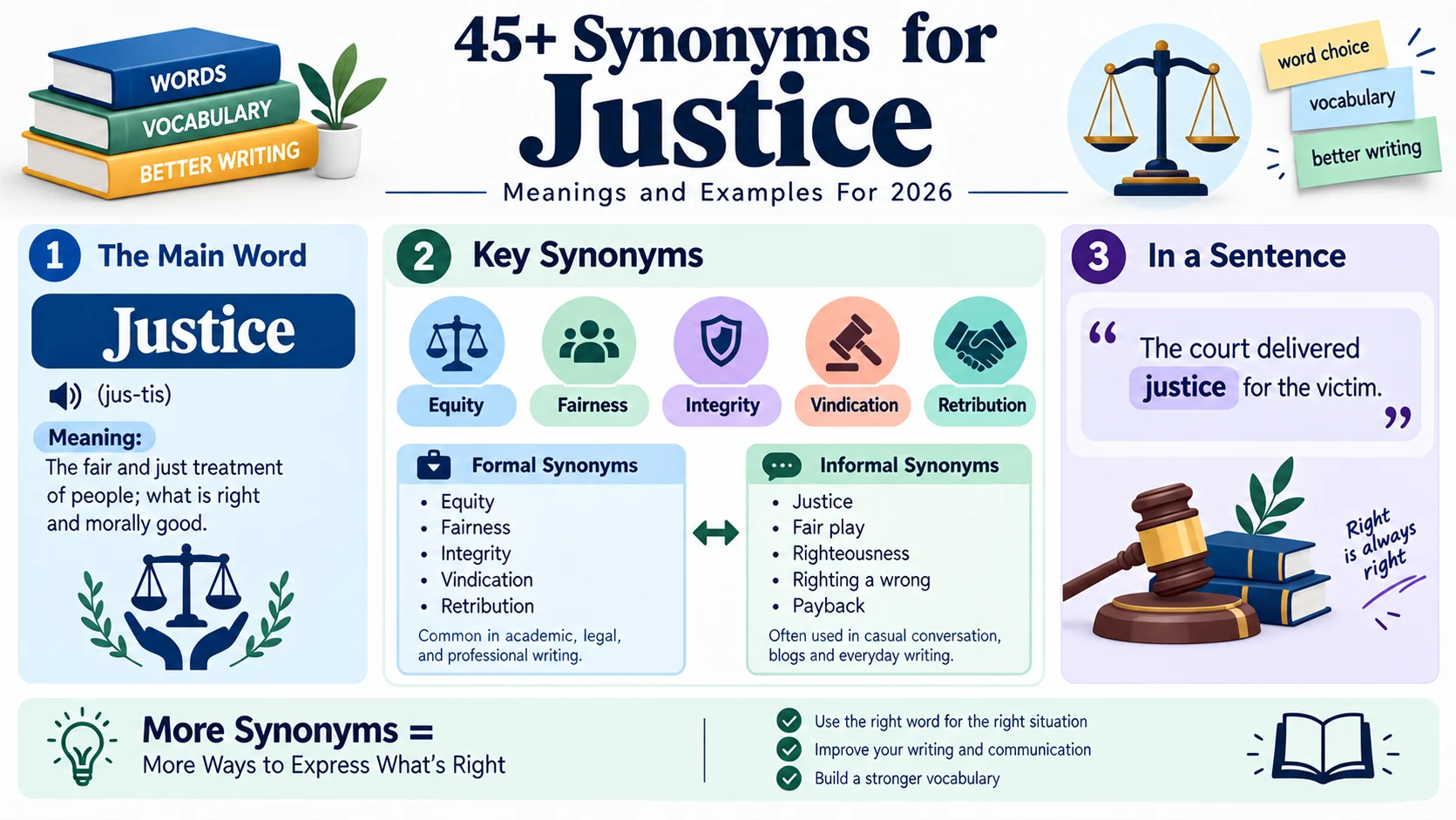
Justice means fairness, moral rightness, or the administration of law. The best synonyms depend on context. For formal writing, try “equity” or “righteousness.” For legal settings, use “judicature” or “due process.” For casual conversation, “fairness” works best. For emotional impact, consider “retribution” or “vindication.”
Meaning, Tone and Context
The word “justice” is a foundational concept in law, ethics, and everyday life. It describes the quality of being fair, impartial, and morally right. It also refers to the system that enforces laws and punishes wrongdoing.
1. Simple Definition: Justice is the quality of being fair and reasonable. It also refers to the legal system that upholds fairness and punishes crimes.
2. Part of Speech: Justice is a noun. It can be used as a countable noun when referring to a specific system or a judge, and as an uncountable noun when referring to the concept of fairness.
3. Tone: The tone is generally positive and serious. It conveys moral weight and authority. However, in some contexts, it can carry a tone of retribution or vengeance, such as “rough justice.”
4. Formality: Justice is a formal word. It is appropriate for legal documents, academic writing, and serious professional communication. In casual conversation, “fairness” is more common.
5. Common Use Cases: You will encounter “justice” in many situations.
- Legal Contexts: “The court delivered justice for the victim.”
- Social Contexts: “The community demanded justice for the unfair treatment.”
- Moral Contexts: “He believed in justice for all people.”
- Professional Contexts: “The company is committed to social justice.”
6. Important Word Forms:
- Adjective: just. “She made a just decision.”
- Adverb: justly. “He was justly rewarded for his efforts.”
- Noun: justice. “They fought for justice.”
- Noun (Person): justice. “The Justice delivered the ruling.”
When and How to Use “Justice”
Knowing when to use “justice” is about understanding its weight and formality. Here are several scenarios where it is the perfect choice.
- Legal Context: To describe the proper application of the law.
Example: “The judge ensured that justice was served for the victim’s family.” - Social Context: To demand fairness for a group or individual.
Example: “The protestors marched for justice and equal rights.” - Academic Context: To discuss philosophical or ethical concepts.
Example: “The philosopher wrote extensively about the nature of justice.” - Professional Context: To describe a company’s ethical commitments.
Example: “Our organization is dedicated to pursuing social justice in our community.” - Emotional Context: To express a deep sense of moral outrage or satisfaction.
Example: “After years of waiting, the family finally felt a sense of justice.” - Creative Writing: To add moral weight to a story.
Example: “The hero’s quest was not for revenge but for justice.” - Social Media Captions: To express support for a cause.
Example: “No peace without justice. We stand with the community.” - Resume or Cover Letter: To highlight values and professional commitment.
Example: “I am passionate about a career in law because I believe in equal justice for all.”
Another Word for “Justice”
Choosing the best replacement for “justice” depends entirely on the context. Here are the most effective single word alternatives categorized by use.
- Professional Writing: “Equity” or “Fairness.” “The company’s policies promote equity in the workplace.”
- Academic Writing: “Righteousness” or “Jurisprudence.” “The study examines the principles of jurisprudence in modern society.”
- Casual Conversation: “Fairness.” “All I want is fairness in this situation.”
- Emotional Writing: “Vindication” or “Retribution.” “The verdict was a vindication for the victims.”
- Creative Writing: “Nemesis” or “Judgment.” “The villain finally faced his nemesis.”
- Resume or Workplace: “Integrity” or “Ethics.” “I approach every project with a strong sense of integrity.”
- Social Media Captions: “Equality” or “Rights.” “We are fighting for equality and rights for everyone.”
- Stronger Meaning: “Retribution.” This word implies punishment for wrongdoing. “He sought retribution for the crimes committed against his family.”
- Softer Meaning: “Fairness.” This is a milder, more everyday word. “The teacher treated all students with fairness.”
When Not to Use “Justice”
While powerful, the word “justice” can be too heavy or vague in certain situations. Using a more precise synonym can improve clarity and impact.
- When You Mean “Fairness” in a Simple Situation: If you are talking about a playground dispute, “fairness” is more appropriate. “The kids argued about fairness” is better than “The kids argued about justice.”
- When You Mean “Legality”: “Justice” is about moral rightness. “Legality” is about what the law allows. “The business deal was of questionable legality” is more precise than “of questionable justice.”
- When You Mean “Revenge”: “Justice” is about restoring balance. “Revenge” is about personal retaliation. “He wanted revenge” is different from “He wanted justice.”
Example of Precision: Compare these two sentences.
- Vague: “The manager was concerned with justice.”
- Precise: “The manager was concerned with fairness and equal treatment.”
The second sentence is more direct, professional, and clear.
Words Commonly Confused With “Justice”
Understanding the differences between these related words will significantly refine your English.
- Justice vs. Fairness: “Fairness” is a broader, more general term. “Justice” is a more formal, often legal, concept. Fairness is about equal treatment; justice is about moral rightness and the law.
- Justice vs. Equality: “Equality” means everyone is treated the same. “Justice” often means treating people differently based on their needs to achieve a fair outcome. Justice can require equity, not just equality.
- Justice vs. Law: “Law” refers to the system of rules. “Justice” refers to the fair application of those rules. A law can be unjust. Justice is the ideal that the law should aim to achieve.
- Justice vs. Revenge: “Revenge” is a personal act of retaliation. “Justice” is an impartial, often institutional, response to wrongdoing. Revenge is personal; justice is societal.
- Justice vs. Mercy: “Justice” means giving someone what they deserve. “Mercy” means showing compassion and not giving someone the full punishment they deserve. Justice and mercy are often in tension.
- Justice vs. Righteousness: “Righteousness” is about moral correctness, often in a religious or spiritual sense. “Justice” is broader and can refer to the legal and social system. Righteousness is personal; justice is often communal.
Best Synonym by Context for “Justice”
| Context | Best Synonym | Why It Works | Example |
|---|---|---|---|
| Formal Writing | Equity | It sounds sophisticated and precise. | “The new policy aims to promote equity in hiring.” |
| Academic Writing | Jurisprudence | It is the formal study of law and justice. | “Her research focuses on constitutional jurisprudence.” |
| Professional/Business | Integrity | It highlights ethical conduct. | “Our company operates with the highest level of integrity.” |
| Resume | Ethics | It showcases your moral principles. | “My commitment to ethics guides every decision I make.” |
| Casual Conversation | Fairness | It is simple and easily understood. | “All I want is fairness.” |
| Creative Writing | Nemesis | It adds a dramatic, literary element. | “The hero finally faced his nemesis.” |
| Emotional Tone | Vindication | It conveys a powerful sense of being proven right. | “The court’s decision was a vindication for her.” |
| Strong Intensity | Retribution | It suggests punishment for wrongdoing. | “The villain faced retribution for his crimes.” |
| Soft/Moderate Tone | Fairness | It is gentle and accessible. | “The teacher treated all students with fairness.” |
| Social Media Captions | Equality | It is a powerful and common term. | “We march for equality and justice for all.” |
| US/UK Usage | Fairness or Equity | Both are common and understood. | “The principle of equity is central to the law.” |
Which Synonym Should You Choose?
Choosing the right word can seem difficult, but this simple guide will help you decide. It is all about matching the word to your goal, audience, and the message you want to send.
- Is your message legal or formal? Use “jurisprudence,” “equity,” or “due process.” These words are precise and appropriate for professional settings.
- Is your message about social issues? Use “equality,” “rights,” or “social justice.” These words are powerful and carry moral weight.
- Is your message personal or emotional? Use “vindication,” “retribution,” or “mercy.” These words carry strong emotional weight.
- Is your message casual and friendly? Use “fairness.” It is simple, clear, and universally understood.
- Do you want to be direct and clear? Use “fairness” or “integrity.” These are the most direct and accessible synonyms.
Real Life Examples of “Justice” in Sentences
Here are examples of how “justice” and its stronger synonyms can be used in different real world scenarios.
- School: “The student council fought for justice after the unfair grading policy was introduced.”
- Workplace: “The HR department is committed to ensuring equity and fairness for all employees.” Stronger: “The HR department is committed to ensuring justice for all employees.”
- Writing: “The author’s novel explores themes of justice and retribution in a small town.” Stronger: “The author’s novel explores themes of vindication and retribution.”
- Conversation: “He just wants fairness in the situation.” Stronger: “He just wants justice.”
- Social Media: “No peace without justice. We stand with the community.” Stronger: “No peace without equity. We stand with the community.”
- Resume: “I am passionate about a career in law because I believe in equal justice for all.” Stronger: “I am passionate about a career in law because I believe in equal justice and equity for all.”
- Email: “We are writing to demand justice for the unfair treatment of our members.” Stronger: “We are writing to demand vindication for the unfair treatment of our members.”
- Storytelling: “The hero’s quest was not for revenge but for justice.” Stronger: “The hero’s quest was not for revenge but for retribution.”
25 Synonyms for “Justice”
The following table lists 25 accurate and practical synonyms for “justice.”
| Synonym | Simple Meaning | Best Used For | Example Sentence |
|---|---|---|---|
| Fairness | The quality of being fair and impartial. | General use, casual conversation. | “The teacher treated all students with fairness.” |
| Equity | Fairness in the way people are treated. | Professional writing, social issues. | “The company’s policies promote equity in the workplace.” |
| Righteousness | Moral correctness and virtue. | Religious, formal writing. | “He was known for his righteousness and integrity.” |
| Vindication | The act of clearing someone of blame. | Emotional writing, legal contexts. | “The verdict was a vindication for the falsely accused man.” |
| Retribution | Punishment inflicted as revenge for a wrong. | Emotional writing, strong intensity. | “The villain faced retribution for his crimes.” |
| Judgment | A decision or opinion, especially in a court. | Legal contexts, formal writing. | “The court’s judgment was final and binding.” |
| Jurisprudence | The theory and philosophy of law. | Academic writing, legal studies. | “She is a professor of constitutional jurisprudence.” |
| Integrity | The quality of being honest and moral. | Professional writing, resume. | “He is a man of great integrity.” |
| Ethics | Moral principles that govern behavior. | Professional writing, academic. | “The company has a strong code of ethics.” |
| Legality | The quality of being allowed by law. | Legal contexts. | “The legality of the contract was questioned.” |
| Impartiality | Treating all rivals or disputants equally. | Formal writing, legal contexts. | “The judge was praised for her impartiality.” |
| Objectivity | The quality of being unbiased. | Academic writing, journalism. | “The reporter maintained objectivity throughout the story.” |
| Rectitude | Morally correct behavior. | Formal writing, literature. | “He was admired for his moral rectitude.” |
| Honor | High respect and moral worth. | Formal writing, personal contexts. | “She acted with honor and dignity.” |
| Truth | That which is in accordance with fact. | General use, philosophical contexts. | “He was committed to finding the truth.” |
| Mercy | Compassion shown to an offender. | Legal contexts, emotional writing. | “The judge showed mercy to the first-time offender.” |
| Due Process | Fair treatment through the legal system. | Legal contexts, formal writing. | “Everyone is entitled to due process under the law.” |
| Redress | Remedy or compensation for a wrong. | Legal contexts, formal writing. | “The victims sought redress for their losses.” |
| Restitution | The restoration of something lost or stolen. | Legal contexts, formal writing. | “The court ordered restitution for the stolen property.” |
| Equality | The state of being equal in status or rights. | Social issues, professional writing. | “The movement was about equality for all people.” |
| Sovereignty | Supreme power or authority. | Political contexts, formal writing. | “The nation fought for its sovereignty.” |
| Virtue | Behavior showing high moral standards. | Formal writing, religious contexts. | “Patience is a virtue.” |
| Worthiness | The quality of deserving respect or attention. | Formal writing, personal contexts. | “He proved his worthiness for the promotion.” |
| Validity | The quality of being logically sound. | Academic writing, legal contexts. | “The validity of the argument was questioned.” |
| Nemesis | A long-standing rival or an agent of retribution. | Creative writing, literary contexts. | “The hero finally faced his nemesis.” |
Synonym Groups and Usage Differences
Professional vs. Personal Synonyms
In a professional setting, like a legal brief or a company report, choose “equity,” “integrity,” or “jurisprudence.” These words sound polished and authoritative. In a personal setting, “fairness” is more natural and friendly. For example, you would write “The company is committed to equity” in a report, but tell a friend “I just want fairness.”
Formal vs. Conversational Synonyms
Formal Synonyms: “Jurisprudence,” “rectitude,” and “impartiality” are perfect for academic papers, legal documents, or formal speeches.
Conversational Synonyms: “Fairness” and “equality” are the best choices for everyday conversations and emails to friends.
Academic Synonyms
In essays and research papers, “jurisprudence” is a powerful word. It allows you to discuss the philosophy of law. “Impartiality” is also useful for analyzing ethical systems. “Equity” is a key term in social science research.
Professional and Business Synonyms
“Integrity” is a safe and professional choice for almost any workplace communication. “Ethics” is effective when discussing company policies. “Equity” is a great word for human resources and management contexts.
Creative or Literary Synonyms
These words add a layer of artistry to your descriptions.
- Nemesis: A dramatic term for an agent of retribution.
- Vindication: Suggests a powerful, emotional sense of being proven right.
- Retribution: Perfect for describing punishment in a story.
Slang or Modern Synonyms
Justice is a formal word, so slang alternatives are limited. “What goes around comes around” is a casual expression that captures the idea of justice. It is acceptable in casual conversation but should be avoided in formal writing.
Strongest vs. Weaker Synonyms
Here is an intensity scale from mild to strongest:
- Fairness, Equality: Mild, used for general situations.
- Equity, Integrity: Moderate, used for professional contexts.
- Justice: Strong, the standard word.
- Vindication, Retribution: Stronger, used for emotional and legal outcomes.
- Judgment, Nemesis: Strongest, implies a final and dramatic outcome.
Emotional vs. Neutral Synonyms
Emotional Synonyms: “Vindication,” “retribution,” and “nemesis” all carry strong emotional weight.
Neutral Synonyms: “Fairness,” “equity,” “impartiality,” and “legality” are factual and free of emotional charge.
Antonyms of “Justice”
Here are 15 clear antonyms for “justice,” which are words that mean the opposite: unfairness, injustice, and moral wrongness.
| Antonym | Meaning | Example Sentence |
|---|---|---|
| Injustice | Lack of fairness or justice. | “The protest was against the injustice of the new law.” |
| Unfairness | Lack of impartiality or equity. | “She complained about the unfairness of the decision.” |
| Inequity | Lack of fairness or justice. | “The report highlighted the inequity in the education system.” |
| Bias | Prejudice in favor of or against one thing. | “The judge was accused of bias.” |
| Prejudice | Preconceived opinion not based on reason. | “The campaign aimed to fight prejudice and discrimination.” |
| Corruption | Dishonest behavior by those in power. | “The investigation uncovered widespread corruption.” |
| Crime | An action that is illegal. | “The crime was punished by the court.” |
| Wrongdoing | Illegal or dishonest behavior. | “The company was investigated for financial wrongdoing.” |
| Oppression | Prolonged cruel treatment or control. | “The people fought against oppression.” |
| Tyranny | Cruel and oppressive rule. | “The revolution was against tyranny.” |
| Discrimination | Unjust treatment based on a category. | “The law prohibits discrimination in hiring.” |
| Inequality | Lack of equality. | “The gap between rich and poor shows inequality.” |
| Wrong | An unjust or immoral act. | “He knew he had done wrong.” |
| Miscarriage of justice | A failure of the legal system to achieve justice. | “The case was a tragic miscarriage of justice.” |
| Vengeance | Punishment inflicted in retaliation. | “He sought vengeance, not justice.” |
Comparison: “Justice” vs. Similar Words
Justice vs. Fairness
Main Difference: “Fairness” is a general, everyday term for equal treatment. “Justice” is a more formal, moral, and legal concept.Create a modern, clean infographic about synonyms for the word “justice.” The central title should be prominently displayed at the top. Organize the content into clearly labeled visual sections.
Include visual elements related to word choice and vocabulary. Use simple icons such as books, speech bubbles, word cards, arrows, comparison boxes, checklist elements, and vocabulary labels.
Section 1 should show the main word “Justice” with its meaning. Section 2 should display a selection of key synonyms like “Equity,” “Fairness,” “Integrity,” “Vindication,” and “Retribution.” Use arrows and comparison boxes to show the difference between formal and informal synonyms. Section 3 should demonstrate “justice” in an example sentence like “The court delivered justice for the victim.”
- Use a clean educational design with a professional and easy to understand layout. The visual should be suitable for a grammar, writing, vocabulary, or language blog. Use soft modern colors and a clean layout with plenty of white space. Avoid clutter. Avoid childish or cartoonish design. Avoid too much text inside the image. Keep the design modern and simple.
Which One Is Stronger: “Justice” is stronger and carries more moral weight.
Which One Is More Formal: “Justice” is more formal.
Example Sentence with Justice: “The community demanded justice for the victim.”
Example Sentence with Fairness: “The children learned about fairness on the playground.”
Justice vs. Equality
Main Difference: “Equality” means everyone gets the same treatment. “Justice” means everyone gets what they deserve, which may require different treatment.
Which One Is Stronger: “Justice” is a broader and more powerful concept.
Which One Is More Formal: Both are formal, but “justice” is more common in legal and philosophical contexts.
Example Sentence with Justice: “Social justice requires addressing systemic inequalities.”
Example Sentence with Equality: “The organization fights for gender equality.”
Justice vs. Law
Main Difference: “Law” is the system of rules. “Justice” is the fair application of those rules. A law can be unjust.
Which One Is Stronger: “Justice” is the moral ideal. “Law” is the practical system.
Which One Is More Formal: Both are formal, but “law” is more concrete.
Example Sentence with Justice: “The ruling was a victory for justice.”
Example Sentence with Law: “The new law will take effect next month.”
Justice vs. Revenge
Main Difference: “Revenge” is personal retaliation. “Justice” is an impartial, societal response to wrongdoing.
Which One Is Stronger: “Revenge” is more emotional and personal.
Which One Is More Formal: “Justice” is more formal and institutional.
Example Sentence with Justice: “He wanted justice, not revenge.”
Example Sentence with Revenge: “He sought revenge against his enemies.”
Justice vs. Mercy
Main Difference: “Justice” means giving someone what they deserve. “Mercy” means showing compassion and not giving the full punishment.
Which One Is Stronger: “Justice” is about fairness. “Mercy” is about compassion.
Which One Is More Formal: Both are formal.
Example Sentence with Justice: “The court delivered justice for the victims.”
Example Sentence with Mercy: “The judge showed mercy to the young offender.”
Justice vs. Vindication
Main Difference: “Justice” is about fairness and the legal system. “Vindication” is about being cleared of blame or proven right.
Which One Is Stronger: “Vindication” is more personal and emotional.
Which One Is More Formal: Both are formal, but “vindication” is more specific.
Example Sentence with Justice: “The fight for justice continues.”
Example Sentence with Vindication: “The verdict was a complete vindication for her.”
Common Phrases and Expressions with “Justice”
1. Justice is served
Meaning: Fairness has been achieved, often in a legal context.
Example Sentence: “After a long trial, justice was finally served.”
2. Poetic justice
Meaning: A fitting or ironic outcome where good is rewarded and evil is punished.
Example Sentence: “It was poetic justice when the thief’s own camera caught him in the act.”
3. Social justice
Meaning: Fairness in society, especially regarding wealth, opportunities, and privileges.
Example Sentence: “She is a passionate advocate for social justice.”
4. Miscarriage of justice
Meaning: A failure of the legal system that results in an unfair outcome.
Example Sentence: “The wrongful conviction was a clear miscarriage of justice.”
5. Obstruction of justice
Meaning: The crime of interfering with the legal process.
Example Sentence: “The executive was charged with obstruction of justice.”
6. Bring to justice
Meaning: To capture and punish a criminal.
Example Sentence: “The police vowed to bring the culprit to justice.”
7. Do justice to
Meaning: To represent something accurately or fairly.
Example Sentence: “The photograph doesn’t do justice to the beauty of the landscape.”
8. Justice for all
Meaning: The ideal of fair treatment for every person.
Example Sentence: “The pledge ends with the words ‘with liberty and justice for all.'”
Common Mistakes to Avoid
1. Using “Justice” When a More Precise Synonym Is Better
Mistake: “The manager was concerned with justice.”
Better: “The manager was concerned with fairness and equal treatment.” This is more specific and professional.
2. Confusing “Justice” with “Revenge”
Mistake: “He wanted justice for the personal insult.”
Better: “He wanted revenge for the personal insult.” Justice is impartial; revenge is personal.
3. Using a Casual Synonym in Formal Writing
Mistake: “The report called for fairness in the legal system.”
Better: “The report called for equity in the legal system.” “Equity” is more formal and precise.
4. Using an Overly Dramatic Synonym for a Simple Situation
Mistake: “The teacher brought retribution to the student who cheated.”
Better: “The teacher gave the student a fair consequence.” “Retribution” is too dramatic for a classroom setting.
5. Repeating the Same Word Too Often
Mistake: “She fought for justice. She believed in justice. She wanted justice.”
Better: “She fought for justice. She believed in fairness. She wanted equity.” This variation makes the writing more engaging.
6. Choosing a Synonym with the Wrong Emotional Tone
Mistake: “I appreciate your retribution about my performance.”
Better: “I appreciate your fairness about my performance.” “Retribution” has a negative, punitive tone.
7. Using Slang in Academic or Professional Writing
Mistake: “The article is about what goes around comes around.”
Better: “The article explores the concept of justice and retribution.” Slang is too casual for professional writing.
FAQs
1. What is the best synonym for justice?
- The best synonym depends on your context. For general use, “fairness” is a safe choice. For formal writing, use “equity.” For legal settings, “due process” or “jurisprudence” work well.
2. What is a formal synonym for justice?
A formal synonym for justice is “equity.” Another good option is “jurisprudence.” Both are appropriate for formal writing and professional communication.
3. What is an informal synonym for justice?
An informal synonym for justice is “fairness.” This word is perfect for everyday conversation and friendly emails. It is simple and universally understood.
4. What is another word for justice in professional writing?
In professional writing, “equity” is an excellent choice. “Integrity” is also effective when discussing ethical conduct. “Impartiality” is useful for describing fair decision making.
5. What is the difference between justice and fairness?
Fairness is a general, everyday term for equal treatment. Justice is a more formal, moral, and legal concept. Justice often involves the legal system, while fairness is about personal interactions.
6. What is the opposite of justice?
The opposite of justice is “injustice.” Other opposites include “unfairness,” “inequity,” and “bias.” These words describe a lack of fairness or moral rightness.
Conclusion
The word “justice” is a powerful and essential part of the English language. It represents fairness, moral rightness, and the rule of law. Because it covers so many ideas, finding the perfect synonym can seem challenging.
Choosing the best synonym depends entirely on your context, audience, and the tone you wish to convey. For a professional setting, “equity” or “integrity” work well. For a formal context, “jurisprudence” or “impartiality” are excellent choices. In casual conversation, “fairness” is natural and friendly. For an emotional or dramatic tone, “vindication” or “retribution” convey the right weight.
The best advice is to think about your purpose and your audience before you choose a word. Do you want to be fair, legal, moral, or emotional? Matching your word to your intention will make your communication more effective and your English more precise.
A practical vocabulary tip: Try replacing “justice” with a more specific synonym in your writing this week. If you are writing about workplace policies, use “equity.” If you are analyzing a legal case, use “due process.” This small change will significantly improve the clarity and sophistication of your English.
