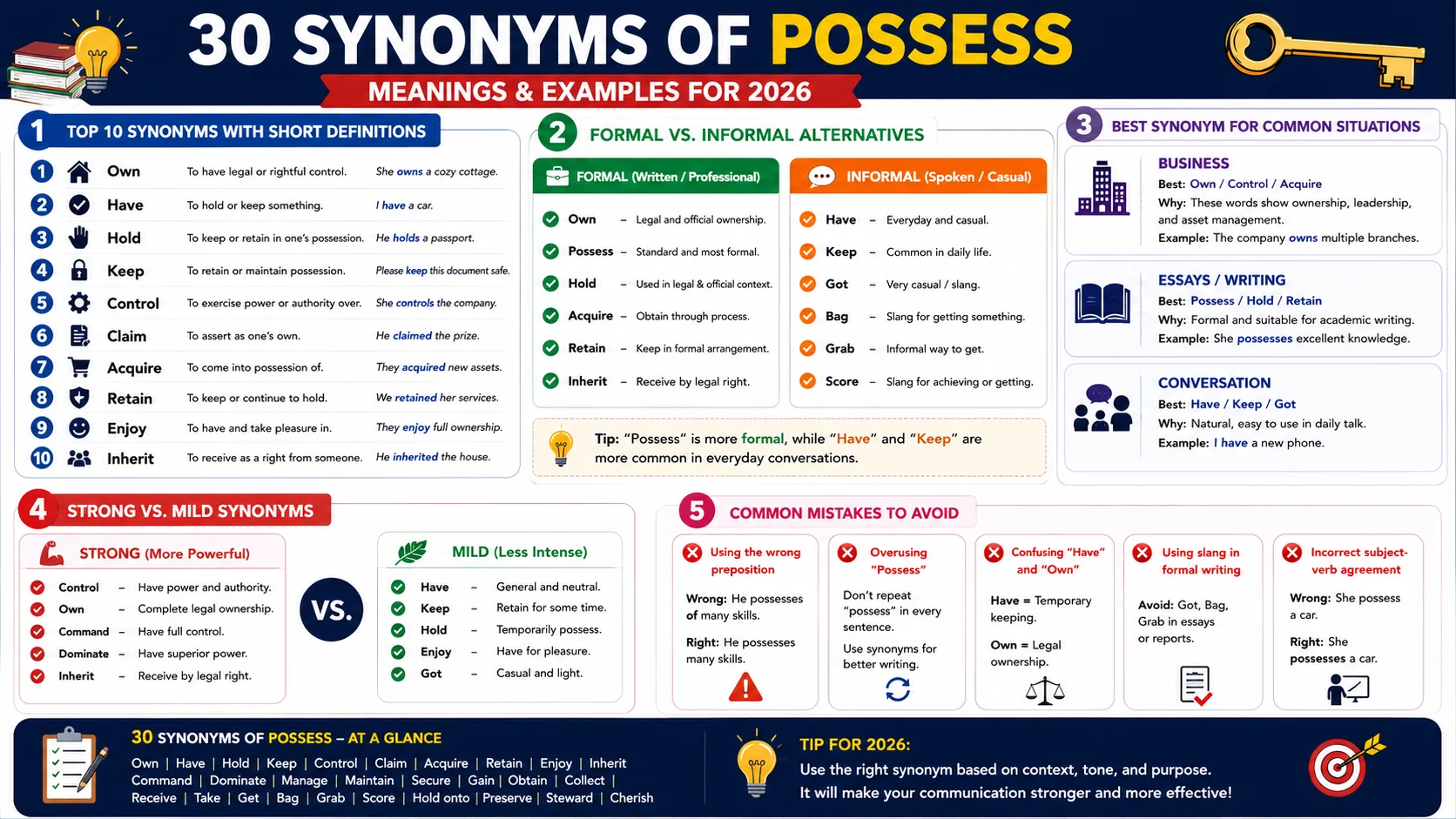
“Possess” means to have or own something. The best synonyms are have, own, hold, occupy, and enjoy. “Have” is the most common and natural in everyday English. Each synonym has a slightly different meaning, tone, or context where it fits best.
Top 10 Synonyms
- Have
- Own
- Hold
- Occupy
- Enjoy
- Command
- Retain
- Boast
- Control
- Keep
Do you find yourself always using “have” or “possess” when talking about owning things? You’re not alone. “Possess” is a useful word, but using it too often can make your English sound stiff or overly formal.
English offers many wonderful alternatives. Some are perfect for everyday conversation. Others work better in business or academic writing. Each one adds a different flavor to your sentences.
In this guide, you’ll learn 30 powerful synonyms for “possess.” You’ll discover exactly when to use each one, how formal they are, and what mistakes to avoid. By the end, your vocabulary will be richer and more impressive.
What Does “Possess” Mean?
Definition
Possess” means to have something as your own. It can mean owning a physical object, having a quality, or being in control of something. For example, you can possess a car, possess a talent, or possess a skill. It’s a more formal way of saying “have.”
Pronunciation
| Feature | Value |
|---|---|
| US IPA | /pəˈzɛs/ |
| UK IPA | /pəˈzɛs/ |
| Syllables | 2 (pos-sess) |
| Tip | Stress the second syllable: “puh-ZESS” |
Grammar
| Grammar Feature | Information |
|---|---|
| Part of Speech | Verb (transitive) |
| Common Position | After the subject, before an object |
| Typical Pattern | Subject + possess + object |
Examples:
- “She possesses a great sense of humor.”
- “He possesses all the necessary qualifications.”
- “The company possesses significant resources.”
Grammar Note: “Possess” is a transitive verb, which means it always needs an object. You can’t just say “I possess.” You must say what you possess.
Word Family
| Word | Part of Speech | Meaning |
|---|---|---|
| Possess | Verb | To have or own something |
| Possession | Noun | Something that is owned |
| Possessive | Adjective | Wanting to own or control |
| Possessor | Noun | A person who owns something |
| Prepossess | Verb | To influence beforehand |
15 Synonyms of “Possess”
Have
Meaning: The most common word for owning, holding, or experiencing something.
Best Used For: Daily conversation, informal writing, any casual situation.
Formality: Informal
Tone: Casual, Direct
Frequency: ⭐⭐⭐⭐⭐ (Very Common)
CEFR Level: A1
Example Sentence 1: “I have a new phone that I bought yesterday.”
Example Sentence 2: “She has three brothers and two sisters.”
Usage Tip: “Have” is the most natural word in everyday English. Use it for simple, informal situations. It’s the best choice for daily conversation.
Own
Meaning: To have something legally as your property.
Best Used For: Talking about property, business, legal contexts.
Formality: Neutral
Tone: Legal, Clear
Frequency: ⭐⭐⭐⭐⭐ (Very Common)
CEFR Level: A2
Example Sentence 1: “My grandparents own a beautiful house by the lake.
Example Sentence 2: “Do you own this car, or are you renting it?”
Usage Tip: “Own” is more specific than “have.” It means you have legal rights to something. It’s perfect for talking about property, cars, and businesses.
Hold
Meaning: To have or keep something, often in your hands or in your possession.
Best Used For: Physical objects, positions, records, and abstract things.
Formality: Neutral
Tone: Active, Present
Frequency: ⭐⭐⭐⭐ (Common)
CEFR Level: B1
Example Sentence 1: “She holds a degree in economics from Harvard.”
Example Sentence 2: “He holds the record for the fastest time.”
Usage Tip: “Hold” is great for positions, titles, records, and physical objects. It’s more active than “have.”
Occupy
Meaning: To have and use a space, position, or role.
Best Used For: Physical spaces, positions, roles, and time.
Formality: Formal
Tone: Official, Factual
Frequency: ⭐⭐⭐ (Moderate)
CEFR Level: B2
Example Sentence 1: “She occupies the office on the third floor.”
Example Sentence 2: “His work occupies most of his time.”
Usage Tip: “Occupy” is for spaces, positions, and time. It’s common in business and formal writing.
Enjoy
Meaning: To have or experience something good or pleasant.
Best Used For: Positive things, good qualities, pleasant experiences.
Formality: Neutral
Tone: Positive, Pleasant
Frequency: ⭐⭐⭐⭐ (Common)
CEFR Level: A2
Example Sentence 1: “She enjoys good health for her age.”
Example Sentence 2: “He enjoys a great reputation in his field.”
Usage Tip: “Enjoy” is used for positive things you have, like health, reputation, or freedom. It adds a happy feeling to your sentence.
Command
Meaning: To have control or authority over something.
Best Used For: Control, authority, resources, and skills.
Formality: Formal
Tone: Powerful, Authoritative
Frequency: ⭐⭐⭐ (Moderate)
CEFR Level: B2
Example Sentence 1: “He commands a great deal of respect in the community.”
Example Sentence 2: “She commands a large team of experts.”
Usage Tip: “Command” suggests authority and power. Use it when you want to show someone is in control.
Retain
Meaning: To continue to have something; to keep possession of something.
Best Used For: Official contexts, legal writing, formal situations.
Formality: Formal
Tone: Permanent, Fixed
Frequency: ⭐⭐⭐ (Moderate)
CEFR Level: B2
Example Sentence 1: “She retained ownership of the property after the divorce.”
Example Sentence 2: “The company retained its top position in the market.”
Usage Tip: “Retain” means you keep something you already have. It’s common in legal and business language.
Boast
Meaning: To have something to be proud of.
Best Used For: Describing good features, marketing, positive descriptions.
Formality: Neutral
Tone: Positive, Proud
Frequency: ⭐⭐⭐ (Moderate)
CEFR Level: B2
Example Sentence 1: “The hotel boasts a swimming pool and a restaurant.”
Example Sentence 2: “The city boasts some of the best restaurants in the country.”
Usage Tip: “Boast” is used when you have something impressive. It’s often used in descriptions of places and products.
Control
Meaning: To have power or authority over something.
Best Used For: Authority, management, power situations.
Formality: Neutral
Tone: Powerful, Authoritative
Frequency: ⭐⭐⭐⭐ (Common)
CEFR Level: B1
Example Sentence 1: “She controls all the company’s finances.”
Example Sentence 2: “He controls the team’s daily operations.”
Usage Tip: “Control” is about having power over things. It’s great for business and management contexts.
Keep
Meaning: To have something and continue to have it.
Best Used For: Possessions, friends, secrets, and promises.
Formality: Informal
Tone: Careful, Responsible
Frequency: ⭐⭐⭐⭐⭐ (Very Common)
CEFR Level: A2
Example Sentence 1: “You can keep the change.”
Example Sentence 2: “I keep all my important documents in a safe place.
Usage Tip: “Keep” suggests holding onto something. It’s very common in everyday speech.
Maintain
Meaning: To have and continue to have something, especially over time.
Best Used For: Relationships, standards, positions, and conditions.
Formality: Formal
Tone: Responsible, Professional
Frequency: ⭐⭐⭐⭐ (Common)
CEFR Level: B2
Example Sentence 1: “She maintains a close relationship with her family.”
Example Sentence 2: “The company maintains high standards of quality.”
Usage Tip: “Maintain” suggests ongoing effort to keep something. It’s common in professional writing.
Contain
Meaning: To have something inside as a part.
Best Used For: Physical containers, documents, information.
Formality: Neutral
Tone: Factual, Precise
Frequency: ⭐⭐⭐⭐ (Common)
CEFR Level: B1
Example Sentence 1: “The box contains all the important documents.”
Example Sentence 2: “The article contains a lot of useful information.
Usage Tip: “Contain” is for things that are inside other things. It’s very precise and factual.
Possess
Meaning: To have or own something, especially formally.
Best Used For: Formal contexts, official documents, academic writing.
Formality: Formal
Tone: Professional, Official
Frequency: ⭐⭐⭐⭐ (Common)
CEFR Level: B2
Example Sentence 1: “He possesses exceptional leadership skills.”
Example Sentence 2: “The company possesses all the necessary resources.”
Usage Tip: “Possess” is the formal version of “have.” Use it in official or academic writing, not in casual conversation.
Boast
Meaning: To have something positive to be proud of.
Best Used For: Describing features, marketing, tourism.
Formality: Neutral
Tone: Proud, Positive
Frequency: ⭐⭐⭐ (Moderate)
CEFR Level: B2
Example Sentence 1: “The resort boasts five swimming pools.”
Example Sentence 2: “The museum boasts an impressive collection of art.
Usage Tip: “Boast” is great when describing places or products that have excellent features.
Comprise
Meaning: To have as parts or members; to consist of.
Best Used For: Formal descriptions, lists of parts, academic writing.
Formality: Formal
Tone: Academic, Precise
Frequency: ⭐⭐⭐ (Moderate)
CEFR Level: B2
Example Sentence 1: “The team comprises experts from five different countries.”
Example Sentence 2: “The course comprises three main modules.
Usage Tip: “Comprise” is used for listing the parts of something. It’s very formal and precise.
Synonyms Comparison Table
| Synonym | Best Context | Formality | Tone | Frequency |
|---|---|---|---|---|
| Have | Everyday speech | Informal | Casual | ⭐⭐⭐⭐⭐ |
| Own | Property, legal | Neutral | Clear | ⭐⭐⭐⭐⭐ |
| Keep | Holding onto things | Informal | Careful | ⭐⭐⭐⭐⭐ |
| Control | Management | Neutral | Powerful | ⭐⭐⭐⭐ |
| Hold | Positions, records | Neutral | Active | ⭐⭐⭐⭐ |
| Contain | Inside things | Neutral | Factual | ⭐⭐⭐⭐ |
| Enjoy | Positive things | Neutral | Pleasant | ⭐⭐⭐⭐ |
| Possess | Formal contexts | Formal | Official | ⭐⭐⭐⭐ |
| Maintain | Long-term keeping | Formal | Professional | ⭐⭐⭐⭐ |
| Retain | Keeping legally | Formal | Permanent | ⭐⭐⭐ |
Best Synonyms by Situation
| Situation | Best Synonym | Why It Works |
|---|---|---|
| Daily Conversation | Have | It’s the most natural and common word |
| Business Email | Possess | Sounds professional and official |
| Academic Writing | Comprise | Precise and academic |
| School Assignment | Own | Clear and understandable |
| Professional Meeting | Control | Shows authority and responsibility |
| Presentation | Possess | Formal and impressive |
| Creative Writing | Boast | Adds descriptive flair |
| Social Media | Have | Casual and fits the platform |
| Legal Writing | Retain | Accurate and specific |
Formal vs Informal Synonyms
Formal Alternatives
| Synonym | Best Used For |
|---|---|
| Possess | Official documents, academic writing |
| Retain | Legal contexts, official keeping |
| Comprise | Academic descriptions, lists of parts |
| Maintain | Professional relationships, standards |
Neutral Alternatives
| Synonym | Best Used For |
|---|---|
| Own | Property, business contexts |
| Hold | Positions, records, physical items |
| Contain | Inside things, information |
| Control | Management, authority |
Informal Alternatives
| Synonym | Best Used For |
|---|---|
| Have | Almost any casual situation |
| Keep | Holding onto things |
| Get | When you obtain something |
Choosing the Right Level: Use “possess” in formal writing and “have” in conversation. The context decides the right word. When in doubt, “have” is almost always safe in informal situations.
Strong vs Mild Synonyms
Mild
Suitable for everyday situations with no special emphasis.
- Have
- Keep
- Contain
Moderate
Suggest more effort, formality, or meaning.
- Own
- Hold
- Control
- Possess
- Enjoy
Strong
High-intensity alternatives that emphasize authority or permanence.
- Command (implies authority and power)
- Retain (implies keeping despite challenges)
- Maintain (implies ongoing effort)
- Comprise (implies precise composition)
How Intensity Changes Meaning: “She has respect” is simple. “She commands respect” sounds much more powerful. Think about the impact you want to have.
Real-Life Examples
School: “Students must possess a good understanding of basic math.”
Office: “The manager controls all project budgets.”
Business Email: “Please ensure you retain copies of all documents.”
Meetings: “Our team comprises experts from various departments.”
Presentations: “This city boasts some of the best restaurants in the world.”
Daily Conversations: “I have two tickets to the concert.”
Social Media: “This restaurant boasts amazing views!”
Academic Writing: “The study comprises data from five different countries.”
Common Collocations
| Common Phrase | Better Alternative |
|---|---|
| Have a problem | Have a difficulty (softer) |
| Have a meeting | Hold a meeting |
| Have respect | Command respect |
| Have a degree | Hold a degree |
| Have control | Retain control (more formal) |
| Have a position | Occupy a position |
Common Phrases
Be in possession of: To have something. (e.g., “He is in possession of a rare stamp.”)
Hold all the cards: To have control over a situation. (e.g., “She holds all the cards in the negotiation.”)
Keep in mind: To remember something. (e.g., “Please keep in mind the deadlines.”)
Take possession of: To officially get something. (e.g., “We will take possession of the house next week.”)
Have a say: To have control or influence. (e.g., “I have a say in this decision.”)
Context Guide
| Situation | Best Synonym | Reason |
|---|---|---|
| Essay | Possess / Comprise | Formal and academic |
| Speech | Command / Possess | Inspiring and impressive |
| Business Email | Possess / Retain | Professional and official |
| Novel | Boast / Possess | Adds literary variety |
| Presentation | Control / Possess | Confident and professional |
| Conversation | Have / Keep | Natural and casual |
| Academic Writing | Comprise / Maintain | Precise and intellectual |
| Marketing Copy | Boast / Enjoy | Positive and appealing |
Related Words
Near Synonyms
- Command: To have authority. (e.g., “She commands attention.”)
- Wield: To have and use power. (e.g., “He wields great influence.”)
- Brandish: To have and show off. (e.g., “She brandishes her qualifications.”)
Antonyms
- Lack: To not have something.
- Need: To require something.
- Want: To desire something you don’t have.
- Miss: To not have something you used to have.
- Surrender: To give up possession.
Related Adjectives
- Possessive: Wanting to own or control.
- Owned: Being someone’s property.
- Controlled: Under someone’s authority.
- Retained: Kept or held.
Related Nouns
- Ownership: The state of owning something.
- Possession: Something that is owned.
- Control: The power to manage.
- Authority: The power to give orders.
Related Verbs
- Obtain: To get something.
- Acquire: To gain something over time.
- Secure: To get something with effort.
- Maintain: To keep something going.
Frequently Asked Questions
What is another word for possess?
Common synonyms for possess are have, own, hold, occupy, and enjoy. The best choice depends on context and how formal you want to be.
Which synonym sounds the most professional?
Possess itself is very professional. Command and retain also sound professional, especially in business and legal contexts.
What is the strongest synonym for possess?
Command is one of the strongest synonyms. It implies not just having something but having authority and power over it.
Which synonym is best for essays?
Possess and comprise are excellent for essays. They sound formal and academic. “Maintain” is also great for discussing ongoing conditions.
What’s the difference between have and possess?
“Have” is casual and used in everyday conversation. “Possess” is more formal and often used in official or academic contexts.
Which synonym is most common in everyday English?
Have” is by far the most common synonym. Native speakers use it constantly for all types of situations.
What is the opposite of possess?
The most common opposites are lack, need, and want. In formal contexts, “surrender” can also be an opposite when you give up possession.
Conclusion
Possessing a rich vocabulary is a wonderful goal for any English learner. By learning these 30 synonyms, you’ve taken a big step toward speaking and writing more naturally.
Remember, the key to choosing the right word is understanding the context. Use “have” in casual conversation. Use “possess” in formal writing. Use “command” when you want to show authority. Use “boast” when you’re describing something impressive.
The best way to improve is to practice. Start by picking just two or three new synonyms to use this week. Pay attention to how native speakers use these words in movies, books, and conversations. Your vocabulary will grow stronger and more natural with every new word you learn.
