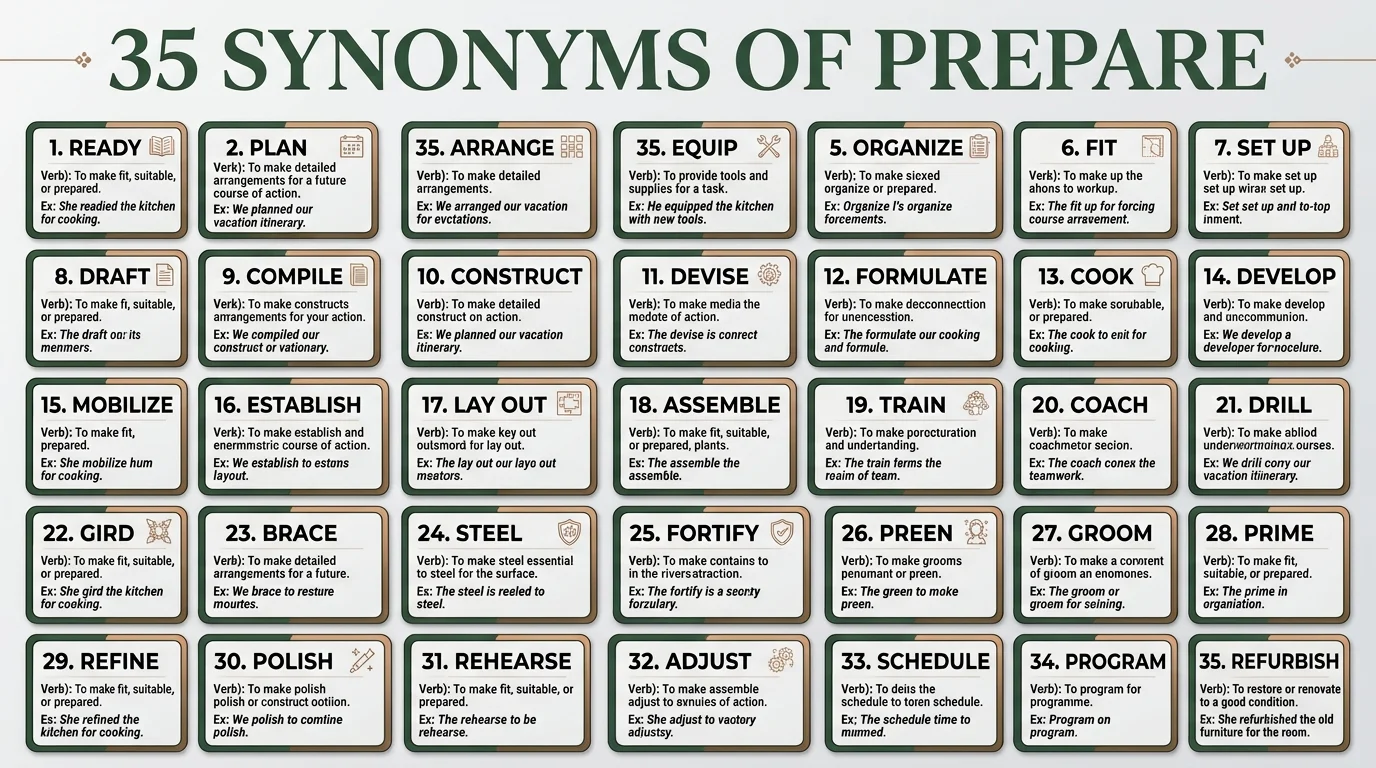
“Prepare” means to make something ready for use or to get ready for an event. The best synonyms are arrange, organize, plan, get ready, and set up. “Arrange” is a common alternative, but each synonym fits different situations and tones.
Top 10 Synonyms
- Arrange
- Organize
- Plan
- Get ready
- Set up
- Equip
- Make ready
- Put together
- Coordinate
- Devise
“Prepare” is a useful word, but do you ever feel like you’re using it too much? Many English learners do. It’s a safe choice, but there are so many better, more specific words available.
Think about it. You prepare food, prepare for an exam, prepare a presentation, and prepare your home for guests. Each of these situations deserves a different word that captures the specific action more clearly.
In this guide, you will learn 35 powerful synonyms for “prepare.” You’ll discover exactly when to use each one, how formal they are, and what mistakes to avoid. By the end, your vocabulary will be richer and more precise.
What Does “Prepare” Mean?
Definition
Prepare” means to make something or someone ready for a particular purpose, event, or situation. It involves planning, arranging, and getting everything in order. You prepare a meal by cooking. You prepare for a test by studying. You prepare a speech by writing it down.
Pronunciation
| Feature | Value |
|---|---|
| US IPA | /prɪˈpɛr/ |
| UK IPA | /prɪˈpɛə/ |
| Syllables | 2 (pre-pare) |
| Tip | Stress the second syllable: “prih-PAIR” |
Grammar
| Grammar Feature | Information |
|---|---|
| Part of Speech | Verb (transitive and intransitive) |
| Common Position | After the subject |
| Typical Pattern | Subject + prepare + object / for + event |
Examples:
- “She is preparing dinner for her family.” (transitive)
- “We need to prepare for the meeting.” (intransitive)
- “He prepared himself for the difficult conversation.” (reflexive)
Grammar Note: “Prepare” can be used with or without an object. You can prepare something (dinner, a report) or prepare for something (an exam, a trip).
Word Family
| Word | Part of Speech | Meaning |
|---|---|---|
| Prepare | Verb | To make ready |
| Preparation | Noun | The action of preparing |
| Prepared | Adjective | Ready and able to do something |
| Preparatory | Adjective | Done in order to prepare for something |
| Preparedness | Noun | The state of being ready |
| Preparing | Gerund | The act of making ready |
15 Synonyms of “Prepare”
Arrange
Meaning: To put things in order or to make plans for something.
Best Used For: Organizing events, setting up meetings, putting things in order.
Formality: Neutral
Tone: Organized, Practical
Frequency: ⭐⭐⭐⭐⭐ (Very Common)
CEFR Level: B1
Example Sentence 1: “I need to arrange a meeting with the team for Friday.
Example Sentence 2: “She arranged the flowers beautifully in the vase.
Usage Tip: “Arrange” is perfect when you’re putting things in order or making plans. It’s a safe, common alternative in both formal and informal contexts.
Common Confusion: Arrange vs Prepare. “Prepare” is broader and can include many actions. “Arrange” focuses specifically on planning or organizing the order of things.
Organize
Meaning: To arrange things in a structured or logical way, or to plan an event.
Best Used For: Events, files, work tasks, anything requiring structure.
Formality: Neutral
Tone: Efficient, Structured
Frequency: ⭐⭐⭐⭐⭐ (Very Common)
CEFR Level: B1
Example Sentence 1: “We need to organize the conference for next month.
Example Sentence 2: “She organized all her files on the computer.”
Usage Tip: “Organize” emphasizes creating structure and order. It’s a great word for both physical and abstract preparation.
Plan
Meaning: To decide in advance what you are going to do and how.
Best Used For: Future events, projects, travel, anything requiring forethought.
Formality: Neutral
Tone: Strategic, Thoughtful
Frequency: ⭐⭐⭐⭐⭐ (Very Common)
CEFR Level: A2
Example Sentence 1: “We need to plan our vacation carefully.”
Example Sentence 2: “She planned every detail of the party.”
Usage Tip: “Plan” focuses on the thinking and decision-making part of preparing. You plan before you prepare.
Get ready
Meaning: To prepare yourself or something for a future event.
Best Used For: Daily life, informal situations, getting prepared physically or mentally.
Formality: Informal
Tone: Casual, Action-oriented
Frequency: ⭐⭐⭐⭐⭐ (Very Common)
CEFR Level: A2
Example Sentence 1: “I need to get ready for work.”
Example Sentence 2: “The team is getting ready for the big game.”
Usage Tip: “Get ready” is the most natural way to say “prepare” in everyday conversation. It’s informal and very common.
Set up
Meaning: To prepare equipment, a system, or an event so it is ready to use.
Best Used For: Equipment, technology, events, starting something new.
Formality: Informal
Tone: Practical, Hands-on
Frequency: ⭐⭐⭐⭐⭐ (Very Common)
CEFR Level: B1
Example Sentence 1: “Can you set up the projector for the presentation?”
Example Sentence 2: “They set up a new business last year.”
Usage Tip: “Set up” is great for physical preparation, like arranging equipment, or for starting something new, like a business.
Equip
Meaning: To provide someone or something with the necessary items, tools, or skills.
Best Used For: Providing tools, training, or supplies for a specific purpose.
Formality: Formal
Tone: Practical, Professional
Frequency: ⭐⭐⭐ (Moderate)
CEFR Level: B2
Example Sentence 1: “The school equips students with the skills they need.
Example Sentence 2: “We need to equip the kitchen with new appliances.”
Usage Tip: “Equip” focuses on providing tools or resources. It’s perfect when you’re giving someone what they need to succeed.
Make ready
Meaning: To prepare something or someone for a particular purpose.
Best Used For: Formal contexts, military, official preparations.
Formality: Formal
Tone: Official, Serious
Frequency: ⭐⭐ (Rare)
CEFR Level: B2
Example Sentence 1: “The soldiers made ready for battle.”
Example Sentence 2: “The hotel room was made ready for the guests.”
Usage Tip: “Make ready” is quite formal and a bit old-fashioned. Use it in formal writing, but not in everyday conversation.
Put together
Meaning: To assemble, organize, or create something from different parts.
Best Used For: Creating documents, assembling items, organizing events.
Formality: Informal
Tone: Practical, Collaborative
Frequency: ⭐⭐⭐⭐⭐ (Very Common)
CEFR Level: A2
Example Sentence 1: “We need to put together a presentation for the client.”
Example Sentence 2: “She put together a delicious meal from leftovers.”
Usage Tip: “Put together” is a very natural phrasal verb. Use it when you’re creating something from various parts or components.
Coordinate
Meaning: To organize and combine different activities or people to work well together.
Best Used For: Events, teams, complex projects.
Formality: Formal
Tone: Professional, Collaborative
Frequency: ⭐⭐⭐⭐ (Common)
CEFR Level: B2
Example Sentence 1: “She coordinates all the volunteers for the charity event.”
Example Sentence 2: “We need to coordinate our efforts to finish the project on time.”
Usage Tip: “Coordinate” emphasizes bringing different parts or people together. It’s a great word for team situations.
Devise
Meaning: To invent, plan, or think out something carefully.
Best Used For: Creative solutions, strategies, plans.
Formality: Formal
Tone: Creative, Strategic
Frequency: ⭐⭐⭐ (Moderate)
CEFR Level: B2
Example Sentence 1: “The team devised a clever plan to solve the problem.”
Example Sentence 2: “She devised a new system for organizing the office.”
Usage Tip: “Devise” is for creating new ideas or plans. It suggests creativity and careful thinking.
Prepare (oneself)
Meaning: To make yourself mentally or emotionally ready for something.
Best Used For: Emotional preparation, mental readiness.
Formality: Neutral
Tone: Emotional, Personal
Frequency: ⭐⭐⭐⭐⭐ (Very Common)
CEFR Level: B1
Example Sentence 1: “She prepared herself for the bad news.”
Example Sentence 2: “We need to prepare ourselves for the challenges ahead.”
Usage Tip: This use of “prepare” is about mental and emotional readiness, not physical preparation.
Arrange for
Meaning: To make plans or preparations for something to happen.
Best Used For: Booking, scheduling, planning logistics.
Formality: Neutral
Tone: Practical, Organized
Frequency: ⭐⭐⭐⭐ (Common)
CEFR Level: B1
Example Sentence 1: “I’ll arrange for a car to pick you up at the airport.”
Example Sentence 2: “We arranged for a meeting with the director.”
Usage Tip: “Arrange for” is great when you’re making logistical preparations, especially for travel or meetings.
Gear up
Meaning: To prepare for an activity, especially by wearing appropriate clothing or getting mentally ready.
Best Used For: Athletic events, challenges, exciting activities.
Formality: Informal
Tone: Exciting, Active
Frequency: ⭐⭐⭐ (Moderate)
CEFR Level: B1
Example Sentence 1: “The team is gearing up for the championship.”
Example Sentence 2: “We’re gearing up for a busy week.”
Usage Tip: “Gear up” has an energetic feel. It’s perfect for exciting events or challenges.
Line up
Meaning: To arrange or organize things or people in a specific order.
Best Used For: Events, performers, participants, schedules.
Formality: Neutral
Tone: Organized, Planned
Frequency: ⭐⭐⭐ (Moderate)
CEFR Level: B2
Example Sentence 1: “We lined up some great speakers for the conference.”
Example Sentence 2: “Everything is lined up for the big day.”
Usage Tip: “Line up” suggests you’ve got everything in place and ready to go. It’s a great word for event planning.
Ready
Meaning: To prepare something for use.
Best Used For: Everyday situations, quick preparations.
Formality: Informal
Tone: Direct, Simple
Frequency: ⭐⭐⭐⭐⭐ (Very Common)
CEFR Level: A2
Example Sentence 1: “I need to ready the room for the guests.”
Example Sentence 2: “She readied her equipment before the shoot.”
Usage Tip: Using “ready” as a verb is common in everyday English. It’s a quick, simple alternative to “prepare.”
Synonyms Comparison Table
| Synonym | Best Context | Formality | Tone | Frequency |
|---|---|---|---|---|
| Arrange | Organizing events | Neutral | Organized | ⭐⭐⭐⭐⭐ |
| Organize | Creating structure | Neutral | Efficient | ⭐⭐⭐⭐⭐ |
| Plan | Future decisions | Neutral | Strategic | ⭐⭐⭐⭐⭐ |
| Get ready | Daily conversation | Informal | Casual | ⭐⭐⭐⭐⭐ |
| Set up | Equipment, events | Informal | Practical | ⭐⭐⭐⭐⭐ |
| Put together | Creating documents | Informal | Collaborative | ⭐⭐⭐⭐⭐ |
| Coordinate | Team projects | Formal | Professional | ⭐⭐⭐⭐ |
| Equip | Providing tools | Formal | Practical | ⭐⭐⭐ |
| Devise | Creative solutions | Formal | Creative | ⭐⭐⭐ |
| Gear up | Excitement, sports | Informal | Energetic | ⭐⭐⭐ |
Best Synonyms by Situation
| Situation | Best Synonym | Why It Works |
|---|---|---|
| Daily Conversation | Get ready | Natural and casual |
| Business Email | Arrange / Coordinate | Professional and clear |
| Academic Writing | Devise / Equip | Formal and precise |
| School Assignment | Plan / Organize | Shows thought and effort |
| Professional Meeting | Coordinate | Sounds collaborative |
| Presentation | Put together | Practical and action-oriented |
| Creative Writing | Devise | Adds creativity to the writing |
| Social Media | Get ready / Gear up | Casual and engaging |
| Event Planning | Arrange / Line up | Focuses on organization |
Formal vs Informal Synonyms
Formal Alternatives
| Synonym | Best Used For |
|---|---|
| Coordinate | Managing teams or complex projects |
| Equip | Providing resources or skills |
| Devise | Creating new strategies or systems |
| Make ready | Official or military contexts |
Neutral Alternatives
| Synonym | Best Used For |
|---|---|
| Arrange | Planning meetings or events |
| Organize | Creating order or structure |
| Plan | Future activities or projects |
Informal Alternatives
| Synonym | Best Used For |
|---|---|
| Get ready | Most casual situations |
| Set up | Equipment, technology |
| Put together | Creating something from parts |
| Gear up | Exciting challenges |
Choosing the Right Level: In academic writing, use “devise” or “equip.” In business emails, “coordinate” and “arrange” are excellent. In everyday conversation, “get ready,” “set up,” and “put together” sound much more natural.
Strong vs Mild Synonyms
Mild
Suitable for simple everyday preparations.
- Get ready
- Ready (as a verb)
- Set up
Moderate
More specific and professional alternatives.
- Arrange
- Organize
- Plan
- Put together
Strong
High-intensity alternatives that suggest complexity or creativity.
- Coordinate (complex coordination)
- Devise (creative solutions)
- Equip (providing everything needed)
How Intensity Changes Meaning: “I prepared a report” is basic. “I devised a comprehensive report that solved the problem” sounds much more impressive. Choose stronger words when you want to emphasize skill or complexity.
Real-Life Examples
School: “The students need to prepare for their final exams.”
Office: “We need to coordinate with the marketing department.”
Business Email: “Please arrange a meeting with the client for next week.”
Meetings: “Let’s plan the agenda for the quarterly review.”
Presentations: “I spent all night putting together the slides.”
Daily Conversations: “I need to get ready for my dentist appointment.”
Social Media: “We’re gearing up for an amazing giveaway!”
Academic Writing: “The researchers devised a new methodology for the study.”
Common Collocations
| Common Phrase | Better Alternative |
|---|---|
| Prepare for a test | Study for a test |
| Prepare a meal | Cook a meal |
| Prepare a report | Put together a report |
| Prepare a speech | Write a speech / Draft a speech |
| Prepare for an event | Get ready for an event |
| Prepare the equipment | Set up the equipment |
Common Phrases
Prepare the ground: To make it easier for something to happen. (e.g., “The agreement prepared the ground for future cooperation.”)
Prepare yourself: To get ready mentally. (e.g., “Prepare yourself for some exciting news.”)
Ready to go: Completely prepared. (e.g., “Everything is ready to go for the trip.”)
In preparation for: In order to prepare for something. (e.g., “The team practiced in preparation for the game.”)
All set: Completely ready. (e.g., “We’re all set for the presentation.”)
Context Guide
| Situation | Best Synonym | Reason |
|---|---|---|
| Essay | Devise / Equip | Academic and sophisticated |
| Speech | Plan / Arrange | Shows forethought |
| Business Email | Coordinate / Arrange | Professional and organized |
| Novel | Devise / Make ready | Literary and varied |
| Presentation | Put together | Practical and actionable |
| Conversation | Get ready | Natural and casual |
| Academic Writing | Devise / Equip | Formal and precise |
| Marketing Copy | Gear up | Energetic and engaging |
Related Words
Near Synonyms
- Prep: A short, informal way to say prepare. (e.g., “I need to prep for the meeting.”)
- Prime: To make something ready for use. (e.g., “He primed the engine.”)
- Pave the way: To make something easier to happen.
- Make arrangements: To plan or prepare for something.
Antonyms
- Ignore: To not pay attention to.
- Neglect: To not give proper care.
- Forget: To fail to remember.
- Delay: To put off preparation.
- Postpone: To delay preparation.
Related Adjectives
- Prepared: Ready and able.
- Unprepared: Not ready.
- Ready: Prepared and available.
- Preparatory: Done in order to prepare.
Related Nouns
- Preparation: The act of preparing.
- Planning: The act of making plans.
- Arrangement: The way things are organized.
- Readiness: The state of being prepared.
Related Verbs
- Ready: To prepare something (informal).
- Mobilize: To organize and prepare for action.
- Assemble: To put things together.
- Draft: To prepare a first version of a document.
Frequently Asked Questions
What is another word for prepare?
Common synonyms include arrange, organize, plan, get ready, set up, and put together. The best choice depends on your context and how much formality you need.
Which synonym sounds the most professional?
Coordinate and coordinate sound very professional. “Devise” is excellent for academic and creative contexts. “Equip” is great for training and resource contexts.
What is the strongest synonym for prepare?
Devise is one of the strongest. It implies creative thinking and careful planning. “Coordinate” is also strong, suggesting complex management of multiple elements.
Which synonym is best for essays?
Devise and equip are excellent for academic essays. “Prepare” itself is also fine, but using “devise” shows a more sophisticated vocabulary.
What’s the difference between prepare and arrange?
“Prepare” is a general word for making things ready. Arrange” specifically means putting things in order or making plans. You prepare a meal, but you arrange a meeting.
Which synonym is most common in everyday English?
“Get ready” and “plan” are very common in everyday speech. “Set up” and “put together” are also used frequently in casual contexts.
What is the opposite of prepare?
Common opposites include neglect, ignore, and delay. In formal contexts, “disregard” and “forget” can also be opposites.
Conclusion
“Prepare” is a wonderful word, but it shouldn’t be your only option. By learning these 35 synonyms, you can now express yourself with much more precision and style.
Remember, there is no single perfect synonym for every situation. Your choice should depend on the context, your audience, and what you want to emphasize. Use “arrange” and “organize” for planning. Use “get ready” and “set up” for casual conversations. Use “devise” and “coordinate” for professional contexts.
The best way to improve is to practice actively. Try using one or two new synonyms each day. Pay attention to how native speakers use these words in movies, podcasts, and conversations. Your vocabulary will become richer and more natural with time.
