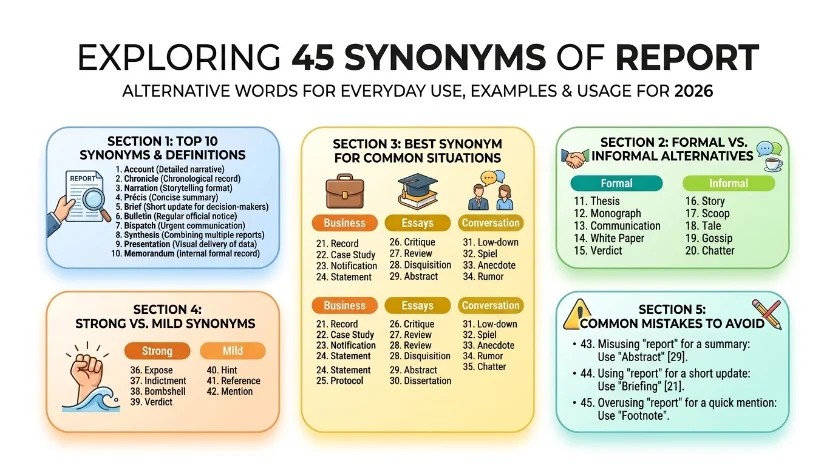
“Report” means to give information about something or a written document about an event. The best synonyms are account, statement, announce, describe, and document. “Account” is a common alternative. Each synonym has a slightly different meaning and context.
Top 10 Synonyms
- Account
- Statement
- Announce
- Describe
- Document
- Record
- Summary
- Review
- Bulletin
- Brief
“Report” is a word we use in many situations. You report news, report an accident, submit a report at work, or report on your progress. It’s useful, but using it too often can sound repetitive.
English has many wonderful alternatives. Some words describe written reports, while others describe speaking. Some are formal, and some are casual.
In this guide, you’ll learn 35 powerful synonyms for “report.” You’ll discover when to use each one, how formal they are, and what common mistakes to avoid. Let’s get started!
What Does “Report” Mean?
Definition
Report” has two main meanings. As a verb, it means to give information about something that has happened. As a noun, it means a written or spoken account of something. You can report news, report a problem or write a report for your boss.
Pronunciation
| Feature | Value |
|---|---|
| US IPA | /rɪˈpɔrt/ |
| UK IPA | /rɪˈpɔːt/ |
| Syllables | 2 (re-port) |
| Tip | Stress the second syllable: “rih-PORT” |
Grammar
| Grammar Feature | Information |
|---|---|
| Part of Speech | Verb and Noun |
| Common Position | After the subject (verb) or after article (noun) |
| Typical Pattern | Subject + report + object / Report + on + something |
Examples:
- “The news anchor reported the story.” (verb)
- “She wrote a detailed report.” (noun)
- “Please report on your progress.” (verb)
Grammar Note: “Report” is both a verb and a noun. As a verb, it needs an object. As a noun, it’s countable.
Word Family
| Word | Part of Speech | Meaning |
|---|---|---|
| Report | Verb/Noun | To give information or a document |
| Reporter | Noun | A person who reports news |
| Reported | Adjective | Said or claimed by someone |
| Reporting | Gerund | The act of giving information |
| Reportedly | Adverb | According to what has been said |
15 Synonyms of “Report”
Account
Meaning: A description or report of an event that gives details of what happened.
Best Used For: Written descriptions, stories, eyewitness accounts.
Formality: Neutral
Tone: Descriptive, Detailed
Frequency: ⭐⭐⭐⭐⭐ (Very Common)
CEFR Level: B1
Example Sentence 1: “She gave a detailed account of the accident.”
Example Sentence 2: “The book provides a fascinating account of his travels.
Usage Tip: “Account” is a great alternative for a detailed description or story. It’s common and versatile.
Common Confusion: Account vs Report. An “account” is often more personal or narrative in style.
Statement
Meaning: Something that is said or written in a formal or official way.
Best Used For: Official communication, legal contexts, public announcements.
Formality: Formal
Tone: Official, Serious
Frequency: ⭐⭐⭐⭐⭐ (Very Common)
CEFR Level: B1
Example Sentence 1: “The police issued a statement about the incident.”
Example Sentence 2: “She gave a statement to the media.”
Usage Tip: “Statement” is formal and official. Use it for legal, police, or official contexts.
Announce
Meaning: To make something known publicly, especially officially.
Best Used For: Public news, official communication, breaking news.
Formality: Formal
Tone: Official, Public
Frequency: ⭐⭐⭐⭐ (Common)
CEFR Level: B1
Example Sentence 1: “The company announced their new product today.”
Example Sentence 2: “They announced their engagement to the family.”
Usage Tip: “Announce” is about making something public, often officially. It’s perfect for news and public events.
Describe
Meaning: To tell someone what something is like, to give details.
Best Used For: Explaining, narrating, giving details.
Formality: Neutral
Tone: Informative, Detailed
Frequency: ⭐⭐⭐⭐⭐ (Very Common)
CEFR Level: A2
Example Sentence 1: “Can you describe what you saw?”
Example Sentence 2: “She described the beautiful scenery.
Usage Tip: “Describe” is about explaining details. It’s perfect when you’re giving specific information.
Document
Meaning: A written or printed record that gives information, or to record information.
Best Used For: Official records, research, legal papers.
Formality: Formal
Tone: Official, Factual
Frequency: ⭐⭐⭐⭐ (Common)
CEFR Level: B2
Example Sentence 1: “The document contains all the details of the agreement.”
Example Sentence 2: “He documented his findings in a report.”
Usage Tip: “Document” as a noun is a formal paper. As a verb, it means to record information officially.
Record
Meaning: Information kept about something, or to write something down.
Best Used For: History, data, audio/video recordings.
Formality: Neutral
Tone: Factual, Permanent
Frequency: ⭐⭐⭐⭐⭐ (Very Common)
CEFR Level: B1
Example Sentence 1: “The doctor’s record showed his medical history.”
Example Sentence 2: “She recorded all the details in her notebook.”
Usage Tip: “Record” is for keeping information permanently. It’s common and works in many contexts.
Summary
Meaning: A short statement giving the main points of something.
Best Used For: Academic, business, condensing information.
Formality: Neutral
Tone: Concise, Informative
Frequency: ⭐⭐⭐⭐ (Common)
CEFR Level: B1
Example Sentence 1: “Please write a summary of the meeting.”
Example Sentence 2: “The summary of the report was only one page.”
Usage Tip: “Summary” is perfect when you need to condense information into the main points.
Review
Meaning: A report or assessment of something.
Best Used For: Books, movies, performance, products.
Formality: Neutral
Tone: Critical, Evaluative
Frequency: ⭐⭐⭐⭐⭐ (Very Common)
CEFR Level: B1
Example Sentence 1: “I read a great review of that new movie.”
Example Sentence 2: “The review of our performance was positive.”
Usage Tip: “Review” is great for evaluations of books, movies, or performance. It often includes opinions.
Bulletin
Meaning: A short public announcement giving recent news.
Best Used For: News, organizations, public updates.
Formality: Formal
Tone: Informative, Brief
Frequency: ⭐⭐⭐ (Moderate)
CEFR Level: B2
Example Sentence 1: “The hospital issued a bulletin about the patient.
Example Sentence 2: “We received a bulletin from the organization.”
Usage Tip: “Bulletin” is a short, official announcement. It’s often used for news updates.
Brief
Meaning: A short written document giving instructions or information.
Best Used For: Business, law, written instructions.
Formality: Formal
Tone: Concise, Professional
Frequency: ⭐⭐⭐ (Moderate)
CEFR Level: B2
Example Sentence 1: “The lawyer prepared a brief for the case.
Example Sentence 2: “She gave a brief of the situation.”
Usage Tip: “Brief” is a formal, concise report. It’s often used in business and legal contexts.
Memo
Meaning: A written message or report used in an office.
Best Used For: Workplace communication, internal announcements.
Formality: Neutral
Tone: Professional, Internal
Frequency: ⭐⭐⭐⭐ (Common)
CEFR Level: B1
Example Sentence 1: “The manager sent a memo to all staff.
Example Sentence 2: “Please read the memo about the new policy.”
Usage Tip: “Memo” is short for memorandum. It’s a professional report used in workplaces.
Inform
Meaning: To tell someone about something.
Best Used For: Communication, giving information.
Formality: Formal
Tone: Professional, Direct
Frequency: ⭐⭐⭐⭐ (Common)
CEFR Level: B1
Example Sentence 1: “Please inform me of any changes.”
Example Sentence 2: “She informed the police about the incident.”
Usage Tip: “Inform” is a formal way of saying “tell.” Use it in professional communication.
Notify
Meaning: To formally or officially tell someone about something.
Best Used For: Official communication, warnings, updates.
Formality: Formal
Tone: Official, Serious
Frequency: ⭐⭐⭐ (Moderate)
CEFR Level: B2
Example Sentence 1: “The school will notify parents of the schedule.”
Example Sentence 2: “Please notify us if there are any problems.”
Usage Tip: “Notify” is very formal. Use it for official communication and warnings.
Narrate
Meaning: To tell a story or give a description of events.
Best Used For: Storytelling, movies, books.
Formality: Neutral
Tone: Story-like, Descriptive
Frequency: ⭐⭐⭐ (Moderate)
CEFR Level: B2
Example Sentence 1: “She narrated the story in a calm voice.”
Example Sentence 2: “He narrated the documentary about nature.”
Usage Tip: “Narrate” is for telling stories or giving descriptions in a narrative style.
Proclaim
Meaning: To announce something publicly and officially.
Best Used For: Official announcements, declarations.
Formality: Very Formal
Tone: Official, Bold
Frequency: ⭐⭐ (Rare)
CEFR Level: C1
Example Sentence 1: “The king proclaimed a new law.”
Example Sentence 2: “She proclaimed her innocence to the public.”
Usage Tip: “Proclaim” is very formal and dramatic. Use it for official and important public announcements.
Synonyms Comparison Table
| Synonym | Best Context | Formality | Tone | Frequency |
|---|---|---|---|---|
| Account | Descriptions | Neutral | Detailed | ⭐⭐⭐⭐⭐ |
| Statement | Official communication | Formal | Official | ⭐⭐⭐⭐⭐ |
| Announce | Public news | Formal | Official | ⭐⭐⭐⭐ |
| Describe | Giving details | Neutral | Informative | ⭐⭐⭐⭐⭐ |
| Document | Official records | Formal | Factual | ⭐⭐⭐⭐ |
| Record | Keeping information | Neutral | Permanent | ⭐⭐⭐⭐⭐ |
| Summary | Condensed information | Neutral | Concise | ⭐⭐⭐⭐ |
| Review | Evaluation | Neutral | Critical | ⭐⭐⭐⭐⭐ |
| Memo | Workplace | Neutral | Professional | ⭐⭐⭐⭐ |
| Bulletin | News updates | Formal | Brief | ⭐⭐⭐ |
Best Synonyms by Situation
| Situation | Best Synonym | Why It Works |
|---|---|---|
| Daily Conversation | Account / Describe | Natural and casual |
| Business Email | Memo / Statement | Professional and clear |
| Academic Writing | Document / Summary | Formal and precise |
| School Assignment | Review / Summary | Shows understanding |
| Professional Meeting | Report / Brief | Professional and efficient |
| Presentation | Announce / Account | Engaging and clear |
| Creative Writing | Narrate / Account | Adds storytelling quality |
| Social Media | Announce / Share | Casual and engaging |
| News Reporting | Bulletin / Statement | Official and reliable |
Formal vs Informal Synonyms
Formal Alternatives
| Synonym | Best Used For |
|---|---|
| Statement | Official announcements |
| Announce | Public declarations |
| Document | Official written records |
| Memo | Workplace communication |
| Notify | Official notifications |
Neutral Alternatives
| Synonym | Best Used For |
|---|---|
| Account | Descriptions of events |
| Describe | Giving details |
| Record | Keeping information |
| Summary | Condensing information |
Informal Alternatives
| Synonym | Best Used For |
|---|---|
| Tell | Casual conversation |
| Let know | Informing someone |
| Write up | Creating a report |
Choosing the Right Level: In academic writing, use “document” or “summary.” In business, use “memo” or “statement.” In everyday conversation, “account” and “describe” sound natural.
Strong vs Mild Synonyms
Mild
Suitable for everyday situations.
- Tell
- Describe
- Give an account
Moderate
More formal or detailed alternatives.
- Report
- Record
- Summary
- Review
Strong
High-intensity alternatives suggesting importance.
- Announce (public importance)
- Proclaim (official declaration)
- Notify (official notification)
How Intensity Changes Meaning: “I told them” is simple. “I announced it to everyone” sounds much more significant. Choose stronger words when the information is important.
Real-Life Examples
School: “The student gave a report on the history project.”
Office: “Please send a memo to all staff about the meeting.”
Business Email: “We need to document all our findings.”
Meetings: “Her account of the project was very thorough.”
Presentations: “He announced the new company policy.”
Daily Conversations: “Can you describe what happened?”
Social Media: “She announced her big news on Instagram.”
Academic Writing: “The summary of the study was one paragraph.”
Common Collocations
| Common Phrase | Better Alternative |
|---|---|
| Write a report | Prepare a summary |
| Give a report | Provide an account |
| Report findings | Document findings |
| Report news | Announce news |
| Report progress | Record progress |
Common Phrases
Report back: To give information after investigation. (e.g., “Please report back after the meeting.”)
File a report: To submit an official report. (e.g., “We need to file a report with the police.”)
Account for: To give a description or explanation. (e.g., “He couldn’t account for his absence.”)
By all accounts: According to what everyone says. (e.g., “By all accounts, it was a great success.”)
On the record: Officially stated. (e.g., “His comments were on the record.”)
Context Guide
| Situation | Best Synonym | Reason |
|---|---|---|
| Essay | Document / Summary | Academic and formal |
| Speech | Announce / Account | Engaging and clear |
| Business Email | Memo / Statement | Professional and official |
| Novel | Narrate / Account | Adds literary quality |
| Presentation | Announce / Review | Clear and professional |
| Conversation | Describe / Tell | Natural and casual |
| Academic Writing | Document / Summary | Precise and formal |
| Marketing Copy | Announce / Record | Engaging and reliable |
Related Words
Near Synonyms
- Narrative: A story or account of events.
- Chronicle: A record of events in order.
- Disclosure: Making information known.
- Testimony: A formal statement, often in court.
Antonyms
- Conceal: To hide information.
- Withhold: To keep information back.
- Suppress: To stop information from being known.
- Deny: To say something is not true.
Related Adjectives
- Reported: Said or claimed.
- Official: Authorized and formal.
- Formal: Official and serious.
- Detailed: Containing many details.
Related Nouns
- Reporter: A person who reports news.
- Documentation: Official papers or records.
- Announcement: A public statement.
- Narrative: A story or account.
Related Verbs
- Relate: To tell or describe.
- Recount: To tell a story or describe events.
- Cite: To mention as an example or proof.
- State: To express something clearly.
Frequently Asked Questions
What is another word for report?
Common synonyms include account, statement, announce, describe, and document. “Account” is one of the most common alternatives.
Which synonym sounds the most professional?
Statement and document sound very professional. “Memo” is excellent for workplace contexts. “Notify” is also professional for official communication.
What is the strongest synonym for report?
Proclaim is one of the strongest synonyms. It suggests an important, official public announcement. “Announce” is also strong for public news.
Which synonym is best for essays?
Document and summary are excellent for academic essays. “Record” is also strong for research-based writing.
What’s the difference between report and account?
A “report” is often more factual and objective. An “account” can be more personal or narrative, like someone telling their story.
Which synonym is most common in everyday English?
“Tell” and “describe” are very common in everyday speech. “Account” is also frequently used.
What is the opposite of report?
Common opposites include conceal, withhold, and suppress. These words mean to hide or keep information secret.
Conclusion
“Report” is a word you’ll use often, but now you have 35 fantastic alternatives. Each synonym adds a different shade of meaning to your language.
The key is understanding the context. Use “account” and “describe” for everyday details. Use “statement” and “document” for official contexts. Use “announce” for public news. Use “record” for keeping information.
The best way to improve is practice. Try using one or two new synonyms each day. Listen for these words in conversations and news reports. Your vocabulary will become richer and more impressive with time.
