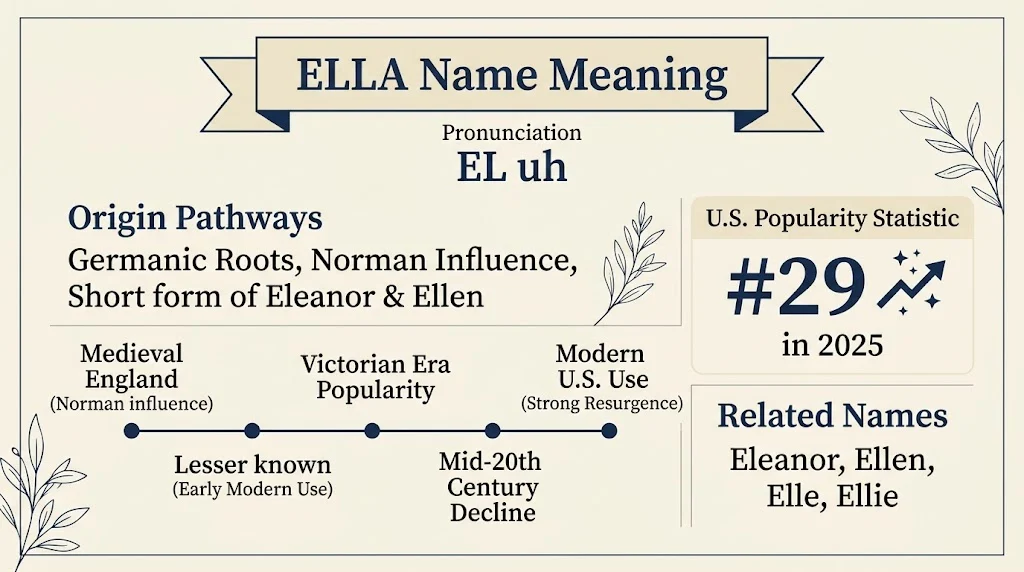
Ella is a feminine given name with multiple documented roots. It developed as a Norman name from a Germanic element meaning “other” and also as a short form of Eleanor, Ellen, and other names beginning with El.
ella name meaning depends on which historical naming tradition is being considered. The name has more than one documented origin, so a single translation does not tell the whole story.
One established tradition traces Ella to Norman England. In this tradition, Ella developed from Germanic names containing alles, connected with the Proto Germanic element aljaz, meaning “other.” The name entered England after the Norman period and later returned to wider use during the nineteenth century.
A second tradition treats Ella as a diminutive. It can function as a short form of Eleanor, Ellen, and other names beginning with El. It can also appear as a shortened form of names ending in ella.
Therefore, the name can carry different associations depending on its family history. For one family, Ella may be an independent traditional name. For another, it may connect to Eleanor, Ellen, Elizabeth, Gabriella, Isabella, or another longer form.
In American English, Ella is pronounced EL uh, with the stress on the first syllable. Oxford’s learner dictionary lists Ella as a feminine first name and notes that it can sometimes be short for Eleanor.
The name also has strong cultural recognition. Ella Fitzgerald, the influential American jazz singer, is one of its best known historical bearers.
Quick Answer Box
| Meaning | Context | Primary Platforms | Example | Tone |
| “Other” | Norman and Germanic history | Names, baby name sites, genealogy | Ella as an independent given name | Traditional |
| Short form of El names | English and European naming | Baby names, family naming | Ella from Eleanor or Ellen | Familiar |
| Feminine given name | Modern American English | Everyday use | “Ella is my daughter’s name.” | Simple |
| Cultural name | Music and popular culture | Books, music, media | Ella Fitzgerald | Classic |
| Modern baby name | U.S. naming culture | Birth records and name databases | Ella ranked #29 in 2025 | Contemporary |
What does ella name mean Reveal About Its Origin?
The most important point is that Ella does not have one universally accepted etymology.
Behind the Name lists two separate entries for Ella. The first identifies Ella as an English name with Norman history and a Germanic root. The second identifies it as a diminutive used across several European languages.
The Norman and Germanic Connection
The older Norman explanation connects Ella with Germanic naming elements. Behind the Name associates the name with alles and the reconstructed Proto Germanic form aljaz. The basic sense is “other.”
This meaning can sound unusual to modern readers. However, historical personal names often developed from elements that do not function like modern descriptions.
A name meaning “other” does not necessarily suggest someone who is strange or different. It reflects an older naming element and its place within Germanic naming traditions.
The Norman connection also matters historically. Ella was introduced into England through Norman influence and remained in use until approximately the fourteenth century. It later experienced a revival in the nineteenth century.
Ella as a Short Form
The second origin provides a different pathway.
Ella can be a diminutive of Eleanor and Ellen. It can also serve as a short form for other names beginning with El or names ending in ella.
This explains why Ella can feel both traditional and modern.
For example, a family might use Ella independently from birth. Another family might use it as a familiar form of Eleanor. A third family might choose it because they like the sound without connecting it to a longer name.
Is “Beautiful” the Meaning?
Many online baby name pages describe Ella with meanings such as “beautiful,” “fairy,” or “maiden.” These descriptions are widely repeated, but they should not automatically be treated as the single historical meaning.
The strongest documented sources show multiple etymological pathways. The Norman and Germanic explanation connects Ella with “other,” while the second Ella entry treats it as a diminutive.
Therefore, saying that Ella always means “beautiful” would oversimplify the evidence.
A Note About Hebrew and Greek Associations
Ella is also associated with words and names from other linguistic traditions. Some sources discuss a Hebrew form associated with a tree in the pistachio family. Other references connect the spelling with Greek mythology.
These connections should be separated from the main English naming history. Similar spellings do not automatically prove that two names share the same origin.
For SEO content, genealogy research, or baby naming, this distinction matters. A spelling can appear independently in several languages.
Contextual Dynamics and Nuances of the Name
The meaning of a personal name changes slightly depending on context.
A dictionary definition answers one question. Etymology answers another. Family usage answers yet another.
Ella works especially well as an example because several naming traditions overlap.
Ella as an Independent First Name
Today, many people use Ella as a complete first name.
In that situation, there is no requirement to expand it to Eleanor or another longer name. The name stands on its own.
This gives parents a short name without requiring a nickname.
It also gives the name a straightforward spelling. In American English, the common pronunciation is two syllables: EL uh.
Ella as a Nickname
Ella can also operate as a nickname.
Possible longer forms include Eleanor and Ellen. Depending on family preference, it may also appear as a short form of other names beginning with El or ending in ella.
However, not every Ella is short for another name.
That distinction is important when interpreting someone’s name. Asking, “Is Ella short for something?” is reasonable in casual conversation, but assuming the answer can create confusion.
Ella in Family Naming
Families sometimes choose short names because they work well across generations.
Ella fits that pattern. It has medieval historical roots, nineteenth century revival history, and modern popularity.
Consequently, the name can sound classic without feeling strongly tied to one historical period.
Ella in Modern American Culture
Ella has remained highly visible in the United States.
According to the U.S. Social Security Administration based data reported from the 2025 national baby name records, Ella ranked 29th among girls’ names in 2025, with 5,831 recorded births.
That ranking provides useful context. Ella is not merely an obscure historical name. It remains a widely recognized contemporary choice in the United States.
Real Life Conversation Examples Using ella name meaning
Because Ella is a personal name rather than internet slang, conversations about it usually involve pronunciation, origin, family history, or naming preferences.
Example 1: Asking About the Meaning
Alex: “What does Ella mean?”
Jordan: “It has more than one origin. One historical explanation connects it to a Germanic element meaning ‘other.’ It can also be a short form of Eleanor or Ellen.”
Alex: “So there isn’t just one meaning?”
Jordan: “Right. The history depends on which Ella tradition you’re talking about.”
Example 2: Asking Whether Ella Is Short for Eleanor
Maya: “Is Ella usually short for Eleanor?”
Claire: “It can be, but it doesn’t have to be.”
Maya: “So Ella can be the full name?”
Claire: “Exactly. It is also used independently.”
Example 3: Discussing Pronunciation
Sam: “How do you pronounce Ella?”
Taylor: “EL uh.”
Sam: “Two syllables?”
Taylor: “Yes. The first syllable gets the emphasis.”
Oxford gives the English pronunciation as /ˈelə/, which corresponds closely to the common American pronunciation “EL uh.”
Example 4: Discussing a Baby Name
Parent: “We’re considering Ella for our daughter.”
Friend: “That’s a classic choice.”
Parent: “We like that it’s short but still feels traditional.”
Friend: “It also has several historical connections, including Norman and Germanic history.”
Example 5: Explaining the Name Online
User: “Someone asked me what my name means.”
Friend: “You can explain that Ella has multiple documented origins.”
User: “What should I mention?”
Friend: “You could say it has a Norman and Germanic history and can also be a short form of Eleanor, Ellen, and related names.”
Platform Specific Breakdown
Ella is not primarily a slang expression. Therefore, social platforms generally treat it as a personal name rather than a coded internet term.
Still, platform context can influence how people encounter searches about the name.
How It Is Used on Snapchat
On Snapchat, Ella may appear as a display name, username, contact name, or profile reference.
For example:
“Ella added you.”
Here, Ella is simply a person’s name.
Searches may also appear in Snapchat conversations about baby names, celebrities, school friends, or family members. The meaning comes from the surrounding conversation rather than from a special Snapchat definition.
This distinction prevents a common mistake. A name appearing frequently in social media messages does not automatically become slang.
The Role of ella name meaning on TikTok
TikTok can amplify searches about names through baby naming videos, genealogy content, pronunciation videos, and cultural discussions.
Creators may discuss questions such as:
“What does Ella mean?”
“Is Ella a vintage name?”
“Is Ella short for Eleanor?”
These are naming questions rather than slang definitions.
TikTok can also introduce simplified interpretations. For example, a creator might summarize Ella as “beautiful” or “fairy.” Such summaries can be useful for casual content, but they may omit the competing historical explanations.
Therefore, users researching the name should compare social media claims with established name references.
Instagram and Texting Dynamics
Instagram often uses names in profile biographies, captions, usernames, and family announcements.
A caption such as:
“Welcome, baby Ella!”
contains no hidden slang meaning.
Likewise, a text saying:
“Ella will be here at seven.”
uses Ella as a person’s name.
Context becomes especially important when the name appears inside usernames. A handle containing “ella” might refer to a person’s name, a brand, a character, or a word in another language.
The spelling alone cannot establish the intended meaning.
Alternative Meanings
Search engines may interpret searches for ella name meaning in several related ways.
Users may search for the same underlying information with very different wording.
| Search variation | Likely intent |
| Ella name meaning | Basic definition |
| Meaning of Ella | General research |
| What does Ella mean | Direct answer |
| Ella origin | Etymology |
| Ella name origin | Historical research |
| Is Ella a biblical name | Religious naming research |
| Ella baby name meaning | Parenting research |
| Ella pronunciation | Speech and spelling |
| Ella nickname | Short form research |
| Is Ella short for Eleanor | Name relationship |
| Ella popularity | U.S. naming trends |
| Ella middle names | Baby naming ideas |
Semantic Variations
Useful semantic variations include:
- meaning of Ella
- origin of Ella
- history of Ella
- Ella baby name
- Ella feminine name
- Ella nickname
- Ella pronunciation
- Ella etymology
- Ella name origin
- Ella in English
- Ella in European languages
- names similar to Ella
- longer names for Ella
- Ella as a nickname
These variations help cover user intent without repeatedly using one exact search phrase.
Related Names
Ella has connections with several names.
| Related name | Relationship |
| Eleanor | Ella can function as a diminutive |
| Ellen | Ella can function as a diminutive |
| Elle | Similar short form and spelling |
| Ellie | Related short form in the same naming family |
| Elizabeth | Some Ella uses can arise from El names |
| Gabriella | Ella can be used as a shortened form |
| Isabella | Ella can function as a shortened form |
| Estella | Ends in the Ella element |
Behind the Name specifically documents Ella as a diminutive of Eleanor, Ellen, and other names beginning with El. It also identifies Ella as a short form of names ending in ella.
Linguistic Variation
The spelling stays familiar across several languages, although pronunciation can change.
Behind the Name lists Ella as an English, German, Swedish, Norwegian, Danish, Finnish, and Hungarian name under its second entry. It gives distinct pronunciation information for English, Finnish, and Hungarian.
This illustrates an important linguistic principle.
A shared spelling does not guarantee an identical pronunciation or etymology.
Misinterpretations:
Some common assumptions about Ella require additional context.
Do Not Treat One Meaning as Universal
The biggest mistake is presenting one definition as definitive.
Ella has multiple documented naming pathways. The Norman and Germanic explanation differs from the diminutive explanation.
A better explanation acknowledges both.
Do Not Assume Every Ella Is Short for Eleanor
Ella can be short for Eleanor. However, it can also be an independent given name.
Therefore, “Ella is always short for Eleanor” is inaccurate.
Do Not Automatically Call Ella a Slang Term
The phrase may appear in searches about slang because people often use broad templates for name and word research.
However, Ella itself is a personal name. Its ordinary use does not indicate internet slang.
Do Not Equate Similar Spellings
Ella may resemble names or words in Hebrew, Greek, Germanic, and other linguistic contexts.
However, similarity in spelling does not establish common ancestry.
Etymology requires historical and linguistic evidence.
Do Not Assume Popularity Means One Specific Meaning
Ella’s popularity in the United States tells us about naming behavior. It does not prove which etymological meaning parents intended.
A family choosing Ella may select it for sound, family tradition, a relative, cultural connection, or personal preference.
How to Respond in Chat Comfortably
If someone asks what Ella means, a short answer works best.
A useful response is:
“Ella has more than one documented origin. It is associated with a Norman and Germanic tradition connected with ‘other,’ and it can also be a short form of Eleanor, Ellen, and other El names.”
If someone asks whether Ella is a good name, the answer depends on personal preference rather than etymology.
You can instead describe its characteristics:
- Two syllables in common American English pronunciation.
- Short and easy to spell.
- Long historical usage.
- Multiple documented origins.
- Strong recognition in the United States.
- Flexible use as either a full name or short form.
If Someone Asks About the Meaning in a Text
Keep the answer concise.
Question: “What does Ella mean?”
Response: “Ella has several origins. One historical line connects it with a Germanic element meaning ‘other,’ while another treats it as a short form of Eleanor, Ellen, and other El names.”
If Someone Asks Whether It Is Biblical
Avoid giving a simple yes or no without clarifying the specific tradition.
The English name Ella documented by Behind the Name has a Norman and Germanic history. A separate Hebrew word or name with a similar spelling should not automatically be treated as the source of the English given name.
If Someone Asks for a Baby Name Description
A polished description could emphasize the name’s historical depth.
Ella is a classic feminine name with Norman, Germanic, and European naming connections. It can stand independently or serve as a short form of names such as Eleanor and Ellen.
That wording avoids claiming a single disputed meaning.
FAQs
1. What does ella name mean?
The search phrase usually refers to the meaning and origin of the personal name Ella. The name has multiple documented explanations. One connects it with a Germanic element meaning “other,” while another treats it as a diminutive of Eleanor, Ellen, and other El names.
2. Is Ella a girl’s name?
Yes. Ella is primarily documented as a feminine given name in the naming references used for this guide. Oxford also describes Ella as a first name for girls.
3. Is Ella short for Eleanor?
It can be. One documented Ella entry identifies it as a diminutive of Eleanor, Ellen, and other names beginning with El. However, Ella is also used independently.
4. Is Ella an old name?
Yes. The Norman form has medieval English history. Behind the Name states that this form was introduced to England by the Normans, used until the fourteenth century, and later revived in the nineteenth century.
5. How do you pronounce Ella?
In common American English, Ella is pronounced EL uh, with the stress on the first syllable. Oxford gives the pronunciation as /ˈelə/.
6. Is Ella popular in the United States?
Yes. Ella ranked 29th among U.S. girls’ names in 2025, based on Social Security Administration data. The recorded number for that year was 5,831 births.
7. When was Ella most popular in the United States?
The available U.S. birth data show a particularly strong period around the late 2000s and early 2010s. A Social Security Administration based dataset records a peak rank of 12 in 2012 and 2011.
8. What are common nicknames for Ella?
Ella is already short, so it does not require a nickname. Informal variants may include Elle or Ellie, depending on family preference. However, these are related forms rather than mandatory nicknames.
9. Is Ella a European name?
Ella has documented use across several European naming traditions. The second Ella entry is listed for English, German, Swedish, Norwegian, Danish, Finnish, and Hungarian usage.
10. Is Ella a modern name?
Ella is modern in popularity but historical in origin. Its documented Norman history reaches back to medieval England, while its current U.S. popularity demonstrates continued modern use.
U.S. Popularity and Naming Trends
Ella has a long history in American naming records.
U.S. Social Security Administration based data show that the name has appeared in national birth records since the late nineteenth century. The modern period brought a substantial revival.
The name reached a particularly strong position during the 2010s. Behind the Name’s U.S. data show Ella at number 12 in 2011 and 2012. It remained within the top 20 for much of the following period before moving lower in the ranking.
The 2025 position was number 29.
That places Ella among the most frequently used girls’ names in the United States, while also showing that its recent popularity has fluctuated rather than remaining fixed.
| Year | U.S. girls’ rank |
| 2010 | 13 |
| 2011 | 12 |
| 2012 | 12 |
| 2015 | 18 |
| 2019 | 13 |
| 2020 | 15 |
| 2021 | 16 |
| 2022 | 25 |
| 2023 | 32 |
| 2024 | 30 |
| 2025 | 29 |
The data show an important pattern. Ella remains common, but its ranking changes from year to year.
This is useful for parents who want a name that feels established without assuming that current popularity will remain constant.
Cultural Associations and Famous Bearers
One of the most influential people associated with the name is Ella Fitzgerald.
Fitzgerald was an American singer whose career became closely associated with jazz and popular music. Behind the Name identifies her as a famous bearer of the name.
Her cultural legacy gives Ella a strong association with music.
However, the name is not defined by one famous person.
A personal name can accumulate cultural associations over time. Literature, music, television, film, and family history can all influence how people perceive it.
Consequently, two people may hear the same name and think of entirely different references.
Ella Across Languages and Cultures
Ella has broader international usage than its simple spelling might suggest.
Behind the Name lists the second Ella entry across English, German, Swedish, Norwegian, Danish, Finnish, and Hungarian usage.
Pronunciation can change between languages.
| Language | Documented pronunciation |
| English | /ˈɛl.ə/ |
| Finnish | /ˈel.lɑ/ |
| Hungarian | /ˈɛl.lɒ/ |
These differences demonstrate why pronunciation should be treated separately from spelling.
The same written name can move between languages while developing different spoken forms.
Ella and Eleanor
The relationship between Ella and Eleanor is especially relevant in English naming.
Ella can function as a diminutive of Eleanor.
However, Eleanor has its own complex history. Therefore, describing Ella as simply “the meaning of Eleanor” would skip several stages of linguistic development.
Ella and Ellen
The same principle applies to Ellen.
Ella can serve as a diminutive of Ellen, but Ella also has an independent Norman and Germanic history.
This makes the name especially flexible.
Conclusion:
The search for ella name meaning leads to a broader story about how personal names evolve.
Ella is not simply a modern nickname. It has documented medieval history, Norman connections, Germanic linguistic roots, and later use as a diminutive of Eleanor, Ellen, and other El names.
Its history also demonstrates why name meanings should be researched carefully.
A single spelling can represent more than one linguistic pathway. A name can begin as a medieval form, disappear from common use, return during a later revival, and eventually become a popular modern baby name.
Ella illustrates that process clearly.
In the United States, the name remains widely recognized. It ranked 29th among girls’ names in 2025, with 5,831 recorded births that year.
Its short spelling also gives it practical appeal. The pronunciation is straightforward in American English, and the name can stand independently or connect to longer names such as Eleanor and Ellen.
Most importantly, there is no need to force Ella into one definition.
The strongest explanation recognizes its multiple documented origins. One historical tradition connects it with a Germanic element meaning “other.” Another identifies it as a diminutive or short form within the broader El and ella naming families.
That combination of history, flexibility, cultural recognition, and modern usage explains why Ella continues to appear across generations and naming traditions.
