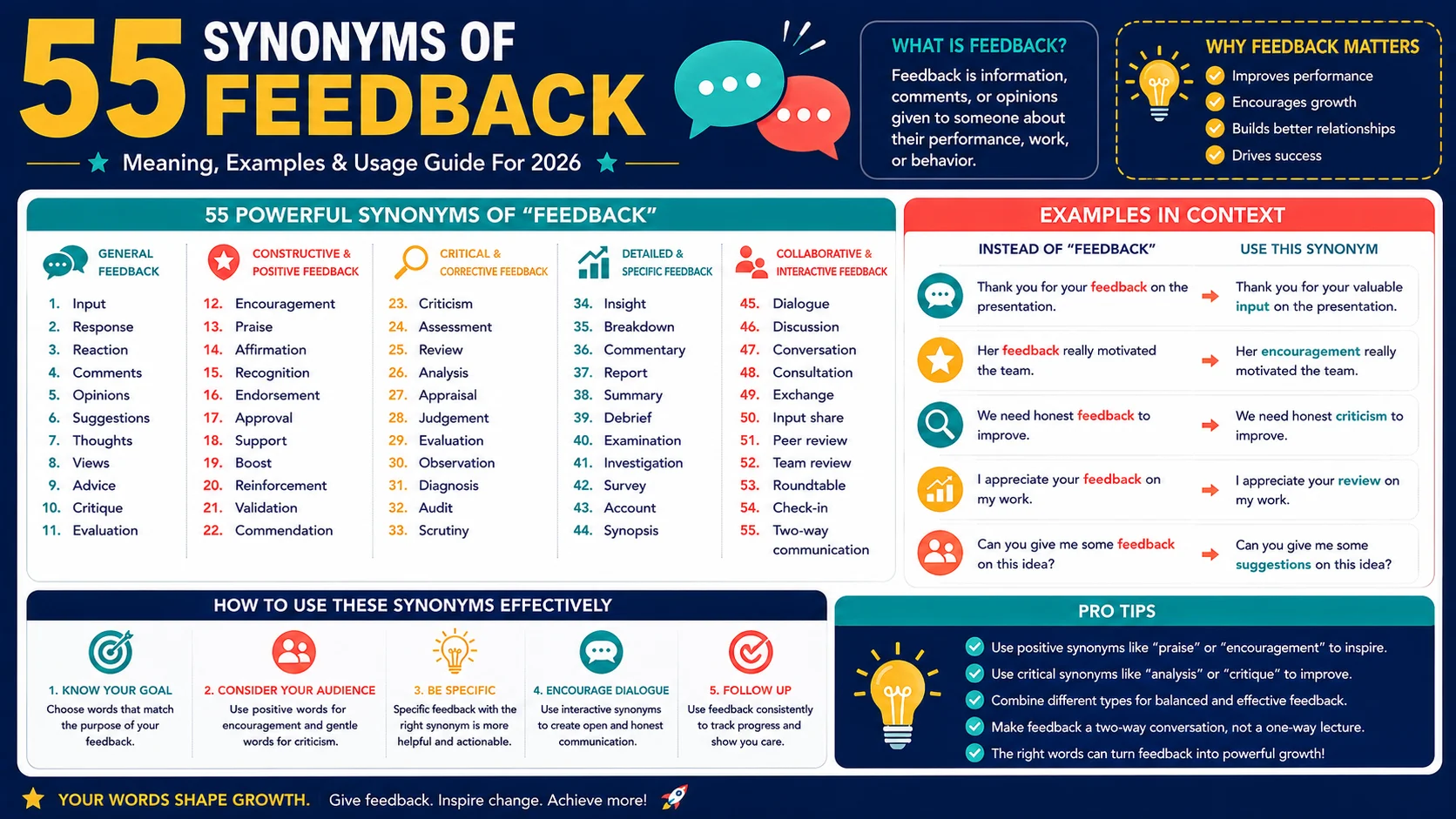
Feedback means information or opinions about how well someone is doing, or suggestions for improvement. The best synonyms include response, reaction, input, evaluation, assessment, critique, commentary, and review. The most common everyday synonym is response, while evaluation works best in professional contexts. Each synonym has a slightly different tone and fits different situations.
Top 10 Synonyms
- Response
- Reaction
- Input
- Evaluation
- Assessment
- Critique
- Commentary
- Review
- Opinion
- Observation
Every synonym has a slightly different meaning, tone, or context, so choose carefully based on your situation.
Do you keep saying “feedback” in every email, meeting, and conversation? It’s a useful word, but overusing it makes your communication sound repetitive and dull.
Learning synonyms for “feedback” helps you express yourself more precisely and naturally. Whether you’re giving constructive criticism, asking for opinions, or reviewing someone’s work, having the right word makes your message clearer and more professional.
In this guide, you’ll discover 35 powerful alternatives to “feedback.” You’ll learn their meanings, when to use them, and which ones native speakers prefer in different situations. Let’s dive in!
What Does “Feedback” Mean?
Definition
Feedback means information, opinions, or evaluations given about someone’s performance, work, or behavior. It’s the response you get after doing something—whether good or bad.
In everyday terms, think of feedback like a mirror. It shows you what you’re doing well and what you could improve. It helps you grow and get better at whatever you’re doing.
Feedback can describe:
- Professional evaluations (“My manager gave me feedback on my presentation”)
- Customer opinions (“The company collects customer feedback”)
- Academic comments (“The teacher wrote feedback on my essay”)
- Personal observations (“I value your honest feedback”)
Pronunciation
| Feature | Value |
|---|---|
| US IPA | /ˈfiːd.bæk/ |
| UK IPA | /ˈfiːd.bæk/ |
| Syllables | 2 (feed-back) |
| Tip | Stress the first syllable: FEED-back |
Grammar
| Grammar Feature | Information |
|---|---|
| Part of Speech | Noun (uncountable) |
| Common Position | After verbs (give, receive, provide) |
| Typical Pattern | give/receive + feedback + on/about |
Example Sentences:
- “My supervisor gave me feedback on the project.”
- “We received positive feedback from our customers.”
- “She asked for feedback about her presentation.”
Grammar Notes: “Feedback” is uncountable. You cannot say “feedbacks.” Say “pieces of feedback” or “some feedback” instead.
Word Family
| Word | Part of Speech | Meaning |
|---|---|---|
| Feedback | Noun | Information or opinions about performance |
| Feed | Verb | To give food or supply something |
| Back | Adverb/Noun | In return; the rear part |
| Feedforward | Noun | Information given before a task |
| Backfeed | Verb | To send information back |
| Feedback loop | Noun | A system where output returns as input |
55 Synonyms of “Feedback”
1. Response
Meaning: An answer or reaction to something that has been said or done.
Best Used For: General use, polite requests, everyday conversation.
Formality: Neutral
Tone: Neutral, Helpful
Frequency: ⭐⭐⭐⭐⭐ Very Common
CEFR Level: A2
Example Sentence 1: “I’m still waiting for a response to my email.”
Example Sentence 2: “The audience response was overwhelmingly positive.”
Usage Tip: “Response” is the safest alternative to “feedback.” It works in almost any context. Use it when you want to sound natural and conversational.
2. Reaction
Meaning: A feeling or action in response to something.
Best Used For: Emotional responses, spontaneous reactions, public opinion.
Formality: Neutral
Tone: Emotional, Immediate
Frequency: ⭐⭐⭐⭐⭐ Very Common
CEFR Level: A2
Example Sentence 1: “Her reaction to the news was surprise and delight.
Example Sentence 2: “The audience reaction was exactly what we hoped for.”
Usage Tip: “Reaction” focuses on feelings and immediate responses. Use it when you want to describe how people felt or acted.
3. Input
Meaning: Ideas, suggestions, or opinions contributed to a discussion.
Best Used For: Collaborative work, meetings, brainstorming.
Formality: Neutral to Formal
Tone: Collaborative, Inclusive
Frequency: ⭐⭐⭐⭐⭐ Very Common
CEFR Level: B1
Example Sentence 1: “I’d love your input on this project.”
Example Sentence 2: “The team’s input was invaluable for the final product.”
Usage Tip: “Input” suggests active participation and contribution. Use it when you’re asking for ideas, not just opinions.
4. Evaluation
Meaning: A careful assessment of the value, quality, or importance of something.
Best Used For: Professional reviews, performance, serious assessments.
Formality: Formal
Tone: Professional, Serious
Frequency: ⭐⭐⭐⭐ Common
CEFR Level: B2
Example Sentence 1: “The manager conducted an evaluation of each employee.
Example Sentence 2: “We need an evaluation of the program’s effectiveness.”
Usage Tip: “Evaluation” is formal and serious. Use it for official assessments and professional reviews.
5. Assessment
Meaning: An evaluation of someone’s skills, abilities, or performance.
Best Used For: Education, training, professional reviews.
Formality: Formal
Tone: Academic, Professional
Frequency: ⭐⭐⭐⭐⭐ Very Common
CEFR Level: B1
Example Sentence 1: “The teacher gave each student a written assessment.”
Example Sentence 2: “We completed a risk assessment for the new project.
Usage Tip: “Assessment” is common in education and professional settings. Use it for evaluating skills and performance.
6. Critique
Meaning: A detailed analysis and assessment of something.
Best Used For: Creative work, writing, art, serious reviews.
Formality: Formal
Tone: Analytical, Honest
Frequency: ⭐⭐⭐⭐ Common
CEFR Level: B2
Example Sentence 1: “She asked for my critique of her new painting.
Example Sentence 2: “The professor’s critique was helpful but direct.”
Usage Tip: “Critique” implies detailed, honest evaluation. It can be positive or negative. Don’t confuse it with “criticism,” which is usually negative.
7. Commentary
Meaning: A series of comments or observations about something.
Best Used For: Media, events, providing perspective.
Formality: Formal
Tone: Observational, Insightful
Frequency: ⭐⭐⭐⭐ Common
CEFR Level: B2
Example Sentence 1: “The news provided commentary on the election results.”
Example Sentence 2: “His commentary offered a fresh perspective on the issue.”
Usage Tip: “Commentary” suggests ongoing observations. Use it for media, events, or when you want to share perspective.
8. Review
Meaning: A formal examination or assessment.
Best Used For: Products, books, performances, meetings.
Formality: Neutral to Formal
Tone: Evaluative, Informative
Frequency: ⭐⭐⭐⭐⭐ Very Common
CEFR Level: A2
Example Sentence 1: “The review of the movie was mostly positive.”
Example Sentence 2: “We need to do a review of the company’s performance.”
Usage Tip: “Review” is a common and versatile synonym. Use it for products, performance, or formal examinations.
9. Opinion
Meaning: A personal view or belief about something.
Best Used For: Personal perspectives, advice, sharing views.
Formality: Neutral
Tone: Personal, Subjective
Frequency: ⭐⭐⭐⭐⭐ Very Common
CEFR Level: A2
Example Sentence 1: “I’d love your opinion on this matter.
Example Sentence 2: “Everyone had a different opinion about the proposal.”
Usage Tip: “Opinion” is personal and subjective. Use it when you want someone’s individual perspective, not a formal evaluation.
10. Observation
Meaning: A comment or remark based on watching something.
Best Used For: Insights, noticing patterns, factual comments.
Formality: Neutral to Formal
Tone: Observant, Objective
Frequency: ⭐⭐⭐⭐ Common
CEFR Level: B1
Example Sentence 1: “She made an interesting observation during the meeting.”
Example Sentence 2: “My observation is that the team works well together.”
Usage Tip: “Observation” suggests you noticed something. Use it for insights based on watching or paying attention.
11. Suggestion
Meaning: An idea or plan offered for consideration.
Best Used For: Ideas for improvement, proactive recommendations.
Formality: Neutral
Tone: Helpful, Constructive
Frequency: ⭐⭐⭐⭐⭐ Very Common
CEFR Level: A2
Example Sentence 1: “She offered a helpful suggestion for the project.”
Example Sentence 2: “Do you have any suggestions for improvement?”
Usage Tip: “Suggestion” is positive and helpful. Use it when you’re offering ideas, not just evaluating.
12. Advice
Meaning: Guidance or recommendations offered about what to do.
Best Used For: Problems, decisions, seeking help.
Formality: Neutral
Tone: Helpful, Wise
Frequency: ⭐⭐⭐⭐⭐ Very Common
CEFR Level: A2
Example Sentence 1: “I need your advice on this situation.”
Example Sentence 2: “He gave me good advice about my career.”
Usage Tip: “Advice” is more personal than “feedback.” Use it when someone is seeking guidance or help with a decision.
13. Criticism
Meaning: The expression of disapproval or pointing out faults.
Best Used For: Constructive feedback, negative evaluations.
Formality: Neutral
Tone: Negative or Constructive
Frequency: ⭐⭐⭐⭐⭐ Very Common
CEFR Level: B1
Example Sentence 1: “She received criticism for the mistakes in her report.”
Example Sentence 2: “Constructive criticism can help you improve.”
Usage Tip: “Criticism” is often negative. To make it positive, say “constructive criticism.” Use it when you need to point out problems.
14. Recommendation
Meaning: A suggestion or proposal about what should be done.
Best Used For: Formal suggestions, professional advice.
Formality: Formal
Tone: Professional, Helpful
Frequency: ⭐⭐⭐⭐⭐ Very Common
CEFR Level: B1
Example Sentence 1: “The report made several recommendations for improvement.”
Example Sentence 2: “I have a recommendation for the new hire.”
Usage Tip: “Recommendation” is formal and suggests action. Use it in reports, professional settings, and when you want to suggest changes.
15. Feedback loop
Meaning: A system where information is continuously shared.
Best Used For: Systems, processes, communication.
Formality: Formal to Technical
Tone: Technical, Systemic
Frequency: ⭐⭐⭐ Moderate
CEFR Level: C1
Example Sentence 1: “We created a feedback loop to improve communication.”
Example Sentence 2: “The feedback loop helped us adjust quickly.”
Usage Tip: This is a technical term. Use it when describing systems or processes that involve continuous exchange.
16. Impression
Meaning: An idea or feeling about something based on experience.
Best Used For: First experiences, personal perceptions.
Formality: Neutral
Tone: Personal, Subjective
Frequency: ⭐⭐⭐⭐ Common
CEFR Level: B1
Example Sentence 1: “What was your impression of the new manager?
Example Sentence 2: “My impression is that the project is going well.”
Usage Tip: “Impression” is about feelings and perceptions, not facts. Use it for personal reactions.
17. Takeaway
Meaning: The main point or lesson from something.
Best Used For: Meetings, learning, key insights.
Formality: Informal
Tone: Summarizing, Insightful
Frequency: ⭐⭐⭐⭐ Common
CEFR Level: B2
Example Sentence 1: “My main takeaway from the meeting was to improve communication.”
Example Sentence 2: “What was your takeaway from the training?”
Usage Tip: “Takeaway” is modern and informal. Use it when you want to ask about the main point or lesson learned.
18. Verdict
Meaning: A decision or opinion reached after consideration.
Best Used For: Final assessments, decisions.
Formality: Neutral to Formal
Tone: Decisive, Final
Frequency: ⭐⭐⭐ Moderate
CEFR Level: B2
Example Sentence 1: “The jury reached a verdict after deliberation.”
Example Sentence 2: “What’s your verdict on the new proposal?”
Usage Tip: “Verdict” suggests a final decision. Use it when someone has made up their mind after thinking carefully.
19. Appraisal
Meaning: An evaluation of the value or quality of something.
Best Used For: Performance reviews, property valuations.
Formality: Formal
Tone: Professional, Official
Frequency: ⭐⭐⭐ Moderate
CEFR Level: B2
Example Sentence 1: “The employee received a positive annual appraisal.”
Example Sentence 2: “We need an appraisal of the building’s value.”
Usage Tip: “Appraisal” is formal and official. Use it for performance reviews or professional evaluations.
20. Judgment
Meaning: An opinion or conclusion based on careful thought.
Best Used For: Decisions, careful consideration.
Formality: Neutral to Formal
Tone: Thoughtful, Decisive
Frequency: ⭐⭐⭐⭐ Common
CEFR Level: B1
Example Sentence 1: “She exercised good judgment in the situation.”
Example Sentence 2: “I trust your judgment on this matter.”
Usage Tip: “Judgment” suggests careful thought. Use it when you want someone’s considered opinion.
21. Reflection
Meaning: Serious thought or consideration about something.
Best Used For: Personal growth, learning, serious topics.
Formality: Formal
Tone: Thoughtful, Deep
Frequency: ⭐⭐⭐ Moderate
CEFR Level: B2
Example Sentence 1: “His reflection on the project helped him learn from mistakes.”
Example Sentence 2: “The book is a reflection of her personal experiences.”
Usage Tip: “Reflection” is deeper and more personal than “feedback.” Use it for personal growth and learning.
22. Insight
Meaning: A deep and clear understanding of something.
Best Used For: Valuable observations, understanding complex things.
Formality: Neutral to Formal
Tone: Intelligent, Perceptive
Frequency: ⭐⭐⭐⭐ Common
CEFR Level: B2
Example Sentence 1: “She offered valuable insights into the problem.”
Example Sentence 2: “The report provided insights into customer behavior.
Usage Tip: “Insight” suggests deep understanding. Use it for observations that are particularly valuable or revealing.
23. Analysis
Meaning: A detailed examination of something.
Best Used For: Data, research, detailed understanding.
Formality: Formal
Tone: Analytical, Detailed
Frequency: ⭐⭐⭐⭐ Common
CEFR Level: B2
Example Sentence 1: “The analysis showed several areas for improvement.”
Example Sentence 2: “We need a thorough analysis of the data.
Usage Tip: “Analysis” suggests careful study and detail. Use it for data, research, and detailed evaluation.
24. Exam
Meaning: A formal test of knowledge or ability.
Best Used For: Education, certification.
Formality: Formal
Tone: Serious, Academic
Frequency: ⭐⭐⭐⭐⭐ Very Common
CEFR Level: A2
Example Sentence 1: “She passed her final exam with flying colors.”
Example Sentence 2: “The exam was more difficult than expected.”
Usage Tip: “Exam” is specific to testing. Use it for formal tests, not general feedback.
25. Investigation
Meaning: A formal inquiry or examination.
Best Used For: Research, problems, formal inquiries.
Formality: Formal
Tone: Serious, Thorough
Frequency: ⭐⭐⭐⭐ Common
CEFR Level: B2
Example Sentence 1: “The company launched an investigation into the issue.”
Example Sentence 2: “The investigation revealed several problems.”
Usage Tip: “Investigation” is formal and serious. Use it for problems, complaints, or formal inquiries.
26. Audit
Meaning: An official inspection of accounts or processes.
Best Used For: Financial checks, compliance.
Formality: Formal
Tone: Official, Thorough
Frequency: ⭐⭐⭐⭐ Common
CEFR Level: C1
Example Sentence 1: “The company completed a financial audit.”
Example Sentence 2: “We conducted an audit of our security procedures.”
Usage Tip: “Audit” is formal and official. Use it for financial or compliance checks.
27. Gauge
Meaning: A way to assess or measure something.
Best Used For: Measuring progress, assessing situations.
Formality: Neutral to Formal
Tone: Measuring, Assessing
Frequency: ⭐⭐⭐ Moderate
CEFR Level: B2
Example Sentence 1: “She used the survey as a gauge of customer satisfaction.”
Example Sentence 2: “The test is a gauge of student progress.”
Usage Tip: “Gauge” suggests measurement. Use it when you’re trying to assess or measure something.
28. Poll
Meaning: A survey or collection of opinions.
Best Used For: Public opinion, elections, surveys.
Formality: Neutral
Tone: Statistical, Objective
Frequency: ⭐⭐⭐⭐ Common
CEFR Level: B1
Example Sentence 1: “The poll showed public support for the new policy.”
Example Sentence 2: “We conducted a poll among our customers.”
Usage Tip: “Poll” is specific to surveys and public opinion. Use it for gathering opinions from many people.
29. Survey
Meaning: A study or collection of data.
Best Used For: Research, customer opinions, feedback collection.
Formality: Neutral to Formal
Tone: Research-based, Informative
Frequency: ⭐⭐⭐⭐⭐ Very Common
CEFR Level: B1
Example Sentence 1: “The survey showed high customer satisfaction.”
Example Sentence 2: “We conducted a survey of employee attitudes.”
Usage Tip: “Survey” suggests systematic data collection. Use it for research and understanding large groups.
30. Score
Meaning: A number or grade representing performance.
Best Used For: Tests, games, evaluations.
Formality: Neutral
Tone: Measurable, Objective
Frequency: ⭐⭐⭐⭐⭐ Very Common
CEFR Level: A2
Example Sentence 1: “She scored 90 on her exam.”
Example Sentence 2: “The score reflected his preparation.”
Usage Tip: “Score” is specific to tests and grades. Use it for measurable results.
31. Rate
Meaning: A measurement of quality or performance.
Best Used For: Performance measurement, quality assessment.
Formality: Neutral
Tone: Evaluative, Measurable
Frequency: ⭐⭐⭐⭐ Common
CEFR Level: B1
Example Sentence 1: “The company rated her performance as excellent.”
Example Sentence 2: “Customer satisfaction rates are high.”
Usage Tip: “Rate” suggests measurement on a scale. Use it for performance measurement.
32. Comment
Meaning: A brief statement or opinion.
Best Used For: Short reactions, quick thoughts.
Formality: Neutral
Tone: Casual, Observational
Frequency: ⭐⭐⭐⭐⭐ Very Common
CEFR Level: A2
Example Sentence 1: “Do you have any comment on the proposal?”
Example Sentence 2: “She made a comment about the new design.”
Usage Tip: “Comment” is simple and casual. Use it for brief reactions or quick thoughts.
33. Recognition
Meaning: Acknowledgment of achievement or quality.
Best Used For: Praise, appreciation, awards.
Formality: Neutral to Formal
Tone: Positive, Appreciative
Frequency: ⭐⭐⭐⭐ Common
CEFR Level: B1
Example Sentence 1: “She received recognition for her hard work.”
Example Sentence 2: “The team deserved recognition for their efforts.”
Usage Tip: “Recognition” is positive. Use it when you want to acknowledge someone’s good work.
34. Admonition
Meaning: A mild warning or gentle criticism.
Best Used For: Gentle correction, warnings.
Formality: Formal
Tone: Serious, Caring
Frequency: ⭐⭐ Rare
CEFR Level: C1
Example Sentence 1: “She gave him a gentle admonition about his behavior.”
Example Sentence 2: “The professor’s admonition was helpful.”
Usage Tip: “Admonition” is formal and means gentle warning or criticism. Use it in formal writing or when you want a serious tone.
35. Clarity
Meaning: Clear understanding or explanation.
Best Used For: Explanations, understanding complex things.
Formality: Neutral
Tone: Clear, Helpful
Frequency: ⭐⭐⭐⭐ Common
CEFR Level: B1
Example Sentence 1: “I need more clarity on this topic.”
Example Sentence 2: “The report gave clarity to the situation.”
Usage Tip: “Clarity” suggests clear understanding. Use it when you want to understand something better.
Synonyms Comparison Table
| Synonym | Best Context | Formality | Tone | Frequency |
|---|---|---|---|---|
| Response | General use | Neutral | Helpful | ⭐⭐⭐⭐⭐ |
| Reaction | Emotional | Neutral | Immediate | ⭐⭐⭐⭐⭐ |
| Input | Collaboration | Neutral | Inclusive | ⭐⭐⭐⭐⭐ |
| Evaluation | Professional | Formal | Serious | ⭐⭐⭐⭐ |
| Assessment | Education | Formal | Academic | ⭐⭐⭐⭐⭐ |
| Critique | Creative work | Formal | Analytical | ⭐⭐⭐⭐ |
| Commentary | Media events | Formal | Insightful | ⭐⭐⭐⭐ |
| Review | Products/books | Neutral | Evaluative | ⭐⭐⭐⭐⭐ |
| Opinion | Personal views | Neutral | Subjective | ⭐⭐⭐⭐⭐ |
| Observation | Insights | Neutral | Observant | ⭐⭐⭐⭐ |
Best Synonyms by Situation
| Situation | Best Synonym | Why It Works |
|---|---|---|
| Daily Conversation | Response, Opinion | Natural and easy to use |
| Business Email | Input, Feedback | Professional and clear |
| Academic Writing | Evaluation, Assessment | Formal and precise |
| School Assignment | Critique, Review | Shows critical thinking |
| Professional Meeting | Input, Feedback | Collaborative and professional |
| Presentation | Reaction, Impression | Captures audience response |
| Creative Writing | Commentary, Critique | Literary and thoughtful |
| Social Media | Comment, Reaction | Casual and engaging |
| Movie Review | Review, Critique | Standard terminology |
| Book Review | Review, Commentary | Formal and thorough |
Formal vs Informal Synonyms
Formal Alternatives
| Synonym | Best Used For |
|---|---|
| Evaluation | Official assessments |
| Assessment | Education, training |
| Critique | Creative work |
| Appraisal | Performance reviews |
| Investigation | Formal inquiries |
| Audit | Financial checks |
| Analysis | Data and research |
| Commentary | Media and events |
| Recommendation | Official suggestions |
Neutral Alternatives
| Synonym | Best Used For |
|---|---|
| Response | Most situations |
| Reaction | Emotional responses |
| Input | Collaborative work |
| Review | Products and performance |
| Opinion | Personal views |
| Observation | Insights and noticing |
| Suggestion | Ideas and proposals |
Informal Alternatives
| Synonym | Best Used For |
|---|---|
| Takeaway | Main points, lessons |
| Comment | Quick reactions |
| Feedback | Everyday use |
| Reaction | Social media |
| Impression | Personal feelings |
When to choose each level: Use formal synonyms for academic papers, business reports, and official documents. Use neutral synonyms for everyday writing and work. Use informal synonyms for social media, texts, and casual conversation.
Strong vs Mild Synonyms
Mild (Everyday Situations)
- Response
- Reaction
- Comment
- Opinion
- Impression
Moderate (More Expressive)
- Input
- Review
- Observation
- Suggestion
- Criticism
Strong (High-Intensity)
- Evaluation
- Assessment
- Critique
- Analysis
- Verdict
Remember: Stronger doesn’t always mean better. “Critique” sounds serious but might be too strong for casual situations. Choose the intensity that matches your context.
Real-Life Examples
In the Office
“My manager provided constructive feedback on my presentation, and I implemented her suggestions.”
In a Business Email
“Thank you for your input on the project. Your observations were very helpful.”
In Academia
“The professor’s assessment of my thesis was thorough, and her critique helped me improve significantly.”
In Daily Conversation
“I’d love your opinion on this outfit. What’s your takeaway from the movie?”
On Social Media
“Leave your comments below! We’d love your reaction to this video.”
In a Performance Review
“Your annual appraisal shows excellent progress. The evaluation highlighted your strengths.”
Common Collocations
| Common Phrase | Better Alternative |
|---|---|
| Give feedback | Provide input, Offer suggestions |
| Receive feedback | Get a response, Receive evaluation |
| Positive feedback | Encouraging review, Favorable reaction |
| Negative feedback | Constructive criticism, Honest assessment |
| Customer feedback | Customer responses, Client input |
| Employee feedback | Staff suggestions, Team input |
| Written feedback | Written evaluation, Documented review |
Common Phrases
- “Constructive criticism” – Meaning: Helpful feedback for improvement. Instead of just “feedback,” try “constructive criticism” to sound more positive.
- “Food for thought” – Meaning: Information that makes you think. Instead of “feedback,” try “food for thought” for reflections.
- “Two cents” – Meaning: Personal opinion. Instead of “feedback,” try “my two cents” in casual conversation.
- “Sounding board” – Meaning: Someone who listens and responds. Instead of “feedback,” try “sounding board” for brainstorming.
Context Guide
| Situation | Best Synonym | Reason |
|---|---|---|
| Essay | Assessment, Critique | Formal and academic |
| Speech | Reaction, Impression | Engaging and personal |
| Business Email | Input, Feedback | Professional and clear |
| Novel | Reflection, Insight | Literary and descriptive |
| Presentation | Reaction, Review | Captures audience response |
| Conversation | Opinion, Takeaway | Natural and easy |
| Academic Writing | Evaluation, Analysis | Precise and scholarly |
| Marketing Copy | Testimonial, Review | Persuasive and positive |
Related Words
Near Synonyms
- Response: An answer or reply.
- Reaction: A feeling or action in response.
- Input: Ideas or suggestions contributed.
- Evaluation: Careful assessment.
Antonyms
- Silence: No response or feedback.
- Indifference: Lack of interest or reaction.
- Neglect: Failure to give feedback.
- Omission: Leaving out feedback.
Related Adjectives
- Constructive: Helpful and positive.
- Critical: Pointing out faults.
- Positive: Encouraging and supportive.
- Honest: Truthful and direct.
Related Nouns
- Reviewer: Someone who gives feedback.
- Critic: Someone who evaluates.
- Observer: Someone who watches.
- Assessor: Someone who assesses.
Related Verbs
- Evaluate: Assess value or quality.
- Assess: Judge or evaluate.
- Critique: Analyze and evaluate.
- Review: Examine and assess.
Frequently Asked Questions
What is another word for feedback?
The best alternatives are response, reaction, input, evaluation, assessment, critique, commentary, and review. The most common and natural alternative is response, which works in almost any context. For professional settings, evaluation and input are excellent choices.
Which synonym sounds the most professional?
Evaluation, assessment, appraisal, and analysis sound the most professional. These words appear in business reports, performance reviews, and official documents. They suggest thorough and careful consideration.
What is the strongest synonym for feedback?
Critique, evaluation, and analysis are among the strongest alternatives. Critique suggests detailed and honest analysis. Evaluation suggests careful judgment. Use them in formal and serious contexts.
Which synonym is best for essays?
Assessment, evaluation, analysis, and commentary work best in academic essays. They’re formal enough for academic writing while remaining clear and accessible. Avoid overly casual alternatives like takeaway or comment.
What’s the difference between feedback and critique?
Feedback is general information about performance. Critique is more detailed and analytical. A critique is a type of feedback, but it’s more thorough and often comes from an expert. Use “critique” when you want detailed, expert evaluation.
Which synonym is most common in everyday English?
Response, opinion, and comment are the most common everyday alternatives. Native speakers use these words naturally in conversation. Feedback itself is also very common.
What is the opposite of feedback?
The most common opposites are silence, indifference, neglect, and ignorance. These words describe a lack of response or attention. In some cases, praise can be considered the opposite of negative feedback.
Is “feedbacks” grammatically correct?
No, “feedback” is an uncountable noun. You cannot say “feedbacks.” Say “some feedback,” “pieces of feedback,” or “feedback” (without a plural form). For example: “I received some helpful feedback” (not “feedbacks”).
Conclusion
Learning alternatives to “feedback” makes your English more precise and professional. The right word depends on your context, audience, and what you want to emphasize.
For everyday situations, response is your safest choice. It’s natural, clear, and works almost anywhere. For professional settings, input and evaluation sound more professional and collaborative.
Remember these key principles:
- Formal situations need formal words like evaluation, assessment, or appraisal
- Neutral situations work well with response, review, or input
- Informal situations let you use opinion, comment, or takeaway
