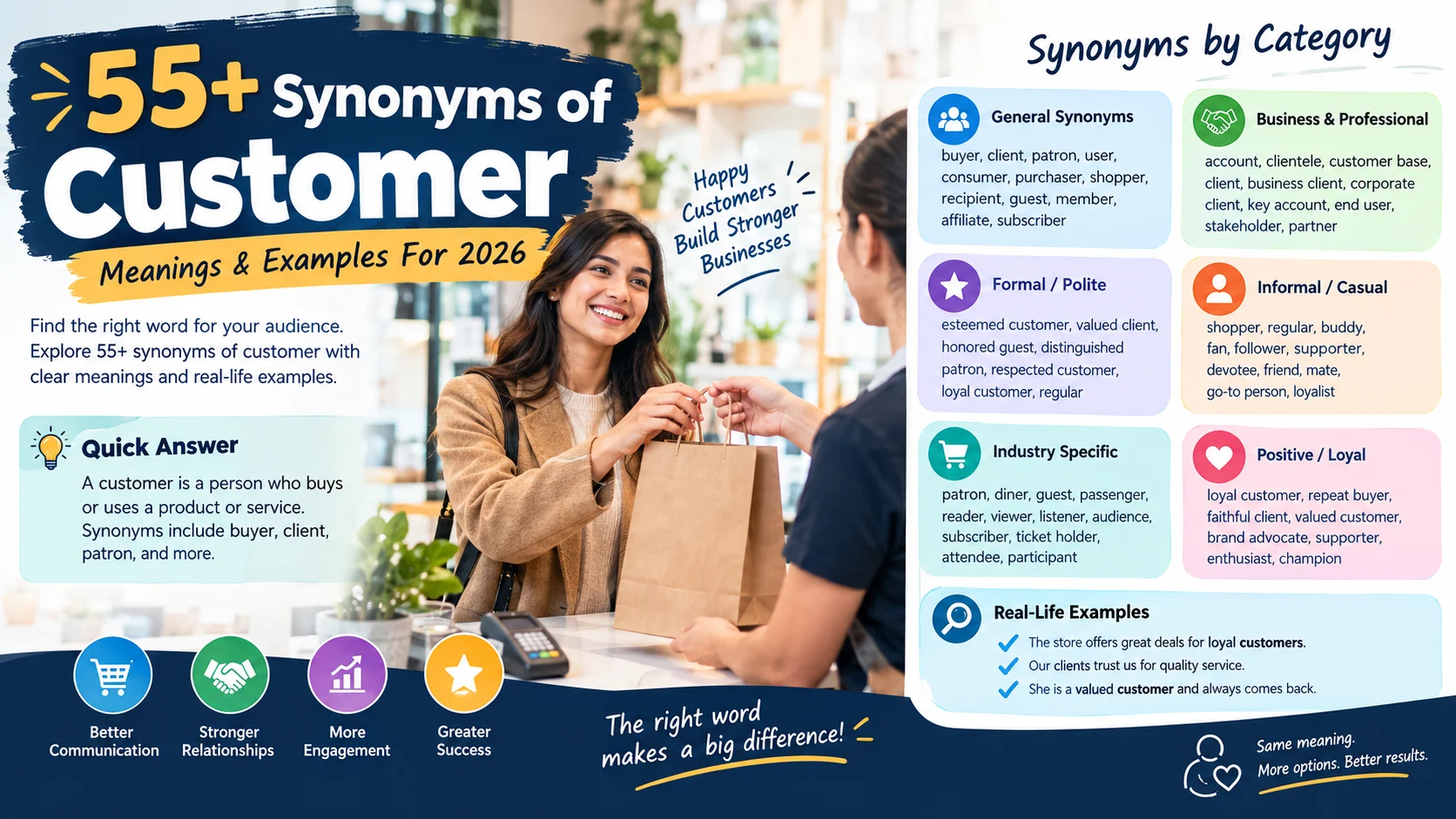
A customer is a person or organization that buys goods or services from a business. The best synonyms depend on context. For general business use, try client or consumer. For formal writing, use purchaser or patron. For modern marketing, consider buyer or shopper.
Meaning, Tone and Context
The word “customer” is a versatile noun with several related meanings. Its core function is to refer to someone who purchases something from a business. The tone is generally neutral and professional, but it can shift depending on the specific synonym you choose.
1. Simple Definition: A customer is a person or business that buys products or services from another business.
2. Part of Speech: Customer is a noun. It can be used in singular and plural forms.
- Singular: “The customer was very satisfied with the service.”
- Plural: “We need to attract more customers to our store.”
3. Tone: The tone is usually neutral and professional. It can be positive when describing loyal customers, or negative when discussing difficult customers.
4. Formality: “Customer” is a neutral word. It is appropriate for both casual business conversation and formal reports. For very formal contexts, you might use “purchaser” or “client.”
5. Common Use Cases: You will encounter “customer” in many situations.
- Retail: “The customer asked for a refund.”
- Business Reports: “Customer satisfaction increased by 15 percent this quarter.”
- Marketing: “We need to target new customers in the 25 to 35 age range.”
- Resume: “Managed customer relationships for over 200 accounts.”
6. Important Word Forms:
- Noun: customer, customers. “The customers were happy with the new product.”
- Noun: customer service. “She works in customer service.”
- Adjective: customer focused. “The company has a customer focused approach.”
When and How to Use “Customer”
Knowing when to use “customer” is about understanding its broad scope. It is the standard term for anyone who buys from a business. Here are several scenarios where it is the perfect choice.
- Retail Context: To refer to someone shopping in a store.
Example: “The customer tried on three different jackets before making a decision.” - Business Context: To discuss relationships with buyers.
Example: “Building strong customer relationships is key to long term success.” - Marketing Context: To describe the target audience for a campaign.
Example: “Our ideal customer is a professional between 30 and 50 years old.” - Resume Context: To highlight your experience with clients.
Example: “Managed a portfolio of 50 high value customers.” - Customer Service Context: To describe interactions with buyers.
Example: “The customer called to complain about a delayed delivery.” - Email Context: To address a business contact politely.
Example: “Dear valued customer, we appreciate your continued business.” - Social Media Context: To engage with your audience.
Example: “Our customers are our top priority. Tell us how we can serve you better.” - Storytelling Context: To illustrate a business scenario.
Example: “The customer walked in, looked around, and walked out without buying anything.”
Another Word for “Customer”
Choosing the best replacement for “customer” depends entirely on the context. Here are the most effective alternatives categorized by use.
- Professional Writing: “Client” or “Account.” “The client approved the new design proposal.”
- Academic Writing: “Consumer” or “Buyer.” “The study examined consumer behavior in the digital marketplace.”
- Casual Conversation: “Shopper” or “Buyer.” “The shopper found a great deal on shoes.”
- Emotional Writing: “Patron” or “Guest.” “The patron was delighted with the service.”
- Creative Writing: “Visitor” or “Soul.” “The weary visitor entered the shop, seeking shelter from the rain.”
- Resume or Workplace: “Stakeholder” or “Partner.” “Managed key stakeholder relationships to drive revenue growth.”
- Social Media Captions: “Shopper” or “Fan.” “Hey shoppers, check out our weekend sale!”
- Stronger Meaning: “Purchaser” or “Account holder.” “The purchaser signed the contract.”
- Softer Meaning: “Visitor” or “Guest.” “We welcome every guest to our store.”
When Not to Use “Customer”
While “customer” is a versatile word, it can be too broad or impersonal in certain situations. Using a more precise synonym can improve clarity and impact.
- When You Need Specificity: If you are talking about a specific type of buyer, use a more precise word. “The customer was happy” is vague. “The client was happy with the legal advice” is much clearer.
- When Discussing Long Term Relationships: “Customer” can sound transactional. “Client” or “partner” sounds more relational. “We value our clients” sounds warmer than “We value our customers.”
- When Criticizing Directly: Using “customer” can sound neutral when you want to be critical. Instead of “The customer was difficult,” try “The guest was demanding.”
Example of Precision: Compare these two sentences.
- Vague: “We need to improve customer service.”
- Precise: “We need to improve client onboarding and support.”
The second sentence is more specific and provides a clearer picture of the task.
Words Commonly Confused With “Customer”
Understanding the differences between these related words will significantly refine your business English.
- Customer vs. Client: A “customer” buys products or services, often in a transactional way. A “client” has an ongoing relationship with a business and receives professional services. You have customers at a grocery store, but clients at a law firm.
- Customer vs. Consumer: A “customer” is the person who buys the product. A “consumer” is the person who uses the product. The customer and the consumer can be the same person, but not always.
- Customer vs. Buyer: A “buyer” is someone who makes a purchase. “Buyer” is more specific and transactional than “customer.” “Customer” implies a relationship; “buyer” just implies a transaction.
- Customer vs. Patron: A “patron” is a customer who regularly supports a business, often in the arts or hospitality. “Patron” has a more formal and respectful tone.
- Customer vs. Shopper: A “shopper” is someone who is looking at or buying goods. “Shopper” is more casual and often refers to retail settings.
- Customer vs. User: A “user” is someone who uses a product or service, often in technology or software. “User” does not always imply a purchase.
Best Synonym by Context for “Customer”
| Context | Best Synonym | Why It Works | Example |
|---|---|---|---|
| Formal Writing | Purchaser | It is precise and legal. | “The purchaser must sign the agreement.” |
| Academic Writing | Consumer | It is the standard term in economics. | “Consumer spending increased last quarter.” |
| Professional/Business | Client | It implies an ongoing relationship. | “The client approved the marketing plan.” |
| Resume | Stakeholder | It highlights strategic value. | “Managed key stakeholder relationships.” |
| Casual Conversation | Shopper | It is simple and friendly. | “The shopper found a great deal.” |
| Creative Writing | Guest | It adds warmth and hospitality. | “The guest was treated like royalty.” |
| Emotional Tone | Patron | It conveys respect and loyalty. | “The patron supported the theater for years.” |
| Strong Intensity | Account | It emphasizes business value. | “She manages our largest account.” |
| Soft/Moderate Tone | Visitor | It is gentle and welcoming. | “The visitor browsed the store quietly.” |
| Social Media Captions | Fan | It is modern and engaging. | “Our fans are the best. Thank you.” |
| US/UK Usage | Customer (Both) | It is universally understood. | US: “The customer is always right.” UK: “The customer is always right.” |
Which Synonym Should You Choose?
Choosing the right word can seem difficult, but this simple guide will help you decide. It is all about matching the word to your goal, audience, and the message you want to send.
- Is your goal to build a long term relationship? Use “client” or “partner.” These words imply trust and loyalty.
- Is your goal to describe a transaction? Use “buyer” or “purchaser.” These words are specific and transactional.
- Is your goal to be warm and welcoming? Use “guest” or “visitor.” These words are friendly and hospitable.
- Is your goal to be formal and academic? Use “consumer.” This is the standard term in economics and research.
- Is your goal to be casual and modern? Use “shopper” or “fan.” These are perfect for social media and casual conversation.
- Do you want to emphasize business value? Use “account” or “stakeholder.” These words highlight the importance of the relationship.
Real Life Examples of “Customer” in Sentences
Here are examples of how “customer” and its stronger synonyms can be used in different real world scenarios.
- School: “For my business class, I have to analyze customer buying habits.” Stronger: “For my business class, I have to analyze consumer buying habits.”
- Workplace: “We need to improve our customer satisfaction scores.” Stronger: “We need to improve our client satisfaction scores.”
- Writing: “The report analyzed customer feedback from the last quarter.” Stronger: “The report analyzed consumer feedback from the last quarter.”
- Conversation: “The customer at the next table was complaining about the food.” Stronger: “The patron at the next table was complaining about the food.”
- Social Media: “We love our customers! Thanks for your support.” Stronger: “We love our fans! Thanks for your support.”
- Resume: “Provided excellent customer service to over 100 clients daily.” Stronger: “Managed key stakeholder relationships for over 100 accounts.”
- Email: “Dear customer, your order has been shipped.” Stronger: “Dear valued client, your order has been shipped.”
- Storytelling: “The customer walked into the shop, looking for a gift.” Stronger: “The visitor walked into the shop, looking for a gift.”
25 Synonyms for “Customer”
The following table lists 25 accurate and practical synonyms for “customer.
| Synonym | Simple Meaning | Best Used For | Example Sentence |
|---|---|---|---|
| Client | A person using professional services. | Business, professional. | “The client was pleased with the legal advice.” |
| Consumer | A person who uses goods or services. | Academic, economics. | “Consumer confidence is at an all time high.” |
| Buyer | A person who purchases something. | Retail, real estate. | “The buyer made an offer on the house.” |
| Purchaser | A person who buys something formally. | Legal, formal. | “The purchaser must complete the payment.” |
| Shopper | A person looking at goods in a store. | Retail, casual. | “The shopper compared prices before buying.” |
| Patron | A regular, loyal customer. | Hospitality, arts. | “The patron donated to the museum.” |
| Guest | A customer in a hospitality setting. | Hotels, restaurants. | “The guest requested a late check out.” |
| Account | A business relationship with a client. | Business, sales. | “She manages our largest account.” |
| Stakeholder | Anyone affected by a business. | Corporate, formal. | “We need to update all stakeholders on the changes.” |
| User | A person who uses a product or service. | Technology, software. | “The app has over one million users.” |
| Shopper | A person who is shopping. | Retail, casual. | “The shopper found a great deal on shoes.” |
| Prospect | A potential customer. | Sales, marketing. | “We have several promising prospects.” |
| Lead | A potential customer who has shown interest. | Sales, marketing. | “The marketing team generated 50 new leads.” |
| Subscriber | A person who pays for a service regularly. | Media, software. | “The magazine has 10,000 subscribers.” |
| Member | A person who belongs to a group or service. | Clubs, organizations. | “The gym has over 500 members.” |
| End user | The final person who uses a product. | Technology, manufacturing. | “The end user manual explains all features.” |
| Warrantor | A person who is covered by a warranty. | Legal, retail. | “The warrantor can claim a replacement.” |
| Sufferer | A person who uses a service in need. | Healthcare, social services. | “The clinic serves many sufferers of chronic pain.” |
| Soul | A person, used informally. | Casual, poetic. | “The little cafe was full of hungry souls.” |
| Body | A person, used in business. | Business, formal. | “The conference attracted over 500 bodies.” |
| Head | A single person, used in inventory. | Business, inventory. | “The company has 100 head of staff.” |
| Traffic | The flow of customers. | Retail, online. | “The store had heavy foot traffic on Saturday.” |
| Follower | A person who follows a brand on social media. | Social media. | “The brand has 50,000 followers on Instagram.” |
| Fan | A loyal, enthusiastic customer. | Social media, entertainment. | “The fans lined up for the concert.” |
| Regular | A frequent customer. | Restaurants, bars. | “The waiter knows all the regulars by name.” |
Synonym Groups and Usage Differences
Professional vs. Personal Synonyms
In a professional setting, like a business report or a resume, choose “client,” “account,” or “stakeholder.” These words sound polished and appropriate. In a personal setting, “regular” or “guest” are more natural and friendly. For example, you would tell a colleague “We need to improve client retention,” but a friend “The regulars at the bar know each other well.”
Formal vs. Conversational Synonyms
Formal Synonyms: “Purchaser,” “consumer,” and “stakeholder” are perfect for academic papers, legal documents, or formal speeches.
Conversational Synonyms: “Shopper,” “guest,” and “regular” are the best choices for everyday conversations and emails to friends.
Academic Synonyms
In essays and research papers, “consumer” is a powerful and precise term. “End user” is also useful in technology and product research. “Buyer behavior” is a common academic phrase.
Professional and Business Synonyms
“Client” is a safe and professional choice for almost any workplace communication. “Account” is effective when discussing sales and relationships. “Stakeholder” is great for corporate communications. “Lead” and “prospect” are essential in sales.
Creative or Literary Synonyms
These words add a layer of artistry to your descriptions.
- Soul: Suggests a person with depth and humanity.
- Guest: Adds warmth and hospitality.
- Visitor: Perfect for describing someone entering a space.
Slang or Modern Synonyms
Fan” and “follower” are modern synonyms for customers in the age of social media. They are acceptable in casual writing, social media, and marketing. “Traffic” is a term for the flow of customers, especially online. These should be avoided in formal academic writing.
Strongest vs. Weaker Synonyms
Here is an intensity scale from mild to strongest:
- Visitor: Very mild, someone who enters a space.
- Shopper: Mild, someone looking at goods.
- Customer: Moderate, the standard word.
- Client, Account: Strong, implies a valuable relationship.
- Stakeholder: Strongest, anyone affected by the business.
Emotional vs. Neutral Synonyms
Emotional Synonyms: “Patron,” “guest,” and “fan” all carry positive emotional weight, suggesting loyalty and appreciation.
Neutral Synonyms: “Customer,” “consumer,” and “buyer” are factual and free of emotional charge.
Antonyms of “Customer”
Here are 15 clear antonyms for “customer,” which are words that mean the opposite: someone who does not buy or is not involved in a transaction.
| Antonym | Meaning | Example Sentence |
|---|---|---|
| Seller | A person who sells goods or services. | “The seller accepted the offer.” |
| Vendor | A person or company that sells something. | “The vendor set up a stall at the market.” |
| Merchant | A person who buys and sells goods. | “The merchant traded spices from the East.” |
| Supplier | A company that provides products. | “The supplier delivers goods every Monday.” |
| Provider | A person or company that provides a service. | “The internet provider offers fast speeds.” |
| Non buyer | A person who does not buy. | “The non buyer left the store empty handed.” |
| Browser | A person who looks but does not buy. | “The browser spent hours in the store but bought nothing.” |
| Competitor | A rival business. | “The competitor lowered its prices.” |
| Employee | A person who works for the business. | “The employee helped the customer.” |
| Manager | A person who runs the business. | “The manager handled the complaint.” |
| Owner | A person who owns the business. | “The owner decided to close early.” |
| Producer | A person who makes goods. | “The producer increased output to meet demand.” |
| Manufacturer | A company that makes products. | “The manufacturer recalled the defective item.” |
| Wholesaler | A person who sells in bulk. | “The wholesaler supplies small shops.” |
| Retailer | A person who sells to consumers. | “The retailer offered a discount.” |
Comparison: “Customer” vs. Similar Words
Customer vs. Client
Main Difference: A “customer” buys products or services, often in a transactional way. A “client” has an ongoing relationship with a business and receives professional services.
Which One Is Stronger: “Client” is stronger because it implies a deeper, more valuable relationship.
Which One Is More Formal: “Client” is more formal and professional.
Example Sentence with Customer: “The customer bought a new phone.”
Example Sentence with Client: “The client relies on our legal expertise.”
Customer vs. Consumer
Main Difference: A “customer” is the person who buys the product. A “consumer” is the person who uses the product. The customer and the consumer can be the same person, but not always.
Which One Is Stronger: “Consumer” is broader and used in economics.
Which One Is More Formal: “Consumer” is more formal and academic.
Example Sentence with Customer: “The customer purchased the toy for her child.”
Example Sentence with Consumer: “The consumer used the toy every day.”
Customer vs. Buyer
Main Difference: A “buyer” is someone who makes a purchase. “Buyer” is more specific and transactional than “customer.” “Customer” implies a relationship; “buyer” just implies a transaction.
Which One Is Stronger: “Buyer” is more specific to the act of buying.
Which One Is More Formal: Both are neutral, but “buyer” is more transactional.
Example Sentence with Customer: “The customer returned to the store.”
Example Sentence with Buyer: “The buyer paid in cash.”
Customer vs. Patron
Main Difference: A “patron” is a customer who regularly supports a business, often in the arts or hospitality. “Patron” has a more formal and respectful tone.
Which One Is Stronger: “Patron” is stronger and more respectful.
Which One Is More Formal: “Patron” is more formal.
Example Sentence with Customer: “The customer ordered a coffee.”
Example Sentence with Patron: “The patron supported the gallery for years.”
Customer vs. Shopper
Main Difference: A “shopper” is someone who is looking at or buying goods. “Shopper” is more casual and often refers to retail settings.
Which One Is Stronger: “Shopper” is casual and less formal.
Which One Is More Formal: “Customer” is more formal.
Example Sentence with Customer: “The customer asked for help.”
Example Sentence with Shopper: “The shopper browsed the sale rack.”
Customer vs. User
Main Difference: A “user” is someone who uses a product or service, often in technology or software. “User” does not always imply a purchase.
Which One Is Stronger: “User” is specific to product usage.
Which One Is More Formal: Both are neutral, but “user” is common in tech.
Example Sentence with Customer: “The customer bought the software.”
Example Sentence with User: “The user logged into the app.”
Common Phrases and Expressions with “Customer”
1. The Customer Is Always Right
Meaning: A motto in retail that the customer’s satisfaction is the top priority.
Example Sentence: “The manager reminded the staff that the customer is always right.”
2. Customer Service
Meaning: The assistance and advice provided by a company to its customers.
Example Sentence: “Good customer service leads to loyal clients.”
3. Customer Satisfaction
Meaning: The measure of how happy customers are with a product or service.
Example Sentence: “Customer satisfaction scores have never been higher.”
4. Customer Loyalty
Meaning: When customers consistently choose a brand over competitors.
Example Sentence: “The rewards program builds customer loyalty.”
5. Customer Base
Meaning: The group of customers a business serves.
Example Sentence: “The company expanded its customer base to Europe.”
6. Customer Retention
Meaning: The ability to keep customers over time.
Example Sentence: “Customer retention is cheaper than finding new clients.”
7. Customer Journey
Meaning: The complete experience a customer has with a brand.
Example Sentence: “We mapped the customer journey from awareness to purchase.”
8. Customer Centric
Meaning: A business approach focused on the customer’s needs.
Example Sentence: “The startup has a customer centric culture.”
Common Mistakes to Avoid
1. Using “Customer” When a More Precise Synonym Is Better
Mistake: “We need to improve customer relationships.”
Better: “We need to improve client relationships.” If you are a law firm, “client” is more accurate.
2. Confusing “Customer” with “Consumer”
Mistake: “The consumer bought the product.”
Better: “The customer bought the product.” The buyer is the customer; the user is the consumer.
3. Using a Casual Synonym in Formal Writing
Mistake: “The shopper was unhappy with the service.”
Better: “The customer was unhappy with the service.” “Shopper” is too casual for a formal report.
4. Using an Overly Dramatic Synonym for a Simple Situation
Mistake: “The stakeholder bought a coffee.”
Better: “The customer bought a coffee.” “Stakeholder” is too formal for a simple retail transaction.
5. Repeating the Same Word Too Often
Mistake: “The customer was happy. The customer paid. The customer left.”
Better: “The customer was happy. The client paid. The shopper left.” This variation makes the writing more engaging.
6. Choosing a Synonym with the Wrong Emotional Tone
Mistake: “The patron grabbed the last item on the shelf.”
Better: “The shopper grabbed the last item on the shelf.” “Patron” implies a refined, loyal customer, not a rushed shopper.
7. Using Slang in Academic or Professional Writing
Mistake: “The fan bought the new album.”
Better: “The customer purchased the new album.” “Fan” is too casual for professional writing.
FAQs
1. What is the best synonym for customer?
- The best synonym depends on your context. For professional services, “client” is a safe choice. For retail, use “shopper.” academic writing, use “consumer.”
2. What is a formal synonym for customer?
A formal synonym for customer is “purchaser” or “client.” Both are appropriate for formal writing and professional communication.
3. What is an informal synonym for customer?
An informal synonym for customer is “shopper” or “regular.” “Fan” is also a good casual choice. These words are perfect for everyday conversation.
4. What is another word for customer in professional writing?
In professional writing, “client” is an excellent choice. “Account” is also effective when discussing sales. “Stakeholder” is useful for corporate communications.
5. What is the difference between customer and client?
A “customer” buys products or services in a transactional way. A “client” has an ongoing relationship and receives professional services. You have customers at a store, but clients at a law firm.
6. What is the opposite of customer?
The opposite of customer is “seller,” “vendor,” or “supplier.” These words describe the person or company providing the goods or services.
Conclusion
The word “customer” is a common and useful term in business. It refers to anyone who buys products or services from a company. However, choosing the right synonym depends entirely on your context, audience, and the tone you wish to convey.
For a professional setting, “client” or “account” work well. For a formal academic context, “consumer” is the standard. In casual conversation, “shopper” or “regular” are natural and friendly. For creative writing, “guest” or “patron” add warmth and hospitality.
The best advice is to think about your purpose and your audience before you choose a word. Do you want to be professional, casual, formal, or warm? Matching your word to your intention will make your communication more effective and your business English more precise.
A practical vocabulary tip: Try replacing “customer” with a more specific synonym in your writing this week. If you work in professional services, use “client.” If you work in retail, use “shopper.” This small change will significantly improve the clarity and sophistication of your English.
