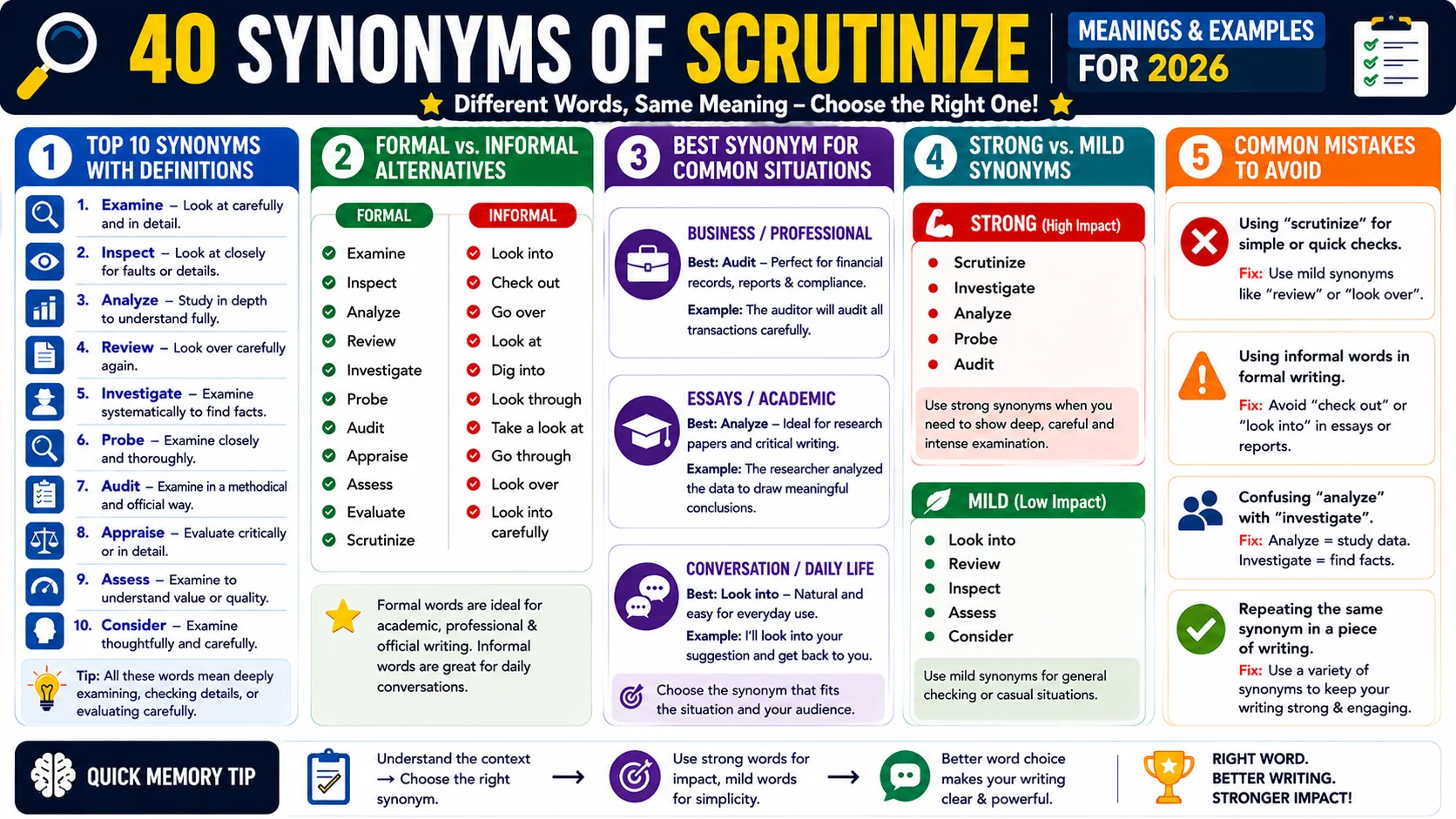
“Scrutinize” means to examine something very carefully and in detail. The best synonyms are examine, inspect, study, analyze, and survey. “Examine” is the most common natural alternative. Each synonym has a slightly different meaning and context where it fits best.
Top 10 Synonyms
- Examine
- Inspect
- Study
- Analyze
- Survey
- Review
- Scan
- Check
- Probe
- Explore
“Scrutinize” is a powerful word for looking at something with extreme care. But using it too often can make your English sound forced or overly academic. It’s a word best saved for moments when you really mean very close examination.
Think about it. You scrutinize a contract, scrutinize someone’s face for clues, scrutinize data for errors, or scrutinize evidence for a case. Each situation might need a different word that captures the specific type of careful examination.
In this guide, you’ll learn 35 powerful synonyms for “scrutinize.” You’ll discover exactly when to use each one, how formal they are, and what common mistakes to avoid. Let’s begin!
What Does “Scrutinize” Mean?
Definition
Scrutinize” means to examine something very carefully, paying attention to every small detail. When you scrutinize, you look closely and critically, trying to understand everything about what you’re examining.
Pronunciation
| Feature | Value |
|---|---|
| US IPA | /ˈskruːtənaɪz/ |
| UK IPA | /ˈskruːtɪnaɪz/ |
| Syllables | 3 (scru-ti-nize) |
| Tip | Stress the first syllable: “SKROO-tuh-nize” |
Grammar
| Grammar Feature | Information |
|---|---|
| Part of Speech | Verb |
| Common Position | After the subject |
| Typical Pattern | Subject + scrutinize + object |
Examples:
- “The detective scrutinized the crime scene.”
- “She scrutinized every word of the contract.”
- “He scrutinized her face for any sign of emotion.”
Grammar Note: “Scrutinize” is a transitive verb, so it always needs an object.
Word Family
| Word | Part of Speech | Meaning |
|---|---|---|
| Scrutinize | Verb | To examine very carefully |
| Scrutiny | Noun | Close and careful examination |
| Scrutinizer | Noun | Someone who scrutinizes |
| Scrutinizing | Gerund | The act of scrutinizing |
15 Synonyms of “Scrutinize”
Examine
Meaning: To look at something carefully and in detail.
Best Used For: Objects, problems, information.
Formality: Neutral
Tone: Careful, Thorough
Frequency: ⭐⭐⭐⭐⭐ (Very Common)
CEFR Level: B2
Example Sentence 1: “The doctor examined the patient thoroughly.”
Example Sentence 2: “We need to examine all the evidence.”
Usage Tip: “Examine” is the most direct synonym. Use it for careful, detailed inspection.
Common Confusion: Scrutinize vs Examine. “Scrutinize” suggests even closer attention to tiny details.
Inspect
Meaning: To look at something closely, often to check its condition.
Best Used For: Physical objects, buildings, quality.
Formality: Neutral
Tone: Checking, Verifying
Frequency: ⭐⭐⭐⭐ (Common)
CEFR Level: B2
Example Sentence 1: “The inspector inspected the building for safety.”
Example Sentence 2: “Please inspect the package before signing.”
Usage Tip: “Inspect” is physical and practical. Use it for checking condition or quality.
Study
Meaning: To examine something carefully to understand it.
Best Used For: Academic topics, behavior, patterns.
Formality: Neutral
Tone: Academic, Thorough
Frequency: ⭐⭐⭐⭐⭐ (Very Common)
CEFR Level: A2
Example Sentence 1: “She studied the effects of climate change.”
Example Sentence 2: “We need to study the problem more carefully.”
Usage Tip: “Study” suggests learning and deep investigation.
Analyze
Meaning: To examine something by breaking it down into parts.
Best Used For: Data, problems, arguments.
Formality: Formal
Tone: Analytical, Detailed
Frequency: ⭐⭐⭐⭐⭐ (Very Common)
CEFR Level: B2
Example Sentence 1: “The scientist analyzed the data carefully.”
Example Sentence 2: “We need to analyze the problem before solving it.”
Usage Tip: “Analyze” suggests breaking things down to understand them.
Survey
Meaning: To look at or examine all of something.
Best Used For: Large areas, situations, conditions.
Formality: Neutral
Tone: Broad, Comprehensive
Frequency: ⭐⭐⭐⭐ (Common)
CEFR Level: B2
Example Sentence 1: “They surveyed the damage after the storm.”
Example Sentence 2: “He surveyed the room for any clues.”
Usage Tip: “Survey” suggests a broad, comprehensive examination.
Review
Meaning: To examine something again or in detail.
Best Used For: Documents, policies, performances.
Formality: Neutral
Tone: Checking, Revising
Frequency: ⭐⭐⭐⭐⭐ (Very Common)
CEFR Level: B2
Example Sentence 1: “Please review the report before the meeting.”
Example Sentence 2: “We need to review our strategy.”
Usage Tip: “Review” suggests going over something again, often to check or improve.
Scan
Meaning: To look at something quickly, or to search thoroughly.
Best Used For: Documents, crowds, information.
Formality: Neutral
Tone: Quick, Searching
Frequency: ⭐⭐⭐⭐ (Common)
CEFR Level: B2
Example Sentence 1: “She scanned the document for errors.”
Example Sentence 2: “He scanned the crowd for his friend.”
Usage Tip: “Scan” can mean quick or thorough context tells you which.
Check
Meaning: To examine something to see if it’s correct or working.
Best Used For: Basic verification, quality control.
Formality: Neutral
Tone: Verifying, Simple
Frequency: ⭐⭐⭐⭐⭐ (Very Common)
CEFR Level: A2
Example Sentence 1: “Please check your work for mistakes.”
Example Sentence 2: “I checked the lock before leaving.”
Usage Tip: “Check” is simple and common. Use it for quick verifications.
Probe
Meaning: To investigate or explore something deeply.
Best Used For: Questions, problems, sensitive topics.
Formality: Formal
Tone: Searching, Inquisitive
Frequency: ⭐⭐⭐ (Moderate)
CEFR Level: C1
Example Sentence 1: “The journalist probed into the scandal.”
Example Sentence 2: “We need to probe deeper into this issue.”
Usage Tip: “Probe” suggests deep, sometimes uncomfortable investigation.
Explore
Meaning: To examine or investigate something to learn about it.
Best Used For: Ideas, options, possibilities.
Formality: Neutral
Tone: Curious, Open
Frequency: ⭐⭐⭐⭐⭐ (Very Common)
CEFR Level: B2
Example Sentence 1: “We need to explore all possible solutions.”
Example Sentence 2: “She explored different approaches.”
Usage Tip: “Explore” suggests open, curious investigation.
Dissect
Meaning: To analyze something by breaking it into parts.
Best Used For: Arguments, texts, complex problems.
Formality: Formal
Tone: Detailed, Analytical
Frequency: ⭐⭐ (Rare)
CEFR Level: C1
Example Sentence 1: “The class dissected the poem line by line.”
Example Sentence 2: “Let’s dissect this argument.”
Usage Tip: “Dissect” is a metaphor from biology. Use it for breaking ideas into parts.
Peruse
Meaning: To read or examine something carefully.
Best Used For: Documents, books, reports.
Formality: Formal
Tone: Careful, Thorough
Frequency: ⭐⭐ (Rare)
CEFR Level: C1
Example Sentence 1: “She perused the contract before signing.”
Example Sentence 2: “He perused the menu carefully.”
Usage Tip: “Peruse” is formal. Use it for careful reading or examination.
Audit
Meaning: To officially examine financial or business records.
Best Used For: Finances, accounts, compliance.
Formality: Formal
Tone: Official, Checking
Frequency: ⭐⭐⭐ (Moderate)
CEFR Level: C1
Example Sentence 1: “The company audited its financial records.”
Example Sentence 2: “They audited the project’s compliance.”
Usage Tip: “Audit” is a formal business term for official examination.
Investigate
Meaning: To carry out a careful search for facts.
Best Used For: Crime, problems, scientific questions.
Formality: Formal
Tone: Thorough, Searching
Frequency: ⭐⭐⭐⭐ (Common)
CEFR Level: B2
Example Sentence 1: “The police are investigating the crime.”
Example Sentence 2: “We need to investigate the cause.”
Usage Tip: “Investigate” suggests searching for answers. Use it for serious inquiries.
Pore over
Meaning: To read or examine something very carefully.
Best Used For: Documents, books, details.
Formality: Informal
Tone: Careful, Absorbed
Frequency: ⭐⭐⭐ (Moderate)
CEFR Level: C1
Example Sentence 1: “She pored over the documents for hours.”
Example Sentence 2: “He pored over every detail of the report.”
Usage Tip: “Pore over” suggests focused, absorbed attention to detail.
Synonyms Comparison Table
| Synonym | Best Context | Formality | Tone | Frequency |
|---|---|---|---|---|
| Examine | General inspection | Neutral | Careful | ⭐⭐⭐⭐⭐ |
| Study | Academic research | Neutral | Thorough | ⭐⭐⭐⭐⭐ |
| Review | Checking documents | Neutral | Revising | ⭐⭐⭐⭐⭐ |
| Analyze | Breaking down | Formal | Analytical | ⭐⭐⭐⭐⭐ |
| Inspect | Physical checking | Neutral | Verifying | ⭐⭐⭐⭐ |
| Check | Quick verification | Neutral | Simple | ⭐⭐⭐⭐⭐ |
| Explore | Investigating options | Neutral | Curious | ⭐⭐⭐⭐⭐ |
| Investigate | Searching for facts | Formal | Thorough | ⭐⭐⭐⭐ |
| Survey | Broad examination | Neutral | Comprehensive | ⭐⭐⭐⭐ |
Best Synonyms by Situation
| Situation | Best Synonym | Why It Works |
|---|---|---|
| Daily Conversation | Examine/Check | Natural and common |
| Business Email | Review/Examine | Professional and clear |
| Academic Writing | Analyze | Formal and precise |
| School Assignment | Study | Shows effort |
| Professional Meeting | Analyze | Sounds thorough |
| Presentation | Examine | Clear and direct |
| Creative Writing | Probe | Adds literary depth |
| Social Media | Check | Casual and relatable |
| Legal Context | Scrutinize | Formal and serious |
Formal vs Informal Synonyms
Formal Alternatives
| Synonym | Best Used For |
|---|---|
| Scrutinize | Very close examination |
| Analyze | Data, arguments |
| Investigate | Crime, problems |
| Probe | Sensitive issues |
| Audit | Financial records |
| Peruse | Documents |
Neutral Alternatives
| Synonym | Best Used For |
|---|---|
| Examine | Most general situations |
| Study | Academic research |
| Review | Documents, policies |
| Inspect | Physical objects |
| Check | Quick verification |
Informal Alternatives
| Synonym | Best Used For |
|---|---|
| Look over | Quick check |
| Go through | Reviewing |
| Pore over | Very careful reading |
Choosing the Right Level: Use “scrutinize” and “analyze” for formal writing. Use “examine” and “study” for most situations.
Strong vs Mild Synonyms
Mild
Suitable for everyday situations with less intensity.
- Check
- Look at
- Scan
Moderate
More careful or thorough alternatives.
- Examine
- Study
- Review
- Inspect
Strong
High-intensity alternatives suggesting extreme care.
- Scrutinize (very close)
- Analyze (breaking down)
- Investigate (searching)
- Probe (deep questioning)
- Pore over (absorbed attention)
How Intensity Changes Meaning: “I looked at the document” is mild. “I scrutinized the document” suggests extreme carefulness. Choose stronger words when you want to emphasize intense attention.
Real-Life Examples
School: “The teacher scrutinized the students’ work for errors.”
Office: “We need to scrutinize the contract before signing.”
Business Email: “Please examine the report carefully.”
Meetings: “Let’s scrutinize the data more closely.”
Presentations: “We analyzed the results thoroughly.”
Daily Conversations: “She looked closely at the painting.”
Social Media: “Always check your sources.”
Academic Writing: “The researcher scrutinized the data for any anomalies.”
Common Collocations
| Common Phrase | Better Alternative |
|---|---|
| Scrutinize the evidence | Examine the evidence |
| Scrutinize the document | Review the document |
| Scrutinize the details | Check the details |
| Scrutinize the data | Analyze the data |
| Scrutinize every word | Read every word carefully |
Common Phrases
Eye with suspicion: To look at carefully and doubt. (e.g., “She eyed him with suspicion.”)
Pick apart: To examine and criticize. (e.g., “They picked apart his argument.”)
Under a microscope: Being examined very closely. (e.g., “Everything was under a microscope.”)
Leave no stone unturned: To examine every possibility. (e.g., “They left no stone unturned.”)
Read between the lines: To look for hidden meaning. (e.g., “Read between the lines of the letter.”)
Context Guide
| Situation | Best Synonym | Reason |
|---|---|---|
| Essay | Analyze | Academic and formal |
| Speech | Examine | Clear and direct |
| Business Email | Review | Professional and clear |
| Novel | Scrutinize | Adds literary depth |
| Presentation | Analyze | Clear and professional |
| Conversation | Look at | Natural and relatable |
| Academic Writing | Analyze | Precise and formal |
| Legal Context | Scrutinize | Formal and thorough |
Related Words
Near Synonyms
- Examine: To inspect carefully.
- Inspect: To check condition.
- Study: To learn about.
- Analyze: To break down.
- Investigate: To search for facts.
Antonyms
- Ignore: To pay no attention.
- Skim: To read quickly.
- Glance: To look briefly.
- Overlook: To fail to notice.
- Neglect: To fail to care for.
Related Adjectives
- Scrutinizing: Examining carefully.
- Analytical: Related to analysis.
- Critical: Using careful judgment.
- Thorough: Done carefully.
- Detailed: Including many details.
Related Nouns
- Scrutiny: Close examination.
- Analysis: The process of analyzing.
- Examination: Careful inspection.
- Investigation: Careful inquiry.
- Review: A careful look.
Related Verbs
- Examine: To inspect.
- Study: To learn about.
- Analyze: To break down.
- Investigate: To search.
- Review: To look again.
Frequently Asked Questions
What is another word for scrutinize?
Common synonyms include examine, inspect, study, analyze, and survey. “Examine” is the most common and direct alternative.
Which synonym sounds the most professional?
Analyze and investigate sound very professional. “Scrutinize” itself is also excellent for formal contexts.
What is the strongest synonym for scrutinize?
Scrutinize itself is among the strongest. Investigate” and “probe” are also strong synonyms for careful examination.
Which synonym is best for essays?
Analyze is the best choice for academic essays. It’s formal and precise.
What’s the difference between scrutinize and examine?
“Scrutinize” suggests even closer attention to tiny details. “Examine” is more general.
Which synonym is most common in everyday English?
“Check” and “look at” are the most common in everyday speech. “Examine” is also frequently used.
What is the opposite of scrutinize?
Common opposites are ignore, skim, glance, and overlook. These words describe not paying close attention.
Conclusion
“Scrutinize” is a powerful word for very close examination, but now you have 35 fantastic alternatives. Each synonym adds a different shade of meaning to your language.
Remember, the key is understanding the context. Use “scrutinize” for extremely close examination. Use “examine” for careful looking. Use “analyze” for breaking things down. Use “investigate” for searching for facts.
The best way to improve is practice. Try using one or two new synonyms each day. Listen for these words in conversations and books. Your vocabulary will become richer and more impressive with time.
