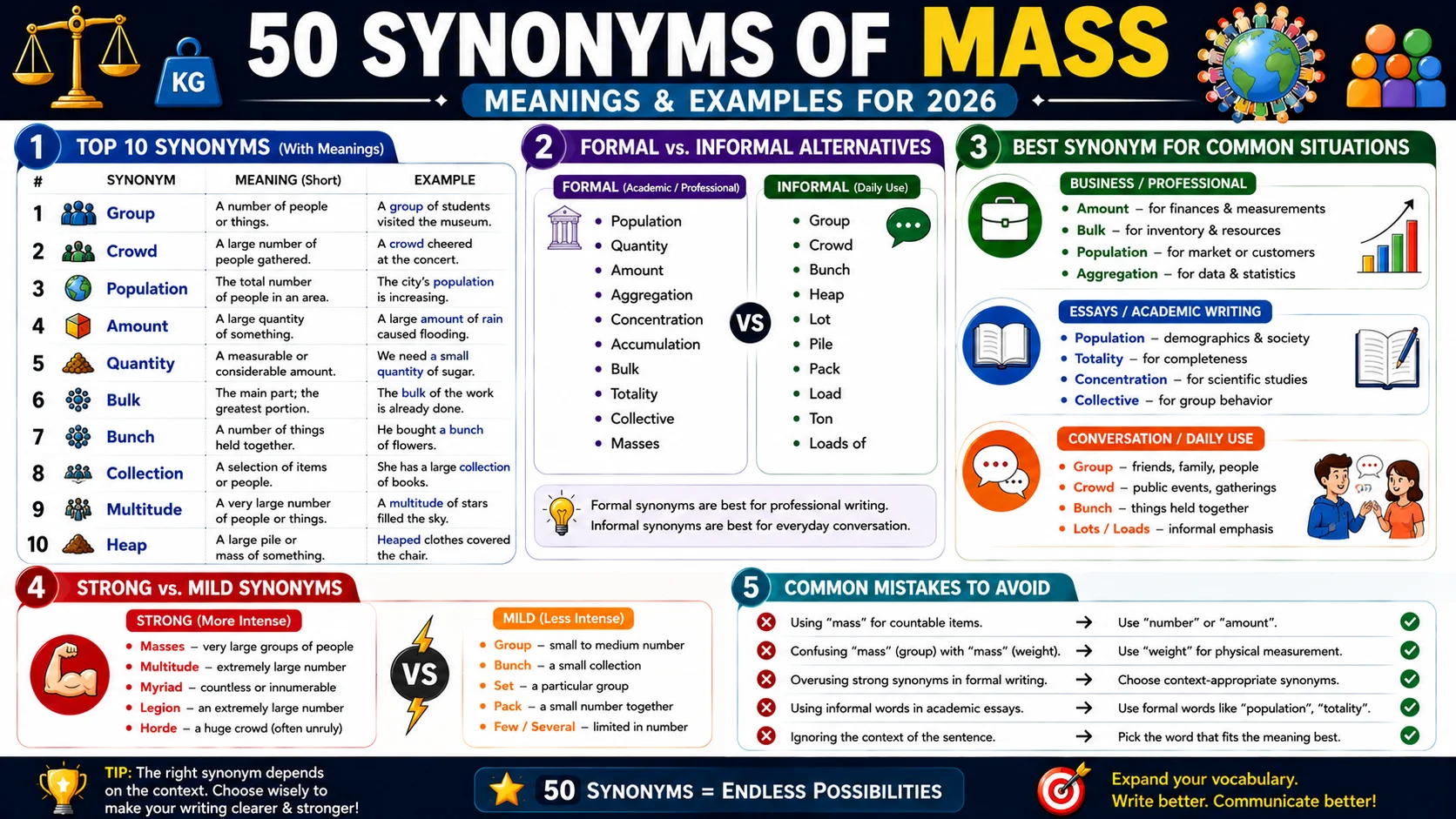
“Mass” means a large amount or quantity of something, or the main body of something. The best synonyms are bulk, volume, multitude, pile, and load. “Bulk” is the most common natural alternative. Each synonym has a slightly different meaning and context where it fits best.
Top 10 Synonyms
- Bulk
- Volume
- Multitude
- Pile
- Load
- Heap
- Stack
- Quantity
- Amount
- Crowd
“Mass” is a word we use in many contexts. We talk about a mass of people, a mass of data, mass production, and the mass of an object. But using it too often can make your English feel repetitive and technical.
Think about it. You can describe a mass of people, a mass of information, a mass of food, or a mass of problems. Each situation might need a different word that captures the specific type of quantity or group.
In this guide, you’ll learn 35 powerful synonyms for “mass.” You’ll discover exactly when to use each one, how formal they are, and what common mistakes to avoid. Let’s begin!
What Does “Mass” Mean?
Definition
Mass” has several meanings. It can mean a large amount or quantity of something. It can mean a large group of people. In science, it means the amount of matter in an object. It can also mean the main body or majority of something.
Pronunciation
| Feature | Value |
|---|---|
| US IPA | /mæs/ |
| UK IPA | /mæs/ |
| Syllables | 1 |
| Tip | Short and clear. Rhymes with “gas” and “class.” |
Grammar
| Grammar Feature | Information |
|---|---|
| Part of Speech | Noun (and sometimes adjective) |
| Common Position | Subject or object |
| Typical Pattern | Mass + of + something |
Examples:
- “A mass of people gathered outside.” (large group)
- “The mass of the object is 5 kilograms.” (scientific)
- “The mass of evidence was overwhelming.” (amount)
Grammar Note: “Mass” can also be used as an adjective, as in “mass production” or “mass media.”
Word Family
| Word | Part of Speech | Meaning |
|---|---|---|
| Mass | Noun/Adjective | Large quantity or main body |
| Massive | Adjective | Very large and heavy |
| Massively | Adverb | In a massive way |
| Massed | Adjective | Gathered together |
15 Synonyms of “Mass”
Bulk
Meaning: The main or largest part of something; a large quantity.
Best Used For: Physical objects, amounts, the main part.
Formality: Neutral
Tone: Practical, Substantial
Frequency: ⭐⭐⭐⭐ (Common)
CEFR Level: B2
Example Sentence 1: “The bulk of the work is already finished.”
Example Sentence 2: “She bought rice in bulk to save money.”
Usage Tip: “Bulk” is the most direct synonym. Use it for large quantities or the main part of something.
Common Confusion: Bulk vs Mass. “Bulk” often refers to physical size or volume. “Mass” is broader.
Volume
Meaning: The amount of space something takes up, or a large quantity.
Best Used For: Space, sound, sales, amounts.
Formality: Formal
Tone: Technical, Measured
Frequency: ⭐⭐⭐⭐ (Common)
CEFR Level: B2
Example Sentence 1: “The volume of water in the lake increased.”
Example Sentence 2: “She turned up the volume on the radio.”
Usage Tip: “Volume” can mean physical space or large quantity. Use it for measurable amounts.
Multitude
Meaning: A very large number of people or things.
Best Used For: Crowds, large groups, many items.
Formality: Formal
Tone: Literary, Impressive
Frequency: ⭐⭐⭐ (Moderate)
CEFR Level: C1
Example Sentence 1: “A multitude of fans waited outside the stadium.”
Example Sentence 2: “She faced a multitude of problems.”
Usage Tip: “Multitude” suggests an impressively large number. It’s a formal, literary word.
Pile
Meaning: A heap or stack of things placed on top of each other.
Best Used For: Physical objects, work, tasks.
Formality: Informal
Tone: Practical, Casual
Frequency: ⭐⭐⭐⭐ (Common)
CEFR Level: A2
Example Sentence 1: “There was a pile of books on the table.”
Example Sentence 2: “She has a pile of work to finish.”
Usage Tip: “Pile” is informal and physical. Use it for stacks or heaps of things.
Load
Meaning: A large amount of something, often heavy.
Best Used For: Work, laundry, cargo.
Formality: Informal
Tone: Practical, Heavy
Frequency: ⭐⭐⭐⭐⭐ (Very Common)
CEFR Level: A2
Example Sentence 1: “He carried a heavy load of books.”
Example Sentence 2: “She has a load of laundry to do.”
Usage Tip: “Load” suggests a heavy amount. Use it for work, cargo, and chores.
Heap
Meaning: A pile of things thrown together loosely.
Best Used For: Physical objects, problems, criticism.
Formality: Informal
Tone: Messy, Disorganized
Frequency: ⭐⭐⭐ (Moderate)
CEFR Level: B2
Example Sentence 1: “He threw his clothes in a heap on the floor.”
Example Sentence 2: “She faced a heap of problems.”
Usage Tip: “Heap” suggests a messy, disorganized pile.
Stack
Meaning: A neatly arranged pile of things.
Best Used For: Books, papers, organized items.
Formality: Neutral
Tone: Neat, Organized
Frequency: ⭐⭐⭐⭐ (Common)
CEFR Level: B1
Example Sentence 1: “She had a stack of papers on her desk.”
Example Sentence 2: “He stacked the plates neatly.”
Usage Tip: “Stack” suggests a neat, organized pile. Use it for orderly arrangements.
Quantity
Meaning: An amount of something that can be counted or measured.
Best Used For: Numbers, measurements, products.
Formality: Formal
Tone: Measured, Technical
Frequency: ⭐⭐⭐⭐ (Common)
CEFR Level: B2
Example Sentence 1: “The quantity of food was enough for everyone.”
Example Sentence 2: “We need to order large quantities.”
Usage Tip: “Quantity” is about measurable amounts. Use it for numbers and measurements.
Amount
Meaning: A total number or quantity of something.
Best Used For: Money, time, general quantities.
Formality: Neutral
Tone: Neutral, General
Frequency: ⭐⭐⭐⭐⭐ (Very Common)
CEFR Level: A2
Example Sentence 1: “The amount of money was not enough.”
Example Sentence 2: “She spent a great amount of time studying.”
Usage Tip: “Amount” is the most general word for quantity. Use it for money, time, and general amounts.
Crowd
Meaning: A large group of people in one place.
Best Used For: People, gatherings, events.
Formality: Neutral
Tone: Social, Active
Frequency: ⭐⭐⭐⭐⭐ (Very Common)
CEFR Level: A2
Example Sentence 1: “A crowd of people gathered at the concert.”
Example Sentence 2: “She lost sight of him in the crowd.”
Usage Tip: “Crowd” is specifically for groups of people. Use it for gatherings and events.
Host
Meaning: A large number of people or things.
Best Used For: People, problems, opportunities.
Formality: Formal
Tone: Large, Numerous
Frequency: ⭐⭐⭐ (Moderate)
CEFR Level: B2
Example Sentence 1: “She has a host of friends.”
Example Sentence 2: “There is a host of reasons to be careful.”
Usage Tip: “Host” suggests a large number. It’s a formal, somewhat literary word.
Mountain
Meaning: A very large amount of something.
Best Used For: Work, problems, food.
Formality: Informal
Tone: Large, Overwhelming
Frequency: ⭐⭐⭐ (Moderate)
CEFR Level: B2
Example Sentence 1: “She has a mountain of homework.”
Example Sentence 2: “He faced a mountain of debt.”
Usage Tip: “Mountain” is metaphorical. Use it for overwhelming amounts.
Ton
Meaning: A very large amount of something.
Best Used For: Work, fun, problems.
Formality: Informal
Tone: Casual, Exaggerated
Frequency: ⭐⭐⭐ (Moderate)
CEFR Level: B2
Example Sentence 1: “I have a ton of work to do.
Example Sentence 2: “We had a ton of fun at the party.”
Usage Tip: “Ton” is informal and exaggerated. Use it in casual conversation.
Ocean
Meaning: A very large amount of something.
Best Used For: Water, problems, possibilities.
Formality: Literary
Tone: Vast, Poetic
Frequency: ⭐⭐ (Rare)
CEFR Level: C1
Example Sentence 1: “There’s an ocean of possibilities.”
Example Sentence 2: “He stared at the ocean of problems ahead.”
Usage Tip: “Ocean” is poetic and literary. Use it for vast, overwhelming amounts.
Flood
Meaning: A very large amount of something arriving at once.
Best Used For: Information, complaints, people.
Formality: Neutral
Tone: Overwhelming, Sudden
Frequency: ⭐⭐⭐ (Moderate)
CEFR Level: B2
Example Sentence 1: “She received a flood of emails.”
Example Sentence 2: “A flood of people entered the stadium.”
Usage Tip: “Flood” suggests a sudden, overwhelming arrival.
Synonyms Comparison Table
| Synonym | Best Context | Formality | Tone | Frequency |
|---|---|---|---|---|
| Amount | General quantity | Neutral | General | ⭐⭐⭐⭐⭐ |
| Load | Work, cargo | Informal | Heavy | ⭐⭐⭐⭐⭐ |
| Crowd | Groups of people | Neutral | Social | ⭐⭐⭐⭐⭐ |
| Bulk | Main part | Neutral | Substantial | ⭐⭐⭐⭐ |
| Volume | Space, sound | Formal | Technical | ⭐⭐⭐⭐ |
| Quantity | Measured amount | Formal | Technical | ⭐⭐⭐⭐ |
| Pile | Physical stacks | Informal | Casual | ⭐⭐⭐⭐ |
| Stack | Neat piles | Neutral | Organized | ⭐⭐⭐⭐ |
| Heap | Messy piles | Informal | Disorganized | ⭐⭐⭐ |
| Multitude | Very large number | Formal | Literary | ⭐⭐⭐ |
| Host | Large number | Formal | Numerous | ⭐⭐⭐ |
Best Synonyms by Situation
| Situation | Best Synonym | Why It Works |
|---|---|---|
| Daily Conversation | Amount/Load | Natural and common |
| Business Email | Quantity/Volume | Professional and clear |
| Academic Writing | Volume/Quantity | Formal and precise |
| School Assignment | Amount | Clear and simple |
| Professional Meeting | Bulk | Sounds professional |
| Presentation | Volume | Measured and clear |
| Creative Writing | Multitude | Adds literary depth |
| Social Media | Ton | Casual and relatable |
| Crowd Context | Crowd | Specific and accurate |
Formal vs Informal Synonyms
Formal Alternatives
| Synonym | Best Used For |
|---|---|
| Volume | Space, sound, amounts |
| Quantity | Measured amounts |
| Multitude | Very large numbers |
| Host | Large numbers |
| Bulk | Main part |
Neutral Alternatives
| Synonym | Best Used For |
|---|---|
| Amount | Most general situations |
| Crowd | Groups of people |
| Stack | Neat piles |
| Quantity | General quantities |
Informal Alternatives
| Synonym | Best Used For |
|---|---|
| Load | Work, cargo |
| Pile | Stacks of things |
| Heap | Messy stacks |
| Ton | Exaggerated amounts |
Choosing the Right Level: Use “volume” and “quantity” for formal writing. Use “amount” and “crowd” for most situations. Use “load” and “pile” with friends.
Strong vs Mild Synonyms
Mild
Suitable for everyday situations with less intensity.
- Amount
- Quantity
- Stack
Moderate
More specific or descriptive alternatives.
- Bulk
- Load
- Pile
- Volume
Strong
High-intensity alternatives suggesting overwhelming amounts.
- Multitude (very large)
- Flood (overwhelming arrival)
- Mountain (overwhelming)
- Ocean (vast)
How Intensity Changes Meaning: “A stack of work” is manageable. “A mountain of work” is overwhelming. Choose stronger words when you want to emphasize size or overwhelm.
Real-Life Examples
School: “She had a mountain of homework to complete.”
Office: “The bulk of the project is finished.”
Business Email: “We need to order large quantities of supplies.”
Meetings: “A multitude of issues were discussed.”
Presentations: “The volume of data is impressive.”
Daily Conversations: “I have a ton of things to do today.”
Social Media: “There’s a flood of comments on this post.”
Academic Writing: “The study examines the quantity of resources.”
Common Collocations
| Common Phrase | Better Alternative |
|---|---|
| A mass of people | A crowd of people |
| A mass of data | A volume of data |
| A mass of problems | A heap of problems |
| A mass of evidence | A wealth of evidence |
| A mass of information | A flood of information |
Common Phrases
Mass production: Making large quantities of goods. (e.g., “Mass production lowered costs.”)
Mass media: Communication to large audiences. (e.g., “Mass media influences public opinion.”)
Critical mass: A large enough amount to cause change. (e.g., “We finally reached critical mass.”)
In the mass: In general. (e.g., “The population in the mass agreed.”)
The masses: Ordinary people. (e.g., “The politician appealed to the masses.”)
Context Guide
| Situation | Best Synonym | Reason |
|---|---|---|
| Essay | Volume/Quantity | Academic and formal |
| Speech | Mass | Clear and direct |
| Business Email | Quantity | Professional and clear |
| Novel | Multitude | Adds literary depth |
| Presentation | Volume | Measured and clear |
| Conversation | Load | Natural and relatable |
| Academic Writing | Quantity | Precise and formal |
| Marketing Copy | Flood | Engaging and powerful |
Related Words
Near Synonyms
- Aggregate: A total or whole formed by combining parts.
- Accumulation: A gathered amount.
- Collective: A group or whole.
- Lump: An irregular mass.
- Clump: A clustered mass.
Antonyms
- Bit: A small amount.
- Fragment: A broken piece.
- Handful: A small number.
- Scatter: To spread out.
- Individual: A single person or thing.
Related Adjectives
- Massive: Very large.
- Bulk: Large in size.
- Voluminous: Taking up much space.
- Sizable: Fairly large.
- Substantial: Considerable in amount.
Related Nouns
- Quantity: Amount.
- Amount: Total number.
- Volume: Space or amount.
- Crowd: Large group of people.
- Load: Heavy amount.
Related Verbs
- Gather: To come together.
- Collect: To bring together.
- Accumulate: To build up.
- Amass: To gather a large amount.
- Heap: To pile up.
Frequently Asked Questions
What is another word for mass?
Common synonyms include bulk, volume, multitude, pile, and load. “Bulk” is the most common and direct alternative.
Which synonym sounds the most professional?
Volume and quantity sound very professional. “Bulk” is also excellent for business contexts.
What is the strongest synonym for mass?
Multitude and flood are among the strongest synonyms. “Multitude” suggests an impressively large number. “Flood” suggests an overwhelming amount.
Which synonym is best for essays?
Quantity is the best choice for academic essays. It’s formal and precise.
What’s the difference between mass and volume?
“Mass” is the amount of matter in something. “Volume” is the space something takes up. They’re often used together but mean different things.
Which synonym is most common in everyday English?
“Amount” and “load” are very common in everyday speech. “Crowd” is also frequently used for groups of people.
What is the opposite of mass?
Common opposites are bit, fragment, handful, and individual. These words describe small amounts or single items.
Conclusion
“Mass” is a useful word, but now you have 35 fantastic alternatives. Each synonym adds a different shade of meaning to your language.
Remember, the key is understanding the context. Use “bulk” for the main part. Use “volume” for space or measured amounts. Use “crowd” for groups of people. Use “load” for casual, heavy amounts.
The best way to improve is practice. Try using one or two new synonyms each day. Listen for these words in conversations and books. Your vocabulary will become richer and more impressive with time.
